[imagebrowser=33]
In the view of many military experts and historians, the Inchon invasion stands out as the most brilliant offensive military action of the Korean War—and possibly of the entire 20th century. It was planned with incredible boldness and executed with striking determination and skill, although a significant measure of luck was involved, too. No condemnation of Gen. Douglas MacArthur’s later conduct of the war, however justified, can alter that fact.
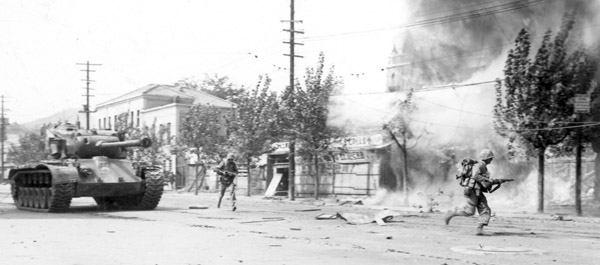
After the elegantly executed Inchon landings, the U.S. Marines faced bloodied but unbowed North Korean forces that dug in to protect Kimpo Airfield and South Korea’s former capital
“Inchon remains a monument to ‘can do,’ to improvisation and risk-taking on a magnificent scale,” British historian Max Hastings would write more than three and a half decades later, “[and] above all, to the spirit of Douglas MacArthur….The amphibious landings of September 15, 1950, were MacArthur’s masterstroke.”
Inchon changed the whole complexion of the war. In the space of 24 hours, the North Korean People’s Army (NKPA) found itself mired in a situation as intractable as the mud flats in Inchon Harbor. After the U.S. Marines completely infiltrated the area, the North Koreans had no hope of holding the key port city. Rather than leave its few surviving defenders to die there, North Korean premier Kim Il Sung ordered them to fall back on Seoul while communist forces already in the area were rushed forward to contest the American advance.
But victory at Inchon was only the first step. The ultimate goal for MacArthur and X Corps was to recapture Seoul. If United Nations forces could reclaim the South Korean capital quickly and decisively, the feat would have a crushing psychological effect—and incalculable strategic impact—on the North Korean army’s ability to carry on the war. By gaining control of the city’s rail and highway networks, X Corps could choke off the enemy’s flow of supplies and reinforcements to its forces in the south, leaving them to wither and die.
To read the entire article, “The Road To Seoul” by Bill Sloan with additional photographs pick up a back issue of the Winter 2010 issue of The Quarterly Journal of Military History!