On September 30, 331 bc, the fate of two empires was decided on a plain 70 miles north of present-day Irbil, Iraq. Lying near the hamlet of Gaugamela, the plain was part of a vast territory north of the Persian provincial capital of Babylon where King Darius III, also known as Darius Codomanus, had mustered an army formidable enough, he hoped, to halt the invasion of the Persian-dominated lands of the eastern Mediterranean by Macedonian forces. But King Alexander III, only 25 years old, his reputation preceding him like thunder before a storm, led his men into Asia. To the king’s soldiers, their invasion would avenge half a century of devastation wrought on Greece during the Persian wars between 499 and 448 bc. Alexander’s personal ambition, however, was nothing less than to eclipse the great Persian empire by conquering its lands and bringing it under his aegis.
Preceding his invasion, a period of continuous skirmishing and political intrigue between Persia and the Hellenic city-states had prevailed up to the assassination of Alexander’s father, King Philip II of Macedon, in 336 bc. Although the person responsible for Philip’s murder was never conclusively determined, many historians regard his divorced wife, Olympias, princess of Epirus and mother of Alexander, as the most likely suspect. Personal animosity had also prevailed between Philip and his son, who favored his mother at the time of the divorce. His complicity in his father’s murder is highly unlikely, however, and inconsistent with his character; Alexander publicly blamed Persian agents for Philip’s death. Upon inheriting the kingdom, after only one year of armed conflict Alexander had consolidated Macedonian control over the rest of Greece’s city-states. He then organized a campaign that promised the Greeks revenge in the conquest of their Persian enemies.
Leaving his trusted general, Antipater, with little more than 10,000 soldiers to exercise control over the newly conquered sections of Greece, in 334 bc Alexander crossed the Hellespont with 30,000 infantry and 5,000 cavalry. The resistance he met along the way—aside from the Persian and Greek mercenary troops he met in battle—at first was minor. Within a short time he established a reputation for justice, tempered by tolerance, as well as invincibility. He reduced the people’s tax burden, using Persian treasuries in the cities he captured to build bridges, roads and irrigation channels. The popularity of his policies, coupled with decisive victories at the Granicus River in May 334 and again at Issus in November 333, required him to post no more than small garrisons in the satrapies of the Persian empire that submitted to him as he advanced into Darius’ kingdom.
It may have been Alexander’s success at Issus—his defeat of a powerful Persian force that considerably outnumbered his own, as well as the astonishing capture of Darius’ family—that contributed to the strategy he would use at Gaugamela. But for Alexander to assume the title Basileus—“Great King”—he would have to capture Darius himself. In the closing stages of the battle at Issus, the Persian sovereign fled. Roughly 4,000 of his men also made good their escape, including about 2,000 Greek mercenaries. Together they sought a safe haven in Babylon, the capital of Persian-held Mesopotamia, where Darius hoped to gather his wits, make plans and put together a stronger, more capable army.
GET HISTORY’S GREATEST TALES—RIGHT IN YOUR INBOX
Subscribe to our Historynet Now! newsletter for the best of the past, delivered every Wednesday.
Alexander, showing great sagacity, did not pursue Darius immediately. He wanted first to secure his conquests on the eastern side of the Aegean, which meant having to deal with the powerful Persian navy. To neutralize that fleet, Alexander spent the 12 months that followed Issus seizing ports on the western Asiatic seaboard. Along the way he recruited all the battle-ready men he could find who were willing to join his expeditionary force. At the same time, in preparation for his attack on the Persian throne, he dispatched a force of bridge builders led by his lifelong confidant, Hephaestion, east to the Euphrates River to await his advance.
Darius did not consider Alexander’s hold on Persian territory secure, and he made it clear that he would accept the Macedonian’s surrender in a letter, stating: “Alexander has sent no representative to his [Darius’] court to confirm the former friendship and alliance between the two kingdoms; on the contrary, he has crossed into Asia with his armed forces and done much damage to the Persian….Now Darius the King asks Alexander the King to restore from captivity his wife, his mother, and his children, and is willing to make friends with him and be his ally.”
Alexander’s reply showed he rejected any form of accommodation with Darius:
Your ancestors invaded Macedon and Greece and caused havoc in our country, though we had done nothing to provoke them. As supreme commander of all Greece, I invaded Asia because I wished to punish Persia for this act—an act which must be laid wholly to your charge….[M]y father was killed by assassins whom, as you openly boasted in your letters, you yourselves hired to commit the crime; you unjustly and illegally seized the throne [of Persia], thereby committing a crime against your country; you sent the Greeks false information about me in the hope of making them my enemies; you attempted to supply the Greeks with money, your agents corrupted my friends and tried to wreck the peace which I had established in Greece—then it was that I took the field against you….By God’s help I am master of your country. Come to me, therefore, as you would come to the lord of the continent of Asia….Ask me for your mother, your wife, and your children…and in the future let any communication you wish to make with me be addressed to the King of all Asia. Do not write to me as to an equal. Everything you possess is now mine. If, on the other hand, you wish to dispute your throne, stand and fight for it and do not run away. Wherever you may hide yourself, be sure I shall seek you out.
Alexander then turned his forces to the port of Tyre, in present-day Lebanon. Its inhabitants held out for seven months, but in August 332 they too collapsed beneath the weight of Macedonian resolve. In contrast to his treatment of cities that had submitted more readily to him, Alexander destroyed most of Tyre and made slaves of most of its inhabitants to set an example for other cities that might consider resisting him. Gaza was besieged from September to November 332, during which time Alexander built an earthen mound 250 feet high with a base circumference of a quarter of a mile, on which to mount catapults and ballistae. After finally storming the city, he killed the garrison commander, Belios, and dragged his body around the city walls, as Achilles had done after slaying Hector during the Trojan War. Alexander also allowed his troops to sack the city.
Darius sent another peace proposal, this time offering concessions that were considerable, including the sum of 10,000 talents to ransom the royal family, and the territory west of the Euphrates up to the Aegean Sea. He proposed they seal an alliance between the two kingdoms by offering his daughter in marriage to Alexander. Considering the noble mores of the day, this was a generous offer that another king might have readily accepted. But Alexander, with an intellect honed by his old teacher, the philosopher Aristotle, apparently viewed Darius’ second attempt at peace as evidence of his enemy’s crumbling resolve. In responding to the offer, Alexander denied interest in money, and said he would not accept any amount of territory less than the entire continent of Asia—it was, he claimed, already his, and if he wished to marry Darius’ daughter, he could do so without the king’s permission.
Recommended for you

On his throne in Babylon, a vexed Darius prepared for war once again. Meanwhile, Alexander invaded Egypt in December 332 bc, encountering no significant opposition. The occupation was complete by March 331, and cut the Persian navy off from all its ports. Alexander established garrisons in Egypt, and laid plans to build what would be the city of Alexandria. He then turned his forces, by now restored to the number—nearly 50,000—that he had commanded at Issus, north to the ancient city of Thapsacus. There, Hephaestion and his men had been working on bridges to prepare for Alexander’s crossing of the Euphrates. But Darius had noted Alexander’s departure from Egypt, and he dispatched Mazaeus, the satrap of Babylon, and some 6,000 cavalry to prevent the crossing. Not wanting to engage Mazaeus without reinforcements, Hephaestion awaited Alexander’s arrival before completing construction of the final bridge. The remainder of the Macedonian forces arrived between July and August 331 bc. Confronted with Alexander’s intimidating cavalry, Mazaeus took his men back to Babylon and left the invaders to complete their crossing unhindered.
Having watched the path of Alexander’s successful advance, Darius weighed the possibilities of what his enemy’s next move might be before deciding on his counterstrategy. If Alexander blundered, as Darius fervently hoped, he would take the shortest route to Babylon. That route, the Euphrates River valley, was a narrow, long green strip through arid desert—at best, a parcel of land hardly adequate to sustain an army the size of Alexander’s. The Macedonian king’s men, lacking adequate support, would become weary during the long march and then be forced to meet the Persian army on ground of Darius’ choosing.
Instead of taking that route south, however, Alexander set his sights on the rich country substantially to the east of his position at Thapsacus, on the far side of the Tigris River. Since a major Persian aim was to allow as little imperial territory as possible to fall into enemy hands, Alexander knew Darius would be compelled to defend that fertile region. In addition, Alexander, bivouacked in that area, could easily maintain his army on that longer but more fertile route to Babylon.
Learning that his Macedonian enemy would not be playing into his hands by traveling down the Euphrates Valley, Darius guessed that Alexander intended to ford the Tigris, probably at Mosul. He resolved to use the river’s swift current—which made crossing it very difficult—to his advantage. The Persian king dispatched scouts to cover and report from all main routes across northern Mesopotamia. In the meantime, he marched his main army north to Arbela (Irbil), roughly 50 miles east of Mosul. From there, Darius would rely on intelligence reports to guide the direction of his march, his primary aim being to intercept Alexander. Several of Darius’ scouts fell into Macedonian hands, however, and by interrogating them, Alexander gleaned enough of the Persian’s plan to gain a slight advantage.
Alexander had in fact probably intended to cross the Tigris at Mosul, but in view of the difficulty of fording the river and the prospect of plunging his men into battle immediately after, he instead proceeded farther north, most likely to somewhere between Abu Dahir and Abu Wajnam, seeking a safer crossing and two days of rest. Darius could not hope to get his army farther north to intercept the crossing on such short notice. Instead, at last ascertaining the direction of the Macedonian advance, he hastily chose the plain near Gaugamela as a reasonably suitable battlefield.
One drawback to his chosen site was the range of hills that lay about three miles northeast of the area earmarked for the Persian line. To an enemy who advanced from that direction, those hills afforded a convenient vantage point from which to observe any movement or alterations in the Persian order of battle.
In addition, when he decided to march to Gaugamela, Darius forfeited the element of surprise. Now, spread out on the plain below what would no doubt become Alexander’s headquarters, his army lay exposed for the vultures to pick over even before the slaughter had begun. Any confidence Darius may have had in himself as a commander was once again diminished.
After a four-day march from the banks of the Tigris to Gaugamela, Alexander established his camp. Then, from September 25 to 28, his men recouped their strength while Alexander met with his generals. What occurred in those secret councils can only be guessed. No historical record has been found of how the Macedonian king planned his offensives.
On the fourth night, Alexander moved his men into battle order, planning to confront the Persians at dawn. Three miles away from the field, however, he ordered another halt—risking some loss of morale among troops whose adrenaline had been raised to a fighting pitch. As the sun rose over Gaugamela, Alexander’s reasoning became apparent. His soldiers were able to see for the first time the vast numbers of warriors they faced. Many of Alexander’s officers showed their unswerving confidence in their commander by proposing an immediate assault. But Alexander’s leading general, Parmenion, recommended yet another day for rest and reconnaissance.
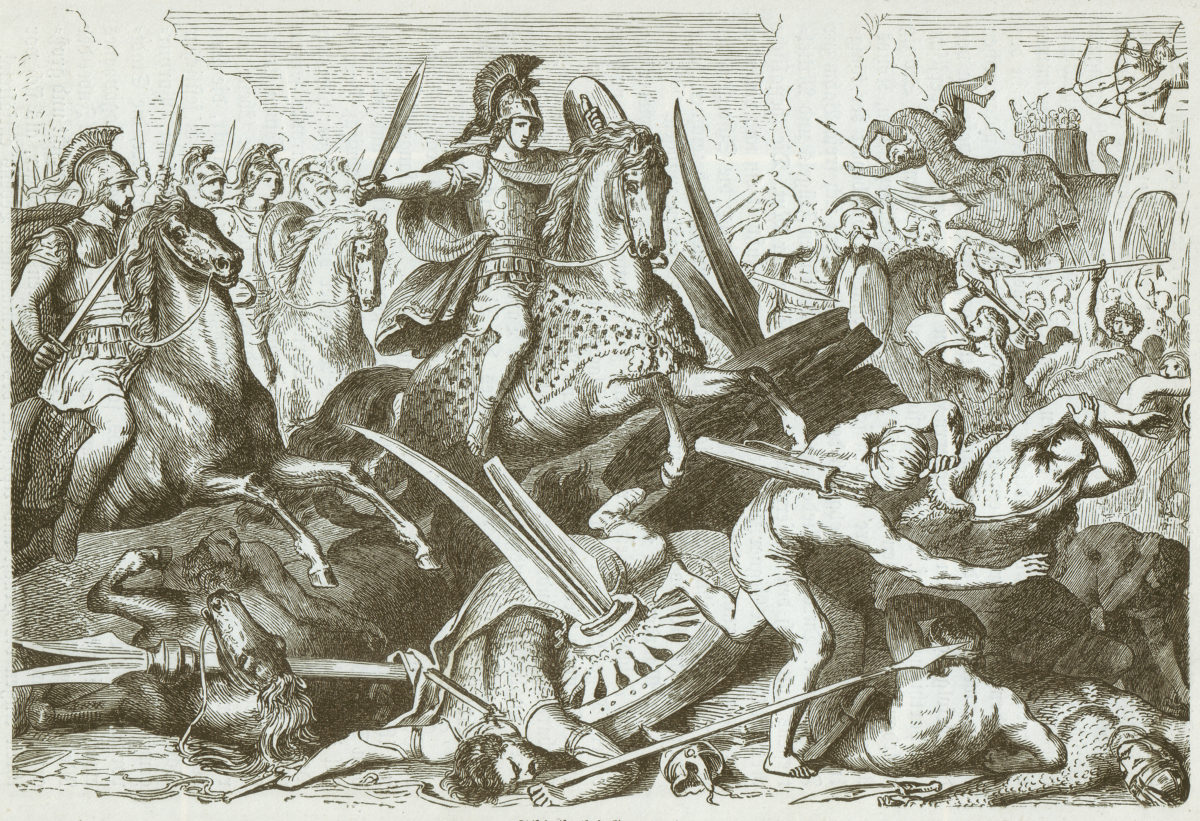
Alexander agreed. He ordered camp to be set up again, then spent the day inspecting both the field of battle, which had been leveled to accommodate Darius’ cavalry and chariots, and the arrangement of the Persian forces. The left and right wings of Darius’ line were predominantly cavalry, intermingled with archers and infantry. In the center, and protecting Darius to their rear, were his special Greek mercenary cavalry and his royal foot and horse guards, sometimes called “apple-carriers” because of the golden apples on their spear butts. In addition, Darius had amassed an infantry contingent of mixed nationality who, it has been surmised, were most probably untrained men hurriedly summoned from the hills. They increased Darius’ head count, but it remained to be seen what they would contribute to their king’s defense. The entire Persian line was fronted by some 200 scythe chariots, so named because of the sickle-like knives protruding from their wheels. A small number of Asian elephants loomed over the Persian host.
The total numbers of the Persian army have been estimated by historians at anywhere from 200,000 to an implausible one million. For Alexander, precise numbers made little difference. Even at the most conservative estimate, he was grossly outnumbered. His battle plan would have to be brilliant. He spent most of that night not in slumber, but in forging that plan. The most critical factor was that Alexander’s cavalry, the fighting force so important to him that numbered approximately 7,000, faced about 34,000 Persian cavalry. Rather than being daunted by such odds, Alexander mapped out a strategy destined to be emulated by later generals such as Napoleon Bonaparte.
At one point in the wee hours General Parmenion came to him, proposing a night attack on the unsuspecting enemy. In addition to the obvious difficulty of maintaining the coherence of his forces at night, Alexander gave Parmenion a more personal reason for rejecting such stealthy action: “I will not demean myself by stealing victory like a thief. Alexander must defeat his enemies openly and honestly.” Nevertheless, that night, believing that Alexander’s troops were moving into battle formation, Darius ordered his men to arms. Waiting the night out in fear of the stealthy attack that Alexander had decided against, Darius’ troops wasted energy they would need in the morning.
As the sun rose on September 30, Alexander delivered a brief address to his officers. They did not need speeches to inspire them, he declared—they had their own courage and pride to sustain them. He asked them to remember that they were not merely fighting for Asia Minor or Egypt, but for sovereignty over all Asia. Then he led his army forward, trailing the main line behind him at an oblique angle of about 30 degrees. The right flank, screened by a small cavalry unit of 600 mercenaries under General Menidas, consisted of two parallel lines of infantry, a line of Thracian cavalry, Macedonian archers and “old mercenaries” (so-called because they had served in his campaign from the beginning).Toward the center were javelineers alongside Alexander’s Royal Guard and his Companion Cavalry, commanded by Philotas. Armed primarily with the xiston, a shortened version of the infantry sarissa, the Companions were divided into eight squadrons and fought in a wedge-shaped or triangular formation, an innovation credited to Philip II.
Alexander’s father had also enhanced the already nearly impenetrable Macedonian phalanx by arming his hoplites, or heavy infantry, with sarissas—spears more than 4 meters in length. Now, their sarissas having been extended to 61⁄2 meters under Alexander’s rule, the phalanx was the center of the Macedonian front. A unit of men most often 16 deep, its spears extended much farther than the swords of the enemy, giving it great strength in the attack. The flanks of the phalanx were protected by some 3,000 troops specially trained for the task, called the Royal Adjutants. At Gaugamela, Alexander had a rough total of 12,000 men in his phalanx battalions, supported from the rear by an additional 12,000 foot soldiers, most of them slingers and javelineers.
Extending to the left of the central phalanx battalions were light infantry and Greek horsemen, including the powerful Thessalian cavalry under General Parmenion. Each Thessalian squadron formed a tactical unit arranged in rhomboid or diamond formation, whose primary task was to hold the left wing steady. Again, the cavalry protected the flanks of a force of mercenaries. All told, Alexander’s infantry numbered approximately 40,000. His foot soldiers were screened by cavalry so that his line appeared much weaker than it was—an intentional arrangement.
As Alexander marched, he offered Darius the tempting bait of a shorter Macedonian right flank against a longer Persian left. Still, the Persians stood fast, and as Alexander continued extending his line, he threatened to move the battle off the ground specially prepared for cavalry and chariot maneuvers. It became a contest of nerves. Darius, meanwhile, continued inching his front to the left to match Alexander’s movement. Finally, he ordered the foremost cavalry on his left wing into action to halt Alexander’s march. Menidas’ outnumbered cavalry raised their war cries and charged. But the intention of their attack was to entice, and therefore irretrievably commit the Persian left wing. Just as fast as they advanced, the mercenaries feigned intimidation at Darius’ numbers and broke off their attack. The Persian left pursued vigorously, not expecting the scores of infantry lying in wait behind the Macedonian right.
Darius then called his next shot. The main body of cavalry, a fighting force of roughly 8,000 commanded by his cousin, Bessus, thundered into the assault. Blade met blade as Greek infantry dodged the cavalry and absorbed the strength of a significant number of Darius’ best. The odds against Alexander’s Companion Cavalry, still awaiting its moment, were thereby reduced. Meanwhile, Darius launched his scythe chariots and sent his elephants into action. Alexander deployed his javelineers, whose missiles killed or disabled most of the chariot drivers before they had a chance to inflict any damage. While intimidating in size, the elephants did little more than create a manageable degree of chaos and interference—most of Alexander’s troops simply parted ranks and let the charging beasts pass.
Still, Darius must have felt confident. The elephants were an experiment. The chariots, though they had failed in other confrontations, had been worth another try. But the Macedonian right wing was heavily engaged. Darius ordered a general advance, pouring more men into the mayhem on his left. To his right, Mazaeus’ cavalry was unleashed against Parmenion’s cavalry and phalanx. Without knowing it, Darius was further reducing the odds against Alexander’s Companions, who still waited to launch their decisive charge against Darius and his royal guards. Adding to that fact, an awkward situation was developing near the junction of the Persian center and the Persian left wing. As men poured into the Macedonian right wing and the struggle there intensified, the battle line stretched still farther to the left, thinning and therefore weakening the Persian front.
At that point, the only Persian cavalry still not committed to the battle were those roughly opposite Alexander and his Companions. Those were most important for Alexander to personally engage—Darius’ kinsmen and guards, and the king himself. The Persians had sacrificed depth in the process of extending their line in an effort to keep their front continuous. The Companions were now ready to crash into the loosely woven Persian ranks. Alexander gathered his still-available forces into a gigantic wedge. At the tip of this wedge was the Royal Guard and Companion Cavalry. Trailing down on the left were the remaining phalanx battalions; on the right were the Thracian infantry and archers as well as the javelineers who had been previously deployed against the chariots.
Through the dust rising out of the conflict, Darius watched Alexander and his dreaded cavalry emerge in nearly perfect order. With the assistance of his phalanx, Alexander beat back the Persian line in the direction of Darius, threatening him in both flank and rear. No doubt Darius hoped Alexander’s assault would be stopped by his own Royal Guard and some 3,000 infantry, but Darius’ guards were quickly overpowered by the sheer momentum of the Macedonian fighting force. The left side of Alexander’s powerful wedge became a dragnet whose ultimate aim was the capture of the Persian king.
A small gap was created in Alexander’s line when he broke through the Persian line, allowing Darius to dispatch a squadron of Persian and Indian cavalry to strike at the Macedonian baggage train, but they were defeated by Thracian light infantry and reinforcing troops from Alexander’s reserve phalanx. Another two cavalry squadrons from the Persian right wing swung around the battle in a bid to reach Alexander’s camp and free the Persian royal family. Although they created a certain degree of havoc, the rescuers were unsuccessful, either killed or chased away by the Macedonian slingers and javelineers.
Bessus was still battling the Macedonian right when he saw the Companions break through the Persian line. Probably fearing the possibility that Alexander would turn these forces to the already heavily engaged Persian left, he ordered a withdrawal. The Persians began to retreat, but were chased down and slaughtered as they fled.
In the center, an intense struggle developed as Alexander’s strategy began to succeed. Darius realized the battle was out of control and, just as he had done at Issus, abandoned his army. Behind him, his infantry and Royal Guard fought desperately for their lives. They managed to break through the encircling Macedonian forces and follow their king. At that point, Alexander turned to assist Parmenion but encountered a large force of Persians and Indians, resulting in the heaviest fighting of the battle and the deaths of 60 of his Companions. That action relieved the Macedonian left wing, however, and Parmenion’s Thessalian cavalry succeeded in besting their opponents. That in turn enabled Alexander’s Companion Cavalry to repel the Persian forces they faced. The ultimate result was panic and the rout of the remainder of Darius’ army.
Enraged that despite his victory on the battlefield, he had not been able to capture the Persian king, Alexander ordered 500 horsemen to accompany him as he began a relentless pursuit of the fleeing Darius. Darius raced north toward the pass of the Caspian Gates with some 30,000 infantry, a depleted treasury and a handful of personal attendants. He had hoped to meet reinforcements, but they failed to materialize. As his situation became increasingly desperate, he was betrayed by his own commanders. One of the leaders of his cavalry, Nabarzanes, plotted with Bessus, urging him to assume the throne. Through the night, the traitors calculated how to rid themselves of Darius, then renew the war with Macedonia. Although he had been forewarned, a despairing Darius allowed himself to be taken away the next night in a common cart. Resistance would have been futile—the weary sovereign had not sufficiently retained the loyalty of his army to have prevented his murder.
Meanwhile Alexander followed on his heels, covering 400 miles in 11 days. Two Persian nobles willing to help rode to the site where the Macedonians were encamped. Before Alexander arrived at the place where Darius had been, however, Bessus had stabbed his cousin to death, then fled into the night. When Alexander found him, the Persian king had breathed his last. In a respectful gesture, Alexander covered him with his cloak, then sent the king’s body to his mother, Sysgambis, for proper burial in the city of Persepolis.
From a tactical point of view, Alexander had emerged the overwhelming victor of Gaugamela, a success that can be attributed to several factors. Among the most important was the fact that his troops had superior morale, not only because of their string of military successes, but also because of the close ties of loyalty they had developed with their commander. By contrast, Darius’ army was a mixture of nationalities, with many soldiers who had stood at arms throughout the preceding night. They fought with much less resolve against a force better disciplined, trained and equipped than they were.
In the preceding century, Macedonian military inventions—in particular the phalanx—had converted the Macedonian army into a fine instrument of war. But under a less talented general, the army might still have been overwhelmed by the sheer weight of Persian numbers. Alexander’s superior tactical judgment, added to his ability to sift through reports rapidly and deduce events as they unfolded in the chaos of battle, enabled him to overcome superior numbers with minimal losses. Alexander later claimed that about 500 of his men were killed at Gaugamela and some 5,000 wounded, while the most conservative (and perhaps least exaggerated) estimate of Persian dead was 40,000.
In strategic terms, there can be no doubt that the battle’s outcome changed the course of history. As a result of Alexander’s victory at Gaugamela, western Asia would remain under Hellenic sovereignty in succeeding centuries. Much of the world would be influenced and largely molded by the amenities of classical Greek education, literature, art and science.
One campaign, one victory, one man accomplished that.
For further reading, Colorado-based author Stormie Filson recommends: The Campaign of Gaugamela, by E.W. Marsden; and The Nature of Alexander, by Mary Renault.

this article first appeared in Military History magazine
Facebook @MilitaryHistoryMagazine | Twitter @MilHistoryMag