In late summer 1862, Confederate armies were on the march everywhere. The most notable advance, that of the Army of Northern Virginia, ended in stinging defeat along the banks of Antietam Creek, Maryland, in mid-September. Southern hopes, therefore, turned to the West. In the western theater, General Braxton Bragg prepared to take his Army of Tennessee north into Kentucky. He hoped to exploit a division in the Union command—Maj. Gen. Don Carlos Buell commanded eastern Kentucky and Tennessee, and Maj. Gen. Ulysses S. Grant the western end of both states—and defeat Buell before Grant could reinforce him.
The ambitious operations in the West eventually would involve all four armies in Bragg’s district. Maj. Gen. Kirby Smith’s command at Knoxville was to join Bragg in Kentucky, while Maj. Gen. Sterling Price’s Army of the West and Maj. Gen. Earl Van Dorn’s Army of the Mississippi kept Grant busy in northern Mississippi.
When he heard that Grant was reinforcing Buell, Price launched an attack toward Iuka, Miss., but two Union columns, one led by Grant himself, almost trapped his army on September 19. Five days later, Price decided to join Van Dorn so they could attack Grant in force.
GET HISTORY’S GREATEST TALES—RIGHT IN YOUR INBOX
Subscribe to our HistoryNet Now! newsletter for the best of the past, delivered every Monday and Thursday.
Grant Scattered
With Union interest concentrated chiefly on Bragg’s invasion of Kentucky, Grant’s command was scattered about western Tennessee and northern Mississippi in several garrisons. Impetuous and aggressive (he was a former Indian fighter), Van Dorn evaluated potential objectives before deciding to attack the strongest, the one at Corinth, Miss. Two strategic railroads, the Mobile & Ohio and the Memphis & Charleston, linked up there, and control of the rails was, as always, a paramount concern in the war.
Recommended for you
After the Battle of Iuka, Grant transferred his headquarters to Jackson, Tenn., leaving Maj. Gen. William S. Rosecrans in command at Corinth. Both Rosecrans and Van Dorn had graduated from West Point in the class of 1842, Rosecrans near the top of the class and Van Dorn near the bottom. Rosecrans was an army engineer for 10 years before resigning his commission to go to work for a railroad. In 1861, he re-entered the army as a colonel of engineers under his friend, Maj. Gen. George B. McClellan, in West Virginia. The army transferred him west, and when Maj. Gen. John Pope conversely went east, Rosecrans became commander of the Army of the Mississippi.
Rosecrans missed the Mexican War, whereas Van Dorn was in the thick of the fighting, being brevetted twice for bravery. He had risen to the rank of major (in the elite 2nd U.S. Cavalry) when the Civil War broke out. Originally assigned to the East at the request of General Joseph E. Johnston, his prewar regimental commander, Van Dorn was transferred west after being in almost constant conflict with Confederate authorities over his rank and command. He later commanded the Army of the West at the Battle of Pea Ridge, and the District of Mississippi at Vicksburg during the summer of 1862.
Van Dorn knew that Rosecrans had 15,000 troops at Corinth, with another 8,000 at the nearby garrisons at Iuka, Burnsville, Rienzi, Danville and Chewalla. If Van Dorn moved quickly, he could strike before Rosecrans consolidated his forces. With 22,000 men, he would have a numerical advantage of about 3-to-2.
Surprise Attack?
To be successful, Van Dorn had to achieve surprise. At first, he did. Without Rosecrans being aware of it, he moved his army from LaGrange to Ripley, where Price joined him on the 28th. The combined army consisted of divisions under Maj. Gen. Mansfield Lovell, Brig. Gen. Dabney Maury and Brig. Gen. Louis Hébert.
On the 29th, Van Dorn’s army marched north toward Pocahontas, thereby threatening the Union garrison at Bolivar. The effort to conceal his objective failed, however, as the canny Grant saw through the feint. On October 1, Grant ordered Rosecrans to concentrate his forces, and the next day the Union units began marching toward Corinth.
Rosecrans’ army consisted of two divisions of his own Army of the Mississippi, those of Brig. Gens. David Stanley and Charles Hamilton, as well as two from the Army of the Tennessee, under Brig. Gens. Thomas Davies and Thomas McKean.
Confederate spy
Rosecrans had one advantage of which Van Dorn was completely unaware. A Confederate spy, Amelia Burton, sent information to Van Dorn indicating that the Union defenses were weakest on the northwest side of town. Unknown to the Confederates, her message was intercepted, copied and sent along. When Rosecrans took command at Corinth of September 26, he immediately began improving the town’s defenses in that direction.
Three lines of fortifications protected Corinth. The old Confederate works (from earlier in the year), several miles from town, were on good defensive ground but encompassed a front too wide for Rosecrans to defend with his small army. The ‘Halleck Line, a mile and a half from Corinth, was also too long. The inner line lay immediately outside town where there were five batteries (or forts) on what was called the College Hill Line.
The weak points of the Union defenses were where Chewalla Road in the center and Purdy Road on the right pierced the lines. Battery Robinett, a fort with three siege guns, dominated Chewalla Road. Battery Williams, with seven guns, was on the other side of the road and somewhat to the rear of Battery Robinett. The guns in both batteries were manned by regulars from the 1st U.S. Infantry.
On the right, Battery Powell was built where Purdy Road came down into the Union lines. The ground about it was open and without rifle pits.
On the 29th, Rosecrans’ cavalry began skirmishing with the Confederates. In the most damaging action, a detachment from the 3rd Michigan Cavalry drove off the Confederates guarding Davis’ Bridge over the Hatchie River near Pocahontas, and destroyed it.
Van Dorn needed to move quickly, but had to wait while his men rebuilt the bridge. The same thing occurred a few miles down the road at Young’s Bridge over the Tuscumbia River, but when his men tried to work, Union skirmishers opened fire, delaying work further until the cavalry could drive them off.
On Alert
To guard against a surprise attack, on October 1 Rosecrans sent Colonel John Oliver to Chewalla with three regiments from McKean’s division, and two 12-pound howizers. The morning of the 2nd, a patrol heard drums on a road leading into Oliver’s rear. Fearing that the Confederates might cut him off from Corinth, Oliver began a withdrawal toward Corinth.
Van Dorn camped at Chewalla on the 2nd. That night he held a council of war with his generals and laid out his plan for attacking Corinth. Though he had one or two good maps, Van Dorn drew a crude sketch on paper indicating how he wanted the army to maneuver. His division commanders thus went into combat the next day without a clear understanding of what Van Dorn wanted them to do.
To cut off Rosecrans from reinforcements, Van Dorn sent his cavalry to strike the railroad during the night, but by then it had lost its tactical importance. When the last supply train arrived in Corinth on the 2nd, the engineer had orders to return to Jackson that day, as Grant expected the Confederates to seize the rail line.
Road to Corinth
At dawn on October 3, Lovell’s division led the Confederate army down the road toward Corinth. Five miles from town, Hebert’s and Maury’s divisions left the road to form a line of battle on the east. At 10 a.m., Lovell advanced, driving into Oliver’s skirmishers. Under pressure, the Union troops retreated, losing a howitzer with a broken axle. Rosecrans reported that Oliver acted feebly and fell back, but in reality, he faced thousands of Confederates with only 500 men.
Oliver retreated to a new position on a hill near the old Confederate line. Rosecrans, thinking this might only be a screen to cover a Confederate attack in some other direction, ordered him to keep up resistance. When Oliver reported he needed reinforcements if he was to hold the hill, Rosecrans moved his units forward to the old Confederate line, Brig. Gen. John McArthur reinforcing Oliver with another of McKean’s brigades, under Davies, to their right, and Hamilton on his right.
Rosecrans ordered Davies and MacArthur to maintain contact with one another, but as the Union lines advanced, the units radiated outward from Corinth so a gap appeared between the two units. When Oliver requested more help, Davies sent him Baldwin’s brigade and a pair of 20-pound rifles.
An initial Confederate advance down the railroad tracks was driven back by cannon fire alone. Lovell then threw his whole division at the hill while Maury attacked Davies’ left.
Attack!
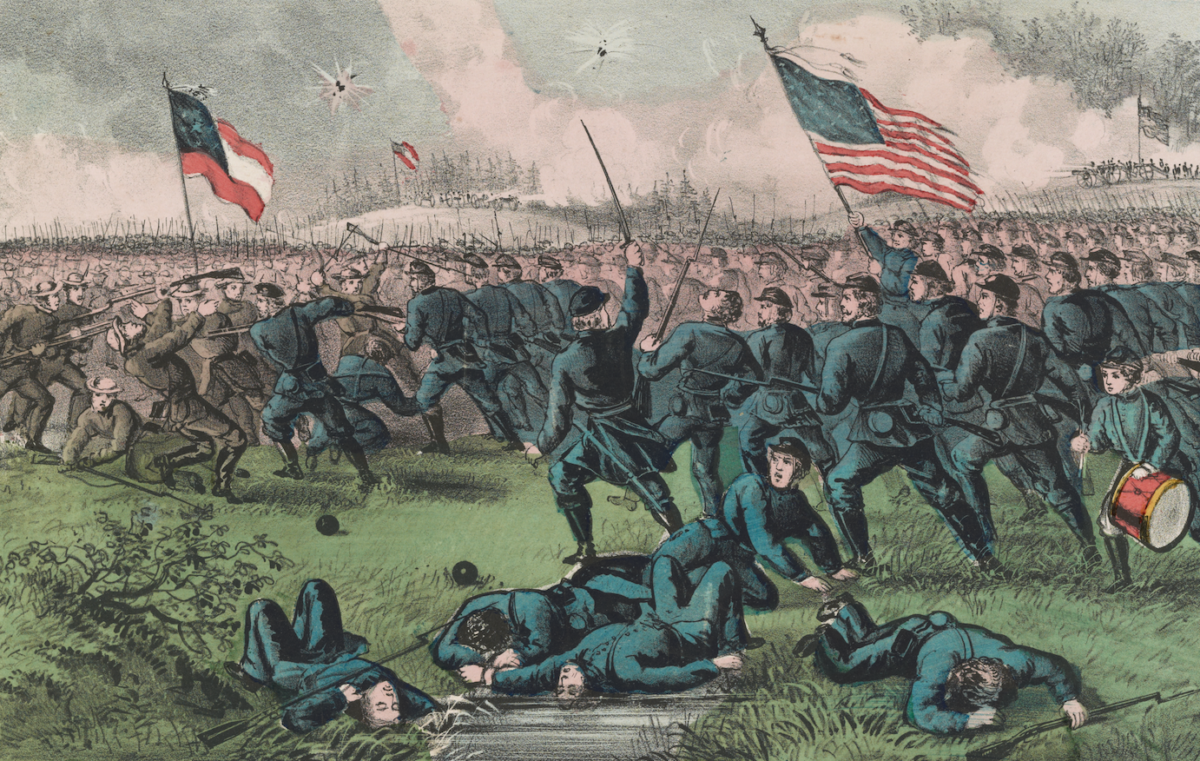
As Lovell’s men emerged from cover, Union artillery tore holes in their ranks. Brigadier General Albert Rust’s brigade suffered 100 casualties within seconds. Knowing he could not afford to stop the attack, Rust ordered his men to fix bayonets and continue forward. Swinging wide to their left to avoid the railroad cut, the men charged forward with cheers and yells. The 9th Arkansas and 22nd Mississippi raced toward the crest, each unit trying to be the first there.
Facing the attack, MacArthur abruptly fell back, exposing Davies’ left. Davies ordered his troops to retreat to the division’s original position at the junction of Chewalla and Columbus roads, but a wounded messenger brought word that they were cut off from Davies, and would have to retreat with MacArthur. Davies coolly retreated in stages to a line 725 yards in front of Battery Robinett.
About 1 p.m., Rosecrans finally decided Corinth was Van Dorn’s objective. He ordered MacArthur and Oliver to retreat to a ridge and form on Davies’ left. At the same time, he ordered Stanley’s division to move up to support Davies.
GET HISTORY’S GREATEST TALES—RIGHT IN YOUR INBOX
Subscribe to our Historynet Now! newsletter for the best of the past, delivered every Wednesday.
God OPens a Window
Rosecrans saw the Confederate success that afternoon as an opportunity to attack. The Confederate left flank hung in the air, with Hamilton’s division behind Hébert’s lines. Rosecrans ordered Hamilton to attack the exposed enemy flank.
With an opportunity not merely to defeat the Confederates but to destroy their army, Hamilton fumbled his chance. When he received Rosecrans’ order to attack (after some confusion), he ordered his division to pivot to the left. Brigadier General Jeremiah Sullivan’s brigade was soon in position, but Brig. Gen. Napoleon Buford’s was delayed by Confederate skirmishers. Thinking they screened the Confederate lines, Buford followed them away from Sullivan. Because of the heavy forest, Hamilton had only one battery of field artillery. With only one small brigade and one battery, he decided not to attack.
On the Confederate right, Lovell stopped short of the Union lines when he encountered a half-mile-wide abatis. He thought the position too strong to attack, but saw that there were no defenses to his left, in front of Maury. He reported this information to Van Dorn.
At about 3 p.m. the Confederates attacked. For an hour and a half, Davies’ 11 guns kept them at bay, firing over 1,500 rounds. Twice Davies had to resupply them. When they finally ran out of ammunition, Davies ordered his gunners back to the line at Battery Robinett. The artillery filed slowly to the rear, men looking more like coal-heavers than soldiers, with perspiration streaming down their faces blackened with gunpowder, and the wounded horses leaving a stream of blood in the road, he reported.
As the Confederates came closer, the infantry opened fire. For a while it seemed that they would run out of ammunition too, but at about 5 p.m. more was distributed. In the 52nd Illinois, some gun barrels were so hot from firing that the charges exploded when the men tried to load their rifles.
Finally, Brig. Gen. John Moore’s brigade of Maury’s division got around MacArthur’s right, forcing him to fall back. Worried about his left flank, Davies ordered his division to retreat to the final line at Battery Robinett.
Last Chances
Each commander believed that with one more hour of daylight, he could have won the battle that day. Van Dorn believed he would have broken through the Union front, while Rosecrans believed Hamilton would have rolled up the Confederate left.
By the end of the day, however, Van Dorn had lost whatever advantage he had enjoyed at the beginning of the campaign. Any chance of outnumbering Rosecrans was gone and, if anything, Van Dorn was now outnumbered. As one Louisiana soldier remembered years later, “The forced marches, the terrible hot weather, want of food, and need of rest, so completely exhausted the troops that large numbers of them did not enter the fight, having failed to reach their commands.”
During the night, Van Dorn sent Major Edward Dillon forward to scout the Union lines, but he was stopped about 40 or 50 yards short when he spotted Union sharpshooters. Van Dorn and others heard the sounds of wagons which he optimistically interpreted as the sounds of axes, a clear indication that Rosecrans was improving his defensive positions instead of falling back.
Casualties were high that first day, and would be higher the next. Rosecrans’ surgeon, Archibald Campbell, selected a large building as a hospital. It became evident in a short time that the building, although a very large one, would be altogether too small for their accommodation, Campbell said. I then took possession of the Tishomingo Hotel, and when it was full, of the Corinth House, as hospitals.
Day 2
For the second day of battle, Rosecrans had all four of his divisions on the College Hill Line, with those having seen the least combat the day before holding the most-exposed positions. As a result, Hamilton was on the far right near Purdy Road, while Stanley was on the left center at Chewalla Road, with Davies between the two and McKean on the far left.
In a key section of the Union right, four brigades in a row, all three of Davies’ and one of Hamilton’s, had new brigade commanders–the commanders of each had been killed or wounded the day before.
Van Dorn’s plan for the 4th was to have Hébert begin the attack down Purdy Road toward Hamilton and Davies.
Once he had Rosecrans’ attention, the attack would spread across the front, with Maury attacking down Chewalla Road toward Stanley, and Lovell attacking McKean through the woods.
Van Dorn’s plan for the 4th was to have Hébert begin the attack down Purdy Road toward Hamilton and Davies. Once he had Rosecrans’ attention, the attack would spread across the front, with Maury attacking down Chewalla Road toward Stanley, and Lovell attacking McKean through the woods.
Every Man in
Van Dorn put all his men into the attack. Though the division commanders tried to save a brigade as a reserve, Van Dorn really had no reserve available with which to exploit a breakthrough. He expected Hébert to attack at dawn, but nothing happened. He then sent three men searching for him without success. About 7 a.m., Hébert appeared at his headquarters with the news that he was sick. (Later that year, two Southern newspapers reported that he suffered from narcotics abuse.) Price put Brig. Gen. Martin Green in command. The rattled Green deployed the division and then redeployed it. It was 8 a.m. before he was ready to advance. By then Maury’s skirmishers were already hotly engaged with Stanley’s skirmishers.
Wondering about the absence of activity on his front, Stanley ordered Companies A and K of the 39th Ohio to find out if the Confederates were still there. The Union troops no sooner reached the woods before their positions than heavy small-arms fire sent them reeling back toward their own lines.
When Green at last was ready, he started his division forward. Our lines moved across the railroad, advancing slowly and steadily, our skirmishers constantly fighting with those of the enemy, driving them back, he reported. When within 200 yards the command was ordered to charge at double-quick. The whole line now moved forward with great rapidity. Officers and men all seemed eager to be foremost in reaching the fortifications but it was a hard road to travel, climbing over logs, brush, and fallen timbers, while masked batteries of the enemy opened upon us at almost every step with greater slaughter, but nothing daunted, the division pressed forward.
Davies ordered his skirmishers out of the way so his artillery could open fire. At 300 yards, some of the Rebel infantry opened fire, and one man fled to the rear. Davies regretted not being close enough to shoot the man (as he claimed to have shot at two the day before). Only a few men ran, and for the moment the Union line held.
Routed
As the Confederates struck the line, the commander of the 52nd Illinois ordered a withdrawal that a turned into a rout. At about that time, the Union brigade, composed of detatchments from one Illinois and three Iowa regiments, gave way. The two remaining regiments tried to stem the tide until the brigade commander, Colonel Thomas Sweeney, ordered them to fall back to the reverse slope of a hill, where the rest of the brigade rallied.
The 56th Illinois was in reserve of Colonel S.A. Holmes’ brigade on Hamilton’s left. The front line fired a few volleys before falling back. The retreat soon became a rout, and they rushed pell-mell upon their comrades, running over men in every direction. The Confederates added to the confusion by turning captured cannon on the Union units still holding their ground.
Green’s men swiftly drove through the hole in Rosecrans’ right. My men pressed forward upon the enemy, and with heavy loss succeeded in getting into his works, having driven him from them, capturing more than forty pieces of artillery and forcing him to take refuge in the houses of the town and in every place that afforded protection from our galling fire, Green reported. He was followed and driven from house to house with great slaughter. The Confederates penetrated so deeply into the town that hand-to-hand fighting occurred in the yard outside Rosecrans’ headquarters.
When he heard firing on his left, Maury ordered his division forward down Chewalla Road toward Batteries Robinett and Williams. Defending Battery Robinett was Colonel John Fuller’s Ohio Brigade of Stanley’s division. Fuller had all four regiments on line, with the 11th Missouri in reserve behind the 63rd Ohio.
Rebels Coming
About 11 a.m., Fuller saw Confederates approaching in three or four columns. At their appearance, the 30-pound Parrotts of Battery Robinett opened fire, as did a battery of field artillery. Fuller ordered his regiments to lie down and hold their fire unit the Confederates were close. When they were 100 yards away, Fuller’s line came to its feet and fired one volley.
Captain Oscar Jackson, commanding Company H of the 63rd Ohio, watched the Confederates fall back. As the smoke cleared away, there was apparently ten yards square of a mass of struggling bodies and butternut clothes, he said. Their column appeared to reel like a rope shaken at the end.
A second attack came, this one using a ravine to cover the advance. Emerging into sight at a run, the Confederates smashed into the 27th Ohio. That regiment fired one volley before the fighting became hand-to-hand. Fighting centered on the colors of the 9th Texas. A Confederate officer yelled for his men to protect their flag, but Private Orrin Gould of Company G made off with it, despite being shot in the chest.
During the first two attacks, the company that Colonel John W. Sprague of the 63rd Ohio had placed in front of Battery Robinett was all but wiped out. He turned to Jackson’s Company H to replace it. Jackson ordered his men to the left and moved into position. In his diary he recorded, It was like moving into dead men’s shoes, for I had seen one company carried away from there on litters, but without a moment’s hesitation we moved up.
A third attack appeared in sight. As it neared the Union line, it divided, one column, the 2nd Texas Legion under Colonel William Rogers, splitting off so it headed directly at Company H. Sprague asked if he could move the rest of his regiment to support Jackson, but Fuller refused.
Rogers, marching to the left of his men, turned about, walking with his back to the Union lines so he could address his men. Boys, when you charge, give a good yell! he urged. As the Confederates charged, a volley from Jackson’s company dropped the men in the front rank, bringing the attack to a temporary halt. Since most of his men did not have bayonets, Rogers rearranged his ranks, putting those who did in the front rank.
‘Let Them Have the Bayonet’
Jackson saw that the Confederates were about to charge before his men were finished reloading. Don’t load, boys; they are too close on you; let them have the bayonet, he shouted.
To check the Confederate momentum, Jackson ordered his handful of men forward. The two forces smashed into one another, with survival depending on the individual soldier’s skill with the bayonet.
Jackson continued to fire his pistol point-blank at Confederates until it was knocked from his hand with a musket, and he was thrown to the ground. Meanwhile, carrying the colors of the 2nd Texas Legion, Rogers marched forward to the parapet of Battery Robinett. As he planted the colors there, a Union drummer boy killed him with a pistol.
As the Confederates stormed the parapets of Battery Robinett, the regulars tried to drive them back using their ramrods as clubs. As more of the enemy poured into the battery, they grabbed their rifles to fire one volley before retreating to the angle of the fort. With almost half his men down, Sprague ordered the 63rd Ohio to fall back. As they did, Major Zephariah Spaulding was afraid the Confederates would turn his left, so he ordered the 27th Ohio to fall back, stopping on line with the 11th Missouri.
Charge!
While the Confederates took Battery Robinett, Major Andrew Wilson had the 11th Missouri lie down. When the Confederates were 10 paces beyond it, the major ordered a bayonet charge. The regiment came to its feet and charged forward. This sudden impact of a fresh regiment broke the back of the Confederate attack, forcing them back.
Further right, Sullivan got off his sickbed to lead a counterattack by the 56th Illinois and 17th Iowa at about the same time Davies’ men counterattacked. An artillery officer who had remained with the 56th Illinois organized an ad hoc artillery squad that manned a gun, throwing canister into the Confederate ranks. The Confederates gave ground slowly. When they finally ran out of ammunition, they gave three cheers before retreating.
A quarter-century later, one former Confederate remembered the battle. Officers and men behaved with a cool and brilliant daring that savored more of romance than of real war, wrote Thomas C. Deleon. Deeds of personal prowess beyond precedent were done; and the Army of the Mississippi added another noble page to its record–but written deep and crimson with its best blood.

This article first appeared in America’s Civil War magazine
Facebook @AmericasCivilWar | Twitter @ACWMag