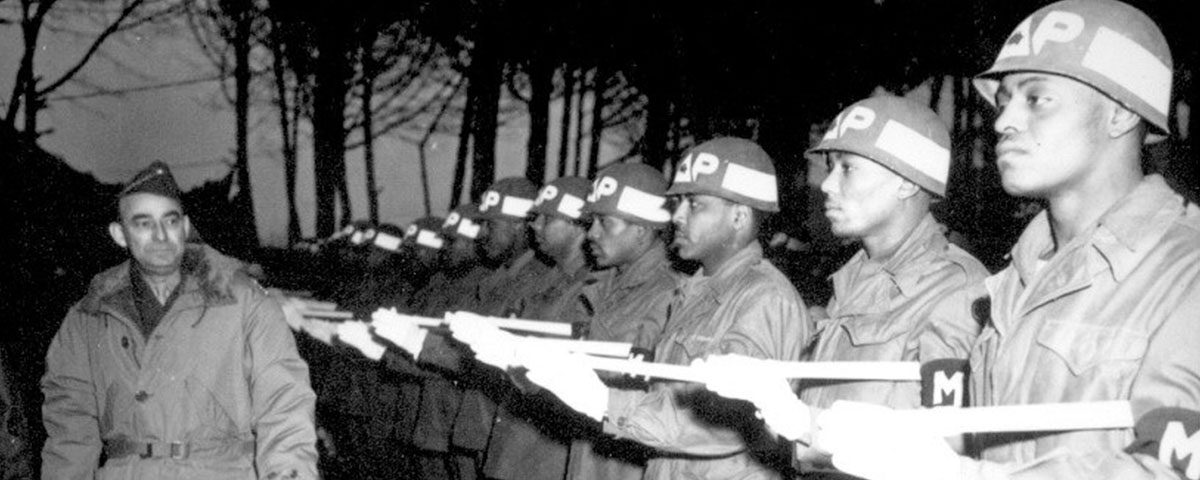
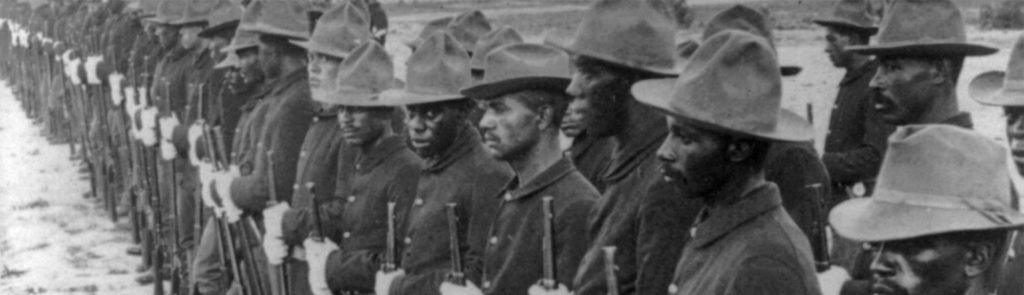
African Americans have fought in every major conflict in which the United States has been involved, from the Revolutionary War on. They frequently served with distinction — the 54th Massachusetts Volunteer Infantry during the American Civil War, the 9th and 10th U.S. Colored Cavalry regiments during the Indian wars and the Spanish-American War, and the 369th Infantry Regiment during World War I all established outstanding fighting records.
Yet with each new war in which the United States became embroiled, the white American establishment tended to forget the contribution made by Black servicemen in previous conflicts. Each time, Black soldiers were committed to combat in racially segregated units and had to prove themselves all over again. Of the 909,000 Black Americans selected for duty in the Army during World War II, only one Black division saw infantry combat in Europe — the 92nd Infantry Division. The vast majority of African Americans in uniform were assigned to segregated construction or supply units or placed in units that performed unpleasant duties such as graves registration. The government’s view was that Blacks were not motivated enough or aggressive enough to fight.
Black enlisted, White officers
While the 92nd was referred to as a Black unit, and its enlisted men and most of its junior officers were Black, its higher officers were white. The 92nd, which had fought in France during World War I, was once again activated in 1942. Under the command of Maj. Gen. Edward M. Almond, the 92nd began combat training in October 1942 and went into action in Italy in the summer of 1944. The unit continued a long and proud tradition by retaining the buffalo as its divisional symbol. Its circular shoulder patch, which featured a black buffalo on an olive drab background, was called The Buffalo — as was the division’s official publication. The 92nd even kept a live buffalo as a mascot.
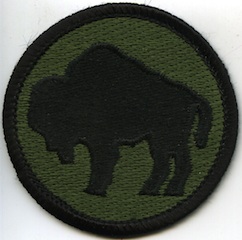
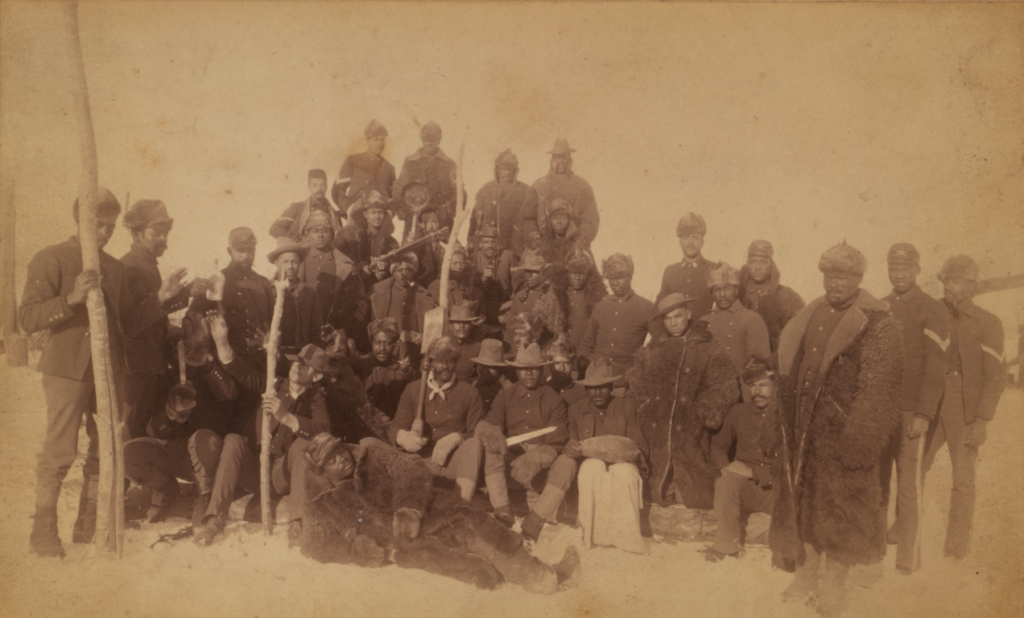
The nickname “Buffalo Soldier” dates back to the late 1860s, when Black soldiers volunteered for duty in the American West. The American Indians, who regarded the new threat as “Black white men,” coined the term “Buffalo Soldier” out of respect for a worthy enemy. According to one story, the Indians thought that the Black soldiers, with their dark skin and curly hair, resembled buffaloes. Another story attributes the name to the buffalo hides that many Black soldiers wore during the harsh winters out West, as a supplement to their inadequate government uniforms.
In the spring of 1944, after years of pressure from the Black community, the government grudgingly rescinded its policy excluding African American soldiers from combat. On July 30, 1944, the first wave of Buffalo Soldiers — the 370th Regimental Combat Team — disembarked at Naples, Italy, where they were greeted by a jubilant crowd of Black American soldiers from other service units. The rest of the division would arrive a few months later.
NEEDED IN ITALY
American troops were facing an uphill battle in Italy, and at that point the Allies were desperately short of infantry troops. After months of hard fighting, the Allies had managed to push German forces under Field Marshal Albert Kesselring almost 500 bloody miles up the Italian peninsula. But even after the fall of Rome on June 4, 1944, the Germans had simply retreated in an orderly fashion from one line of defense to another rather than acknowledge defeat.
On D-Day, two days after the victory at Rome, Allied soldiers swarmed across the beaches of Normandy. For the duration of the war, the American Fifth Army and the British Eighth Army, under the overall command of British Gen. Sir Harold Alexander, would play second fiddle to the Allied push in France. During the summer of 1944, nearly 100,000 men of the Fifth Army, out of a total strength of 249,000, were transferred to the fighting in France. As the Allies stood at the south bank of the Arno River in July, preparing to assault Kesselring’s most formidable barrier yet — the infamous Gothic Line — the Americans clearly had too many tanks and not enough infantrymen. Kesselring had built the line on the slopes of the Apennine Mountains, the 50-mile-deep range that, in northern Italy, runs diagonally from coast to coast and affords natural protection for northern industrial and agricultural centers.
In addition to the 370th, at that point the 92nd consisted of two other infantry regiments, the 365th and the 371st; four field artillery battalions, the 597th, 598th, 599th and 600th; plus headquarters battery, the 92nd Reconnaissance Troop, the 317th Engineer Combat Battalion and 317th Medical Battalion, as well as a medical battalion, signal company, quartermaster company, maintenance personnel and military police. The Buffalo Soldiers were assigned to the IV Corps of the U.S. Fifth Army in two primary areas of operation, the Serchio Valley and the coastal sector along the Ligurian Sea. They occupied the westernmost end of the Allied front, while the Eighth Army attacked across the eastern portion of the Italian peninsula. The 92nd would face not only mountainous terrain and tremendous resistance — including the German Fourteenth Army and its Italian Fascist soldiers, the 90th Panzergrenadier Division and the 16th SS Panzergrenadier Division — but also an array of man-made defensive works.
GET HISTORY’S GREATEST TALES—RIGHT IN YOUR INBOX
Subscribe to our HistoryNet Now! newsletter for the best of the past, delivered every Monday and Thursday.
By fighting an impressive defensive campaign, Kesselring had gained time to build up his Gothic Line. Using 15,000 Italian laborers and 2,000 Slovaks, the Germans constructed bunkers, tank emplacements, tunnels and anti-tank ditches; reinforced existing Italian castles; and laid carefully designed minefields intended to herd enemy troops into interlocking fields of fire.
At this stage in the Italian campaign the Allies did have one advantage. Italy was in a state of civil war, and the Italian partisan forces were proving more than a nuisance to the German cause. Guerrillas had even managed to kill one Luftwaffe division commander. As a result, one German commander, Gen. Fridolin von Senger, discarded his general’s insignia and rode in an unmarked Volkswagen.
DEPLOYED TO THE FRONT
When the Buffalo Soldiers deployed along the front, they began to work together with the tankers of the U.S. 1st Armored Division. In addition to this division, the IV Corps consisted of the 6th South African Armored Division, the Brazilian Expeditionary Force and Task Force 45, composed of British and American anti-aircraft gunners who had been retrained and re-equipped for combat infantry duty.
After landing on the Italian mainland at Salerno on Sept. 9, 1943, the Allies had unsuccessfully attempted to destroy Kesselring before January 1944. Now they once again hoped to make significant advances before the snows came in the winter of 1944. The Fifth and Eighth armies planned an all-out attack on the Gothic Line in August, with the Eighth Army positioned along the Adriatic Coast and the Fifth Army directing its efforts against the center of Italy, toward Bologna. The IV Corps would cross the Arno River, take Mount Albano and Mount Pisano on the plain, extend their front and draw the enemy’s attention. Meanwhile, the Fifth Army’s II Corps, to the right along with the British XIII Corps, would drive the main assault into the center of the Gothic Line. The thinly spread IV Corps also had the task of guarding the Allied west flank against a German counterattack and protecting the crucial Allied port of Leghorn, or Livorno, on the coast.
On Sept. 1, the three battalions of the 370th Regiment, along with elements of the 1st Armored Division, crossed the Arno River and advanced north for two to three miles. By the early morning hours of Sept. 2, the 370th Engineers and 1st Armored Engineers had cleared minefields, worked on fords and placed a treadway bridge across the Arno for the upcoming armored infantry assault. Task Force 45 was bogged down by heavy minefields, but the 370th pushed on. The 3rd Battalion of the 370th moved to the west of Mount Pisano, while the 1st Battalion advanced east of the mountain. Using mule trails, the 2nd Battalion advanced straight over the mountain.
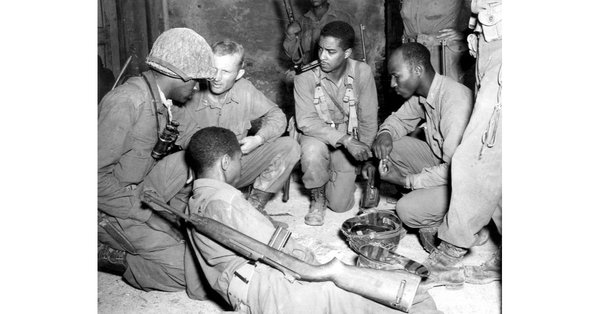
The Germans retaliated with small-arms, machine-gun and artillery fire while their forward elements began to pull back behind the Gothic Line. The Buffalo Soldiers advanced north beyond Mount Pisano and attacked the city of Lucca. They eliminated remaining enemy resistance around the road connecting Pisa to Lucca and spent the next several days patrolling and waiting for the rest of the Fifth Army to move up.
MAIN ATTACK
The main attack started on Sept. 10, and three days later the Buffalo Soldiers and 1st Armored tankers stood at the base of the northern Apennines. By Sept. 18, the II Corps had breached the Gothic Line at Il Giogo Pass, and many of the 1st Armored tanks were shifted to that area. The IV Corps consolidated its units while holding its section of the line until late in the month, when patrols of Buffalo Soldiers entered the Serchio Valley.
The men of the 370th had also penetrated the Gothic Line in their sector and now controlled Highway 12, which served as a crucial east-west communications artery for the Germans. In early October, they were ordered to take the city of Massa, near the coast, which was the first step in capturing the naval base at La Spezia. Although the Germans had been in continuous retreat in Italy, they resisted fiercely at Massa. They were determined to protect the western edge of the Gothic Line, especially because La Spezia’s naval base was nearby. Beset by cold autumn rains, the Buffalo Soldiers found themselves fighting a new enemy — mud — in addition to dug-in enemy troops. They did not take Massa at that point, and all across the Gothic Line, Kesselring’s forces held on. Meanwhile, though the II Corps made some impressive headway, it failed to reach Bologna before the snows set in.
After a six-day battle for control of Massa, the Buffalo Soldiers pulled back and regrouped. As the rest of the 92nd Infantry Division began to land in Italy, the Buffalo Soldiers of the 370th kept up the offensive on a smaller scale with power patrols consisting of between 35 and 75 men and at times machine-gun and mortar crews. The Fifth Army spent most of November conducting defensive actions in preparation for a renewed offensive in December.
By late November, the last elements of the remaining two 92nd Division regiments, the 371st and 365th, had arrived. In addition to the 92nd’s own regiments, a fourth regiment came under the division’s control — the 366th Infantry Regiment, with Black officers and men. The 366th had originally trained for combat but had been initially assigned to guard duty on Allied air bases throughout Italy. The men of the 366th had performed so well in their former assignment that their commanding general did not want to give them up.
As the 370th moved deeper into the Serchio Valley — later with elements of the 371st — resupply became a logistical nightmare. No vehicles could reach the Buffalo Soldiers as they fought their way to the high ground of the 35-mile-long valley. Despite a wealth of technology and industrial might at their command, the Americans found themselves dependent upon pack animals, the same mode of transport employed by Hannibal Barca when he had invaded Italy more than 2,100 years earlier.
Recommended for you
THE MULE PACK
One officer and 15 enlisted men formed the nucleus of the 92nd Division Mule Pack Battalion, which included an Italian veterinarian, two blacksmiths and 600 Italian volunteers who were given American uniforms and even wore the Buffalo insignia. The Americans scoured the countryside for mules and horses, which the U.S. government then purchased from locals. They eventually procured a total of 372 mules and 173 horses. Because the U.S. Army lacked the necessary equipment for pack animals, the blacksmiths had to hammer out their own horseshoes from German barbed-wire pickets. The animals brought up water, ammunition, antitank guns and other crucial materiel and transported the wounded to where they could receive treatment. As it turned out, however, the mules were apparently spooked by the smell of dead men and balked at carrying corpses.
The 92nd was expected to launch a major offensive on Dec. 1 in support of the II Corps’ renewed attack on Bologna. The attack was rescheduled for Christmas Day due to a predicted German counterattack. When intelligence reports indicated a large German build-up in the northern region of the Serchio Valley, the men of the 371st were transferred to the coastal sector, and elements of the 366th were sent to the valley to support the 370th. Although the Fifth Army never launched its early December assault, it was not a quiet month in the Serchio Valley. The Buffalo Soldiers continued to advance, town by town, against German artillery, mortar and small-arms fire. American engineers at first repaired bridges and roads for the advance, but soon shifted to defensive work, laying minefields, rigging bridges for demolition, and helping to evacuate civilians in anticipation of the German counterattack.
On Christmas Eve the Fifth Army called off its Christmas Day assault, but the Buffalo Soldiers, who were deployed on both sides of the Serchio River, continued to advance, facing German mortar and artillery rounds as they moved through more of northern Italy’s mountain towns. The 366th’s 2nd Battalion held the town of Barga on the American right flank, while the 370th held Gallicano, west of the Serchio River. On Christmas Eve, the 370th sent its 2nd Battalion east of the river into the little village of Sommocolonia, the northernmost edge of the American line. Light artillery and mortar rounds hit Sommocolonia but there seemed to be little enemy activity, so most of the 2nd Battalion moved out for duty elsewhere, leaving behind only two platoons. On the extreme right, just east of Sommocolonia, lay the villages of Bebbio and Scarpello, occupied by two platoons of the 92nd Division Reconnaissance Troop.
GERMAN ATTACK!
Before sunrise on the day after Christmas, the Germans attacked the villages just north and east of Gallicano. Although the primary German assault seemed to come from west of the river, toward Gallicano, partisans were also battling enemy soldiers north of Sommocolonia later in the morning. Within two hours, Sommocolonia and the two American platoons there were surrounded. A third platoon moved up to reinforce the embattled Sommocolonia troops. Lt. John Fox, an artillery forward observer for the 366th, exemplified the impressive fighting spirit of the Black soldiers. When enemy troops surrounded the lieutenant’s position inside a house and were about to overrun him, he ordered artillery fire directly on his own position, sacrificing his life. Fox’s heroic action bought valuable time that helped save other troops, and he was posthumously awarded the Distinguished Service Cross.
The two platoons of the 370th, along with a group of partisans, engaged in house-to-house fighting with the enemy during that battle. Many of the Germans were dressed as partisans, making the situation even more confusing and dangerous. Just before noon, the platoons were ordered to evacuate the village, but they were trapped. They managed to hold out until nightfall, but of the 70 Americans involved, only one officer and 17 men managed to fight their way out of the village that night as ordered.
Meanwhile, the two reconnaissance platoons at Bebbio and Scarpello were overrun by enemy troops and ordered to fall back. Despite heavy fighting, they managed to withdraw to their command post at Coreglia. German artillery fire began to cut deeper into American lines, and the 370th ordered its troops to quit Gallicano and secure the high ground nearby.
With the Allied port of Leghorn threatened, the Fifth Army called back the 1st Armored Division from II Corps control, and the 8th Indian Division, a British unit, moved to the area as reinforcements. On Dec. 27, American fighter-bombers roared into the valley and hammered Sommocolonia, Gallicano and other front-line areas. By Jan. 1, the Allies had more or less re-established their original positions.
ALMOND’s PLAN
With the Germans less of an imminent threat, the 8th Indian Division pulled out, leaving the valley to the Buffalo Soldiers. The Fifth Army postponed its major offensive until April, but Gen. Almond decided that his division would launch its own attack in February. Almond devised his operation not as a breakthrough assault but as a division-strength “feeler movement” intended to determine enemy strength and deployment, draw more enemy troops to the area and enhance the division’s own positions. Troops in the Serchio Valley were to seize the Lama di Sotto Ridge, overlooking the German supply center at Castelnuovo di Garfagnana, and create a diversion while the main assault concentrated on the coastal sector. Almond hoped to reach the Strettoia hill mass on the coast, just north of the Cinquale Canal, and then take Massa. Once in Massa, American artillery would come within firing range of La Spezia.
Units were moved around again so that the 370th and 371st occupied the Coastal Sector while the 365th went to the Serchio Valley. The 366th was divided between both areas. On February 4, the 366th held Gallicano, and the next day it pushed its lines into the outlying villages. The 365th, to the east of the Serchio River, took the town of Lama, just north of Sommocolonia, and occupied Mount Della Stella at the foot of the Lama di Sotto Ridge. The 365th held out against numerous counterattacks until February 8, when a full battalion of Germans pushed the Americans off the hill and out of Lama. At nightfall on the 10th, after encountering grueling enemy artillery fire and grenadier counterattacks, the Buffalo Soldiers retook Lama.
COASTAL FIGHT
The Buffalo Soldiers on the coast were hit just as hard as their comrades in the valley. The Germans had tanks, field artillery and thousands of ground troops to protect La Spezia, and they could call on a weapon unavailable to the Americans — heavy coastal guns. Emplaced at Punta Bianca, just southeast of La Spezia, the German coastal guns could not only lob shells into Massa but also reach all the way to Forte dei Marmi, which lay south of the Cinquale Canal. Fire from the powerful coastal guns left craters so large that Allied tanks literally fell into them.
The remainder of the 366th and its supporting armor–including another black unit, the 758th Tank Battalion — advanced along the coast. The 371st attacked on the far right through the coastal hill masses but ran into extensive minefields. The 370th advanced in column with its left flank on Highway 1 and its right flank in the hills. As they advanced, each battalion of the 370th leapfrogged the battalion directly to its front in order to keep up a continuous attack.
Riding on the tanks, the 366th rolled into the sea to avoid mines, then came back onto dry land north of the Cinquale Canal. The first two tanks to hit the beach were knocked out by mines and blocked the way. Before long, four more tanks were destroyed by mines, but the 370th reached the canal and started to cross, taking a pounding from local mortar and machine-gun positions as well as from the coastal guns. The artillery fire prevented engineers from laying a bridge, and foul weather meant no air support for the Buffalo Soldiers that day. Three tanks were lost when they fell into underwater craters while crossing the canal.
Despite numerous German counterattacks, the Buffalo Soldiers did manage to establish a line of defense north of the canal. Without a bridge, they had to hand-carry supplies across the water. Casualties were mounting, and the coastal guns kept pounding away. On the night of February 10, Almond called off the attack and ordered his troops back across the canal. The February operation cost 22 tanks and more than 1,100 casualties, including 56 officers.
REGROUPING FOR THE SPRING
The 92nd underwent drastic changes before its involvement in an offensive in the spring of 1945. The Allies considered it absolutely crucial that the 92nd seize La Spezia during the April attack, but the previous months of fighting had depleted the division’s strength. Although the U.S. Army had hundreds of thousands of Black troops, it could not find enough combat-trained replacements for the 92nd, so the 371st went to the Serchio Valley under IV Corps control while the 366th and 365th were sent elsewhere. The 92nd built up the strength of the 370th, the only Black regiment left in the division, while it gained two new regiments. In addition to the 473rd, made up of white anti-aircraft gunners turned infantrymen, the division received a ferocious fighting unit composed of Nisei soldiers — the famed 442nd Regimental Combat Team. These descendants of Japanese immigrants served in one of the most highly decorated American regiments of the entire war.
The 370th formed the left flank, with the 442nd on the right and the 473rd in reserve in the nearby Serchio Valley. In order to avoid the relentless barrage from the coastal guns, the 92nd Division, now jokingly referred to as the “Rainbow Division,” advanced toward Massa through the hills east of Highway 1. Even though fighter-bombers flew sorties over Punta Bianca and British destroyers shelled the German positions, the coastal guns continued firing.
In less than two hours on April 5, 1945, the 370th’s lead element, Company C, reached its initial objective: Castle Aghinolfi. The company’s artillery forward observer had to convince the artillery twice to give him fire support. Artillerymen could not believe that the riflemen had advanced so far. The Germans were surprised, too — in fact, many were still eating breakfast when the Buffalo Soldiers arrived.
Company C radioed for reinforcements, but the regiment had problems of its own, with two company commanders already killed. No help arrived. The Germans within the castle fired on the lone company with machine guns and mortars. Before long, the company had suffered 60 percent casualties. The forward observer and radioman were both hit and the radio was destroyed, cutting off all contact with the outside. The company had no choice but to pull back. Lt. Vernon J. Baker, the company’s only Black officer, volunteered to harass the enemy so that the wounded could escape. Armed with hand grenades, and on two occasions supported by Pvt. James Thomas’ automatic-rifle fire, Baker personally destroyed three machine-gun nests and an observation post. Baker, who had already received a Bronze Star and a Purple Heart, would receive the Distinguished Service Cross for his actions that day.
RIDGE BY RIDGE
Meanwhile, the 442nd fought the enemy ridge by ridge and systematically blew up German bunkers with bazookas. By April 6, the Nisei had control of Mount Belvedere. The 370th, Company C included, made another assault against the same hills but needed more troops to succeed. The 473rd moved up, and the hard-hit 1st Battalion of the 370th, which had had three company commanders killed in the first two days, went to the Serchio Valley to protect the American flank against a German counterattack.
The 370th and 473rd, along with their supporting armored battalions, pushed through the hills and also advanced along Highway 1, although the German guns at Punta Bianca continued to pound away. On April 9, American tankers rolled into Massa but were driven back by staunch enemy resistance. In a supporting maneuver, the 442nd pushed forward through the mountains and flanked the city’s eastern side. Finally, the Germans withdrew, and on April 10 the Americans controlled the city.
The 92nd Infantry Division continued to press forward, though the bitter fighting continued as the Germans moved their reserve men and panzers into position. With the German lines receding, a full battalion of tank destroyers finally came within range of the coastal guns and over a six-day period sent more than 11,000 rounds into Punta Bianca. By April 20 the big guns were silent and the Germans were retreating.
VALLEY MEN
The Buffalo Soldiers fighting in the Serchio Valley had also been busy. The 370th had taken Castelnuovo on April 20 and pressed forward. They planned to meet up with the 442nd at Aulla, northeast of La Spezia, and cut off the German retreat.
The fighting had left so much destruction that the Americans could not even use their mules, and the division was accumulating more prisoners than it had time to deal with. Partisans had been fighting at La Spezia, and on April 24 the 473rd moved into the city. Three days later, the 473rd and its supporting armor crushed the German resistance at Genoa. The 370th and 442nd in their sector helped prevent two enemy divisions from escaping through the Cisa Pass before the May 2 cease-fire officially ended the hostilities in Italy.
DEEMED A FAILURE DESPITE THEIR SUCCESS
Although Allied forces were ecstatic over their success in Italy, for the Buffalo Soldiers, it was a bittersweet victory. The military establishment considered the 92nd, which comprised less than 2 percent of all Black Americans in the army, a failure. Regarded as an experiment from the outset, the division had been closely watched and roundly criticized.
Much of the blame for the setbacks in February 1945 and other similar occurrences was attributed to confusion between the junior officers and enlisted personnel. However, their officers were rotated so often that the men sometimes had no idea who their commanders were, and in many cases the most outstanding officers and NCOs were killed in action.
In defense of the Black junior officers, Lt. Col. Markus H. Ray, commander of the division’s 600th Field Artillery Battalion (which had all Black officers and men) wrote on May 14, 1945: “I believe that the young Negro officer represents the best we have to offer and under proper, sympathetic and capable leadership would have developed and performed equally with any other racial group …. They were Americans before all else.”
The numbers alone tell an impressive story. Of 12,846 Buffalo Soldiers who saw action, 2,848 were killed, captured or wounded. The Buffalo Soldiers did, in fact, break through the Gothic Line. They reached their objective, captured or helped to capture nearly 24,000 prisoners and received more than 12,000 decorations and citations for their gallantry in combat. The soldiers of the 92nd Division had proved their worth to America once again through months of bitter combat in the Italian Campaign.
The performance of the 92nd Infantry Division sparked many debates, including some about the ethnicity of officers. Some of the military establishment felt that Black troops performed better under Black officers, but others believed that white officers were better-suited to command Black soldiers.
Combat experience showed that troops performed best under good officers, regardless of their skin color. For the most part, the American military establishment considered the “experiment” of Black combat troops a failure. The Black press blamed segregation, while the army’s upper echelons cited racial inferiority, though not all white officers shared that opinion.
A look at the facts, however, suggests that both sides were wrong. The Buffalo Soldiers did indeed break through the Gothic Line. The setback in February 1945 had much to do with the German coastal guns, which survived repeated efforts to silence them.
The 92nd did have its share of problems. In some cases whole platoons were disarmed and arrested because of their performance, although many of the charges against the men were later dropped. It should be noted that, owing to the Army’s inability to supply the number of replacements needed by the 92nd, troops who had formerly been absent without leave were sent to the Black division from the East Coast processing center. Considering the 92nd’s overall success during the Italian campaign, the unit’s experience in World War II sounds far more like a success story than anything else.
Black Americans in uniform found themselves in a rather compromising situation during World War II. The Black press, almost unanimously opposed to a segregated military, promoted the Double-V campaign–a military victory for America overseas and a political victory for the Black community at home. Judge William H. Hastie, the civilian aide to the secretary of war from 1940 to 1943, waged many political battles with the U.S. government on behalf of the Black community. Hastie fought for the inclusion of Blacks in combat units, the Medical Corps, the Army Nurse Corps and the Army Air Corps. He even struggled to abolish the unscientific practice of separating blood plasma according to race. Although Hastie was unable to make much headway in the fight against segregation during the war, he enjoyed many successes.
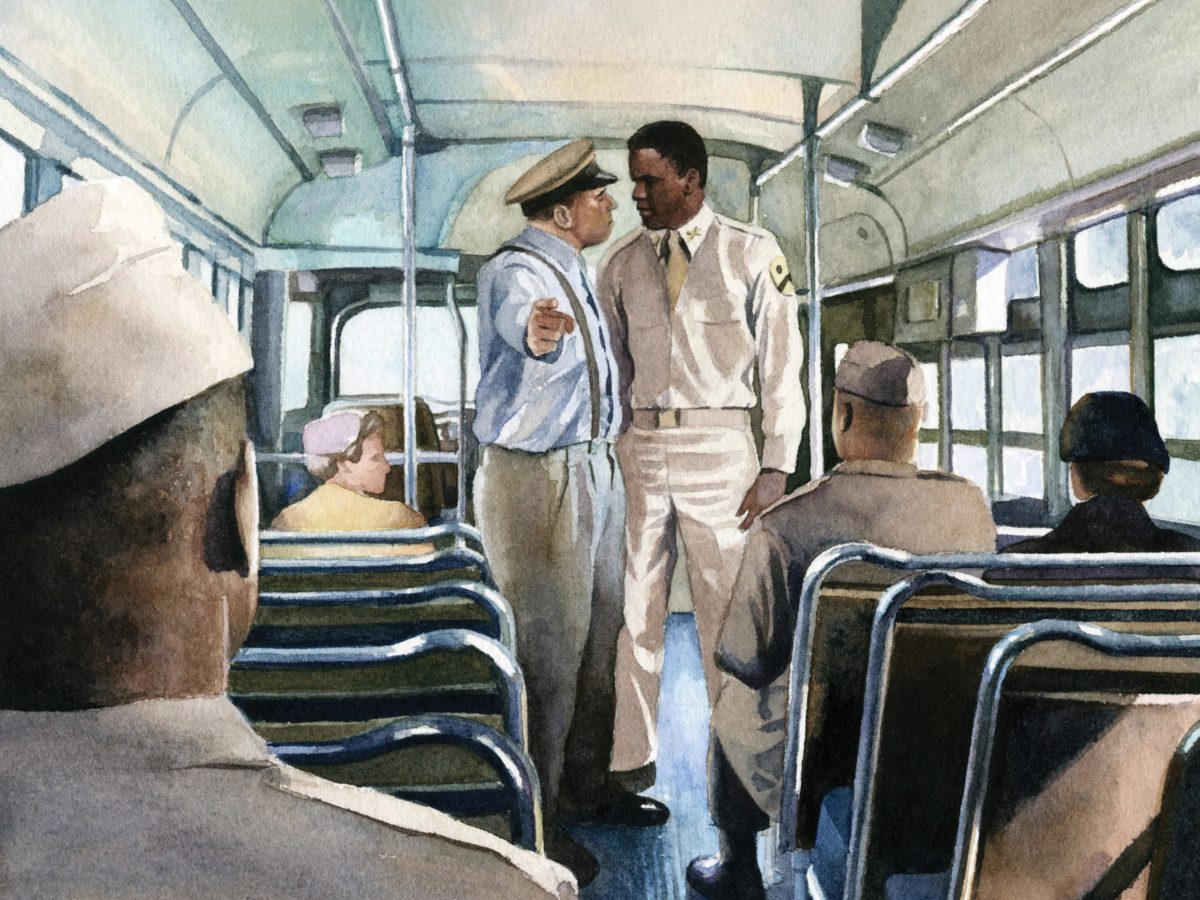
To its credit, the U.S. armed forces officially ended segregation in 1948 — more than a decade and a half before the nation as a whole finally did the same.
During the Korean War, longstanding Black units were disbanded and their troops transferred to integrated groups. At first, integration in Korea often meant that a regiment would have two white battalions with one Black battalion in reserve. But as the fighting continued, that arrangement soon became impractical, and Black GIs began replacing fallen white GIs at the front. Incidentally, blood plasma was finally “desegregated” on Dec. 1, 1950.
historynet magazines
Our 9 best-selling history titles feature in-depth storytelling and iconic imagery to engage and inform on the people, the wars, and the events that shaped America and the world.