
Recommended for you
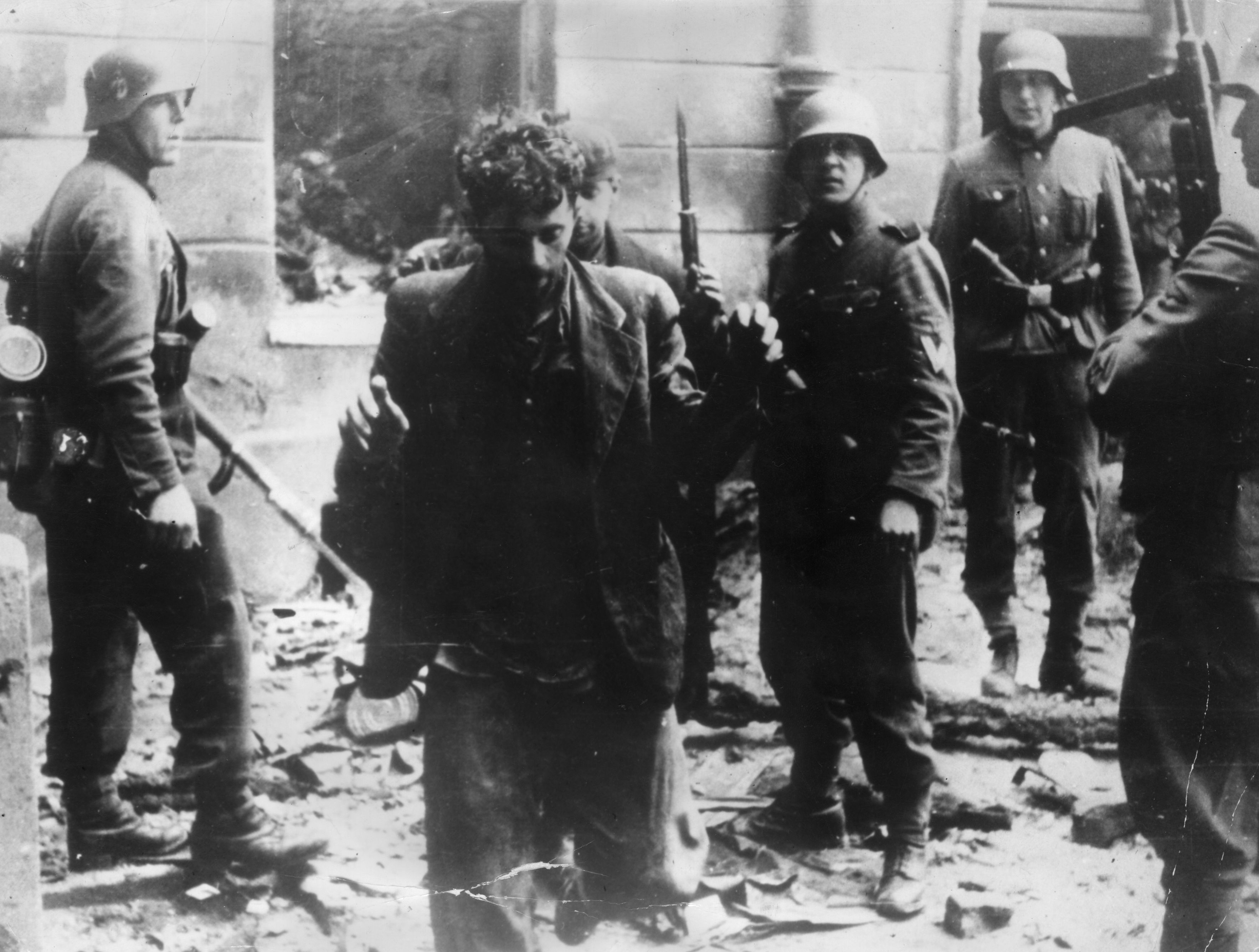
At 7:30 on the morning of April 19, 1943, SS Brigadeführer (brigadier general) Jürgen Stroop was just washing up for the day when his nominal commander, SS Oberführer (senior colonel) Ferdinand von Sammern-Frankenegg, burst into his room in the Bristol Hotel in Warsaw. Near panic, Sammern-Frankenegg reported that the German operation initiated earlier that morning, to deport the last Jews in the Warsaw ghetto to concentration camps for extermination, was not going according to plan. The Germans had, in fact, encountered such spirited armed resistance that they had been driven out of the ghetto.
Calmly lighting a cigarette, Stroop contemptuously dismissed a suggestion by Sammern-Frankenegg to call in bomber aircraft from Krakow. That the first German assault had been ignominiously thrown back by members of what the Nazis regarded as a subhuman race, armed only with infantry weapons, was bad enough. To commit more weaponry to the assault would only humiliate the Third Reich in the eyes of the world. Taking personal charge of the operation, Stroop resolved that he would subdue the Jews with the resources at hand–but those would soon prove not to be enough.
Beginning of the ghetto
Following the German invasion of Poland in September 1939, Reinhard Heydrich, chief of the Gestapo, ordered all Polish Jews to be placed in segregated areas. Food and medical supplies for the residents of these crowded ghettos were strictly rationed by the Germans, in amounts calculated to be inadequate, with the ultimate goal of slowly killing off the Jews by hunger or disease.
In the summer of 1940, Heydrich, under the pretext of containing an outbreak of typhus among the Jews in Warsaw, established a special section in the Polish capital, enclosed by a brick wall 10 feet high and 11 miles in circumference. The cost of the wall’s construction was paid by the Judenrat, the 24-member Jewish Council, which was placed in charge of Jewish affairs inside the ghetto. In September 1940, more than 80,000 non-Jewish Poles living in the ‘infected area’ were ordered to leave, and over the next month Gestapo agents removed about 140,000 assimilated Jews from the economic and cultural life of the city and moved them into the ghetto. In all, some 360,000 Jews, one-third of Warsaw’s population, were thus herded into a 3.5-square-mile area. On November 15, the ghetto’s 22 entrances were closed, effectively sealing it off from the rest of the city.
this article first appeared in world war II magazine


While the Judenrat worked against heavy odds to equitably distribute the ghetto’s meager allotment of rations, more Jews were shipped in from Lodz, Krakow and other cities. Jews fought for jobs, including work in the labor battalions organized by the Nazis. Those unable to find work sold jewels, clothing or whatever else they possessed in order to obtain food. From 300 to 400 people died daily. More than 43,000 starved to death during the first year, and 37,000 more in the first nine months of 1942. Even those statistics, however, were viewed by SS commander Heinrich Himmler, in his capacity of Reichskommissar für die Festigung deutschen Volkstums (Reich Commissar for the Consolidation of German Nationhood), as being insufficient to satisfy his program for the racial ‘purification’ of Germany and Europe.
On July 22, 1942, Himmler ordered all Jews not already in concentration camps to be deported to the camps by the end of the year. This operation was christened Operation Heydrich, as a memorial to the late Gestapo chief, who had died in Prague on June 4 of wounds incurred from a bomb thrown under his car on May 29 by a Czech resistance fighter.
The German authorities placed responsibility on the Judenrat to deliver 6,000 Jews daily to the rail spur north of the ghetto, known as the Umschlagplatz (‘transfer station’). The Germans insisted the deportees were being resettled in labor camps, but Jewish resistance fighters, joining the exodus to reconnoiter and then escaping and returning to the ghetto, revealed the truth to an incredulous populace. A small number of the most able-bodied Jews were, indeed, put to work in forced labor camps, they reported, but for the vast majority of ‘evacuees’ the final destinations had names like Auschwitz and Treblinka. In those camps, the arriving Jews were herded into shower rooms where they were killed by a cyanide gas called Zyklon B. The bodies were then incinerated in ovens. It was a program of efficient, systematic extermination on an industrial scale.
20th-century masada
While many Jews in the ghetto desperately refused to believe what they heard, thousands of others did–and concluded that if they were all to be annihilated anyway, they would kill as many of their tormentors as they could before they died. Young Zionists, conservative-minded pioneers training to go to Palestine, mobilized first, forming a resistance organization called the Zhydowski Zwiazek Wojskowy (Jewish Military Union), or ZZW. They were followed soon after by Jewish members of the Polish Workers Party, which had replaced the former Communist Party. On July 28, 1942, the Zhydowska Organizacja Bojowa (Jewish Fighting Organization), or ZOB, was formed, consisting of about 1,000 men and boys. Their leader was Mordechai Anielewicz, a scholar approximately 25 years old who had displayed an interest in economics and Jewish history before the war.
Making their way through the sewers, Jewish smugglers embarked on a desperate quest to obtain firearms. Some were obtained through the black market at inflated prices and were often paid for by robbing the treasuries of the Judenrat or of high-ranking Jewish collaborators.
The ZOB and ZZW placed high hopes on gaining the support of the Polish Armia Krajowa (AK), or Home Army, the largest anti-Nazi resistance organization in Europe, but they were to be disappointed. The AK officials claimed that they had barely enough small arms for themselves. Several AK men added that the Jews had been too docile toward the Germans and doubted that they had the courage or fighting ability to make good use of any weapons they got. Such sentiments were by no means universal. A number of AK soldiers, who believed in the solidarity of Polish resistance regardless of religious differences, took the Jewish smugglers aside and, on their own initiative, supplied them with some small arms and trained them in their use. Even so, by February 1943, only 50 pistols (many of them defective), 50 grenades and four kilograms of explosives had been obtained from the AK.
bloody ‘housecleaning’
On January 9, 1943, Himmler visited Warsaw and inspected the ghetto, whose population had been reduced to about 66,000. Himmler ordered the ‘intensified measures’ to be brought to an accelerated conclusion. By February 15, he decreed, the last Jews would be cleaned out of the ghetto–16,000 to slave labor camps, the remaining 50,000 ‘resettled’ (i.e., gassed and cremated).
Himmler placed responsibility for this final ghetto ‘housecleaning’ in the hands of SS Oberstandartenführer Ferdinand von Sammern-Frankenegg and the chief of security police, Dr. Otto Hahn. January 18 was to be the date when the initial quota of 8,000 Jews would be removed, and Sammern-Frankenegg confidently invited SS Sturmbahnführer Theodor von Eupen-Malmedy, the commandant of the Treblinka death camp, to witness the ‘resettlement’ process.
Germans swept into the Umschlagplatz, but this time few Jews heeded the order to assemble, as factory workers laid low in hiding places and women hurried their children into bunkers. Some who were caught fought back with knives, axes, iron bars, scissors and anything else resembling a weapon.
Caught unprepared, only four ZOB fighting groups were able to mobilize in reaction. The first armed resistance occurred when a 17-year-old girl named Emily Landau flung a grenade into a cluster of SS men from a rooftop on Gesia Street, killing or wounding a dozen of them.
The SS promptly assaulted the building with submachine guns blazing, only to be met by a volley of return fire that felled four or five Germans and drove the rest back in disorder. Emily Landau was bending down to recover a pistol from a slain SS officer when she was struck by a bullet fired by a German rifleman covering his comrades’ retreat. The first to fight, she was also the first to die.
At the intersection of Zamenhofa and Mila streets, an SS detail was leading some prisoners to the Umschlagplatz when it came under attack by a squad led by Mordechai Anielewicz from his headquarters at Mila 18. The astonished Germans abandoned their captives, who scattered in all directions.
Minutes later, a reinforced German platoon counterattacked and killed all of the ZOB squad save for its leader. Surrounded, Anielewicz made a desperate break, wrenched a rifle from a German’s hand, smashed in his skull with the rifle butt, shot two more Germans, and escaped to a camouflaged bunker under a hail of bullets–miraculously unscathed.
After those two clashes, the ZOB abandoned direct confrontation. Ambushes and hit-and-run forays continued to harry the Germans in nearly every district until January 20, when Sammern-Frankenegg ordered his men out of the ghetto.
Victory for the Resistance
In three days, the Germans removed 5,000 Jews from the ghetto––far short of the one-day quota of 8,000––at the cost of 20 soldiers killed and 50 wounded. Deportations were temporarily suspended. The Jewish resistance fighters had won an astounding victory, and although the ZOB was not blind to its weaknesses in tactics and communication that had been revealed in the fight, it had won the time to incorporate the lessons learned into the next inevitable confrontation.
As another result of the Jews’ success, all but the most anti-Semitic members of the Polish AK began to regard them with a new respect and began smuggling more weapons into the ghetto. Between January and April 1943, the ZOB, divided into 22 groups, built an intricate network of underground cellars and tunnels that were linked with command posts and led to streets on the outside.
Meanwhile, the Germans were hardly taking the emergence of resistance in the ghetto sitting down. On February 16, Himmler ordered the SS Polizeiführer of the General Government in Poland, Friedrich-Wilhelm Krüger, to prepare an all-out campaign to destroy the Warsaw ghetto. The action was to commence on April 19, 1943, the day before Adolf Hitler’s birthday, and Himmler expected it to be successfully concluded within three days so that he could present the Führer with ‘a Warsaw clean of Jews.’
Stroop’s directive
Himmler’s plan ran into an unexpected degree of vacillation on the part of two of the officers assigned to carry it out–Sammern-Frankenegg and SS Brigadeführer Odilo Globocnik. In consequence, he put a new general of police in charge of carrying out his orders: SS Brigadeführer Jürgen Stroop. A veteran of World War I, Stroop had more recently been involved in operations against Soviet partisans in the Ukraine and was familiar with the latest techniques in counterguerrilla warfare.
The Germans took their time preparing to carry out Himmler’s task–a sizable force had to be raised and trained in urban warfare at a time when troops were needed on all fronts. By April 16, when Himmler arrived in Warsaw for a series of secret conferences, the forces at his disposal were comprised of the following: 2,000 officers and men of the Waffen SS; three Wehrmacht divisions, providing sappers and artillery support; two battalions of German police (234 officers and men); 360 Polish police; about 35 security police; and a 337-man battalion of fascist auxiliaries, called ‘Askaris’ by the Germans in contemptuous reference to the black troops who had helped defend Imperial Germany’s African colonies before and during World War I. In total, it was expected that 2,842 Germans would be committed to cleaning out the ghetto, while another 7,000 SS troops and policemen patrolled the surrounding non-Jewish districts.
Inside the ghetto, the resistance fighters awaited the onslaught. About 600 armed fighters, male and female, made up the ZOB, while the more conservative, strictly male ZZW and other groups combined to provide another 400.
As the most organized of the resistance groups, the ZOB had a specialized plan of defense and was armed with smuggled or captured rifles, pistols and grenades, along with locally produced bombs and Molotov cocktails. The ZZW was somewhat better equipped and had more ammunition.
their last passover
Sunday, April 18, marked the first night of the Jewish Passover holiday. At 6 o’clock that evening, a cordon of Polish policemen surrounded the ghetto. About an hour later, the leaders of the ZOB and ZZW were informed of the enemy’s preparations and met in the high-command bunker at Mila 18 for a final conference. Weapons were distributed, along with food and cyanide poison (the latter to be taken if faced with the prospect of capture).
GET HISTORY’S GREATEST TALES—RIGHT IN YOUR INBOX
Subscribe to our HistoryNet Now! newsletter for the best of the past, delivered every Monday and Thursday.
At 2 a.m. on April 19, Sammern-Frankenegg dispatched groups of Lithuanian and Ukrainian SS auxiliaries and Polish police into the ghetto, moving in single file toward the Umschlagplatz. Sammern-Frankenegg believed that the swift occupation of that central area would result in the collapse of Jewish resistance elsewhere. Behind the Askaris went the remaining Ordnungsdienst, or Jewish ghetto police, excluding those of their number who balked at participating in the action or were caught trying to escape–they were brought to the Gestapo gathering point at 103 Zelazna Street and shot.
Save for a few reconnaissance groups, the streets were devoid of Jews, but banners could be seen in conspicuous places–some in Communist red, some in Polish red and white, some in the Zionist colors of blue and white. Some bore slogans calling for the Christian Poles to act in solidarity with their Jewish countrymen.
first contact
At about 6 a.m., as the column reached the corner of Nalewki, Gesia and Franciszkanska streets, it encountered its first armed resistance. Molotov cocktails, grenades, bombs and bullets flew from every window and balcony, driving the soldiers back in panic.
German officers quickly restored order, and the SS advanced again, this time in a less orderly formation and firing wildly at every window and opening. Despite those measures, the Germans were forced to retreat once more. Thanks to their well-prepared defensive positions, the Jews had taken no casualties in the two-hour firefight. After the enemy pulled back, the fighters came out into the street, threw their arms around one another and wished one another mazel tov (‘good luck’). Then they set about the grim but necessary task of looting the enemy dead.
Elsewhere, at the strategically important junction of Zamenhofa and Mila streets, four Jewish fighting groups lay in wait for the oncoming German assault. They allowed the enemy’s vanguard, which consisted of Jewish police, to pass, then opened fire as the soldiers and their auxiliaries approached. Again shocked by the sudden hail of fire, Ukrainians and Germans alike broke and ran for cover or fled the area entirely.
Fifteen minutes later, the Germans brought their first light armor into play–a French-built Chenillette Lorraine 38L tracked weapons-carrier and two armored cars. They were greeted with a volley of Molotov cocktails. An eyewitness keeping records for the ZOB described what followed: ‘The well-aimed bottles hit the tank. The flames spread quickly. The blast of the explosion is heard. The machine stands motionless. The crew is burned alive. The other two tanks turn around and withdraw. The Germans who took cover behind them withdraw in panic. We take leave of them with a few well-aimed shots and grenades.’
Moments later, one of the German armored vehicles re-appeared at the corner, only to be hit and set afire by a bomb. About a half-hour after the fight began, the Germans again abandoned the field to the Jews, whose reaction was described by an eyewitness: ‘The faces that only yesterday reflected terror and despair now shone with an unusual joy which is difficult to describe. This was a joy free from all personal motives, a joy imbued with the pride that the ghetto was fighting.’ Only one Jewish resistance fighter had died in the action.
Stroop takes charge
After receiving Sammern-Frankenegg’s less-than-encouraging situation report, Stroop took charge and quickly exerted his iron will to restore order in the German ranks. After evaluating the reports from his officers, Stroop tersely conceded in his report to Himmler and Krüger: ‘At our first penetration into the ghetto the Jews and Polish bandits succeeded, with arms in hand, in repulsing our attacking forces, including the tank and armored vehicles. The losses during the first attack were: 12 men.’
Settling down to direct the next assault from a bench outside the Judenrat office, Stroop launched his first assault against the corner of Nalewki and Gesia streets at noon. This time, his troops employed fire-and-maneuver tactics, darting from one point of cover to the next. Stroop placed light fieldpieces at Muranowska Place to provide them with artillery support.
Although their light weapons were no match for artillery and their ammunition was running low, the Jewish resistance fighters defended the corner gamely, changing positions through attics and rooftops and punishing the Germans with grenades. Finally, Stroop was reluctantly compelled to call in aircraft, under whose bomb strikes the fighters were at last forced to withdraw to Rabbi Maisels Street. Before retreating, the Jews set a German warehouse at 31 Nalewki Street on fire, in accordance with orders from the resistance leadership that all forced-labor factories and stores of valuables made in them for the Germans be destroyed.
The Germans, in turn, committed their first reprisal after they bombarded and then occupied the ghetto hospital. German, and to a greater degree Ukrainian, soldiers entered the burning wards and threw patients into the flames. In the maternity ward, they tore open the wombs of pregnant women with their bayonets and smashed the heads of newborn infants against the walls.
At 4 p.m., SS troops and German police advancing down Muranowska Street came under fire from a heavy machine gun emplaced atop Muranowska 7, while ZOB men and women moved about from rooftop to rooftop, dropping grenades on the Germans. At 8 p.m., two resistance banners (one in the red-white Polish colors, one in the blue-white Jewish colors) still waved defiantly from the roof of Muranowska 7, and smaller skirmishes were taking place elsewhere as Stroop ordered his men to break off contact and withdraw.
That night, both Stroop and Anielewicz reviewed the day’s fighting and adjusted their tactics for the next day. Inside the makeshift bunkers, Jews said a brief prayer for their dead, but death had become such an everyday occurrence in the ghetto as to be of secondary importance to a victory that the Germans could no longer take away. For the first time in three years, the Passover Seder, a feast commemorating the Jews’ deliverance from Egyptian bondage, was being celebrated in Warsaw by a people who, if only for the moment, were themselves free.
A gruesome present for hitler
The next day, Hitler’s birthday, the Germans sent an intermediary from the Judenrat into the ghetto with an ultimatum: If the resistance fighters did not lay down their arms, the entire ghetto would be razed. It was flatly rejected.
While an artillery battery moved up to the ghetto wall, Stroop widened his area of operations, launching attacks on Swientojerska and Wolowa streets, also known as the brushmakers’ area, and the factory district (Leszno, Smocza and Nowolipie streets), as well as Muranowska Place, where German police took up where they had left off. Backed by two machine guns, the Jews in Muranowska 7 and 9 counterattacked, killing or wounding several Germans and driving off the rest. Half an hour later, four armored vehicles, armed with anti-aircraft guns, resumed the German assault. The resistance fighters disabled one Flakwagen with a grenade, but the others bombarded the buildings for 15 minutes, after which the Germans stormed the Jewish positions. Fierce hand-to-hand combat ensued, ending in the capture of 80 resistance fighters.
Among the German casualties was a senior SS officer. In reprisal, Stroop ordered several hundred Jewish prisoners–mostly unarmed noncombatants–shot on the spot.
At 3 p.m., Stroop personally led 300 SS troops in an assault on the brushmakers’ area, where Jewish defenders were commanded by Marek Edelman. Jews manning an observation post on the third floor of 3 Wolowa Street watched the Germans advance until they passed the gate to Wolowa 6–then, a button was pushed and a mine planted in the gate went off, killing 22 Germans. The rest of the Germans retreated, hurried along by a volley of Jewish bullets and grenades.
Losses and More losses
A second German assault was repulsed, but during the third attempt Jewish fire began to slacken–their ammunition was giving out. Stroop, unmindful of the bullets whizzing around him as he calmly directed his troops, kept up the pressure until evening, when he interrupted the action. During that brief respite, the ZOB leaders decided to pull back to nearby Franciszkanska Street.
In the factory area, a tank led a German column down Leszno Street until brought under fire by the Jewish fighters there. Eight Germans were wounded, but they pressed on to Smocza Street. There, the Jews tried to explode another mine, but it failed to detonate. Dora Goldkorn and other fighters then pelted the tank with Molotov cocktails and had the satisfaction of seeing it catch fire.
Under Stroop’s relentless command, German reinforcements pressed the assault, driving the Jews from Lezsno to Nowolipie Street. Buildings and bunkers were blown up, after which any dazed survivors who emerged were promptly shot by the Germans.
While the ZOB and ZZW battled the Nazis inside the ghetto, two other resistance groups made desultory appearances. On the night of April 19, a large force of Polish AK fighters, led by Captain Jozsef Przenny, tried to blast a hole in the ghetto wall facing Sapierinska Street, through which some Jews could escape. Before they could, however, they were spotted by Polish police, who summoned German troops to the scene. After a brisk firefight, in which two Germans and two Polish policemen were killed, the AK men were forced to withdraw with two dead and several wounded. On April 20, the Guardia Ludowa (Peoples Guard), a small left-wing Polish underground movement, also made a gesture of solidarity with the Jewish fighters by attacking a German artillery emplacement on Nowajarska Street. The gun crew, consisting of two Germans and two Polish policemen, was killed and the gun silenced without loss to the attackers.
On April 22, Stroop changed his strategy in an effort to minimize casualties to his men. Demolition and incendiary teams, detached from the German artillery units, set fires that quickly spread through the ghetto. The screams of thousands of men, women and children could be heard above the roar of the flames as they burned alive in the conflagration.
Help from OUtside
On April 23–Good Friday–the ZOB issued a general appeal to the Polish population, associating the struggle in the ghetto with the time-honored Polish motto, ‘For your freedom and ours.’ Although the overall coordination of Polish and Jewish resistance was limited, there was ample evidence to support a statement in the April 23 edition of the underground paper Glos Warszawy that ‘there were Poles in the ghetto, fighting shoulder to shoulder with the Jews in the streets of the ghetto against the Germans.’ Stroop himself wrote that his soldiers were ‘constantly under fire from outside of the ghetto, i.e., from the Aryan side.’
A noteworthy example of help from Catholic Poles occurred when a unit from the AK’s Corps of Security, commanded by Captain Henryk Iwanski, made early contact with the ZZW and smuggled arms, ammunition and instructional materials through the sewers or hidden in carts carrying lime and cement into the ghetto. One the first day of the uprising, members of Iwanski’s unit were in Muranowski Square and it was they who raised the Polish flag alongside the Jewish one. Soon afterward, Iwanski received a message from the commander of the ZZW unit at Muranowski Square, Dawid Moryc Apfelbaum, informing him that he had been wounded, and requesting more arms and ammunition. On the following day, Captain Iwanski and 18 of his men, including his brother, Waclaw, and his sons, Roman Zbigniew, made their way into the ghetto with weapons, ammunition and food. Seeing the Jewish fighters in an exhausted state, the AK men offered to relieve them at their posts at Muranowski Square and Nalewski Street, where they repelled several German attacks. Stroop later recorded the activities of Iwanski’s unit by writing: ‘The main Jewish group, with some Polish bandits mixed in, retreated to the so-called Muranowski Square already in the course of the first or second day of the fighting. It was reinforced there by several more Polish bandits.’
Iwanski’s brother and both sons were killed in the course of the fighting and the captain himself was seriously wounded. As organized resistance collapsed, Iwanski’s men managed to carry him through a tunnel to safety, as well as guiding out 34 fully armed Jewish fighters, some of whom were subsequently hidden in his home. After the war Henryk Iwanski, his wife, Wiktoria, and 10 other AK fighters were aware the Yad Vashem medal by the Israeli ambassador to Warsaw, for their part in the struggle.
April 23 also saw another attempt by an AK unit, led by Lieutenant Jerzy Skupiensi, to blow open the gate in the ghetto wall at Pawia Street. The Poles killed two sentries, but again a heavy German crossfire frustrated their assault. As they withdrew, the AK fighters shot up a car that had the misfortune to cross the path of their retreat, killing four SS and police officers.
pushing for an end
Also on April 23, Krüger brought Stroop orders from Himmler for the liquidation of the ghetto to be accelerated. ‘The action will be completed this very day,’ Stroop assured him.
But on April 24, German sappers were still working their way westward through the burning ruins, blowing up buildings, while German aircraft dropped incendiary bombs on the ghetto. Increasing numbers of Jewish noncombatants were emerging from the burning houses to surrender, but at the same time armed fighting groups continued to snipe defiantly from the ruins. In a new ZOB tactic, groups of 10 Jews, often wearing captured German uniforms to confuse the enemy and rags tied over their feet to muffle their steps, went out to reconnoiter, forage for food and weapons, and ambush the enemy. Anielewicz led the first such squad on the night of April 23. Among the bits of intelligence they came back with was news that four members of the Judenrat Presidium had been shot by the Germans; so had the remaining Jewish ghetto police–clearly, these wretched collaborators had outlived their usefulness to the Third Reich.
On April 26, after a week of fighting, Stroop was forced to admit that he was still encountering stiff resistance. On the same day, Anielewicz sent his last communication to ZOB contacts outside the ghetto: ‘This is the eighth day of our life-and-death struggle. The Germans suffered tremendous losses. In the first two days they were forced to withdraw. Then they brought in reinforcements in the form of tanks, armor, artillery, even airplanes, and began a systematic siege….
‘Our losses, that is, the victims of the executions and fires in which men, women and children were burned, were terribly high. We are nearing our last days, but so long as we have weapons in our hands, we shall continue to fight and resist….
‘Sensing the end, we demand this from you: Remember how we were betrayed. There will come a time of reckoning for our spilled, innocent blood. Send help to those who, in the last hour, may elude the enemy–in order that the fight may continue.’
last Hope
On the night of April 27-28, the ZOB leadership met in a bunker on Leszno Street and concluded that, with their defensive perimeters narrowing by the hour, the only hope would lie in a breakout. A courier named Regina Fudin was given the task of gathering the fighting groups in the factory area and leading them out. Those too severely wounded to move had to be left behind in the bunker, with a fighter named Lea Korn remaining behind to guard them. A few days later, the Germans discovered the bunker and killed all the wounded. Lea Korn died fighting in their defense.
On the night of April 29, 40 Jewish fighters led by Regina Fudin and aided by Guardia Ludowa fighters commanded by Lieutenant Wladyslaw Gaik, emerged from the sewers on the corner of Agrodowa and Zelazna streets, on the ‘Aryan’ side. A Polish worker named Riszard Trifon gave them shelter for the night in his attic. The next day, the group was transported to the forest in Lomianka, about seven kilometers from Warsaw, in trucks provided by the Guardia Ludowa. A second Jewish escape attempt through the sewers on April 29 was less fortunate. The Germans learned of the first group’s success, and the second group found the manhole through which it emerged to be surrounded. The entire group was wiped out after a desperate firefight.
On May 8, the Germans managed to learn the whereabouts of the ZOB nerve center at Mila 18 and invested it in force, covering the five entrances to the bunker. Three hundred civilians who had been seeking shelter there surrendered, but the 80 armed Jews–including Anielewicz–chose to make a fighting stand.The Germans then threw grenades and gas bombs into the bunker.
All but a 30 of fighters died. Anielewicz and his staff committed suicide, a tragic resort that proved to be unnecessary shortly afterward, when the survivors discovered an exit route and made their way to safety through a series of cellar tunnels and finally through the city sewer system. The survivors of Mila 18 were then carried through the sewers by a group of 50 escapees. On May 10, after a 30-hour exodus, the first 34 escapees emerged from the sewer system outside the ghetto and were driven by the Guardia Ludowa to join their comrades in the Lomianki forest. Before the truck could return for the rest of the group, however, the remaining fugitives were discovered by SS troops and Lithuanian auxiliaries, who killed them all. Those who made it to the Lomianski forest formed a partisan unit named in Anielewics’ honor.
After the Ghetto
By May 13, the ZOB no longer existed as a cohesive organization in Warsaw, but Stroop noted in his report that fighting had flared up anew. That night, the Soviet air force made an unexpected appearance. Responding to a radio appeal from the Polish Workers Party and guided to their targets by the fires in the ghetto, Soviet bombers raided the German staging areas around the ghetto between midnight and 2 a.m. Several Jewish fighting groups tried to take advantage of the confusion caused by the raids to break through the German cordon, but they were only partially successful.
The scattered pockets of Jewish resistance now had two alternatives–die fighting, or surrender and die later in the gas chambers. Stroop, who was now in virtual control of the situation, noted in his after-action report: ‘While it was at first possible to catch the Jews, who are by nature cowards, in great numbers, this became increasingly difficult as the action went on. Fighting groups of 20 to 30 or more Jewish youths, aged 18-25, kept turning up, sometimes with a corresponding number of women who kindled fresh resistance. These fighting groups had been ordered to defend themselves to the last and, if need be, to escape capture by suicide. The women belonging to the fighting groups were armed in the same way as the men. Sometimes these women fired pistols from each hand at once. It happened time and again that they kept their pistols and hand grenades hidden in their bloomers till the last minute, and then used them against the armed SS, police and Wehrmacht.‘
Of his own men, Stroop wrote: ‘The longer the resistance lasted, the more implacable became the men of the SS, the police and the Wehrmacht, who continued untiringly in the fulfillment of their duties in the true comradeship in arms….Only by the continued and untiring efforts of all our forces did we succeed in achieving a total of 56,065 Jews captured and proved killed….The action was completed on May 16, 1943,’ concluded Stroop, ‘with the blowing up of the Warsaw Synagogue at 8:15 p.m. All the ghetto buildings have been destroyed.’
Despite continuing reports of fighting, Stroop reported to his superiors on May 16 that ‘the former Jewish residential district in Warsaw no longer exists.’ Stroop claimed that casualties among the Germans and their collaborators totaled 16 dead and 85 wounded–a highly doubtful statistic. In its underground publication Glos Warszawy, the Polish Guardia Ludowa estimated that the ghetto fighters had killed about 360 Germans and wounded more than 1,000 in the first week alone.
Whatever the truth of the German losses, the Jewish resistance had been an embarrassment to the ‘Master Race.’ Himmler had expected the destruction of the ghetto to be completed in three days. The task had taken 28–about as long as it had taken the Germans to conquer all of Poland in 1939. Nor was the ‘victory’ absolutely complete. Pockets of resistance continued to emerge from the rubble to attack the Germans for months thereafter. Many of the surviving Jewish resistance fighters who had managed to escape the ghetto came out of hiding to fight alongside the Polish AK during the Warsaw Rising of August 1944, only to be driven underground again after its collapse the next month.
Fought in the heart of the Nazi empire against hopeless odds, the Warsaw ghetto uprising has become the symbol for numerous outbreaks of resistance that put the lie to the myth that the Jews were herded into the death camps without a fight–and of the indomitable spirit of a people who, despite the Nazis’ most determined efforts, were not eradicated from the face of the earth.
This article was written by Jon Guttman and originally appeared in the March 2000 issue of World War II.
historynet magazines
Our 9 best-selling history titles feature in-depth storytelling and iconic imagery to engage and inform on the people, the wars, and the events that shaped America and the world.