In early 1942, World War II was not going well for the Allies. France had fallen. Britain was still staggering from the Blitz. Japanese forces had crippled the U.S. Pacific Fleet at Pearl Harbor, attacked the Philippines and Guam, and were seizing territory in the south and central Pacific in assaults that included sinking British battleship Prince of Wales and battle cruiser Repulse off Malaya. Germany armies had advance deep into the Soviet Union. Hitler’s submarines were wreaking havoc on convoys leaving the United States for Russian ports.
In wartime, secure communications are crucial, but for the U.S. armed forces, securing messages become a bewildering problem. Japanese cryptographers, many of them educated in the United States and fluent in standard and colloquial English, were amazingly adept at breaking codes. Enemy forces often knew about American battle plans in advance, and no defense against Japanese codebreaking had materialized. “Military communications were made available to the enemy like sand sifting through a sieve,” an analyst said.
An unlikely answer came from an unlikely source. Philip Johnston, a civil engineer who lived in Los Angeles, was the child of missionaries who had raised their son on the Navajo Reservation, which stretches across New Mexico and Arizona. Born in Kansas in 1892, Johnson had grown up speaking Navajo. In that language, unique to reservation dwellers and rarely used elsewhere, inflection determines a word’s meaning. Depending on pronunciation, a Navajo word can have four distinct meanings. Navajo verb forms are especially complex. Outsiders generally find the language incomprehensible and have likened hearing it spoken to listening to the rumble of a freight train, the gurgling of a partially blocked drain, and the flushing of an old-fashioned commode. In 1942, there was no Navajo alphabet. The language did not exist in written form. At government boarding schools to which Indian children were sent, teachers and administrators often forbade their charges to speak Navajo or any other Indian language, demanding that they speak only English.
At 50, Johnson, who had served in France with the American Expeditionary Force during World War I, was too old to fight in World War II, but he still wanted to serve. Reading an article about military security, he had an idea: base a secret code on Navajo. He thought through his concept and in February 1942 visited U.S. Marine Corps Camp Elliott near San Diego. At a meeting with Signal Corp Communications Officer Lieutenant Colonel James E. Jones, Johnston described how a code based on Navajo would thwart enemy codebreakers. Jones was skeptical but Johnston persuaded him to test the premise.
Back in Los Angeles, Johnston recruited four bilingual Navajos. He and they traveled on February 28 to Camp Elliott for a demonstration before Marine staff officers. Two Navajos were given a typical military field order and assigned to a room from which they were to transmit the message in Navajo to their companions several rooms away. Retranslated into English, the Navajo message accurately recapitulated the order as given, amazing the Marine observers.
Impressed, Camp Elliott commander Major General Clayton Vogel asked Marine Corps Headquarters in Washington, DC, to authorize the immediate recruitment of 200 young, well-educated Navajos as Marine communications specialists. Headquarters authorized 30, reasoning that to be enough to prove Johnston’s theory.
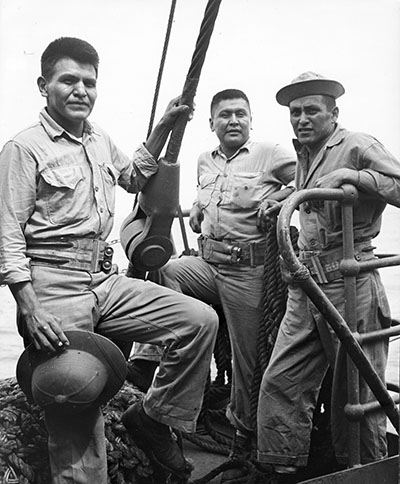
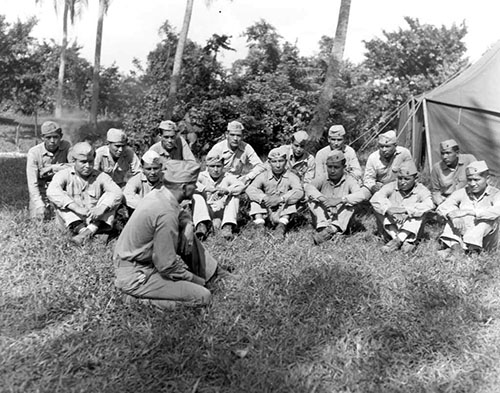
By April, Marine personnel were on the Navajo Reservation recruiting volunteers from Indian agency schools at Fort Wingate and Shiprock, New Mexico, and Fort Defiance, Arizona. Besides fluency in Navajo and English, candidates had to demonstrate that they were physically fit to serve as messengers in combat. Recruiters told volunteers only that they would be “specialists” serving at home and overseas. Officially, Marine recruits had to be between 16 and 35 years of age. Birth records were not usually kept on the reservation; some underage volunteers lied about when they were born, as did 36-year-old Fort Defiance resident Carl Gorman. Few volunteers had ever left the reservation. Many had never ridden on a bus or train. Several recruits’ families insisted that their sons participate in a religious ceremony to pray for a safe return before departing for basic training at San Diego Marine Corps Recruit Depot. Officially the 382nd Platoon, U.S. Marine Corps, at boot camp, the group was referred to as “The Navajo School.”
Military discipline—obeying orders, marching in cadence, and keeping one’s quarters scrupulously clean, in Marine parlance “squared away”—was another new and sometime difficult experience, but nearly all the reservation recruits adjusted. Following basic training, the Navajos moved to Camp Pendleton at Oceanside, California. During a dress parade on a hot day, several white Marines passed out; the Navajos remained erect in formation and at attention during the personal inspection that followed. “They’re a typical Marine outfit of budding specialists,” the publication Marine Corps Chevron reported. “They gripe about the things that all Marines gripe about—liberty, chow and the San Diego weather.”
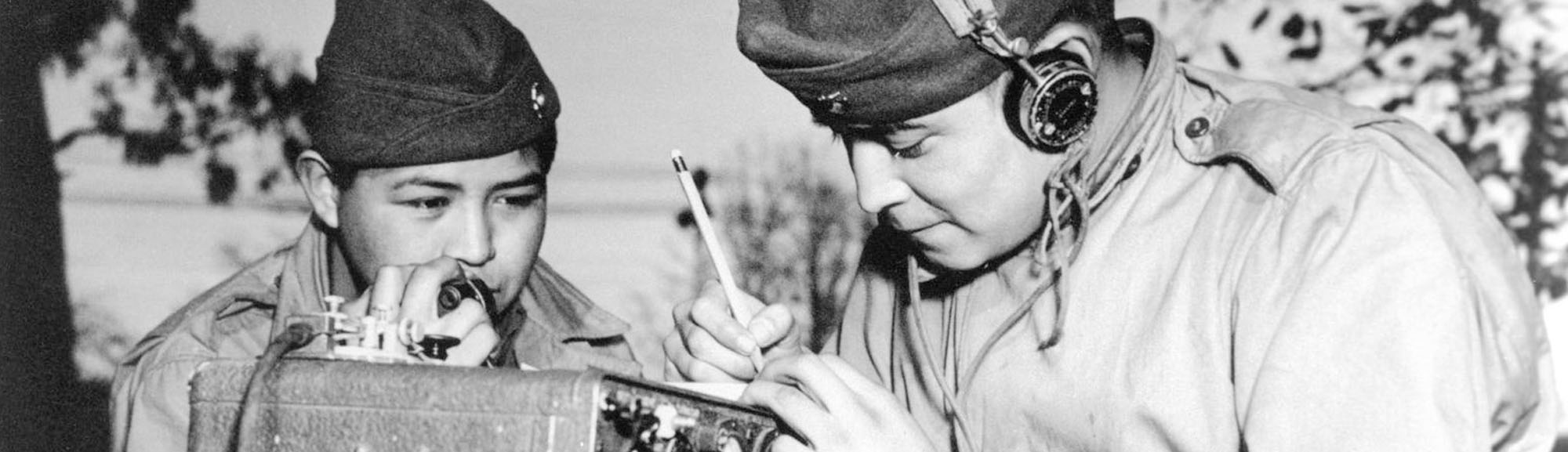
The Navajos were assigned to devise a code in their language that would baffle enemy listeners. Code words had to be short and easily learned and recalled. The men developed a two-part code. A 26-letter phonetic alphabet used Navajo names for 18 animals or birds, plus the words “ice” (the letter I), “nut” (N), “quiver” (Q), “Ute” (U), “victor” (V), “cross” (X), “yucca” (Y), and “zinc” (Z). The second part was a 211-word English vocabulary with Navajo synonyms. Conventional Marine Corps codes involved lengthy encoding and deciphering procedures using sophisticated electronic equipment. The Navajo code, relying on the sender’s and the receiver’s brains, mouths, and ears, was much faster. In training and in combat, code-talkers’ proficiency erased official distrust.
One volunteer dropped out. Several remained in California to train the next group. Two became recruiters. The rest reported to Guadalcanal in August 1942, assigned to the First Marine Division, commanded by Major General Alexander Vandegrift, who soon was asking headquarters for 83 more Navajo just to handle encoding and decoding for his division. A second group of volunteers went through boot camp, then was assigned to the code-talker program at Camp Pendleton, which by August 1943 had trained nearly 200 Navajo and whose administrator was Staff Sergeant Philip Johnston.
In jungle combat, stamina, Spartan habits, ingenuity, scouting and tracking skill, and utter disregard for hardship stood the Navajo in good stead. At first assigned mainly at the company-battalion level, code-talkers became virtually indispensable. Often, especially when a Marine regiment was fighting alongside an Army unit, white soldiers mistook the Navajo for the enemy, nearly costing several code-talkers their lives. Sometimes GIs “captured” and interrogated Navajo. Code-talker William McCabe, waiting on a Guadalcanal beach for his ship, joined a chow line. “I got lost among the big chow dump,” he recalled, “All of a sudden I heard somebody say, ‘Halt,’ and I kept walking. ‘Hey, you! Halt, or I’m gonna shoot!’. . . . [T]here was a big rifle all cocked and ready to shoot. I’m just from my outfit, I was coming here to get something to eat. And he said, ‘I think you’re a Jap. Just come with me.’” After that incident, a white fellow Marine accompanied McCabe at all times.
GET HISTORY’S GREATEST TALES—RIGHT IN YOUR INBOX
Subscribe to our HistoryNet Now! newsletter for the best of the past, delivered every Monday and Thursday.
On the eve of the First Marine Division’s departure for Okinawa, expected to be the bloodiest landing yet, the Navajo performed a sacred dance invoking their deities’ blessings and protection for themselves and other Americans. They prayed that their enemies prove weak. Some white personnel scoffed from the sidelines, but when war correspondent Ernie Pyle reported the story, he observed that the Okinawa landings had gone easier than had been anticipated, a point he said Navajo Marines were quick to point out to skeptics. When Japanese resistance inland almost halted the American advance, a white Marine asked his foxhole mate, a Navajo, what he thought of his prayers now. “This is completely different,” the Navajo said. “We only prayed for help during the landings.”
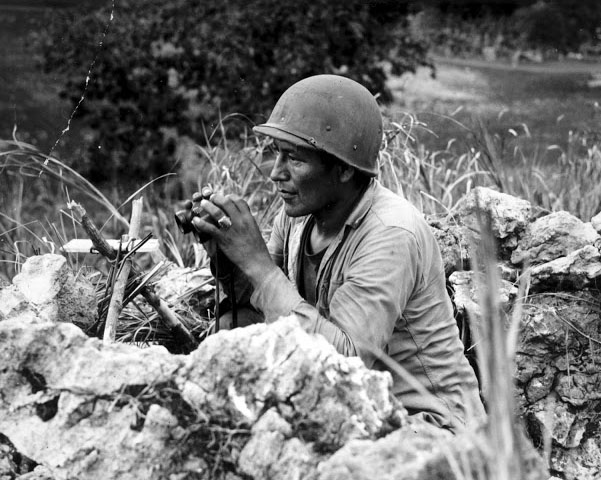
Code talkers served with all six Marine divisions in the Pacific and with Marine Raider and parachute units, earning lavish praise for their performance in the Solomons and the Marianas and on Peleliu and Iwo Jima. Of Iwo Jima, Fifth Marine Division Signal Officer Major Howard Conner said, “The entire operation was directed by Navajo code. . . . During the two days that followed the initial landings I had six Navajo radio nets working around the clock. . . . They sent and received over 800 messages without an error. Were it not for the Navajo Code Talkers, the Marines never would have taken Iwo Jima.”
“Navajo School” graduated 421 code talkers assigned mostly to combat units overseas. Following Japan’s surrender, several volunteered for occupation duty. Others were sent to Marine units in China. Code talker Willson Price stayed a Marine for 30 years, retiring in 1972.
Most code talkers came home to family reunions and purification rites, traditional dances, and curing ceremonies, coupled with maternal prayers of thanks for sons’ safe return. These rites originated to protect returning Navajo from harmful influences they might have encountered or duties they had to to perform while away.
Few former code-talkers displayed evidence of serious psychological problems or combat fatigue, but reservation life nonetheless proved difficult. The men missed the excitement, the challenges, and especially the privileges of wartime service. Some re-enrolled in high school, others attended college on the G.I. Bill. Teddy Draper, Sr., who volunteered for occupation duty, became so fluent in Japanese that he served as an interpreter. “When I was going to boarding school [before the war], the U.S. government told us not to speak Navajo, but during the war, they wanted us to speak it!” Draper said. In combat, he thought, “If I can get back to the reservation safely, I want to become a Navajo language teacher and educate young Navajos.”
Draper did return to the reservation and become a teacher, but his experience was an exception. On the reservation, jobs were nonexistent. The G.I. Bill provided money for home loans to veterans, but many banks refused Navajo veterans loans because Navajo families held reservation land parcels in trust and had no proof of title. Despite this shameful treatment, one former code-talker said, “We’ve faced difficult situations before, and tough trails have never defeated us! Somehow the Navajos survived.”
In June 1969, the Fourth Marine Division honored its Navajo members at the unit’s annual reunion in Chicago, presenting 20 former code-talkers with medallions honoring each man’s wartime exploits. A few veteran code talkers still take part in holiday parades, often riding in convertibles. The Navajo Nation has chosen several to serve as chairman and vice-chairman, the tribe’s top executive positions, and others have served on the Tribal Council. The Navajo Code Talkers’ Association meets regularly at Window Rock, Arizona, the Navajo Nation capital.
In December 1971, President Richard M. Nixon presented the code talkers with a certificate of appreciation for the “patriotism, resourcefulness, and courage” they brought to bear in giving the Marine Corps its only unbreakable means of battlefield communication, saving thousands of American lives and perplexing the enemy to the very end. After the war, a former Japanese general acknowledged that Navajo transmissions had befuddled Japan’s most highly skilled cryptographers. An interviewer informed him that the troublesome code had been based on a Native American language. “Thank you,” the general said. “That is a puzzle I thought would never be solved.”