This post contains only a snippet of this article. Please purchase the Autumn 2009 issue of Military History Quarterly to read the entire article.
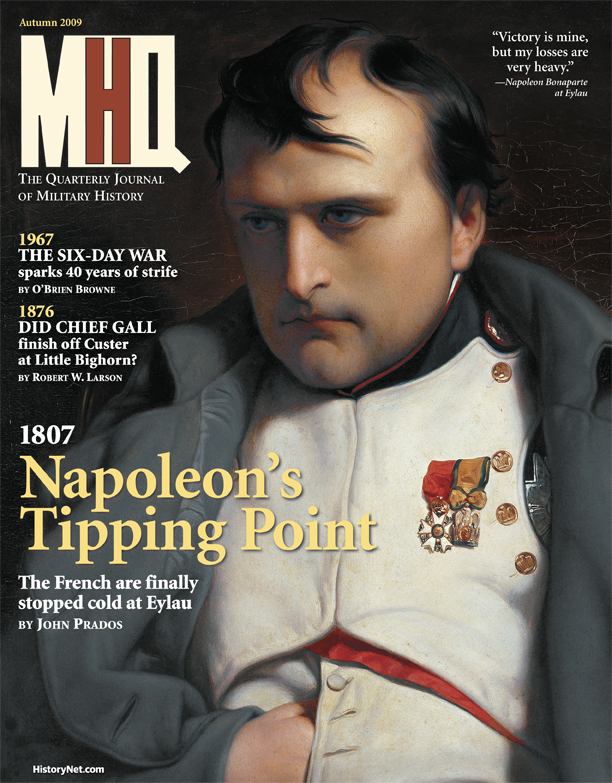
Forget Waterloo: Napoleon’s decline was clearly signaled by his failures at the Battle of Eylau eight years earlier.
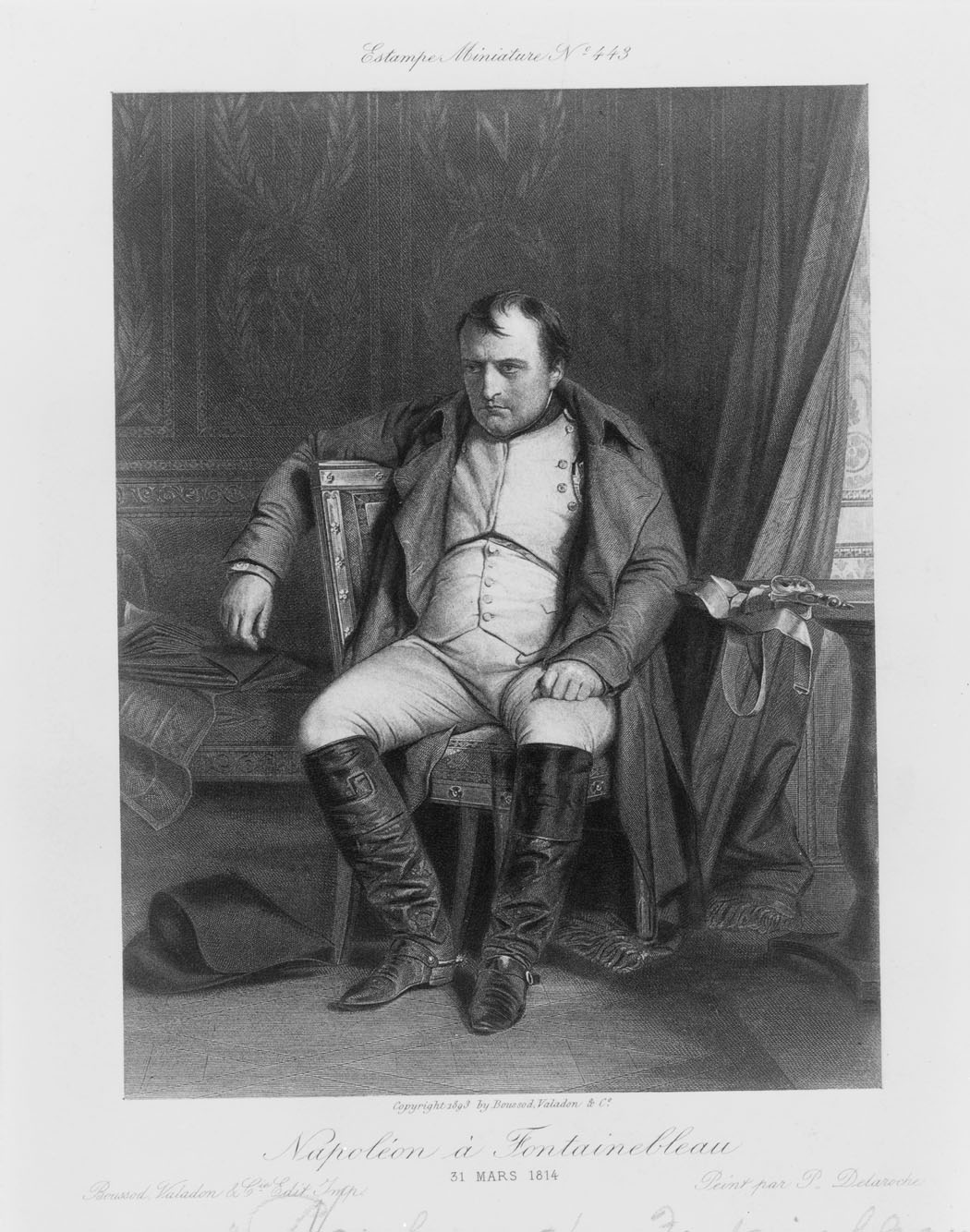
Poland, February 8, 1807. In the midst of a blizzard, Napoleon I, emperor of France, stands in the steeple of a church in the little East Prussian village of Preussisch-Eylau, commonly called Eylau, straining to see what is happening as a desperate battle rages about him. Advancing Russian troops are within a few hundred feet of capturing or killing the emperor, and what once seemed a routine battle has suddenly taken on far greater importance. N Just 10 days earlier, French armies had been some 145 miles south, standing on the frozen Vistula River, relishing their capture of Warsaw. They had marched hundreds of miles across Prussia, shattering the military might of a country the French had feared since Frederick the Great ruled there.
In Warsaw, French diplomacy had confronted Polish nationalism, and Napoleon saw its face take the form of the beautiful countess Marie Walewska. That encounter was the beginning of a torrid love affair, and became a perhaps fateful distraction, as the Age of Napoleon was poised to either wax or wane. For more than a decade, in the face of every obstacle, Napoleon had fought wars and scrounged supplies for his troops, while simultaneously supervising the political and social transformation of his army, which was then serving Revolutionary France, and was now serving an empire.
But Russian armies had begun to move against him from the north, with an eye toward relieving Danzig, their aim to defeat his Grande Armée, even in the dead of winter. His own army tired and hungry, Napoleon faced a grim decision. “The enemy seem to be maneuvering,” Napoleon had written to François-Marie Roullet, Baron de la Bouillerie, one of his bankers. “I am raising my camps to make a countermarch.”
Now, at Eylau (modern Bagrationovsk, 20 miles south of the Russian supply center of Königsberg), a classic battle was unfolding. It would witness the greatest cavalry charge of the era, mammoth flanking movements, and some of the most desperate fighting of Napoleon’s time.
The two-day clash would not be the largest battle of the Napoleonic Wars, but it was one of the bloodiest, a huge engagement fought under the worst imaginable conditions. It was brought about by the emperor glimpsing an opportunity to drive a wedge into the Russo-Prussian alliance that had led to the so-called War of the Fourth Coalition. In doing so, Napoleon sought to keep alive Polish hopes for independence, and no doubt to please his countess mistress as well.
Measured in terms of France’s territorial control, Napoleon’s apogee would not come until 1812 when, for a fleeting moment, his empire extended from Gibraltar to Moscow. Some historians assert, however, that the tipping point came in 1809, when Napoleon made critical mistakes in the first key battle of an Austrian campaign in Aspern-Essling. Others believe his star began falling in 1808, when Napoleon led a French army into Spain but stopped short of decisively destroying his British adversaries.
In fact it appears the critical turning point came in Poland in 1807, and began with a strange winter campaign. Indeed, a very good case can be made that he lost his guiding star, and pitched his empire into decline, in the swirling snow of Eylau.
Imperial Russia had been quick to join Prussia, Saxony, Sweden, and Great Britain against France in the War of the Fourth Coalition, but was much slower to mobilize. By the time Russian troops reached the Vistula, Prussia had been all but knocked out of the war at the twin battles of Jena-Auerstädt on October 14, 1806. The first Russian clashes with Napoleon’s weary men came the day after Christmas that year at the villages of Pultusk and Golymin. The Russians had no luck, and though they claimed victory at Pultusk, they retreated from the field. Napoleon’s marshal Jean Lannes won that battle, while Marshal Louis-Nicolas Davout prevailed at Golymin, backed by Marshals Pierre Augereau and Joachim Murat. The emperor himself arrived on the scene only the next day.
Napoleon could see that pursuit would be futile. “I think the campaign is over,” he informed his trusted adviser Jean-Jacques Regis de Cambacérès. “The enemy have retired behind swamps and deserts.”
The Russians had withdrawn in good order, French troops were exhausted, and the weather was vile—it had been raining for days. Napoleon wrote to Empress Josephine, “I am in a wretched barn…the mud is up to our knees.” The winter was reasserting itself quickly, with the thermometer plunging and the prospect of freezing imminent. French armies were exhausted after their long advance across Prussia. In addition, supply lines had yet to catch up with the advance of the Grande Armée; the troops were short of almost everything. On December 27, Napoleon decided to suspend operations and ordered his marshals to make camp for the season.
Yet the New Year of 1807 was not to bring a typical military campaign, when armies entered winter quarters to emerge rested and replenished in the spring. The Russians had hardly weighed in to the fight, as yet, and felt compelled to do more for their Prussian allies. The Prussian king had been driven from his capital, Berlin, but he remained unbowed, and the remnants of his army marched with the Russians.
This phenomenon—that a defeated enemy might persist in resisting the French—was one sign that Napoleon’s world had begun to shift. On January 2, Russian commanders conceived a plan for a new offensive, one designed to overwhelm Napoleon’s left wing and perhaps open the road to Berlin. The plan would lead to battle at Eylau.
There can be no doubt that Napoleon had his hands full before Eylau. In his system, the emperor insisted on making every major decision himself, and the government essentially moved with the army’s general headquarters. Napoleon was simultaneously occupied with military operations, grand strategy, support and recruitment of the armies, foreign and imperial policy, French domestic administration, and economic and social affairs.
Just a survey of the issues of concern to Napoleon during the very month his troops were crossing Prussia, exploiting the victory at Jena-Auerstädt, gives a sense of the emperor’s huge workload. Concerned about the scope of the coalition against him, Napoleon exerted himself to placate the Austrian Empire lest it join the conflict. His diplomats also negotiated with Prussia—in vain—for a direct settlement of their hostilities.
To distract Russia, he encouraged the Ottoman Empire to oppose Russia in the Balkans, and saw a flurry of diplomatic activity in late November when the Ottoman ruler, facing his own decision on a war, demanded to know more of the status of the French conflict with Prussia and Russia. To break Great Britain, Napoleon issued a decree in Berlin on November 21 that created a whole new foreign policy, the Continental System, which aimed to destroy British trade. As it became clear over the following weeks that his brother Louis, whom he had made king of the Netherlands, was not enforcing the new strictures on the Dutch, Napoleon intervened to force Louis to put his shoulder to the wheel.
Meanwhile, Napoleon changed the German map—and raised additional troops for his armies—by creating a new Kingdom of Saxony from part of Prussia. The emperor had also to wrestle with the question of Poland’s political status. Poles ardently desired independence, and creating a Polish nation would further weaken Prussia, but it threatened to send shock waves throughout Europe.
 To alleviate the increasing frustration of the French citizenry, weary of his successive wars, Napoleon received a delegation from the French senate and made appropriate promises. And then there was his wife, Empress Josephine, so desperate to join her husband that she had already begun the journey. Napoleon wrote a series of letters affirming his love for her, warning of the dangers on campaign, and finally virtually prohibiting her from being with him. Later, to Marie Walewska, he proclaimed his ardor and simultaneously hinted at the quo for the quid, writing: “All your wishes shall be complied with. Your country will become more dear to me if you take compassion on my poor heart.”
Article continues in the Autumn 2009 issue of Military History Quarterly!