

Historynet/feed historynet feedback facebook link Weider History Group RSS feed Weider Subscriptions Historynet Home page

Stahlhelm Model 1916: The Signature German ‘Coal Scuttle’

By Jon Guttman 
Originally published by Military History magazine. Published Online: September 08, 2011 
Print Friendly
0 comments FONT +  FONT -

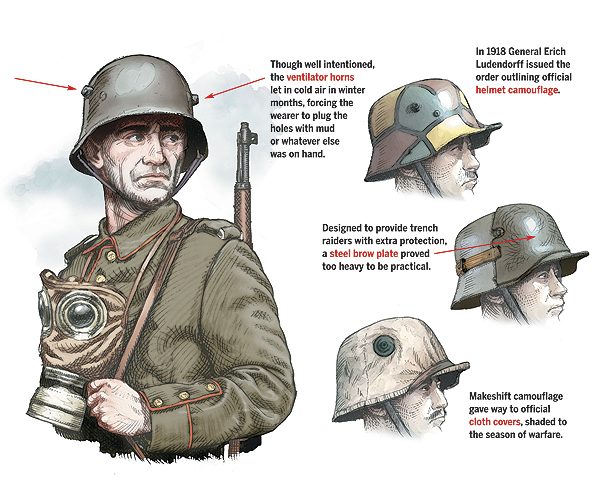
The iconic Stahlhelm, which debuted in World War I and achieved infamy in World War II, is echoed in many modern-day military helmet designs. (Illustration by Gregory Proch)

A popular image of German militarism is the helmet, whether the spiked Pickelhaube ("point bonnet") of Kaiser Wilhelm II or its successor the Stahlhelm ("steel helmet"). Behind the latter's infamous shape, however, were practical considerations.

In 1915, as World War I settled into the static meat grinder of trench warfare, Prussian engineering professor Friedrich Schwerd of the Technical Institute of Hanover studied the nature and circumstances of returning soldiers' head wounds and recommended the use of a steel helmet, which would better protect wearers from projectiles or shrapnel than the boiled leather Pickelhaube still largely in use. Schwerd based his prototype on the broad-tailed medieval sallet.

Subscribe Today

Subscribe to Military History magazine

German metalworkers crafted the Stahlhelm from martensitic silicon/nickel steel, a harder alloy than that used in the British Brodie helmet. Fabrication of each Stahlhelm required the use of heated dies, making for a greater unit cost than the one-piece Brodie. The liner comprised a leather headband, three padded leather pouches, adjustable leather or fabric cords, and a one-piece leather chinstrap. Ventilator horns ensured airflow.

On the strength of successful field tests, the German army placed an order for 30,000 helmets, though it didn't officially issue the Stahlhelm until New Year's Day 1916, hence its designation as the Model 1916. It saw its first combat use during the February 1916 Verdun offensive. A succession of refinements followed, and variations on the "coal scuttle" became standard headgear in dozens of armies worldwide, most notably in Germany's own World War II Wehrmacht. Its basic design is echoed in the Kevlar helmet used by American service personnel today.

Leave a Reply

Human Verification: In order to verify that you are a human and not a spam bot, please enter the answer into the following box below based on the instructions contained in the graphic.


Related Articles


History Net Images Spacer
History net Spacer
History net Spacer
History Net Daily Activities
History net Spacer
History net Spacer
Historynet Spacer
HISTORYNET READERS' POLL

Which of these defensive lines best served its purpose?

View Results | See previous polls

Loading ... Loading ...
History net Spacer
STAY CONNECTED WITH US
RSS Feed Daily Email Update
History net Spacer History net Spacer

What is HistoryNet?

The HistoryNet.com is brought to you by the Weider History Group, the world's largest publisher of history magazines. HistoryNet.com contains daily features, photo galleries and over 5,000 articles originally published in our various magazines.

If you are interested in a specific history subject, try searching our archives, you are bound to find something to pique your interest.

From Our Magazines
Weider History Group

Weider History Network:  HistoryNet | Armchair General | Achtung Panzer!
Today in History | Ask Mr. History | Picture of the Day | Daily History Quiz | Contact Us

Copyright © 2012 Weider History Group. All rights reserved. Reproduction in whole or in part without permission is prohibited.
Advertise With Us | Subscription Help | Privacy Policy