By August 1944 Adolf Hitler had few prizes left in his beleaguered domain. From Tripoli to Rome to Kiev, the conquered metropolises had been retaken. He had just lost the first capital he had won almost five years earlier, as Josef Stalin’s surging Red Army replaced Warsaw’s brown yoke with a red one.
When resistance forces within Warsaw rose against the Germans in anticipation of the Russians’ arrival, Stalin paused. Seasoned guerrilla fighters would not be a valued commodity in Soviet-occupied Poland, so the dictator ordered his advancing hordes to halt mere miles from Warsaw, leaving the hapless guerrillas alone against a German garrison determined to thoroughly eradicate this rioting gang of “subhumans.”
By the time the new rulers marched in, the city was a smoldering rubble heap whose inhabitants were in no state to present difficulties. It was a situation the Führer also found quite appealing, if for a very different reason. If Hitler and Germany could not have Warsaw, why should anyone else? For that matter, why should anybody else have Paris?
Far from Warsaw, a very powerful American was also preoccupied with the fate of Paris. For General Dwight D. Eisenhower, the French capital, the cultural and artistic nucleus of Western civilization, was a gargantuan headache. Two miles inland from the Normandy coast, the supreme Allied commander sat in his nondescript, rain-drenched command caravan and reluctantly decided that he would have to postpone the liberation of the “City of Light.”
On the desk before Eisenhower lay a 24-page report which warned that taking Paris would seriously limit the Western Allies’ ability to maintain pressure on the Germans elsewhere. Fuel demands alone for the required armor would be a crippling drain because gasoline had to be trucked over steadily increasing distances from the Normandy beaches in convoys that burned almost as much as they delivered. Then there was the projected 75,000 tons of food and medical supplies that would be needed for the winter stockpile, and the 1,500-ton daily coal allotment.
In conjunction with the high command’s determination to achieve a bridgehead over the Rhine before the arrival of winter, the Allied planners had concluded that the “great liberation” should be postponed a couple of months and suggested an alternate plan. British General Sir Bernard Law Montgomery‘s Twenty-First Army Group could strike eastward between the Seine and Oise rivers, secure the potentially invaluable port of Le Havre and neutralize the V-1 and V-2 missile emplacements at the Pas-de-Calais. Meanwhile, the American Twelfth Army Group could move south of Paris to cross the Seine at Melun, advance the 100 miles north to Reims, then swing west and link up with the British moving down from their newly captured jumping-off point of Amiens. Eisenhower could readily see the advantages of the plan: A destructive urban battle in Paris proper would be avoided, the terrain in question was suitable for the passage of armor, and since the city’s German garrison would be neutralized by encirclement rather than direct assault, with its accompanying attrition, precious gasoline would be conserved for the coming attack on the Siegfried Line, which defended the German frontier. The operation was tentatively set to begin sometime between September 15 and October 1, 1944, and while the supreme commander had grudgingly come to agree with his planners, General Charles de Gaulle, leader of the Free French forces, certainly did not.
American recognition of the collaborationist government of Vichy France, the failure of Washington to inform de Gaulle of the impending U.S. landings in North Africa the previous year, and the persistent friction between him, U.S. President Franklin D. Roosevelt and British Prime Minister Winston Churchill had already strained de Gaulle’s relationship with his allies. And the French general also had other foes to consider. Determined to be his country’s postwar head of state, de Gaulle saw in his political opponents, the Communists, a threat as great as the occupying Germans. With the French underground resistance movements predominately left wing, he had dispatched agents to spy on his countrymen as well as the Nazis. He learned that the Communists were planning a major uprising in Paris to liberate it themselves before the Allied armies arrived, hoping to entrench themselves politically as the emancipators of the capital and shunt the towering general into the obscurity and exile he so feared.
When de Gaulle learned of the plan to bypass the city and delay liberation, he became convinced that the Americans were for some as yet unknown reason plotting to destroy his political future. Whoever expelled the Germans and freed Paris would likely build for himself in the process a power base with which to dominate the entire country in years to come. De Gaulle estimated that the Communists had 25,000 armed men in the city (if this figure was accurate, they outnumbered the Germans); he ordered the cessation of all Resistance-bound arms drops into the area. While Eisenhower brooded in his gloomy headquarters, de Gaulle was in Algiers, busily sending trusted subordinates to the City of Light to do everything in their power to head off any premature insurrection that might well sow the seeds of a civil war. France, drained by four years of Nazi occupation, was in no condition to endure such a calamity.
During World War I, the Germans had been frustrated in their efforts to take Paris. Two million of them had died in the bloody mud of the Western Front. One of the scarred, embittered survivors was a young corporal named Adolf Hitler, and four years after the Nazis had triumphantly goose-stepped into the French capital, he was obsessed with defending it. However, Hitler also realized that he might lose Paris. If the city’s liberation became imminent, he decided, it was to be destroyed.
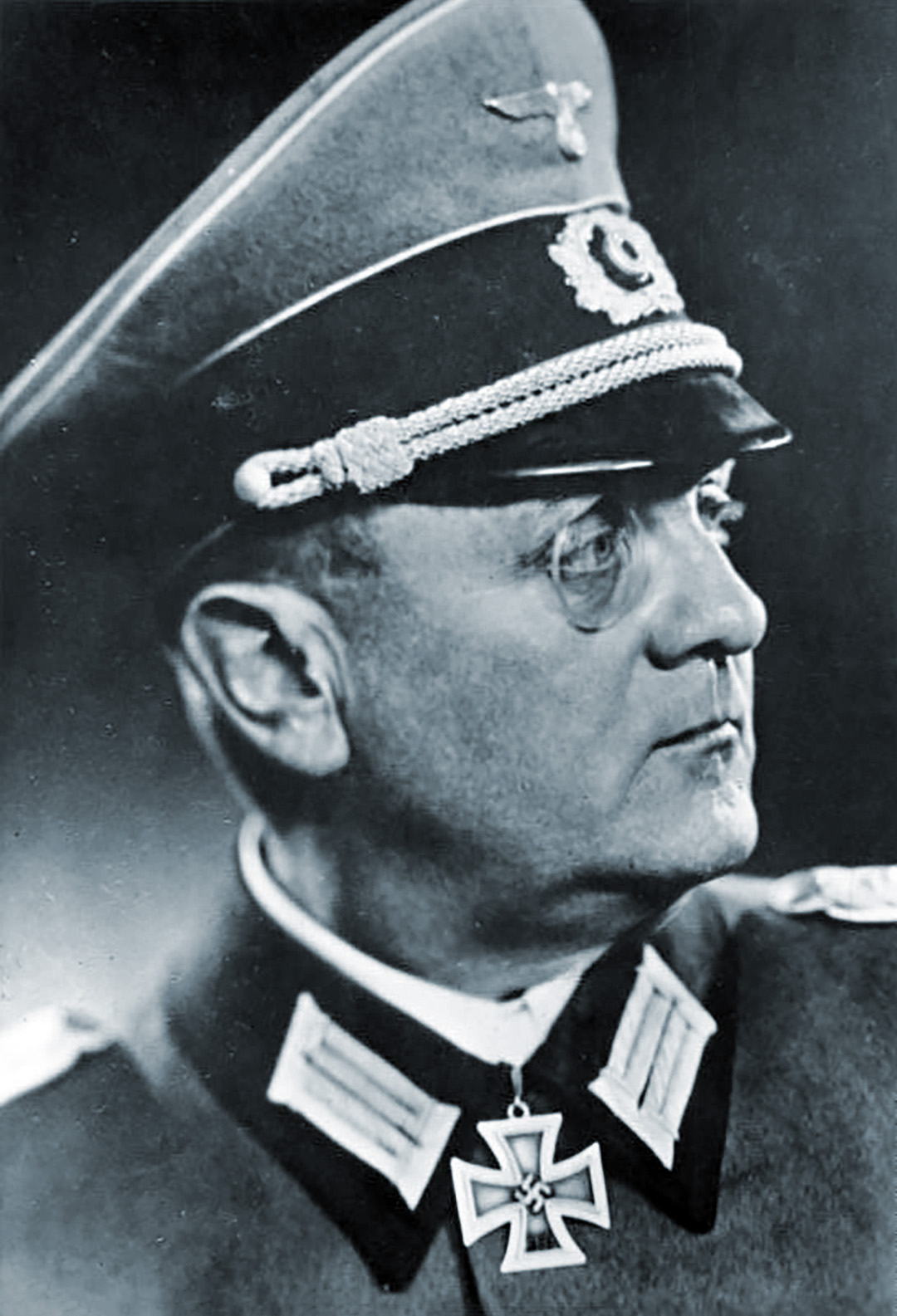
After three years of distinguished service on the Russian Front, Maj. Gen. Dietrich von Choltitz was brought west by Hitler. Since the July 20, 1944, bomb attempt on his life, the Führer had had little faith in his military commanders’ trustworthiness; yet in Choltitz he believed he had found his man for a monumental task. Choltitz’s family heritage of generations of Prussian militarism left little room for an independent spirit. He had been raised to do as he was told. When he led the German invasion force into Holland in the spring of 1940, he commanded the bomber formations that pulverized Rotterdam before the city had a chance to surrender. During the gory July 1942 siege of the Crimean port of Sevastopol, Choltitz’s 4,800-man regiment was so decimated that he decided to force Russian POWs to carry shells and load the big guns being used against their comrades. While Choltitz suffered only an arm wound, all but 347 of his soldiers died in action. Transferred to Army Group Center a year later, he obediently followed the Führer’s scorched-earth policy, making sure the advancing Russians found nothing but smoldering rubble in the wake of the withdrawing Wehrmacht.
Dietrich von Choltitz was indeed an able city destroyer, but by the time he arrived in Paris as its new military governor, he had had a couple of encounters that changed him radically. He had first met Hitler at a summer 1943 conference on the Russian Front, and though shocked by the Austrian peasant’s table manners during a luncheon, he was captivated by the powerful personality and contagious confidence of the Führer. When he arrived at the Führer’s headquarters in Rastenburg, East Prussia, a year later, however, he was in for a shocking disappointment. Hitler’s health had been wrecked by the incredible pressures of his life, the previous month’s attempted assassination and, some doctors suspected, Parkinson’s disease. After a rambling discourse on his career and the war, Hitler concluded with a shrieking diatribe against the Prussian officer corps. Finally, he told Choltitz he would be Befehlshaber, fortress commander, of Paris and should “stamp out without pity” all civilian acts of disobedience or terrorism.
Leaving Hitler’s forest compound, Choltitz realized that the conference had not left him reassured about the war’s future. All it had done was clarify his new posting for what it was, another scorched-earth assignment. This time, however, it was not some dour industrial or farming town on the Russian steppes—it was Paris, the most beautiful city in the world. For the first time in his life, Choltitz thought of disobeying a direct order.
On the long train ride from the Führer’s headquarters, Choltitz had a chance meeting with SS Reichsleiter Robert Ley, leader of the German Workers’ Front. Chatting over cigars, they exchanged news of their dealings of the past few days, and Ley informed his companion of a newly drafted law which had that very afternoon received final approval from Hitler. This Sippenhaft law was legislation that in effect made hostages of the families of front-line soldiers. Prompted by the bomb plot, these draconian measures provided the death penalty for the next of kin of men who surrendered, deserted or merely performed at levels below what was dictated.
A stunned and sickened Choltitz finally mumbled that if Germany was resorting to such bestial measures, she was reverting to the Middle Ages. After a thoughtful pause, Ley drawled, “Yes, perhaps, but these are exceptional times.” The next morning Choltitz stopped off in Baden-Baden for a fleeting reunion with his wife, Uberta, his daughters Maria Angelika, 14, and Anna Barbara, 8, and his infant son, Timo. During a stopover in Berlin the previous night he had received a cable informing him of his promotion to general der infanterie, but the two new bars on his shoulders could not hide the tension he felt from his family. Meanwhile, deep in the forests of Rastenburg, Hitler issued orders for “all available reinforcements” to be sent to France, remarking sullenly, “Why should we care if Paris is destroyed? The Allies, at this very moment, are destroying cities all over Germany with their bombs.”
Upon arrival at his new command, Choltitz was informed by Generalleutnant Gunther Blumentritt of the dreaded expected orders for a scorched-earth withdrawal should the Germans be unable to hold the city. Soon the 813th Pionierkompanie (Engineer Company) began the strategic placement of explosives. Electric and water facilities were given the greatest priority, but the first structures mined were the centuries-old bridges spanning the Seine. Without these bridges, the broad, meandering loops of the river would be a troublesome obstacle for an advancing army. On August 16, Hitler had ordered the Gestapo and noncombat administrators to evacuate the city. The previous day, eight Germans had been killed in an ambush in an adjoining suburb. There was no doubt that things were about to get hot. But by telling the Wehrmacht Western Front operations chief, Generaloberst Alfred Jodl, that the preparations were not yet completed, Choltitz managed to hold off any blasting.
Sappers were mining the 400-year-old Palais du Luxembourg with its priceless trove of literary and art treasures, the Chamber of Deputies, the French Foreign Office, the telephone exchanges, the railroad stations, the aircraft plant and every major factory in the area. On August 17, Choltitz had received from Feldmarschall Gunther von Kluge a cable that read in part: “I give the order for the neutralization and destruction envisaged for Paris.” Whatever he did, the general would be forced to act soon. He was torn between his ingrained Prussian inclination to do as he was told and the realization that to obey would be a bestial act of mass vandalism for which he would be eternally held responsible.
West of the city, Lt. Col. Hubertus von Aulock was deploying his forces in a 60-mile arc before the advancing Allies. With only 10,000 men available, the line was stretched impossibly thin, but Choltitz had been promised reinforcements. For the time being Aulock’s forces busied themselves digging in and installing the 88mm anti-aircraft pieces that had been removed from the city and placed at their disposal for use as artillery against the approaching armored columns. The guns would not be needed at their former posting. The Allies would never bomb Paris.
A tunnel beneath the city was filled with U-boat torpedoes that, if ignited, would produce a titanic explosion and tremendous devastation. On August 17, the busy general received at his headquarters Pierre Charles Tattinger, the mayor of Paris. The mayor was alarmed at all the explosives being deployed throughout the city and asked the German for an explanation. He was shocked by Choltitz’s response: “As an officer, Monsieur Tattinger, you will understand there are certain measures I shall have to take in Paris. It is my duty to slow up as much as possible the advance of the Allies.”
Although he was a collaborator, Tattinger was understandably aghast at this revelation. How could even the Nazis consider such an atrocity? Suddenly, Choltitz was seized by one of his periodic attacks of asthma and went into a fit of uncontrollable coughing. Leading him onto the balcony for some fresh air, Tattinger looked down on the lovely sculptured garden of the Tuileries and had an inspiration. Gesturing at the captivating vista, he made his point. Below them a lovely young girl was riding her bicycle on the Rue de Rivoli; on the manicured grounds of Le Notre, children played by the pond with their sailboats; across the adjacent Seine was the glittering dome of Les Invalides; and beyond that stood the landmark of the City of Light, the Eiffel Tower.
The Frenchman’s appeal was powerful: “Often it is given a general to destroy, rarely to preserve. Imagine that one day it may be given you to stand on this balcony again, as a tourist, to look once more on these monuments to our joys, to our sufferings, and be able to say, ‘One day I could have destroyed this, and I preserved it as a gift to humanity.’ General, is not that worth all a conqueror’s glory?” Choltitz looked silently to his left at the Louvre and to his right at the Place de la Concorde and replied: “You are a good advocate for Paris, Monsieur Tattinger. You have done your duty well. Likewise I, as a German general, must do mine.” Would he?
Despite the frantic adjurations of his most able lieutenants, de Gaulle was unable to keep the feared uprising from materializing–so he did the next best thing and beat the Communists to the draw. On the morning of August 19, Gaullist forces throughout the area commenced attacking German forces and fortifications. It was not long before the Communists joined the fray, and scores of occupation troops were assailed by irregulars armed with World War I surplus Lebel rifles, Molotov cocktails, pistols, shotguns and a few slow-firing Hotchkiss machine guns. As the Germans began to strike back with their panzers, the destruction began to mount.
The heart of the rebellion was the police prefecture, so Choltitz decided to attack it with dive bombers and armor at daybreak on August 20. He mentioned his plan to a new acquaintance, Raoul Nordling, the Swedish consul in Paris, and Nordling proposed a novel alternative–that the general offer a cease-fire to the desperate men inside the prefecture. Choltitz like the suggestion. He would not have to declare open war against the capital by attacking such a central institution, and a truce would restore order. The Führer did not want his troops to be forced to defend the city against attacks from without and within. The truce was also the greatest thing imaginable for General Charles de Gaulle.
General Eisenhower experienced a mix of emotions as he awaited de Gaulle’s arrival at his Granville headquarters, but anger prevailed. The Parisian uprising had him agitated enough. Without immediate help from the Allies, the irregulars would likely be wiped out, and Paris would suffer the same blazing fate as Warsaw. Eisenhower realized that he and the Western Allies as a whole would be held as accountable as the Germans if they failed to prevent this catastrophe, but preventing it could disrupt the entire timetable of the war in Europe and prolong the horrid conflagration by several months.
Even if de Gaulle was not responsible for the rebellion, Eisenhower was certain he would attempt to use it to his advantage to pressure the Americans and British into pursuing the immediate liberation of Paris, following which he would be able to set himself up as the undisputed leader of postwar France. Eisenhower was fed up with de Gaulle’s habitual “trying to get us to change our plans to accommodate his political needs.” However, there was a crucial trade-off of which the American was keenly aware. Without de Gaulle there was the very real possibility that France might become a bulwark of European communism.
Despite his guest’s threat to withdraw the 2nd Free French Armored Division from Allied forces and send it to Paris alone, Eisenhower still refused to change his battle plan. The day before de Gaulle’s arrival, the Allied commander had received a dispatch from intelligence sources informing him that German reinforcements had left Denmark en route to the Paris area. This reinforced Eisenhower’s conviction that the Germans were prepared to defend the city with all of the forces at their disposal.
Back in the capital, the head of the Communist resistance, “Colonel Rol,” was doing his best to disrupt the truce his Gaullist rivals were managing to impose. Issuing orders to his men to attack Germans at every opportunity, he denounced the cease-fire as a ruse to “exterminate the working classes of Paris,” and permit “those stirred by hatred and fear of the people to work their dirty deals.” Rol was uninterested in sparing the city from destruction; he wanted only to establish his faction as the ruling government. “Paris,” he declared, “is worth 200,000 dead.”
Sure enough, by late afternoon on August 20, the truce was dying under the steady gunfire of Communist insurgents and patrolling squads of Germans. By midnight, 106 Frenchman and an undetermined number of Nazis were dead. Just as the situation was at its worst and it seemed that Choltitz would be compelled to commence demolition and launch an outright major offensive against the partisans, there came a breakthrough.
An SS patrol arrested three Resistance leaders caught in a car filled with arms and classified papers. Rather than leftists, they turned out to be staunch Gaullists–“ministers of de Gaulle,” Choltitz was informed by the officer in charge of their apprehension. One of the trio was Alexandre Parodi, de Gaulle’s representative in occupied France. After outlining to him the dire potential consequences of the deteriorating cease-fire, Choltitz released the stunned Frenchman and his companions to do what they could to restore the peace.
Racing to his apartment on the Rue Sain-Augustin, Parodi initiated the previously prepared Operation Prise du Pouvoir. For every minister in de Gaulle’s government-in-exile, there was a carefully screened, Paris-based stand-in. Parodi began placing as many of them as he could locate in their respective ministries. Aided by an energetic young Gaullist partisan named Yvon Morandat, whom the Communists had tried to assassinate 10 days earlier, Parodi assembled his ersatz cabinet at the prime minister’s residence at the Hotel de Matignon, where he intended to boldly declare his assembly as the newly returned government of France, headed by General Charles de Gaulle. He, too, would beat the leftists to the draw.
After his initial success, however, Parodi was unable to bring unity to the splintered Resistance. In a stormy meeting in an apartment over the Avenue de Parc-Montsouris, the Communists refused to agree to any kind of cease-fire extension. They would do all-out battle with the occupiers immediately and threatened that, if the Gaullists refused to join in, they would plaster every wall and building in Paris with placards accusing the Gaullists of “stabbing the people of Paris in the back.”
The truce was dead, but the time the Gaullists managed to expend in establishing this seemingly disastrous fact would be all that was needed. While the Resistance leaders of Paris bickered, 122 miles to the west the 16,000 men of the 2nd French Armored Division were mobilizing. The division’s commander, General Jacques Philippe Leclerc, had been preparing for this move for some time. To ensure that the Americans would be unable to prevent his outfit’s attacking independently, he had not reported tanks and other vehicles that had been lost in action and had continued drawing gasoline allotments for machines he no longer had. For the previous three nights the men had filched the rest of the fuel and ammunition they needed from American supply dumps. Now, in the pre-dawn of August 21, Leclerc–after attempting repeatedly and futilely to obtain permission from his American superiors to advance, and receiving no word of instruction of any kind from de Gaulle–was moving out on his own authority.
The reinforcements Choltitz had been promised were not coming to his aid; instead, they were sent south of the city to where the main Allied thrust was expected. The thin line of Germans deployed in the semicircle to the west was all that stood between the 2nd Armored and Paris. Then even those forces were mysteriously ordered to the south. It seemed to confirm that Choltitz was not intended to preside over the defense of the capital anyway. He was to see to its destruction. For Paris to be reduced to rubble in a siege was something Choltitz could understand. That would be a military operation. But for it to be obliterated merely to appease Germany’s leader was unacceptable to him. Choltitz could no longer delude himself into believing his cause was just, nor would he continue to fight for it. If only the Americans would hurry.
Meanwhile, a Gaullist agent named Roger Gallois had managed to make it to the American lines and was frantically imploring General George Patton (who was roused in the middle of the night) to send his forces directly to Paris. Reciting the reasons previously outlined by Eisenhower, Patton refused, but after a furious jeep ride, Gallois reached U.S. Twelfth Army headquarters at 6 a.m. on August 22, where his emotional appeal did convince intelligence officer Brig. Gen. Edwin Sibert. Unknown to Sibert, Eisenhower also had had a change of heart. At his new headquarters in a village called Grandchamp, Eisenhower had received another appeal from de Gaulle for the immediate liberation of Paris. This missive, similar in content to Gallois’ appeal, finally tipped the scales.
Back in the city, Parodi had assembled his Gaullist government in the prime minister’s office and announced its existence to reporters. Sure enough, the Communists, preoccupied with their costly but effective revolt against the Germans, did not notice they were being supplanted.
After Gallois made a follow-up trip to brief Generals Bradley and Eisenhower, final approval for the drive on Paris was given, and Bradley granted Leclerc permission to go first, not realizing that the French division was already en route.
In the city the rebels were running out of ammunition and the Germans were pressing them with increasing violence. More than 500 French had died so far, and the metropolitan area was slowly beginning to resemble a charred battlefield. In the midst of the fighting, the Germans mined the cellar of Les Invalides; if detonated, the explosives could destroy the French Army Museum, military art gallery, 400-year-old barracks and the tomb of Napoleon Bonaparte. On the drizzling morning of August 23, four SS engineers were inspecting the supports of the Eiffel Tower, looking for the best spots to place charges.
Choltitz risked his life and his family by lying to the chief of staff of Army Group B, Generalleutnant Hans Speidel, telling him the destruction of the city had already begun. In the meantime, the defenders were reassembling their defensive perimeter west of the capital, but it was too late. The 2nd French Armored and the U.S. 4th Infantry Division were already poised to strike. The Germans, though, had managed to redeploy their deadly array of 88mm artillery, and as the 2nd French Armored passed the outlying town of Massy-Palaisaeu, they met their first opposition as the well-camouflaged field pieces opened fire.
The Luftwaffe had received orders directly from Hitler to carry out a terror raid on the city proper, but the major in charge of the operation had to contend with an aroused Choltitz, who was determined to abort the attack (scheduled for the night of August 24-25 to avoid Allied fighter interference) not only because of its barbarity but also since it targeted a large area thick with his troops. Such an operation, Choltitz growled, “would kill as many Germans as Parisians.”
War correspondent and impromptu Resistance fighter Ernest Hemingway had cursorily scouted the roads out of Toussus-le-Noble just west of Paris and declared them clear, but as the Shermans moved out they were caught in a shower of 88mm shells from the guns of the 11th Flak Regiment hidden under haystacks in a wheatfield overlooking the western approaches. In the first of a series of costly clashes, the 2nd French Armored cleared the field and advanced to the next bottleneck. The tankers’ frantic impatience moved them to hurl themselves and their machines recklessly into German strongpoints rather than attempt standard flanking moves by their accompanying infantry. Their desperate tactics were expensive, but they saved time–something of which Paris had very little.
In the capital, the embattled irregulars were buoyed by the noise of shellfire to the west. The sound was getting louder, and the Germans began to burn incriminating documents. They had executed 4,500 Frenchmen in the Gestapo prison of Mont Valerien alone. Sappers were still at work in the city, but the Resistance fighters, emboldened by the ever-nearing crash of artillery, began to put a stop to it. A German six-truck convoy headed for the Chamber of Deputies was stuffed with high-explosive torpedoes. It never reached its destination. One after another, the trucks were knocked off by the partisans.
As the Allies began to filter through the suburbs, they met violent but sporadic resistance. Late on the afternoon of August 24, Bradley sent the 4th Infantry Division posthaste to the support of the 2nd French Armored. It was a move that would have been better made 24 hours earlier, but Bradley, like the whole high command, was under the misconception that the approaches to the capital were virtually undefended. Although he was horrified to learn of the losses suffered by the 2nd, he made it clear that the French were to press their advance at all costs. In preparation for this, Leclerc sent his aid, Captain Raymond Dronne, alone into the city under cover of darkness to inform as many of the Resistance members as possible that the next day would bring liberation.
The bleeding 2nd French Armored knocked out the last major German strongpoint outside the city limits, opening the road to Paris. The only real problem was the commander of the very professional enemy garrison. Although he had seen to it that Hitler’s scorched-earth orders were not executed, Choltitz as yet had no intention of handing the city over to his approaching enemies without a fight, as some of his men were now suggesting. He promised his assembled officers that evening that he would “personally shoot, in my own office, the next man who comes to me suggesting we abandon Paris without a fight.” Destroying the city for no good reason was one thing; running away from a fight was quite another.
The fact that the battle had scarcely begun could not dampen the wild exuberance of the celebration that commenced about 9:30 p.m. on August 24. As Leclerc’s remaining men and machines clattered exhaustedly into the heart of Paris, its citizens flung themselves on these heroes with the screaming joy of four years’ longing for this moment. As the tired soldiers were pulled from their tanks by the throngs of delighted Parisians, the deafening strains of the “Marseillaise” drowned out all other sounds—even the growing rattle of gunfire.
The Germans would fight for Paris, but despite the occasional violent flare-up, opposition was futile and quickly overcome. Many of the 20,000 Wehrmacht troops were soft and complacent after four easy years of congenial occupation duty and had lost the will to fight. They surrendered in droves, and by noon of August 25 the tricolor was again fluttering from the summit of the Eiffel Tower. Back in the dreary forests of East Prussia, Hitler snarled at Jodl, “Is Paris burning?” It was not, and would not.
In his Hotel Meurice headquarters, Choltitz, demoralized by the events of the past two weeks and despairing of receiving help, decided to surrender. Slightly after 1 p.m., soldiers of the bloodied Free French armored division marched into the office of the commander of the Paris garrison. Their leader announced himself as “Lieutenant Henri Karcher of the army of General de Gaulle.” Choltitz responded, “General von Choltitz, commander of Gross Paris.”
“You are my prisoner,” Karcher informed him. “Ja,” replied Choltitz.
The general’s small band of captors was barely able to protect him from the unruly mob forming outside. Fully expecting to be lynched, he was somehow ushered through the vindictive throng, with a few nicks, bruises and a saliva-spattered uniform his only injuries, and driven away.
Around 4:30 p.m., a three-car procession pulled up in front of the 2nd French Armored’s newly established headquarters at the Hotel de Ville. From the second auto, an open Hotchkiss, stepped General Charles de Gaulle. When Leclerc handed him a copy of Choltitz’s surrender paper, de Gaulle’s face hardened in anger. On the document, which he had had no chance to sign himself, was the signature of his Communist rival, Colonel Rol. However, in the coming victory-liberation parade, the general—his massive frame accentuating his imposing, formidable presence—would read a “proclamation of The Republic” to the cheering masses. That was all it would require from this towering symbol of Free France to ensure that there would be no left-wing coup.
In Germany a military tribunal convened to try Choltitz in absentia for treason. The defendant still had highly placed friends in the military, however, and they managed to delay the trial so that the war came to an end before the court-martial could come to order, thereby saving Choltitz’s wife and children from execution or imprisonment.
Ultimately, the liberation of Paris was to come at a great cost. Allied fuel reserves had been depleted, and those German forces that escaped reached the safety of the Siegfried Line. The Western Front stagnated with the approach of autumn and winter. There would be a great slaughter in the dreary Hürtgen Forest. The British would be crushed at Arnhem. There would be a Battle of the Bulge. Worst by far, innocents beyond counting would continue to die miserably in the death camps of the SS. It was a terrible price to pay for the grandest city in Europe.