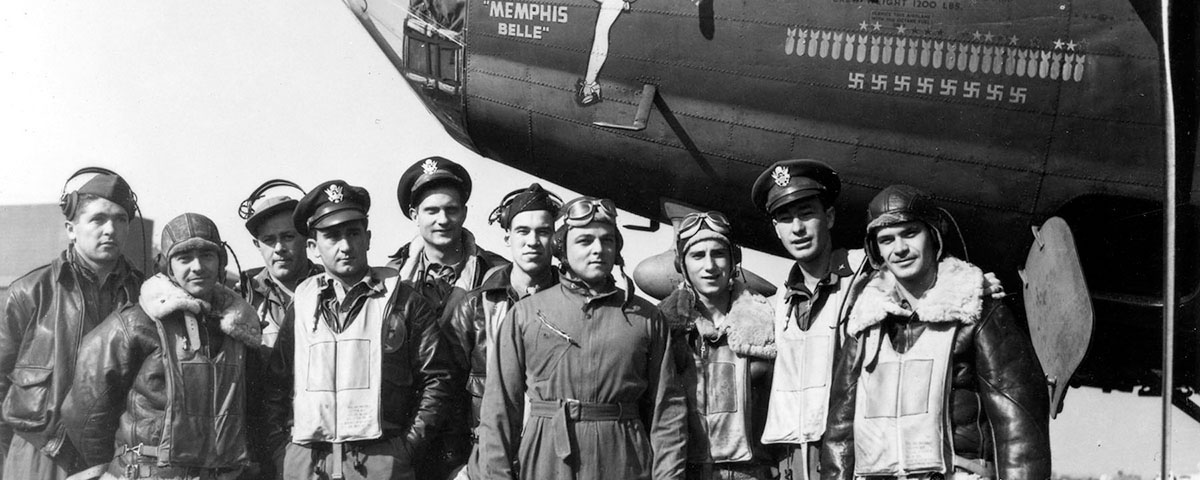
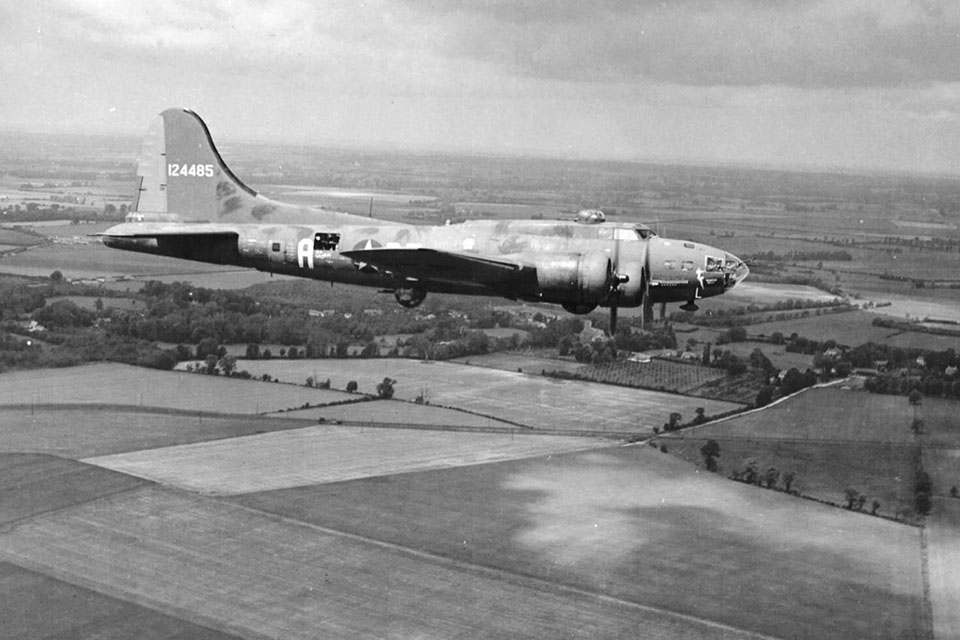
In the flak-filled sky over a German U-boat installation in occupied France on January 23, 1943, Memphis Belle was battling for her life. The U.S. Army Air Forces Boeing B-17F, destined to become the most famous Flying Fortress in history, had approached the submarine base at Lorient flying in formation, amid one of four groups of bombers that had targeted the sub pens.
Nearing their goal, Captain Robert K. Morgan and the crew of Memphis Belle had to penetrate a protective screen of German fighters, then thread their way through a thick blanket of anti-aircraft fire over the sub pens. Their basic mission was straightforward: Hold steady, with no evasive maneuvers to complicate the drop, and finally “Bombs away.” Then the bomber could head home to the Eighth Air Force base at Bassingbourn, England. But they still had to get past those fighters. “Because ours was the smallest of the four groups, they concentrated on us,” Morgan later remembered. “For 22 minutes, they gave us hell.”
At one point, a Focke Wulf Fw-190 attacked Belle head-on. “One of us had to move,” Morgan recalled. “The usual procedure was to dive. I couldn’t do this because another group was below us, so I pulled up straight. The shells meant for our nose banged into our tail.”
Morgan was not immediately aware of what happened after that impromptu chandelle, but he thought that he had likely avoided disaster—until he heard a report from the tail gunner, Sergeant John Quinlan. Quinlan shouted over the mic: “Chief, the tail is hit. The whole back end is shot off! It’s blazing! The whole tail is leaving the plane!” After what seemed an eternity, Quinlan’s voice came through again: “Chief, it’s still on fire. There goes another piece!” Another moment of silence, then the tail gunner came through again more calmly, “Chief, the fire has gone out.” Morgan said later, “This was the sweetest music I ever heard.”
The lanky pilot climbed out of his seat to see exactly what had happened. “It looked like we had no tail at all,” Morgan recalled. “I got back in the cockpit and flew back to the base in two hours. It was tough flying, and tougher than that to set her down. The elevators were damaged so badly that the controls jammed. Somehow we managed to get down safely.” In later years one of Belle‘s former crewmen summed up Morgan’s flying skills: “He’s a damn good pilot. He always brought us back.”
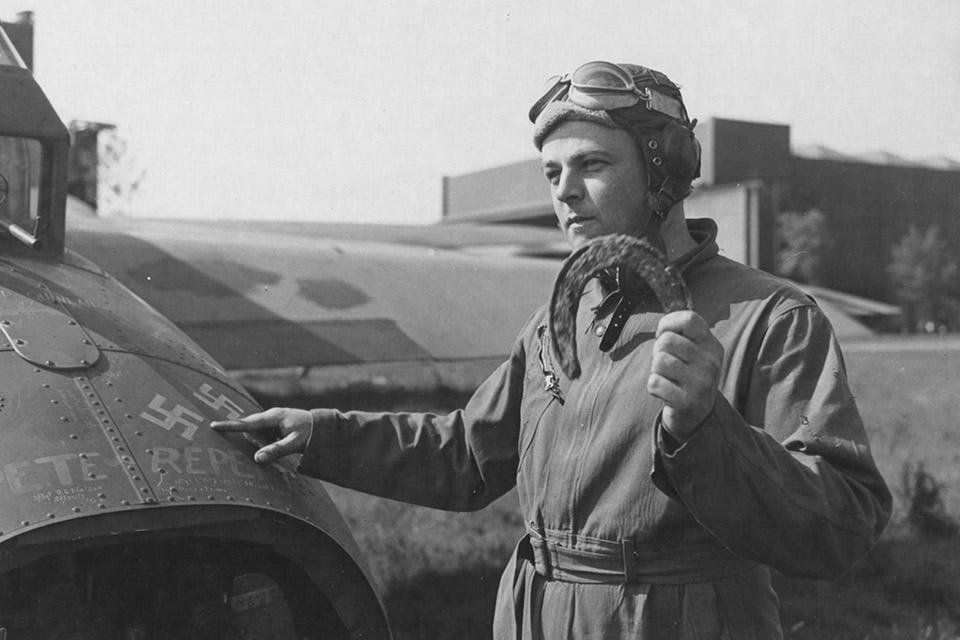
Of the 12,750 B-17s produced, Memphis Belle is famous for being the first Eighth Air Force bomber to complete 25 combat missions over occupied Europe without a crewman being killed and returning to the United States. In Belle‘s first three months of sorties from Bassingbourn, 80 percent of the bomb group she was part of was shot down. Morgan has a grim and graphic explanation of what those devastating losses meant to the surviving crews: “Eighty-percent losses means you have breakfast with 10 men and dinner with only two of them.” During public appearances he is frequently asked, “Weren’t you scared to death?” “Scared is not the word,” he generally answers. “You had apprehension and concern. You were so busy. Each of the 10 guys had a job to do. We didn’t have time to get scared.” He adds: “If you want just one word on how we were able to go through the hell over Europe 25 times and get back without a casualty, I’ll give it to you. It is teamwork. Until you have been on a Flying Fortress in combat, you can’t know how essential that is.”
Belle participated in some of the most hazardous raids of the war, when the Luftwaffe still had a commanding fighter superiority and defenses of the Nazi regime were strong. She was bullet-ridden, flak-battered and on five separate occasions had one of her engines shot out. But she slugged it out with Messerschmitts and Focke Wulfs and absorbed their cannon fire without flinching. The longest period the storied plane was out of service was five days, when transportation difficulties delayed a wing replacement.
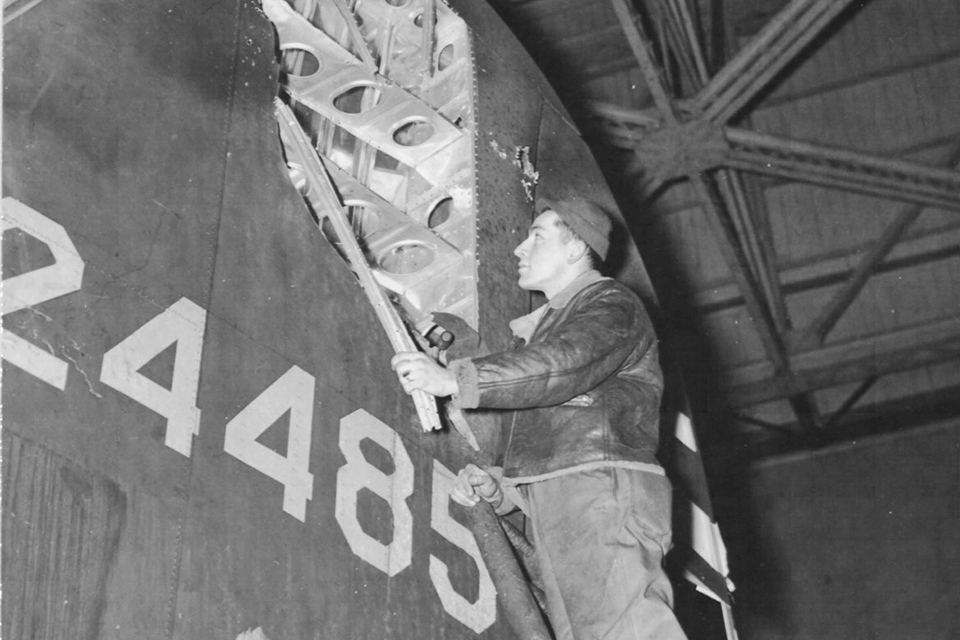
During her 25 combat missions, Belle‘s gunners were credited with destroying eight enemy fighters, but they also probably destroyed five others and damaged at least a dozen more. Her crew dropped more than 60 tons of bombs over France, Germany and Belgium, knocking out supply depots, railway yards, aircraft plants and an assortment of military bases. With amazing accuracy—thanks in no small part to the sterling work of bombardier Vincent B. Evans—Belle‘s crew blasted the Focke Wulf plant at Bremen, locks at St. Nazaire and Brest, docks and shipbuilding installations at Wilhelmshaven, railroad yards at Rouen, submarine pens and powerhouses at Lorient and aircraft factories at Antwerp.
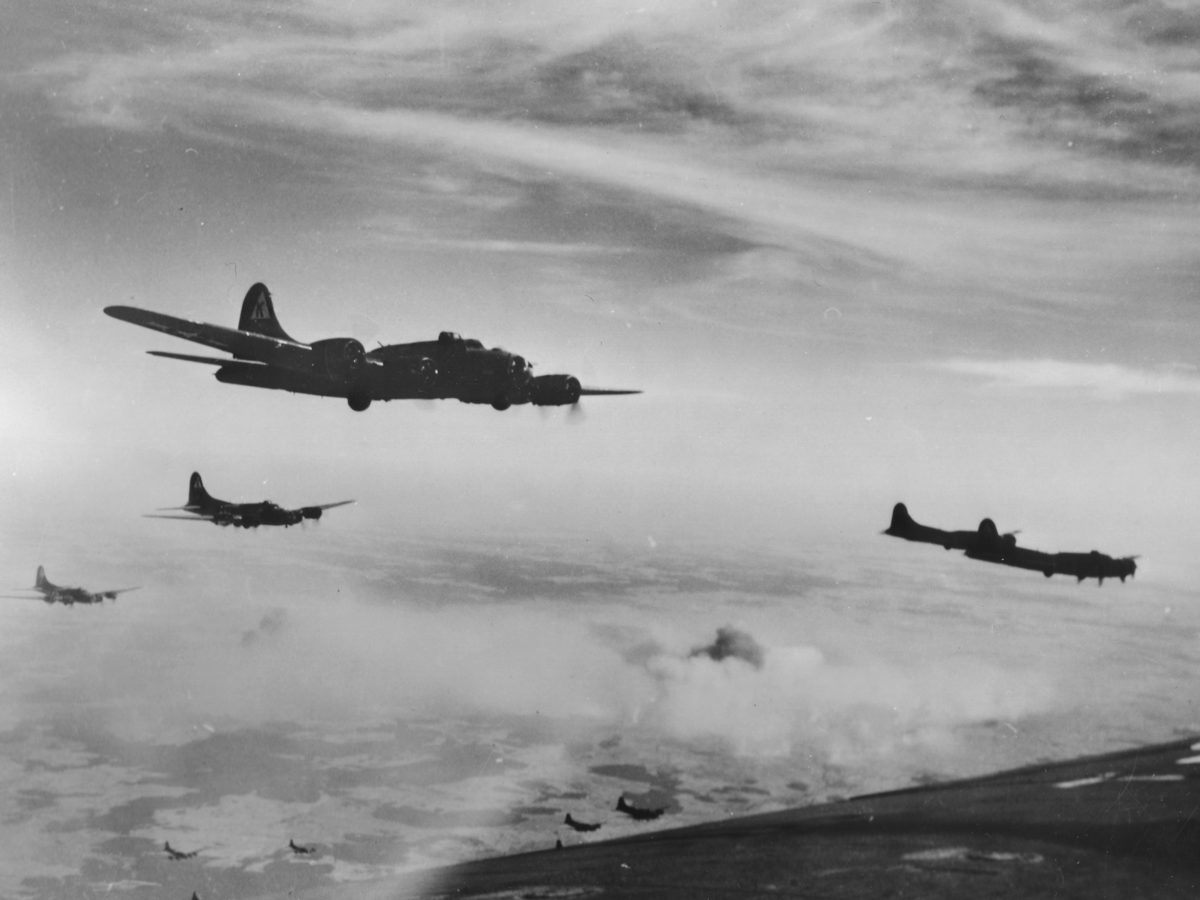
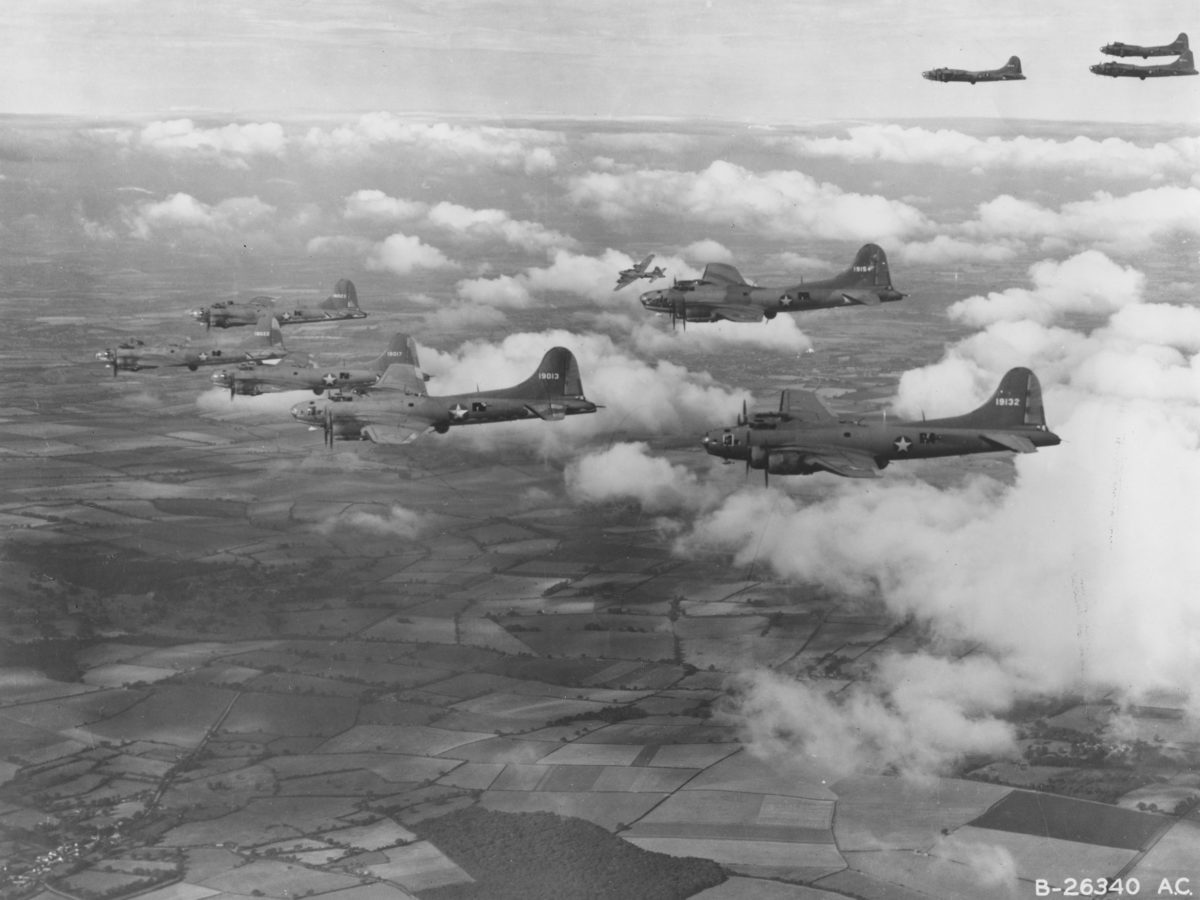
Looking back on those days, Morgan remembered no easy missions, no milk runs. The secret to a successful B-17 mission, he decided, was tight formations—so tight that the wings often nearly touched in flight. That way, “We were able to put out an amazing amount of firepower,” he said. “That, and the Norden bombsight, which made us extremely accurate at high altitudes. I also feel there was a bit of divine intervention for the crew.”
GET HISTORY’S GREATEST TALES—RIGHT IN YOUR INBOX
Subscribe to our HistoryNet Now! newsletter for the best of the past, delivered every Monday and Thursday.
Although Belle‘s crew members earned 51 decorations, only one Purple Heart was awarded—to tail gunner John Quinlan, who described his wound as a pin scratch on the leg. Each of the crew received the Distinguished Flying Cross and the Air Medal with three oak leaf clusters.
The members of Belle‘s crew first set eyes on their brand new B-17F-10-BO at Bangor, Maine, in September 1942. Morgan had just begun a romance with Margaret Polk, from Memphis, Tenn., and when it came time for the bomber crews to name their planes, he thought Memphis Belle had a nice ring to it. Other crew members had their own ideas for a name, but Morgan persuaded one of them to vote with him, so now he had two votes for Belle and eight for other names. Memphis Belle it was, and a belle in a bathing suit was painted on her side. Her soon-to-be famous nose art had originally been created by George Petty for Esquire magazine. Captain Morgan contacted Petty and gained permission to re-create the curvaceous cutie, and Corporal Tony Starcer painted her on the bomber’s nose.
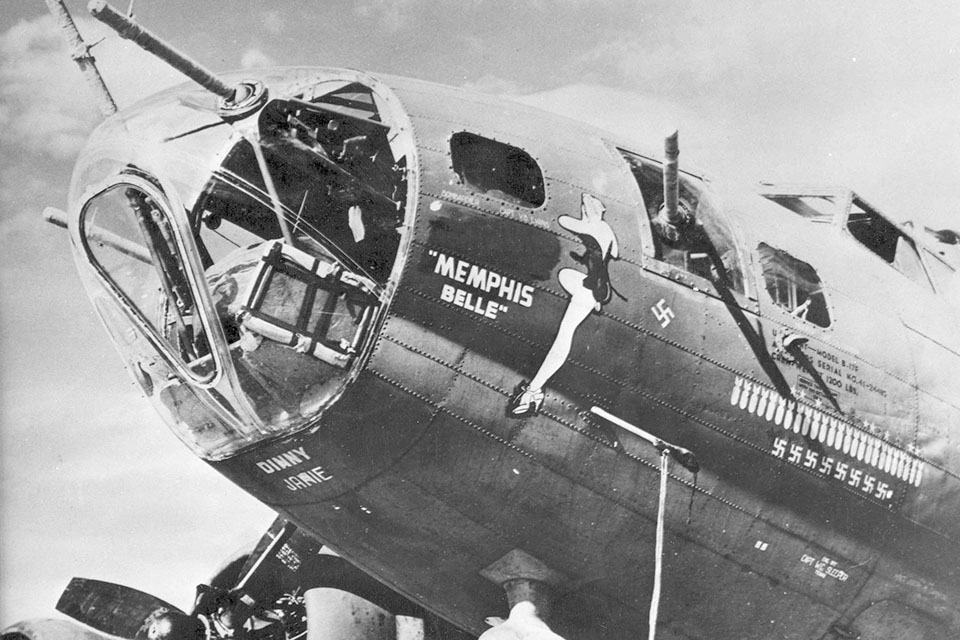
Morgan flew Belle to Memphis on her shakedown flight. There she was officially christened, with Margaret Polk as an admiring witness. Memphis Belle then crossed the Atlantic to what became the home base for the 91st Bomb Group, Bassingbourn, England.
One of Belle‘s more notable missions was flown as part of the 91st Bomb Group’s assault on enemy installations at Romilly sur Seine. In his post-mission debriefing, Morgan recalled: “We hit the hangars and the depots. We wrecked 100 German fighter planes on the ground, and we hit a German officers’ mess at lunchtime. We heard later that we also blew up a cellar full of cognac.” A diary kept by navigator Charles Leighton provided additional details: “On the way we flew over Romilly. We flew over Rouen, where we were attacked by about 25 German fighters. They were coming at the nose so I got off a lot of shots. Bob said ‘I got one,’ but I was firing so fast I didn’t have time to notice. I shot over 700 rounds. I saw two B-17s go down in front of us. When they fire at you head-on, it looks as if the whole plane is exploding.”
Morgan reported: “First one squadron hit us and then another and another. We were shot at on the way to the target, over the target and then on the way out. By the time it was over, some of the Germans had attacked us…landed and refueled, picked up some ammunition and were up attacking us again. For one hour and fifty-eight minutes they followed us. I never saw so many attacks in my life.” On that occasion, Belle was over enemy territory for 2 1/2 hours.
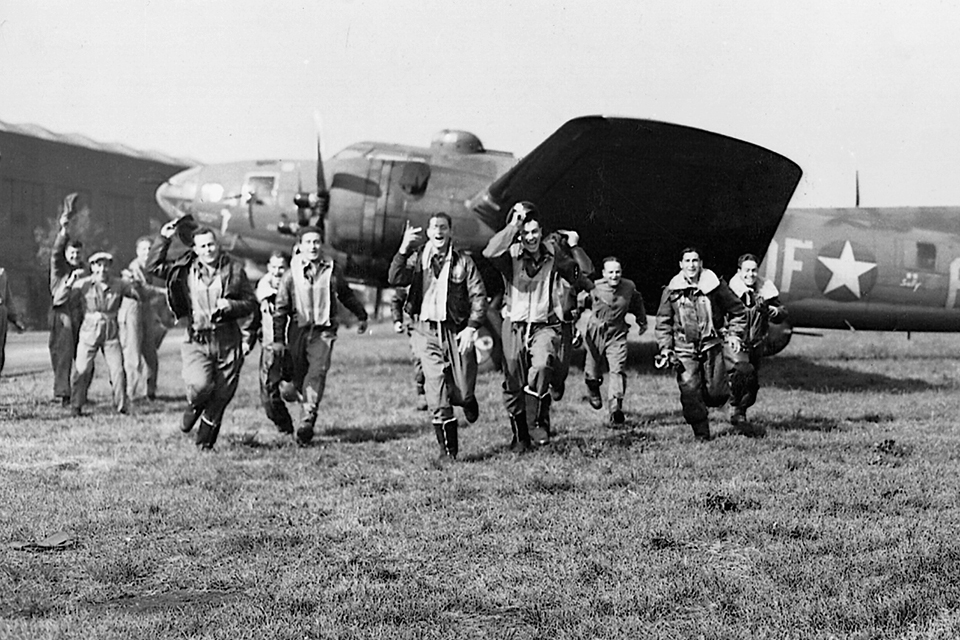
After her 25th, and final, raid over Europe, Belle set out on one more mission—returning to the States on a triumphant public relations tour. That three-month mission during the summer of 1943 took the crew to 31 cities, including Washington, Cleveland, Los Angeles, Wichita and Mobile. Every time they appeared—at bond rallies and aircraft plants—the crewmen were treated as heroes.
The famous plane had only one female passenger in her triumphal tour across the United States—the aircraft’s mascot, Stuka, a Scottish terrier that came aboard in England. Purchased in a London pet store by copilot James Verinis, the Scottie accompanied the crew to every one of Belle’s tour destinations. Stuka dined on filet mignon almost daily. Although General Henry H. “Hap” Arnold had given Morgan permission to fly the B-17 as low as he pleased during their tour, it’s almost certain that the general hadn’t meant for the bomber to buzz rooftops as she made her way across the nation. Nonetheless, when Morgan piloted Belle to an event in his hometown of Asheville, N.C., he brought the big bomber in low, barely skimming the roofs of downtown buildings and seemingly aiming for the city hall and courthouse. There was some space between the two buildings, but not enough to accommodate the 103-foot wingspan of the B-17. Just moments before Belle would have crashed, Morgan flipped her on her side and blasted through the gap—vertically. Some startled observers on the ground muttered that whoever was piloting the plane should be court-martialed.
Morgan again put on a good show in Memphis, the second stop on the tour. Once more someone mentioned a court-martial for the pilot, this time a high-ranking military officer. One Memphis newsman wrote: “He had a special reason to pull out all the stops here. Waiting on the ground was the girl he loved (Margaret Polk), the girl he was engaged to marry. A cocky young man always wants to strut in front of his girl.” Morgan and Polk never quite made it to the altar, but they remained lifelong friends after their romance ended. As for Belle, she would eventually end up in the city that she was named after.
Morgan’s military career did not end with his final flight in Memphis Belle. When the young pilot returned from Europe, USAAF commander Hap Arnold had jokingly told him that he could have any position in the Army Air Forces but his own. Morgan subsequently volunteered to lead a squadron in the first Boeing B-29 Superfortress strike against Tokyo, in November 1944. He flew in a B-29 dubbed Dauntless Dotty (named after Dorothy Johnson, the woman Morgan did marry, just before shipping out for the Pacific War). Morgan’s B-29 strike against Tokyo was America’s first attack on the Japanese city since the Doolittle raid two years earlier in North American B-25s. One hundred eleven planes were launched against the Japanese city, 17 of which were forced to turn back by engine problems. The flight was commanded by General Emmett Rosy O’Donnell, flying with Morgan in Dotty.
When they encountered the jet stream for the first time during that mission, the bomber formations were disrupted, making accurate bombing all but impossible. Morgan later recalled of that sortie, “We had a hell of a time with our bombsight, and I had the best bombardier with me, Vince Evans, my bombardier on the Memphis Belle.”
A later mission to the Japanese Home Islands, on March 9, 1945, proved much more successful. This time 302 B-29s participated, with 270 arriving over the target.
Recommended for you
As a squadron commander, Morgan went on to fly with many different crews, racking up mission after mission. On April 14, General O’Donnell suggested that it was about time for him to quit risking his life, saying: “Don’t you think it’s time to retire from combat? You’ve been extraordinarily lucky to complete 50 missions, and I think it’s time for you to go home.” After he arrived back in the States, Morgan continued to serve in the U.S. Air Force, retiring in 1965 as a full bird colonel. Dauntless Dotty flew 53 combat missions but failed to survive the war. On her return flight to the States, she plunged into the Pacific.
Divorced from Dorothy in 1958, Morgan later remarried—in a venue befitting a former Flying Fortress pilot. He and Linda Dickerson, herself a pilot, were married in a red-carpet ceremony in 1992 on Mud Island, near Memphis, with Memphis Belle serving as the backdrop for the ceremony. Dickerson, an airshow producer, was given away by retired General Paul Tibbets, the man who dropped the first atomic bomb on Hiroshima. Morgan’s copilot on Belle, James Verinis, served as best man.
After her public relations tour, Belle had been assigned for a time to a training command. But in 1945 she ended up in the aircraft boneyard in Altus, Okla., waiting to be scrapped. An enterprising reporter saw her, wrote a story on her plight and contacted the mayor of Memphis—who engineered her purchase for $340.
For a time the famous B-17 rested outside Memphis’ National Guard armory, mounted on a concrete base. Belle was eventually moved near the Memphis International Airport, where she remained on display in the open, unprotected from the elements, for many years.
this article first appeared in AVIATION HISTORY magazine


Then Hugh Downs, host of the ABC News TV show 20/20, flew to Memphis in May 1986 to narrate a special segment on Belle. Downs, who had served as a pilot in World War II, interviewed both Morgan and Colonel Richard Uppstrom, director of the Air Force Museum near Dayton, Ohio. Uppstrom delivered an ultimatum to the city of Memphis: If they continued to force Belle to live like some of its street people, he said, she was going to be reclaimed by the Air Force.
After the show aired, Frank Donofrio, chairman of the Memphis Belle Memorial Association, found that he had some fresh recruits. One of the most enthusiastic was Memphis advertising executive Ward Archer Jr., who would found the Save the Belle Fundraising Drive. Contributions rolled in from the city of Memphis, Boeing Aircraft Company, local corporations and thousands of private citizens—$552,000 in six months.
In May 1987, Memphis celebrated Memphis Belle‘s homecoming to Mud Island. Thousands of city residents flocked to the island to see the largest formation of B-17s assembled since World War II roar across the sky in tribute. Among those present on the stage were Polk, Morgan, Donofrio and Archer. Other Belle crew members on hand were navigator Charles Leighton; James Verinis (who recently died); Casimar A. Tony Nastal and Clarence E. Bill Winchell, both waist gunners; and Robert J. Hanson, radio operator. For all, it was a memorable occasion. Belle had come home, destined for refurbishment and an exciting new career in the public eye.
Now in his mid-80s, Robert Morgan still makes personal appearances and speaks at airshows, collectibles shows and universities. Few know more about real aerial combat than Morgan—although moviegoers are pretty well versed about Morgan’s career with Memphis Belle, thanks to a spate of films and documentaries that immortalized the famous B-17’s story.
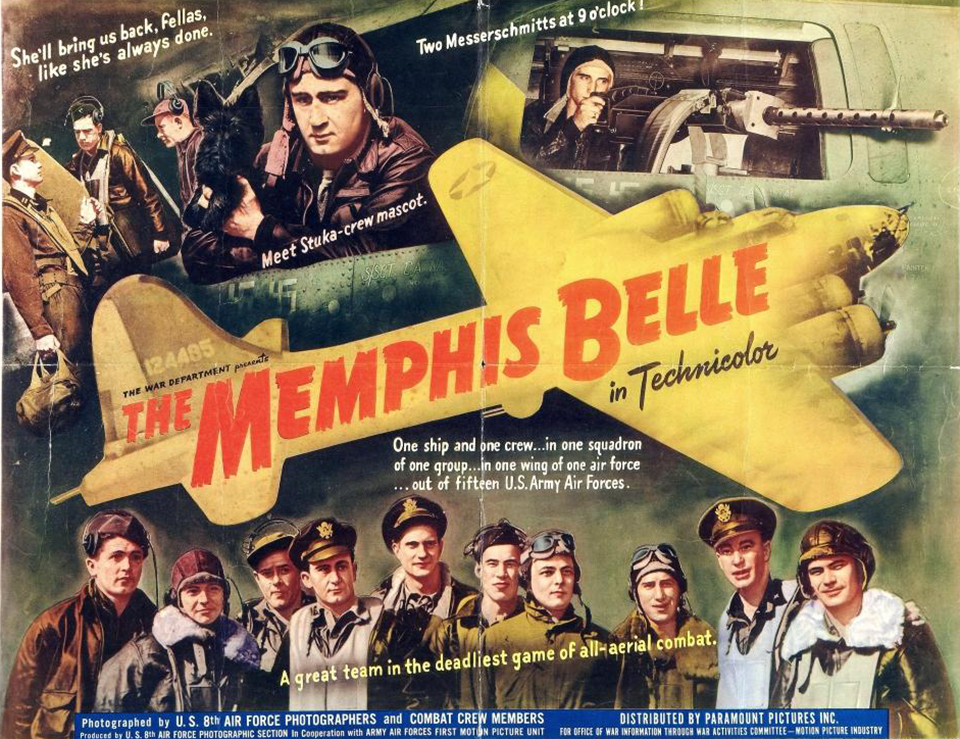
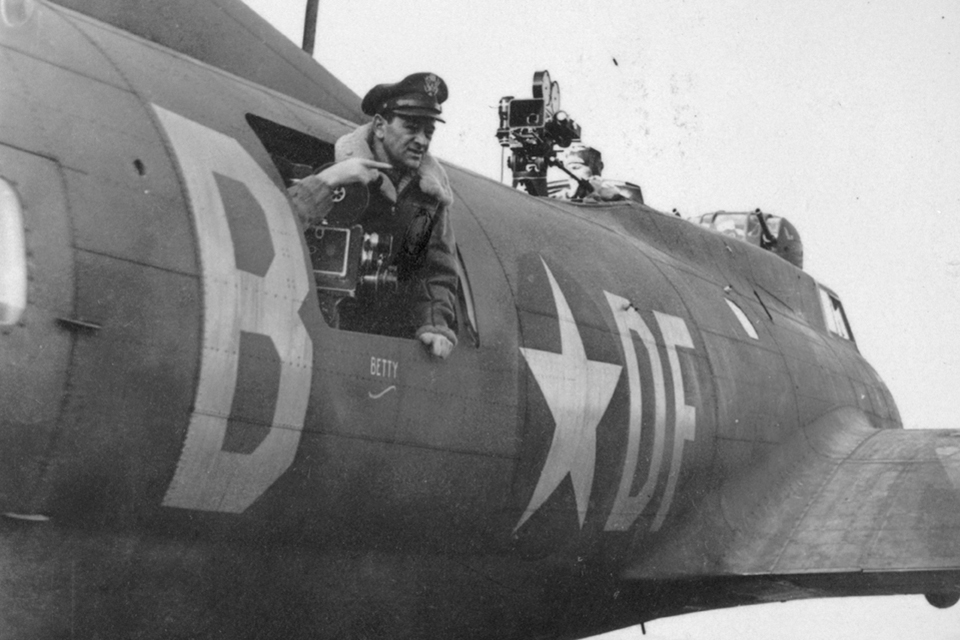
Filmmaker William Wyler created his The Memphis Belle documentary during the war. In postwar interviews, Morgan recalled that working with Wyler gave him his first taste of cinema. He told an interviewer that Wyler gave out 16mm cameras to crew members. “He said, ‘If you’re not busy shooting your guns, stick these cameras out the window and get some footage.’ Wyler stayed back by the waist gunners, because the angles he’d have gotten from the front would have been terrible. He flew five missions with us. We thought he was making a training film.”
The postwar movie 12 O’Clock High was partially based on Belle‘s history, as was the 1990 film Memphis Belle. While the latter was fictional (it borrowed exploits of many bombers), that and other movies have brought renewed attention to an aircraft that deserves a permanent spot in the hearts of Americans.
George T. Wilson hails from Memphis. For more on Belle‘s exploits, try: The Man Who Flew the Memphis Belle, by Colonel Robert Morgan, with Ron Powers; The Memphis Belle: Home at Last, by Menno Duerkson; and Biography of a B-17, by Brent Perkins.
This article originally appeared in the September 2003 issue of Aviation History magazine.
For more great articles subscribe to Aviation History magazine today!