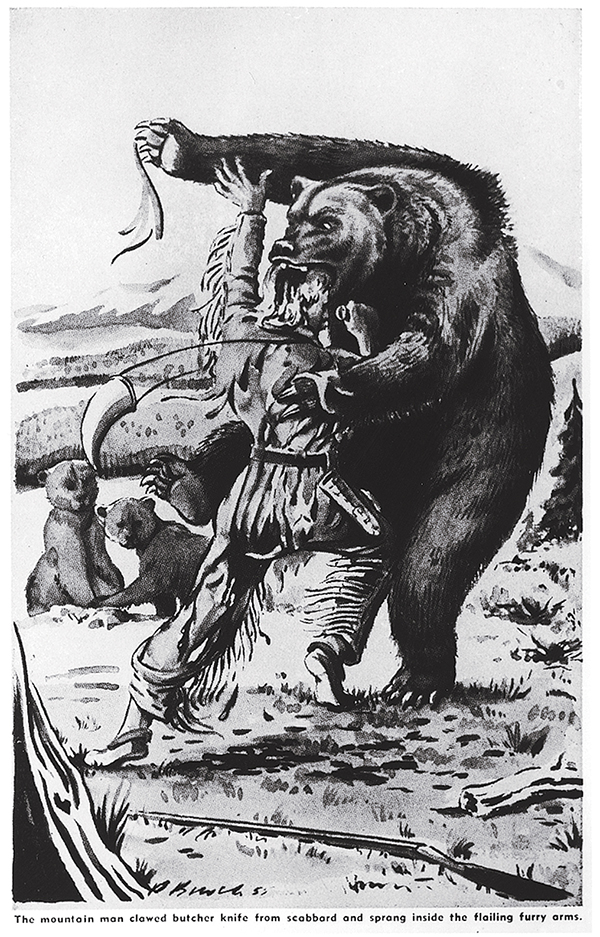
Every man there knew Hugh Glass was a gone ‘coon.’ They had only to look at what little the she-grizzly’s 3-inch claws had left of the old trapper. At least what they could make out through the blood, which was everywhere. To look at his shredded scalp…face…chest…arm…hand. To see how she’d chewed into his shoulder and back. They had only to listen to the blood bubble from the rip in his throat with his every breath. What astonished them was that he breathed at all. Again. And yet again.
Tough as they’d found the old coon (a term mountain men used to describe themselves) to be that summer of 1823 as they challenged the Upper Missouri tribes to reach the beaver streams, Major Andrew Henry and his nine trappers would have been incredulous if they’d known how indestructible Glass and his story have proved to be. That he would become the subject of controversy would not have surprised them. That some men would call him a liar and accuse him of slandering a gallant comrade might have puzzled them. The notion that Hugh Glass was about to crawl into American legend, to become an epic hero of story and poem, would have made them laugh.
He was going to die. Any minute now. Any fool could see that.
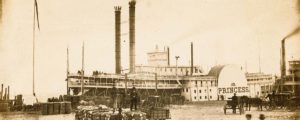
Hostile natives had already finished off 17 of their brigade. Arikara (also known as Ree) Indians had killed 15 in a June 2 attack that forced them off their Missouri River keelboats and–that route to the mountains closed–set them trudging west up the Grand River valley. August was two-thirds gone, yet several of them still nursed scars from that battle, including Old Glass, who’d taken a ball in his thigh. That hadn’t stopped him, but the grizzly had finally done him in.
He was old compared to most of his fellow mountain men. Nearing or in his early 40s, Glass was old enough to be the father of young men like Jim Bridger, who was beginning his second year as a trapper. But they called him ‘old’ with a measure of affection and respect. He was a loner, who often insisted on going his own way. His willful foray up the draw for ripe plums, which had ended in ‘Old Ephraim’s’ embrace, was typical. But his skill and courage had served them all well. Tall and powerfully built, he wasn’t a man to run from a fight.
One or two of the somber group that ringed his dying ground thought Glass deserved to lose this battle. He’d exposed them all to greater risk. The U.S. Army had made a sham of punishing the Arikara village for the devastating June attack. If a couple of frustrated trappers hadn’t torched the Arikara village on their own, the Rees could have laughed in their faces. They were uncowed and on the prod. Henry had ordered his small crew to stick close together as they hurried cross-country toward his fur post on the Yellowstone River. He allowed only two designated hunters and wanted no unnecessary gunfire.
Yet even with those precautions, they’d lost two more men in a recent night attack. Two others suffered wounds. When the attacking warriors proved to be usually friendly Mandans, the trappers knew the Ree contempt was spreading–Assiniboines, Sioux and Hidatsas could well emulate the Blackfeet, who already considered any white man fair game. To draw attention could be to die. The gunshots needed to finish the grizzly and her two yearlings echoed through the gully. So, too, did the screams of Glass. They had to get their 18th fatality underground and move. Now!
But this corpse was still breathing.
Others, watching, remembered Glass’ quick and effective response to the Arikara guns. Afterward, he’d nursed the wounded, especially young John Gardner. Knowing he was dying, Gardner had entrusted Glass with his last message to his family back in Virginia. Somewhere in his shadowy past, Glass had gained enough education to express himself clearly and gracefully in writing. He had proved more than equal to this sensitive task.
‘My painful duty it is to tell you of the deth of y[ou]r son…,’ Glass wrote the young man’s father. ‘He lived a short while after he was shot and asked me to inform you of his sad fate. We brought him to the ship where he soon died. Mr. Smith a young man of our company made a powerful prayer wh[ich] moved us all greatly and I am persuaded John died in peace….’
But the scribe himself would not oblige and follow. They tore strips from shirts and bound up his wounds as best they could, sure he’d be dead by morning. When the sun woke them, though, he still breathed.
The saga of Hugh Glass must be pieced together from accounts written by several of his contemporaries, each with varying details. Respected mountain man George C. Yount recorded in his memoirs that he talked with Glass directly, as well as with a trapper named Allen (Hiram Allen was one of Major Henry’s 1823 brigade) and a later Glass cohort of record named Dutton.
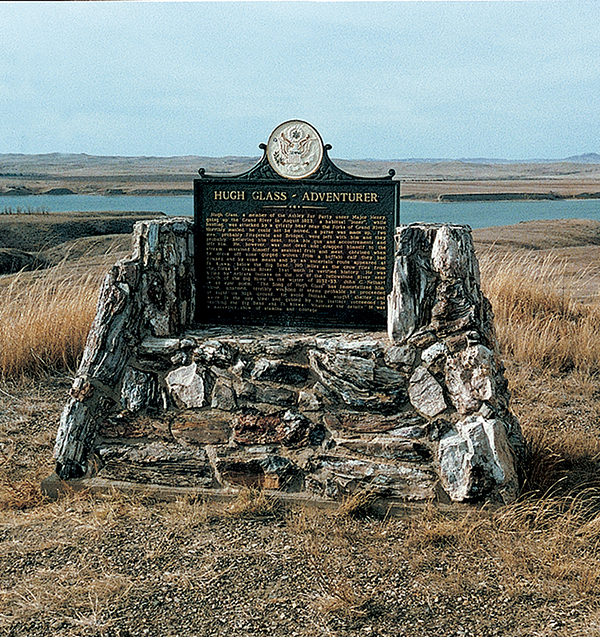
Allen recalled that Major Henry ordered branches cut for a litter and that they carried the groaning, blood-wrapped man two days or more. Whatever distance, it was too little, too painful and it took too long. Near the forks of the Grand River (in present-day South Dakota), the trappers reached a grove of trees that sheltered a spring-fed stream, and Henry faced facts. He could lose all his men trying to prolong the life of one already as good as dead.
They’d leave Glass here to recover, if he could, or die in peace. But the major needed two volunteers to stay until the expected happened and give Hugh a decent burial. It couldn’t be long. Then they could catch up. The company would pay each a bonus worth several month’s wages. He waited. Neither trapper Allen nor the experienced Moses Harris found the bonus worth risking his scalp for. There was dead silence.
Finally a man spoke up and then another–John S. Fitzgerald and 19-year-old Jim Bridger. Although he was the youngest of them all, Bridger had to support both himself and his younger sister with his wages. Whether inspired by practicality, compassion, or youthful optimism born of inexperience, Bridger accepted the charge. Before either could change his mind, Henry and the other seven hurried away.
Fitzgerald and Bridger were alone, except for the blood-caked, wheezing apparition at their feet. They could do nothing for him except administer a few drops of water and wave off the flies. Dusk came, then dark, then dawn. Every hour increased their risk. They could do nothing for themselves except watch anxiously for Indian sign and dig the grave so all was ready. Another day, another night. Their odds of catching up with the others shrank.
Through yet another sunrise Hugh Glass’ wispy breaths bound them to their dangerous camp as efficiently as a spider’s silk bound captured flies. And as fatally. Fitzgerald began to argue for moving on. The man was in his death sweats, but it was taking him forever. They’d stayed far longer than Henry expected, risked far more. It was time to save themselves. No one would blame them.
Eventually the younger man agreed. Quickly they collected their gear. But as Fitzgerald packed up, he proved he was intent on saving something more than his life. He also wanted both the bonus and his reputation. That required they tell Henry that Old Glass was dead and buried. And in the grave, Glass had no use for a rifle. Or powder and shot. Or his knife. Or his possibles sack with flint and steel. If they didn’t take all his fixins, someone was sure to ask why. In the mountains, you didn’t waste valuable gear on a corpse.
If Bridger was repelled by applying such logic to a corpse that not only was warm but also still drew breath and moaned now and again, he failed to raise convincing arguments against it. They moved the invalid to within reach of water and, certain his days of needing anything more were done, walked away, carrying every tool Hugh Glass possessed.
What they could not take away from him was more vital–his grit, his fury at their treachery, his will to survive and get revenge. The mind inside the battered head was on fire with fever, and he sank in and out of consciousness. He was close to death, but he’d been there before, and fortune had never left him completely on his own hook. He’d lived through scrapes those cowards had never dreamed of.
His trail should have ended half a dozen years earlier in that Pawnee village. He could remember the heat from his partner’s body after their Skidi Pawnee captors hung him up, shot hundreds of pine slivers into his skin and turned him into a human torch. Glass was to be the next sacrifice to the morning star. But when his turn came, something inspired him to fish a packet of vermilion from his pocket and calmly present it to the chief. The unexpected gift of the rare and valued red powder transformed this white man from a sacrifice into a favored son. He’d learned a lot in his years with the Pawnees.
Now, Glass faced an even greater survival test. In lucid moments, he reached for water, and as he became more aware he stripped buffalo berries from an overhanging bush. Crushing them in a palm full of water, he managed to get some down his damaged throat. For several days he could do no more. Then fortune found him, and he woke to see a torpid rattlesnake nearby. Glass stretched for a sharp-edged rock and killed the snake. Using the rock, or perhaps his razor (accounts vary), he shakily skinned the rattler and chopped the raw meat fine enough to get it down.
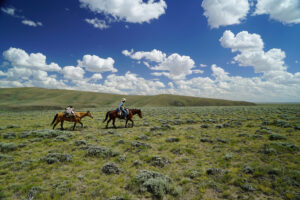
Gaining strength from the meat, he decided it was time. He rolled to his knees, but quickly discovered he could not stand. To follow his betrayers west over rough, rising country was not possible. But he had one good arm, one good leg. The nearest help would be back on the Missouri at the French fur post of Fort Kiowa. He began to crawl downstream. He put a yard, than another, behind him. When one of his feeble, quivering limbs collapsed, he rested until it could hold his weight again. Then crawled on.
His nose was close to the clay, but that’s where his food was also. Pawneelike, he dug for breadroot and robbed nests of eggs. When he came across a buffalo carcass, he hunted bones green enough, cracked them open and scraped and sucked the nourishing marrow. The yards stretched to rods, then a mile, then two a day. Focusing on what was possible, he refused to believe his goal was impossible–even though the fur post lay 250 miles away.
When a wolf pack downed a buffalo calf near where he crouched, he hungrily watched them devour about half the animal. He then bluffed the wolves away from the remains and gratefully gulped down whatever bits of liver, guts and heart they’d missed. The flesh was rich with blood; he needed all he could get. For the next few days he ate, rested, grew stronger. His torn back, which he could not reach to clean, festered and became infested with maggots. His other wounds were gradually draining, scabbing over, beginning to heal. When he headed on, it was on two feet–again a man.
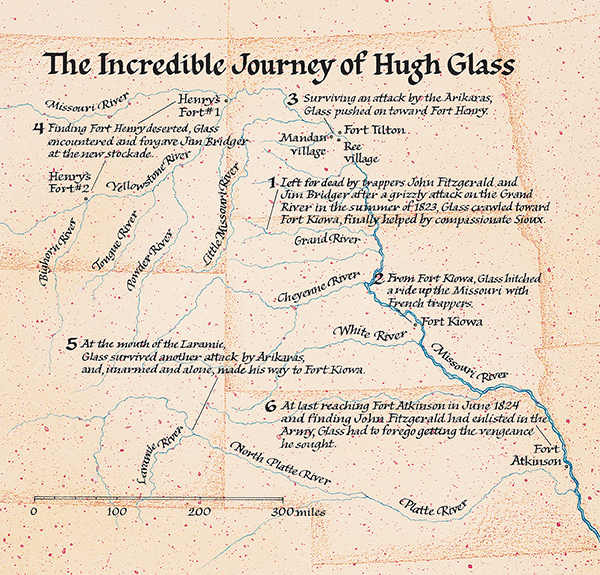
Before he reached the Missouri, nights were sharp with October’s frost. Somewhere along the river, perhaps on a sidetrip north to scavenge for corn in fields the Arikaras had abandoned, he met up with a party of Sioux on the move. In a good-natured mood, the Sioux took the tenacious cripple in, cleaned his back wound and helped him downriver to Fort Kiowa.
Glass took only a day or two to tell his story of betrayal and recruit his strength. The French company was sending a pirogue up the Missouri as far as the Mandan villages, hoping to reopen the long-established trade. Glass signed for a new outfit, gratefully hefting the new rifle that would give him vengeance, and hitched a ride. They’d put him that much nearer Fort Henry at the mouth of the Yellowstone.
Glass eagerly anticipated a confrontation upriver with his betrayers, but the French trappers were on edge. The Mandans had let Rees resettle in their unused adjacent village. Whose side were the Mandans on now? Did they offer trade or a trap? On October 15, 1823, the French leader wrote his last will and testament.
Of the seven men in that boat, only Hugh Glass and interpreter Toussaint Charbonneau reached the villages alive. Charbonneau, possibly anticipating trouble, had gone on ahead, and fortune had again nudged Hugh. He was ashore hunting at the critical moment Arikaras attacked the pirogue. Even then it was a close thing, for he did stumble into a group of Rees. He was losing his hobbling race for cover when one or two Mandan warriors chose to cheat the Rees of their prey and whisked Glass up on horseback and away to safety.
It was November 20 and safety was relative. Glass was still determined to reach Henry’s post. The Columbia Fur Company manned tiny Fort Tilton between the again-friendly Mandans and the unpredictable Rees, but the Rees kept them well corralled. The traders were amazed at Glass’ story, but if he insisted on going farther, the only help they could offer was to ferry him to the east side of the river where he was less apt to run into Rees. The 250-mile trek to the Yellowstone’s mouth, where Fort Henry sheltered his quarry, he had to make on his own.
He was used to that. But arcing northwest, he faced into numbing arctic winds and needed every skill to find food enough to keep his body going. He trudged riverbottom when he could, ranged the gale-swept buttes when he had to. The days had totaled nearly a month when he looked across the confluence and saw the walls of Fort Henry. He rafted over on two logs tied together with bark, but as he approached he must have realized the chimneys were smokeless, the corral empty, the stockade cold and deserted. Whatever despair he felt, it was not long before he moved on to more useful action. Finding sign that Major Henry and his men had headed south up the Yellowstone, he doggedly followed.
The year 1823 was giving way to 1824 when Glass staggered up to the pickets of the new stockade the major had built at the mouth of the Bighorn River. No cannon boomed a welcome. No one threw open the gate. The men inside, warm and woozy from passing the New Year’s keg, focused in disbelief on the emaciated ruin. What could be only a gaunt, frozen corpse walked into their midst carrying a rifle. Terror gripped their hearts. But only for a moment. This corpse talked. Identified himself. Incredible as it was, he was Old Hugh Glass. Tension melted into relief, celebration, a barrage of questions.
Except for one man. Young Jim Bridger still stood frozen in shock and fear. Then, as the questions were answered, he became shamefaced. By the time Glass’ recital peaked at the betrayal that had goaded him more than 1,000 miles–the vengeance he had struggled so far to enjoy–the young trapper was such a piteous sight that Glass could not bring himself to cock his rifle. Whatever words Glass actually used, his meaning was clear. Bridger knew he’d done wrong. His punishment would come from his own conscience. He was forgiven. John Fitzgerald–older, more treacherous — was another issue altogether. Glass still had some vengeance on his mind. Fitzgerald was the one who had convinced young Bridger to leave him–bear-battered but still breathing–at the Grand River. Where was that gutless varmint?
It was Glass’ turn to be rocked. Fitzgerald was gone. He’d quit the mountains and left in mid-November with Moses Harris and a third trapper. They’d been rowing down the Missouri as Glass was coming up. Somewhere along the way, the betrayer, who still held Glass’ treasured rifle, had crossed his path unseen. Fitzgerald was probably at Fort Atkinson by now.
On February 28, 1824, Glass started on his trail again, an eager volunteer to carry an express back to the States. He and a trapper named Dutton traveled with E. More, A. Chapman, and a man named Marsh south to the Platte River, where they built one or two bullboats. They pushed off, intending to boat down the Platte to the Missouri and Fort Atkinson. Seeing a large Pawnee encampment at the mouth of the Laramie River, they stopped to barter for food. Dutton waited in a boat with the guns while Glass and the others went to parley with Glass’ old friends. But they had hardly sat down when Glass caught a word or two spoken with a strange inflection. These were not Pawnees, but their cousins–whose village lay in ashes back on the Missouri.
‘These are Rickarees!’ Glass shouted. The men dived for the door and scattered, running, then swimming for their lives. On the far bank, Glass scrambled behind some rocks, from where he saw Moore and Chapman cut down. He lost track of the others. He hunkered down and waited for dark, then slipped away. Again alone he turned toward the Missouri, 400 miles east.
Sometime in May, Dutton and Marsh reached Fort Atkinson, where they reported sadly that their party of five had been attacked on the Platte by Arikaras, who’d killed Moore, Chapman and Glass.
They had underestimated Old Glass again. ‘Although I had lost my rifle and all my plunder, I felt quite rich when I found my knife, flint and steel in my shot pouch,’ he said later. ‘These little fixins make a man feel right peart when he is three or four hundred miles from anybody or any place.’ Unarmed, he decided to leave the Platte and veer north to Fort Kiowa, where he arrived early in June. A few days later he was at Fort Atkinson, telling his story and demanding Fitzgerald’s head and the rifle Fitzgerald had stolen from him.
Fitzgerald was indeed there, but he had enlisted in April, and the Army declined to let a civilian execute a soldier. Glass had to be satisfied with the knowledge he’d shamed his betrayer, a purse collected by sympathetic troopers, and the solid weight of his rifle again in his hand.
Before long, Glass joined a trading party heading for Santa Fe, and for nine more years he continued as a free trapper, always independent, living life on his own terms. Early in 1833, the Arikaras finally succeeded in ending that life when they caught him and two other trappers walking down the iced-over Yellowstone. When it was over, the Rees rode away, triumphantly bearing his long-cherished rifle. Had good fortune finally turned her head? Or, with age slowing his reactions and the end of the trapping era approaching, had she done him one last favor?
This article was written by Nancy M. Peterson and originally appeared in the June 2000 issue of Wild West.
For more great articles be sure to subscribe to Wild West magazine today!