When Germans, Americans, Italians or Belgians think of World War I aviation, the first names that come to their minds are usually their highest-scoring fighter pilots — Manfred von Richthofen, Eddie Rickenbacker, Francesco Baracca and Willy Coppens. However, while the French acknowledge René Fonck as their ace of aces, it is for their second-ranking ace, Georges Guynemer, that they reserve the greater fame and affection. The difference is largely a matter of personal impression. Fonck, though the higher scorer, with 75 confirmed victories, was a self-serving braggart who rubbed his comrades the wrong way. He further tarnished his image postwar by failing in a 1926 transatlantic attempt and being suspected of collaboration with France’s German occupiers during World War II. Guynemer, in contrast, eschewed fame while devoting all his energy to fighting for his country from the earliest days of air-to-air combat. Perhaps just as important, he died in battle, achieving national martyrdom and an immortality that Fonck was denied — partly because he had survived.
Born in Paris on December 24, 1894, Georges Marie Ludovic Jules Guynemer was a sickly child who studied at home until age 14, when he attended the Lycée de Compiègne. This was followed by Stanislas College, where his headmaster’s first report said he had “a willful character but is not particularly good at sports but shows promise at the College’s small bore rifle shooting competition.”
During a visit to the Panhard automobile factory, Guynemer acquired a lifelong interest in mechanics. In 1911 a friend of his father’s took him up for a 20-minute flight in a Farman airplane, and from then on Georges’ ambition was to fly. Focusing on his studies, he passed all his examinations in 1912 with highest honors, but his health failed again, and his parents took him to southern France. By the time he regained his strength, war had broken out in Europe.
Guynemer promptly applied for the air service, or Aviation Militaire, on August 3, 1914, but he did not pass the medical examination until the fourth attempt. Assigned to Pau aerodrome as a mechanic on November 23, Guynemer continued to press for flight training and finally succeeded. He earned his flying license on March 10, 1915, was promoted to corporal on May 8 and was assigned to Escadrille MS.3 at Vauciennes, near Villers-Cotteret, on June 8. He flew his first mission over the front two days later, and his observer, Private Jean Guerder, reported that the new pilot displayed no fear from either groundfire or the occasional rifle fire they encountered from passing German reconnaissance planes.
Equipped with Morane-Saulnier L two-seater parasol monoplanes when Guynemer joined it, MS.3 was in the process of transitioning from a reconnaissance to a fighter unit, under the aggressive leadership of Captain Antonin Félix Gabriel Brocard. On July 3, 1915, Brocard, armed with only a carbine, attacked an Albatros two-seater over Dreslincourt, killed its observer and brought it down. Among the many pilots inspired by that feat was Guynemer, who installed a machine gun mount behind the observer’s cockpit of his Morane-Saulnier L.
On July 19, Guynemer and Guerder encountered an Aviatik two-seater, and Guynemer promptly attacked, while Guerder blazed away as opportunity permitted. Ultimately the duo succeeded in shooting down the enemy plane between the lines, killing its crew. Both Guynemer and Guerder were awarded the Médaille Militaire for scoring MS.3’s second air-to-air victory.
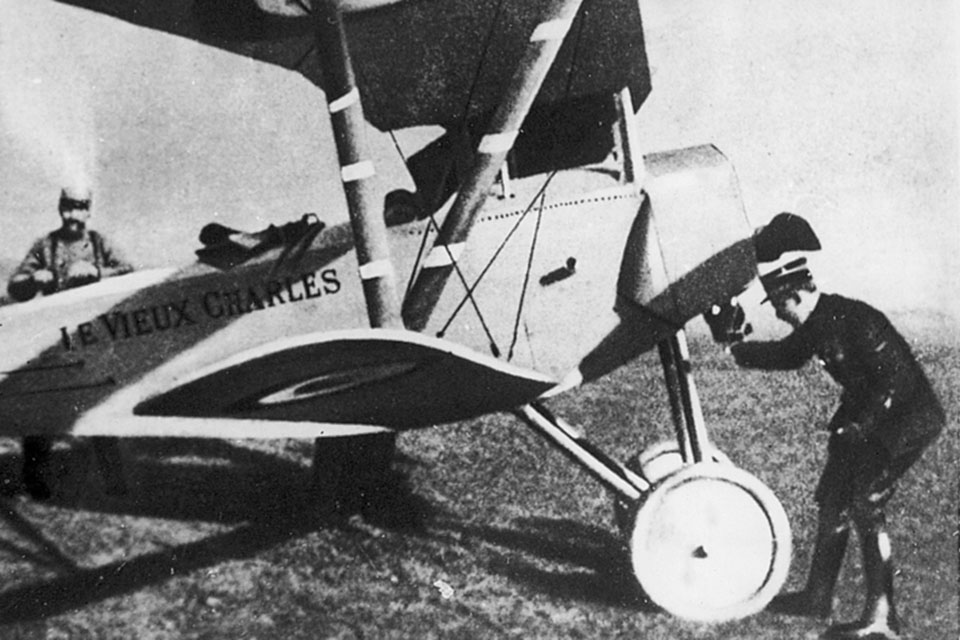
A few day later, MS.3 began receiving more potent aircraft for aerial combat. Designed by Gustave Delage, the Nieuport 10 was a two-seater sesquiplane, with a single-spar lower wing of much narrower chord than the upper, braced by V-shaped interplane struts and powered by an 80-hp Clerget or Le Rhône 9B rotary engine. Nieuport pilots began installing a lightweight Lewis machine gun above the upper wing, on a mounting that allowed the weapon to be pulled down so the pilot could change its ammunition drum. Some aggressive units had the observer’s cockpit faired over, turning the reconnaissance plane into a single-seat fighter. In the summer of 1915, Nieuport tested a smaller single-seat version of the 10. Designated the Nieuport 11, it came to be popularly known as the Bébé (baby).
On August 28, Brocard shot down an enemy plane north of Senlis. His escadrille was fully reequipped with Nieuports on September 20 and officially redesignated N.3. On December 5, Sergeant Guynemer, flying a single-seat Nieuport 10, shot down an Aviatik over Bois de Carré. He downed an LVG five days later, and on the 14th he teamed with a two-seater Nieuport 10, crewed by Adjutant André Bucquet and Lieutenant Louis Pandevant, to bring down a Fokker monoplane over Hervilly.
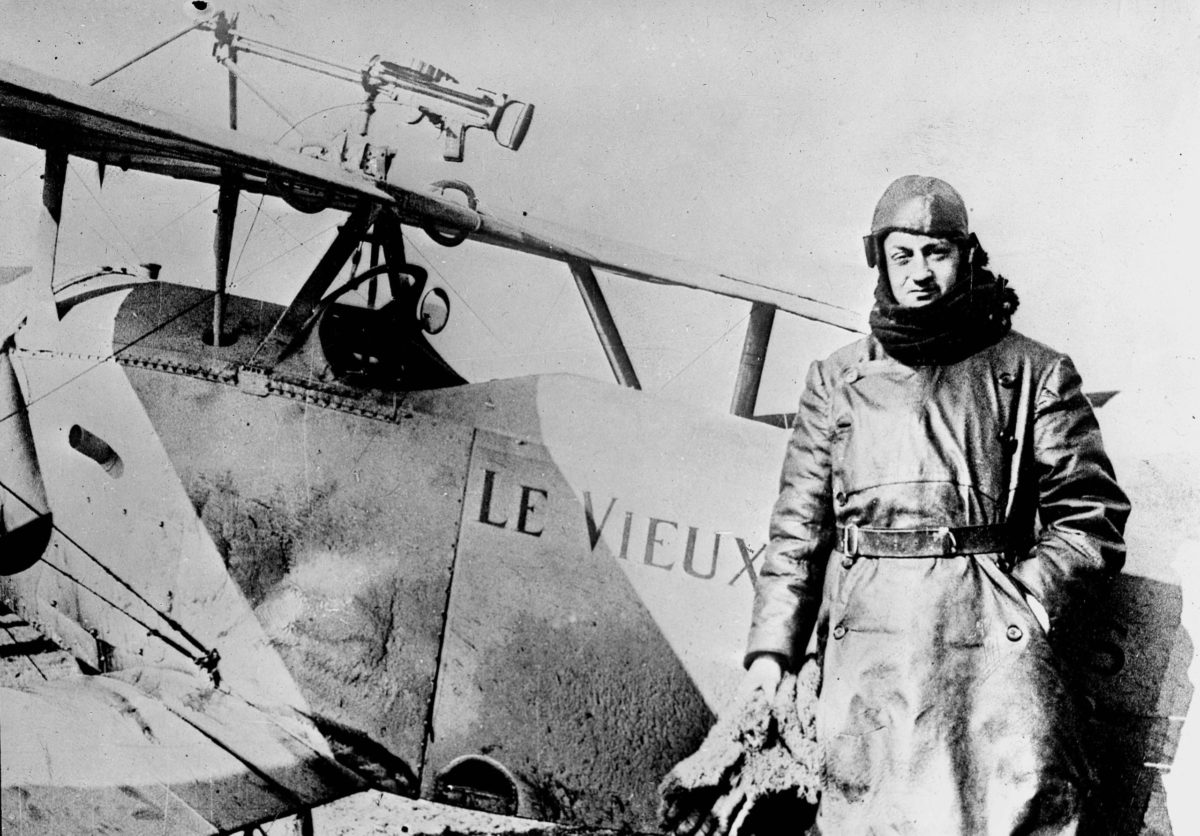
Early in 1916, Guynemer received Nieuport 11 N836. On its fuselage he applied the legend Le Vieux Charles, a reference to Sergeant Charles Bonnard, a well-liked member of old MS.3 who had transferred to the Macedonian front. Guynemer was flying that Bébé on February 3, 1916, when he encountered an LVG near Roye. “I did not open fire until I was at 20 meters,” he later wrote. “Almost at once my adversary tumbled into a tailspin. I dived after him, continuing to fire my weapon. I plainly saw him fall in his own lines. That was all right. No doubt about him. I had my fifth. I was really in luck, for less than ten minutes later another plane, sharing the same lot, spun downward with the same grace, taking fire as it fell through the clouds.”
Guynemer drove down an LVG at Herbecourt on February 5, and one more on March 12. While engaging another LVG the next day, however, he was hit twice in the arm and wounded in the face and scalp by fragments from his windscreen. While recovering he received a permanent commission as sub-lieutenant on April 12.
By the time Guynemer rejoined N.3 in mid-1916, the escadrille was mainly equipped with the Nieuport 17, a somewhat enlarged version of the Bébé with a 110-hp Le Rhône engine and a synchronized .30-caliber Vickers machine gun firing through the propeller. On June 22, he teamed with Sergeant André Chainat to destroy an LVG for his 10th victory. On July 16, he took on three LVGs and seven Roland and Halberstadt fighters, surviving 86 hits on his Nieuport to emerge with credit for one of the two-seaters. He downed another LVG on the 28th, helped Lieutenant Alfred Heurteaux to down an enemy plane on August 4, added an Aviatik to his tally on August 17 and a Rumpler the next day.
On September 2, Guynemer received another new fighter, one in which he would become personally involved in more ways than one. In 1915 Swiss designer Marc Birkigt had designed a remarkably lightweight, water-cooled eight-cylinder engine, the 150-hp Hispano-Suiza 8A. One of the first airplane builders to take an interest in the new power plant was the Societé Anonyme Pour l’Aviation et ses Dérivés, or Spad. Early in the war, Spad’s chief designer, Louis Béchereau, had tried to solve the problem of firing a machine gun past the propeller arc by placing a gunner in a pulpit held by means of struts in front of the propeller and its 80-hp Le Rhône rotary engine. The Spad A2 proved to be a failure, but its basic airframe was sound. Its single-bay wing cellule, which featured intermediate struts to which the bracing wires were attached at midpoint, added strength and, by reducing vibration in the wires, reduced drag as well. Adapting that arrangement to the Hispano-Suiza 8A engine and a synchronized Vickers machine gun, Béchereau created the Spad 7.C1, or VII, which was ordered into production on May 10, 1916.
Among the earliest units to receive the new fighter was, of course, N.3, in late August 1916. Just two days after being assigned Spad VII S115, Guynemer used it to destroy an Aviatik C.II over Hyencourt. In five minutes on September 23, Guynemer downed two Fokkers, plus a third that went unconfirmed, but as he returned over the lines his plane was struck by a 75mm shell fired by nervous French anti-aircraft gunners. With the water reservoir shattered and fabric torn away from his left upper wing, Guynemer spun down. But he managed to regain control just in time to pull up and crash-land in a shell hole, emerging with a cut knee and a slight concussion. “Only the fuselage was left, but it was intact,” he wrote his father afterward. “The Spad is solid, with another machine I would now be thinner than this piece of paper.” Sold on the new fighter, he was back in action in Spad VII S132 two days later.
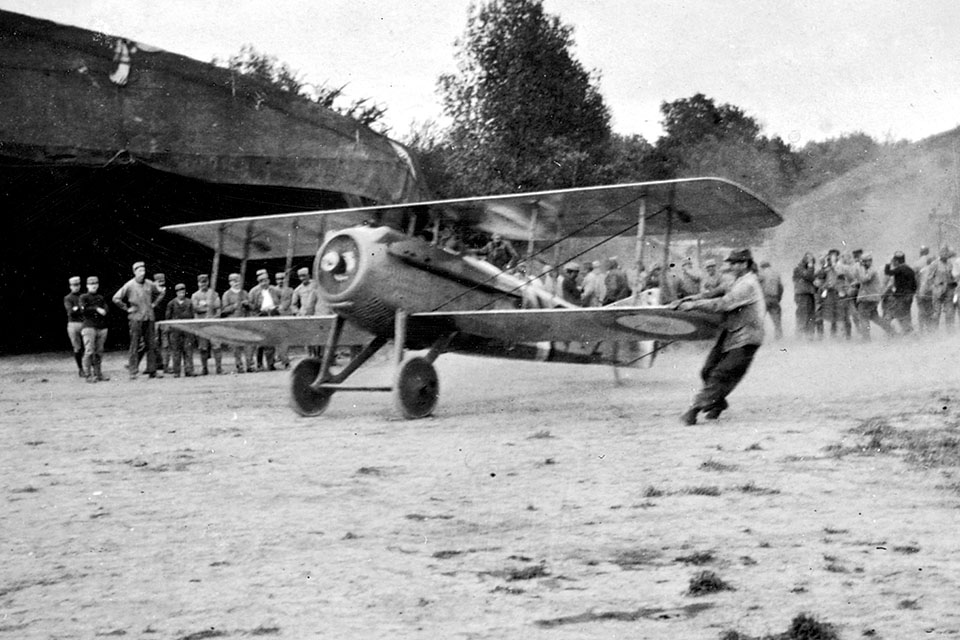
By November 1, N.3 had been credited with 65 enemy aircraft shot down, for the loss of three pilots, two observers and one gunner killed in action, and two pilots and two observers missing. Guynemer had 18 victories to his credit, and five of his squadron mates — René Dorme, André Chainat, Alfred Heurteaux, Albert Deullin and Mathieu Tenant de la Tour — were also aces of considerable renown.
As famous as its pilots were the markings of N.3’s aircraft. Its squadron insignia was a stork, a bird known to nest annually in the chimneys of Alsace-Lorraine, which had been in German hands since the end of the Franco-Prussian War in 1871. N.3’s stork symbolized France’s determination to return and retake those provinces. Within the squadron, pilots had become associated with the numbers that identified their planes — 1 was Brocard’s, 2 adorned nearly all of Guynemer’s aircraft, 3 was Deullin’s, 6 was Chainat’s, 7 was Alfred Auger’s, 8 was Joseph-Henri Guiguet’s, 9 was Georges Raymond’s, 11 was Heurteaux’s and 12 was Dorme’s. Personal touches included Guynemer’s famous legend Le Vieux Charles beneath his cockpit, as well as Chainat’s l’Oiseau Bleu, Guiguet’s P’tit Jo, Raymond’s Ma Ninon and Pére Dorme (Father Dorme), which alluded to the maturity rather than the age of the coolly vindictive Dorme, who was then 22.
Guynemer also applied some creative flair to the sound of his Hispano-Suiza engine. Whenever he returned to the aerodrome after downing an enemy, he would open and close the throttle to produce a punctuated sound that resembled the words “J’en ai en” — “I got one of them.”
On October 16, N.3 became the nucleus of a new concept in aerial warfare. During the Verdun and Somme campaigns, the French had collected fighter squadrons into temporary groups to achieve local air superiority. Now they would form permanent groupes de combat, one of the first being GC.12. Commanded by Brocard, GC.12 combined his old escadrille, N.3, now under Lieutenant Heurteaux, with N.26, N.73 and N.103. The group officially commenced operations from Cachy aerodrome on November 1. In the months that followed, its other escadrilles would adopt variations on N.3’s stork as a common emblem for all their aircraft.
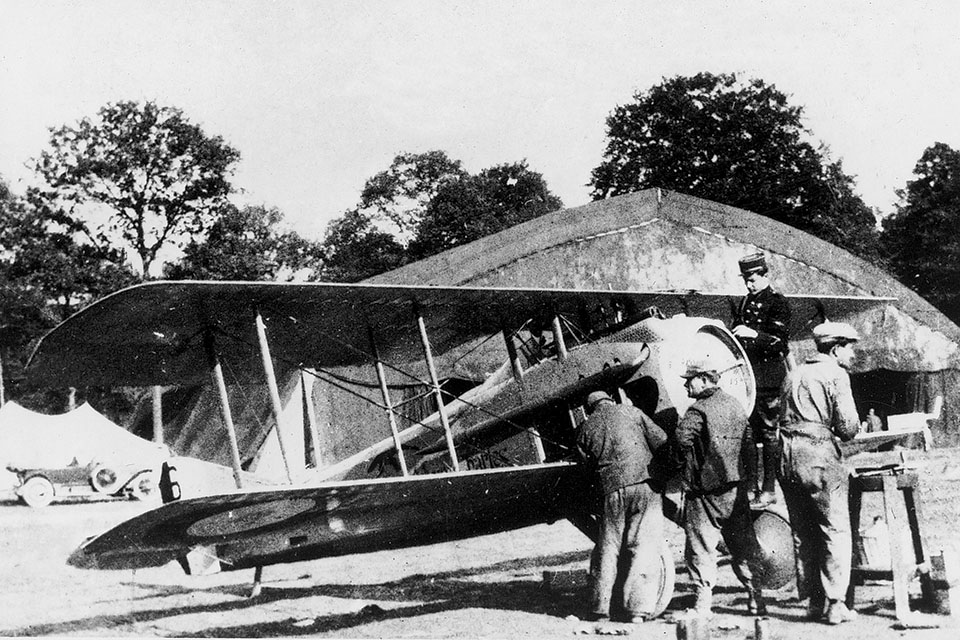
When he was not hunting enemy planes, Guynemer used his fame — and influence — to advocate advances in the tools of his trade. In December 1916, he wrote a letter to Béchereau: “The 150-hp Spad is not a match for the Halberstadt. Although the Halberstadt is probably no faster, it climbs better, consequently it has the overall advantage. More speed is needed; possibly the airscrew could be improved.”
As one response, Hispano-Suiza increased the compression ratio of its original engine to produce the 180-hp 8Ab. The first Spad VII to use it, S254, was presented to Guynemer in mid-December 1916. He went on to score 19 victories in that plane and never changed its engine — a remarkable indication of both the motor’s reliability and that of the ground crewmen who maintained it, often joined by former mechanic Guynemer himself. Fortunately for posterity, the doubly historic S254 survived combat and decades of retirement, eventually to be restored and displayed at the Musée de l’Air et l’Espace at Le Bourget. The 180-hp Hispano 8Ab, combined with improved cooling systems and other refinements, allowed the Spad VII to hold its own practically to the end of the war.
The groundwork for a successor to the Spad VII was laid on June 11, 1916, when Hispano-Suiza successfully bench-tested a new geared V-8 engine, the 8B, which could produce 208 hp at 2,000 rpm at ground level. After testing it in the Spad VII, Béchereau decided that a somewhat larger, more robust airframe would be necessary to accommodate it. The Spad 13.C1 or XIII, which was ordered into production in February 1917, featured twin .30-caliber Vickers machine guns. In spite of an impressive maximum speed of 124 mph and a climb rate of 13,000 feet in 11 minutes, problems with the Hispano-Suiza 8B’s spur reduction gear would delay the Spad XIII’s frontline debut and would handicap it for months thereafter.
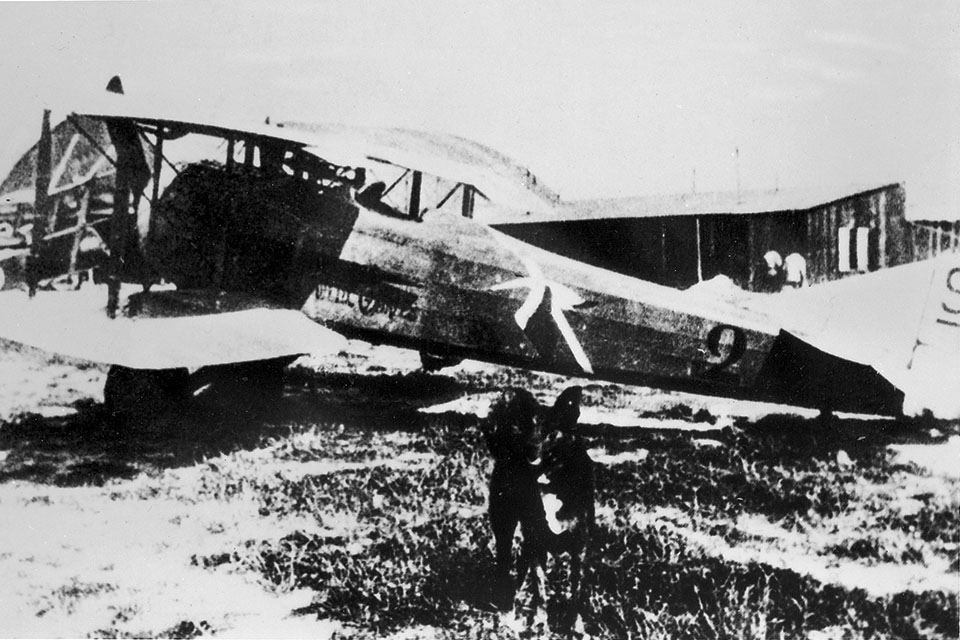
Another suggestion that Guynemer made to Béchereau at the end of 1916 was for a fighter capable of mounting a cannon. Since the geared Hispano-Suiza engine raised the propeller above the cylinder heads, Birkigt was indeed able to arrange a 37mm Puteaux cannon with a shortened barrel to fire through a hollow propeller shaft. Taking matters from there, Béchereau designed an enlarged version of the Spad VII, which was designated the 12Ca.1, or type XII. Although the XII was elegant to look at, its cockpit interior was intimidating, with the cannon breech protruding between the pilot’s legs. This necessitated Deperdussin-type elevator and aileron controls on either side of the pilot instead of a central control column. When Guynemer test-flew it in May 1917, the main flaw he saw in what he called his “avion magique” was the fact that the 37mm cannon was a single-shot weapon that had to be reloaded by hand. However, the Spad XII also had a single synchronized Vickers machine gun, which could be used to help sight the cannon on a target before it was fired, or to help the pilot fight his way out of trouble after it had been fired.
Promoted to lieutenant on the last day of 1916, Guynemer started his scoring for the new year with a double on January 23, 1917, when he sent a Rumpler C.I down in flames over Maurepas and drove another two-seater down near Chaulnes. Heurteaux and Guynemer were both credited with double victories on the 24th. Just as he was closing in on a Rumpler C.I that morning, Guynemer’s motor quit, but using what momentum he had, he got in a telling burst and forced the enemy plane down near Goyencourt. After getting his engine working again, he downed a second Rumpler.
Borrowing Adjutant Bucquet’s Spad on January 26, Guynemer intercepted an Albatros C.VII, only to find that his machine gun would not fire. In spite of that and the 200 rounds loosed at him by the German observer, he managed to bluff the pilot into landing at Monchy airfield. Landing there, Guynemer learned from the embarrassed German that the pilot of the Rumpler he had forced down at Goyancourt two days earlier had to have his leg amputated above the knee, and that its observer had been killed. That confirmation from a captured enemy brought Guynemer’s score up to 30, and added to the legend of a hero who was already the talk of France.
In a subsequent conversation, Guynemer expressed his attitude toward attacking two-seaters. “It was simply murder for the fast chasse airplanes to bring down the poor old observation planes,” he opined, “but in view of the consequences of the observation to artillery and infantry, it was necessary to repress one’s natural repugnance to engaging in such unequal combats and to attack the slower planes with all one’s strength.”
At the end of January, GC.12 moved to Manoncourt-en-Vermois in response to recent German bombing attacks on the nearby city of Nancy. On February 8, 15 twin-engine Gotha G.IIIs and seven fighters were reported crossing the lines at Moncel-sur-Seille. All the Storks scrambled up, but it was Guynemer and Chainat who managed to intercept one of the big planes. Guynemer attacked from the rear and was met by heavy machine gun fire, but managed to score hits on both of the Gotha’s engines. Soon after landing, Guynemer and Chainat learned that the bomber, riddled with 180 hits, had crash-landed at Bouconville and that its three-man crew had been taken prisoner. The Gotha was subsequently exhibited at La Place Stanislas Leczinski in Nancy.
On March 16, Guynemer became the first Frenchman to shoot down three enemy planes in one day. His first, in collaboration with Lieutenant Raymond, was an Albatros two-seater in flames at 0908 hours. Within 22 minutes of that success, N.3 engaged Roland D.IIs of the recently formed Jagdstaffel 32. Guynemer brought down a Roland, whose wounded pilot, 2nd Lt. Rudolf Lothar Arndt Freiherr von Hausen, was taken prisoner, while Deullin sent Jasta 32’s commander, 1st Lt. Heinrich Schwander, down in flames. Guynemer had a lively discussion with von Hausen in the field hospital near St. Nicolas-de-Port after the fight, but the young German later died of complications from bleeding and tetanus on May 15.
On the afternoon of March 16, French President Raymond Poincaré arrived to present Guynemer with the Russian Order of St. George 4th Class, but the award ceremony came as an anticlimax at 1430, when he witnessed the ace send another Albatros two-seater down burning over Regnéville-en-Haye, not far from the aerodrome. The next day Guynemer and Captain Kiyotake Shigeno, a Japanese volunteer in N.26, teamed up to destroy another two-seater in flames near Attancourt.
April 1917 saw the start of a series of costly Allied offensives that kept GC.12 in action. Guynemer downed Albatroses on April 14, May 2 and May 4, and then took leave to test-fly the new Spad XII. Upon his return, he made history again on May 25, by shooting down four two-seaters in a single day. That afternoon, however, Pére Dorme, then second only to Guynemer with 23 confirmed and 29 probable victories to his credit, was killed near Reims by Reserve 2nd Lt. Heinrich Kroll of Jasta 9.
Guynemer scored another double victory on June 5, but during that period of intense combat, an incident occurred that somewhat contradicted his relentlessly deadly image. In his book, Mein Fliegerleben, Ernst Udet described his dogfight with a lone Spad near Lierval:
“Sometimes we pass so closely I can clearly recognize a narrow, pale face under the leather helmet,” Udet wrote. “On the fuselage, between the wings, there is a word in black letters. As he passes me for the fifth time, so close that his propwash shakes me back and forth, I can make it out: ‘Vieux’ it says there — vieux — the old one. That’s Guynemer’s sign. Yes, only one man flies like this on our front, Guynemer, one who had brought down thirty Germans. Guynemer, who always hunts alone, like all dangerous predators, who swoops out of the sun, downs his opponents in seconds, and disappears….I know it will be a fight where life and death hang in the balance.”
Udet, though a consummate flier in his own right, was unable to outmaneuver Guynemer. “I try anything I can, tightest banks, turns, side slips, but with lightning speed he anticipates all my moves and reacts at once,” he wrote. “Slowly I realize his superiority. His aircraft is better, he can do more than I, but I continue to fight. Another curve. For a moment he comes into my sights. I push the button on the stick…the machine gun remains silent…stoppage!”
For what Udet described as the longest eight minutes of his life, he struggled on while trying to clear his jammed weapons. At one point he was pounding on the receiver with both fists when the Spad flew over his Albatros. “Then it happens,” Udet wrote. “He sticks out his hand and waves to me, waves lightly, and dives to the west in the direction of his lines.”
Udet remained convinced ever since that Guynemer, seeing his plight, had spared him in an act of knightly chivalry. With the benefit of hindsight, however, a later, less idealistic breed of fighter pilot might have thought the French ace’s noble compassion somewhat misplaced, given the total of 62 Allied planes credited to Udet by the end of the war.
At the start of July, Guynemer received the first operational Spad XII, S382. During its first frontline sortie on July 5, he attacked a DFW C.V two-seater, but the enemy gunner inflicted such damage that he had to disengage and return the cannon Spad for nearly three weeks of repairs. Reverting to his Spad VII, he downed a DFW C.V the next day and scored another double victory on July 7.
On July 11, GC.12 was ordered north to the Dunkirk area, to support General François Anthoine’s First Army, fighting alongside the British in the Third Battle of Ypres. Shortly after the group’s arrival in the sector, British Sopwith Camel pilots arrived to familiarize its personnel with GC.12’s aircraft. “There was a Canadian I remember, one of their aces, I cannot remember his name,” recalled Louis Risacher, a Parisian-born flying instructor who obtained a transfer to N.3 on June 27. “He offered to have a mock dogfight….It was decided by Guynemer and the Canadian ace that they would cross in the air and the ‘combat’ would begin at once. Immediately, Guynemer was on his tail and he could not get him off….Guynemer had outmaneuvered a Camel in a Spad — absolutely!”
Although French spirits were high, they were entering an extraordinarily dangerous sector. Unlike the Aviation Militaire, Britain’s Royal Flying Corps (RFC) and Royal Naval Air Service (RNAS) had pursued a policy of constantly sending offensive patrols into enemy territory, with or without a specific mission, simply as a gesture to assert aerial supremacy. The Germans, who referred to their British adversaries as being “more sporting” than the French, usually responded to the challenge whenever they chose and on their terms, resulting in the heavy British losses of “Bloody April” and a concentration over their sector of some of the most battle-seasoned Jagdstaffeln in the German air service. Those would include a group of four squadrons, created in emulation of GC.12, in June 1917: Jagdgeschwader (fighter wing) I, consisting of Jastas 4, 6, 10 and 11, under the command of Captain Manfred Freiherr von Richthofen.
Guynemer took a few days’ leave to visit his family, during which his father suggested that he retire from combat and reapply his experience as an instructor and a technical adviser. “And it will be said that I have ceased to fight because I have won all the awards,” Georges replied. “Let them say it,” his father protested, “for when you reappear stronger and more ardent, they will understand…there is a limit to human endurance.” “Yes,” Georges shot back, “a limit! A limit to be passed. If one has not given everything, one has given nothing.”
On July 20, Guynemer got his Spad XII back, and on the 27th he used it to destroy an Albatros fighter between Langemarck and Roulers with eight machine gun rounds and one cannon shell. He downed a DFW C.V over Westroosebeke the next day, using two shells and 30 bullets, but again his victim’s return fire sent S382 back to the repair shop until August 15. Guynemer scored a “double” on August 17 — one German two-seater with machine gun fire alone, and a second with the cannon — but an inconclusive fight with an aggressive two-seater crew the next day put his plane temporarily out of action once more.
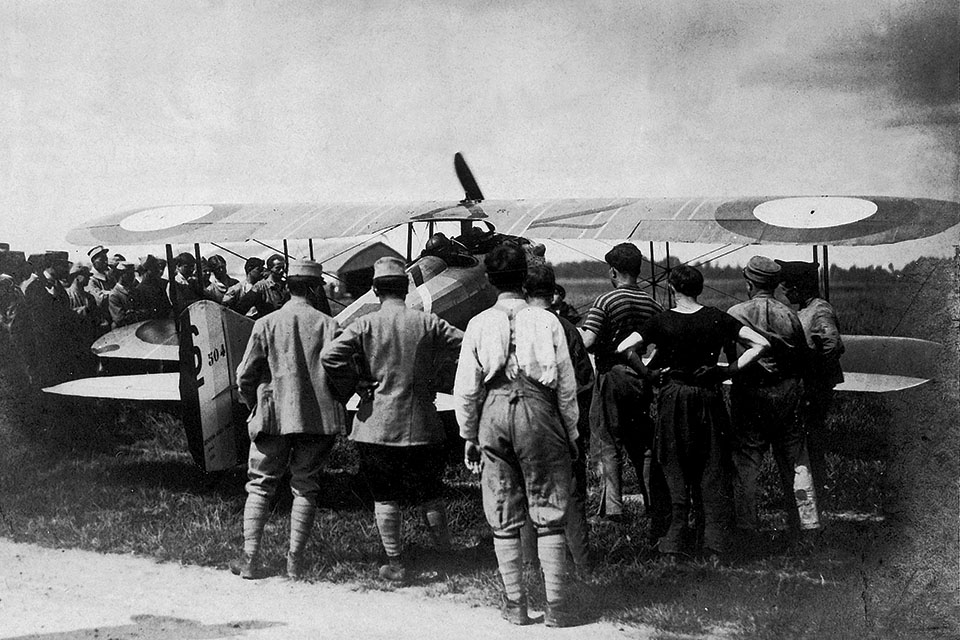
In spite of his mixed fortunes, Guynemer had achieved enough success in the cannon fighter for Spad to get a contract for 300 more. It is doubtful that anywhere near that number were built, however, for the few Spad XIIs that saw service proved to be a handful for all but the most skilled pilots. Meanwhile, Guynemer received Spad XIII S504 and wasted no time in blooding it by shooting down a DFW C.V over Poperinghe on August 20. Guynemer’s first victory in the twin-gun Spad was also his 53rd overall.
On the 24th, Guynemer visited the Spad factory at Buc, to inspect the repairs to his Spad XII and recommend improvements. Typically for Guynemer, who seldom rested, he was in a dangerously nervous state, and on the 28th he remarked to a friend, “I shall not survive.”
After returning to N.3, Guynemer took off with Sub-Lieutenant Benjamin Bozon-Verduraz on September 8, but bad weather forced them to abort their patrol. With the weather still unsuitable for flying on the 9th, Guynemer attended Sunday Mass at St. Pol-sur-Mer. He took off in S504 on September 10, but had to land at the Belgian airfield at Les Möeres when the plane’s water pump control became stuck. After returning to N.3, Guynemer borrowed Deullin’s new Spad XIII to attack a large number of German aircraft, but took four bullets in his plane and was forced to land with a disabled air pump. Returning by automobile, he took off in another borrowed Spad, but this time the fuel overflowed due to a loosened carburetor cover, the engine caught fire and Guynemer was again forced to make a hasty landing.
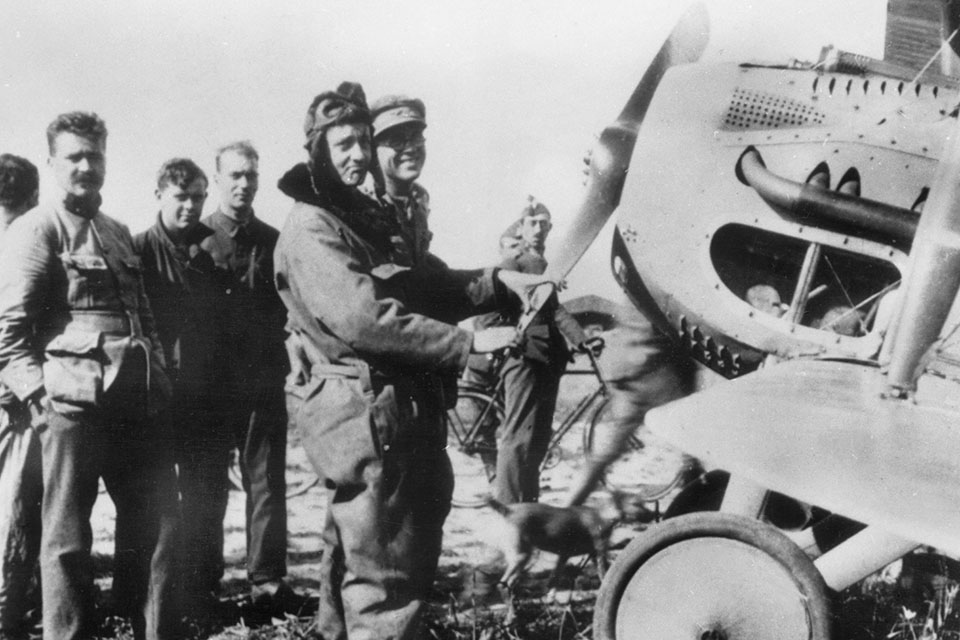
Visibly annoyed by the day’s bad luck, Guynemer ordered his mechanics to have S504 working and ready to fly at 0800 hours the next morning, but fog delayed takeoff until 0825 on September 11. He was to have been accompanied by Bozon-Verduraz and Sergeant Risacher, but the sergeant was having trouble starting his engine, and Guynemer impatiently took off with Bozon-Verduraz only.
The haze disappeared at 5,000 feet altitude, and at 12,000 feet the Frenchmen spotted what Bozon-Verduraz later identified as a DFW C.V northeast of Ypres. Waving to his wingman, Guynemer dived on the German from above and behind. Bozon-Verduraz followed him, fired, missed and was pulling up to make another pass when he noticed eight German aircraft approaching. The enemy formation turned away, so Bozon-Verduraz went back to find Guynemer, only to see no trace of him or the DFW. Following another indecisive combat over Poperinghe, Bozon-Verduraz returned to St. Pol-sur-Mer at 1020. His first words were, “Has he landed yet?”
Guynemer had not, nor would anything be known of his fate for another month, when the Germans announced that 2nd Lt. Kurt Wissemann of Jasta 3 had killed the great ace for his fifth victory. Wissemann himself was not available for comment by then, having been killed on September 28 by two S.E.5as of No. 56 Squadron, flown by Captain Geoffrey H. Bowman and Lieutenant Reginald T.C. Hoidge. Other witnesses indicated that Guynemer’s luck had run out while attacking a German two-seater that was shot down elsewhere later that day. Recent research by historian Marco Fernandez-Sommerau indicates that Flieger Georg Seibert and Reserve 2nd Lt. Max Psaar of Royal Württemberg Flieger Abteilung (Artillerie) 224 were on a long-range reconnaissance flight in Rumpler C.IV 1643/17 at that time and suggests that Psaar may have shot down Guynemer. The Germans continued with their mission, but three hours later they were caught and killed near Dixmuide by Sub-Lieutenant Maurice Medaets, a Spad VII pilot of the Belgian 10th Escadrille. In any case, a sergeant of the German 413th Regiment certified that he had seen the Spad crash and identified the body, noting that Guynemer had died of a head wound, although one of his fingers had also been shot off and a leg was broken.
In his career, Guynemer had been made an Officier de la Légion d’Honneur, his Croix de Guerre was adorned with 26 palms and he also received the British Distinguished Service Order and medals from Russia, Belgium, Serbia, Romania and Portugal. Once, when asked what decoration remained for him to obtain, Guynemer had replied, “The wooden cross.” That last honor, however, was ironically denied him, for an Allied artillery barrage drove the Germans back before they could recover or properly bury his remains, which thus vanished amid the chaos that was the Western Front. Whatever the tragic circumstances of his death, however, Georges Guynemer entered French legend as its second ranking ace, who, popular myth insisted, had flown so high he could never come down.
This article was written by Jon Guttman and originally published in the September 2006 issue of Aviation History. Jon Guttman wishes to thank German reader Joern Leckscheid for the recent update on who might have killed Georges Guynemer. For more great articles subscribe to Aviation History magazine today!
To build your own homage to the legendary ace, click here!