
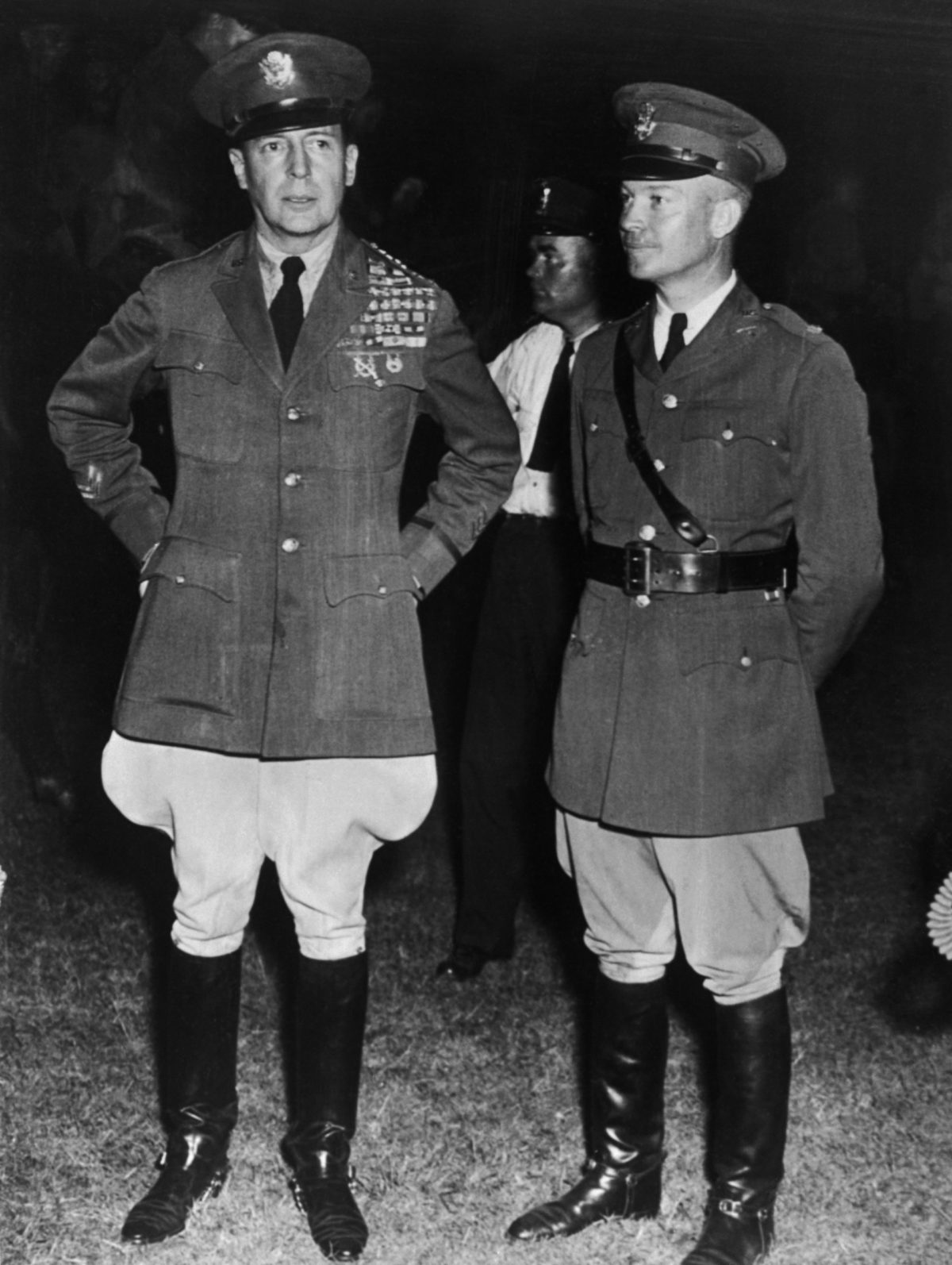
One of the most enigmatic relationships in modern military history was that of Dwight Eisenhower and Douglas MacArthur. Their often turbulent association spanned virtually the entire decade of the 1930s, during which time Eisenhower worked almost exclusively for MacArthur in a multifaceted role of secretary, adviser, staff officer and, frequently, whipping boy. Theirs was a relationship that began with great promise and ended in a lifelong enmity between two of the most important figures of World War II.
Douglas MacArthur had risen to the army’s highest and only four-star rank in 1930 after a brilliant career that mirrored the exploits of his famous father, Lt. Gen. Arthur MacArthur Jr., who had earned the Medal of Honor on Missionary Ridge, Tennessee, in November 1863. Obsessed with emulating his father, MacArthur became first captain of the Corps of Cadets at the U.S. Military Academy, graduated first in his class, and was recommended for but never awarded the Medal of Honor for his exploits during the Veracruz, Mexico, expedition in April 1914.
MacArthur’s valor under fire in the famed 42nd “Rainbow” Division was legendary and earned him the distinction of being the most decorated American soldier of World War I. As the superintendent of West Point from 1919 to 1922, MacArthur instituted major reforms that finally brought the archaic military academy into the 20th century.
By contrast, Eisenhower graduated from West Point in 1915 with an indifferent academic record and no firm belief that the Army represented a permanent career choice. To his dismay, he spent World War I commanding a tank training center at Camp Colt, in Gettysburg, Pennsylvania. Frustrated by his failure to see combat in France, and convinced his military career might never recover, Eisenhower nevertheless emerged from the war with a glowing reputation as a troop trainer.
He soon came to the attention of Brig. Gen. Fox Conner, perhaps the Army’s most brilliant intellectual, who rejuvenated and further sharpened Eisenhower’s already significant appetite for reading and studying history. Under his intense one-on-one tutelage, Eisenhower’s military education began to take shape in the early 1920s in Panama. In the narrow world of the interwar military, where budgets rather than military necessity ruled supreme, Conner was a steady voice of reason who repeatedly warned Eisenhower of future danger from a resurgent and aggressive Germany.
GET HISTORY’S GREATEST TALES—RIGHT IN YOUR INBOX
Subscribe to our HistoryNet Now! newsletter for the best of the past, delivered every Monday and Thursday.
Eisenhower: Macarthur’s perfect Aide
When MacArthur became the army’s youngest-ever chief of staff in 1930, the most highly regarded staff officer in the War Department was a balding 40-year-old major named Dwight D. Eisenhower. That Eisenhower would eventually be chosen to toil exclusively for MacArthur was, in retrospect, inevitable. From the time of his assignment to the general staff in late 1929, his drive, initiative and seemingly endless capacity for producing well-organized and thoughtful staff work had made Eisenhower an invaluable commodity to the men who ran the War Department. Eisenhower was not only exceptionally loyal to his bosses but was, according to Stephen Ambrose, “able to think from the point of view of his chief, a quality both MacArthur and [George] Marshall often singled out for praise. He had an instinctive sense of when to make a decision himself and when to pass it up to his boss.”
Eisenhower was one of MacArthur’s few subordinates who could objectively judge both his virtues and his flaws. Never one to freely dispense praise, Eisenhower’s greatest compliments were reserved for MacArthur: “He did have a hell of an intellect! My God, but he was smart. He had a brain.” All genius has its price, and for MacArthur it was an inviolate belief in his own infallibility.
“MacArthur could never see another sun, or even a moon, for that matter, in the heavens as long as he was the sun,” Eisenhower told biographer Peter Lyon.
Eisenhower was by equal measures awed and repelled by MacArthur. Although impressed by his genius, his charm and his flattery toward a junior officer, he deplored MacArthur’s posturing and unwillingness to accept advice. On balance, however, Eisenhower viewed their relationship as positive.
As it happened, the two men were very heavy smokers, thoroughly addicted to nicotine. They were both ideal candidates for lung cancer. Although neither ever contracted the deadly disease, Eisenhower’s years of smoking undoubtedly contributed to his later health problems.
Clashing Personalities
MacArthur, Harvard professor Samuel Huntington noted, was a general in the tradition of Winfield Scott: “brilliant, imperious, cold, dramatic officers deriving their values and behavior from an older, aristocratic heritage and finding it difficult to subordinate themselves to civilian authorities.” Gen. Harold K. Johnson, U.S. Army chief of staff from 1964 to 1968 and a survivor of the Bataan Death March, viewed MacArthur as “a great commander in the tradition of a Caesar. [But] I don’t think that he was the human sort of man that Eisenhower was.”
By contrast, Eisenhower was representative of “the friendly, folksy, easygoing soldier who reflects the ideals of a democratic and industrial civilization and who cooperates easily with his civilian superiors,” according to historian T. Harry Williams. Whereas MacArthur seemed to relish controversy and often dashed boldly into frays, Eisenhower, “Speaking less and smiling more than MacArthur … appeared the embodiment of consensus rather than controversy. MacArthur was a beacon, Eisenhower a mirror.”
That two such polar opposites could survive each other without conflict occurs only in fiction. By 1932, although still officially assigned to the office of Assistant Secretary of War Frederick H. Payne, Eisenhower had long since become MacArthur’s de facto military secretary. That year, he found himself involved in one of the most disgraceful incidents in American history and the most personally repugnant and controversial event of his military service under MacArthur.
More on Ike and Mac
The Bonus Army Fiasco
In 1924, Congress had voted to award to some 3.5 million veterans what were called Adjusted Compensation Certificates — basically bonds masquerading as one $1,000 bonuses due to mature in 1945 (or upon the death of the holder). For some it was the only asset they possessed. As America entered the 1930s, the bread line and the soup kitchen had become national symbols of the Depression, and joblessness, unrest and privation became the catalyst for the Bonus March on Washington in the summer of 1932. The veterans believed their government had betrayed them by failing to pay the promised compensation for their World War I service. But an unsympathetic Hoover administration turned a blind eye to the plight of the former servicemen and never considered paying the bonus. When the veterans began to mount organized protests, they were stonewalled in the ill-advised belief that to react would inevitably lead to even further unrest.
More than 10,000 veterans, calling themselves the Bonus Expeditionary Force, converged on Washington to lobby Congress, some with their families, virtually all with no place to live and no money to afford food or accommodations. A few squatted in unoccupied, condemned buildings along Pennsylvania Avenue not far from the White House, but the largest contingent created an enormous shantytown in the Anacostia mud flats, unofficially known as “the Flats” or “Hooverville.” Violence broke out the morning of July 28, 1932, when District of Columbia police attempted to eject the squatters from downtown. Exceeding Hoover’s orders merely to clear the protesters, the War Department called out armed troops on that fateful July afternoon. Although Eisenhower attempted to dissuade him, MacArthur elected to personally direct the operation dressed in full uniform.
That evening, MacArthur was alleged to have ignored a directive from Hoover that the army was not to pursue the protesters across the Anacostia River and clear the shantytown. The Bonus March ended after someone set fire to one the shanties, and as the few remaining veterans and their families fled into the night, the Washington, D.C., Hooverville was consumed by flames. (Decades passed before historical evidence established beyond doubt that the controversial order for the Army not to advance on Hooverville never reached MacArthur.)
Eisenhower thought any public comment by the army inadvisable and, as MacArthur prepared to return to the War Department, suggested his boss ought to avoid contact with the press and let the Hoover administration defend the army’s actions. During a late-night press conference, however, MacArthur was unable to resist gloating at having saved the nation from “incipient revolution” by a mob of “insurrectionists,” likening it to the liberation of a nation from tyranny. The press reacted to MacArthur’s outburst with almost universal condemnation.
Making excuses
Eisenhower was chosen to draft the official after-action report that stoutly defended MacArthur and the army; privately, he shared in the general disgust at the Army being ordered to attack its own veterans, calling it a pitiful scene. About all he ever publicly said about the incident was that he had counseled MacArthur concerning the impropriety of becoming directly involved. Yet at times his attitude toward MacArthur and the Bonus March seemed rather self-serving, and his few public remarks biographer Piers Brendon described as “disingenuous,” “bland” and “charitable.” Eisenhower, he believes, was “ever ready to sacrifice plain-speaking on the altar of benevolence.”
After loyally defending MacArthur’s actions during the Bonus March for years, however, a truer expression of Eisenhower’s disdain was revealed in 1954 when he noted in his diary, “I just can’t understand how such a damn fool could have gotten to be a general.” He was even more candid later during an interview with Stephen Ambrose: “I told that dumb son-of-a-bitch he had no business going down there. I told him it was no place for the Chief of Staff.”
The long-term damage from the Bonus March was incalculable in an era in which the military was already under fire and facing budgetary cutbacks. MacArthur and the army became the public exemplars of an ungrateful nation that rewarded its veterans by gassing, bayoneting and shooting them. During his long and distinguished military career MacArthur was at the heart of numerous controversies, but none did more to permanently tarnish his reputation, and that of the Army he headed, than the Bonus March. Eisenhower had properly anticipated trouble and offered sound advice; MacArthur, perhaps blinded by his own self-importance, had not heeded it. The lamentable result was an unmitigated public relations fiasco at a moment when the Army could ill afford to become even more inconsequential.
Prince and Pauper
In February 1933, Eisenhower moved into a tiny alcove no larger than a broom closet behind a slatted door adjacent to MacArthur’s large inner sanctum, to become his principal special assistant and, on occasion, his aide. MacArthur’s method of summoning Eisenhower to his presence was to simply raise his voice. Eisenhower would later write that Douglas MacArthur “spoke and wrote in purple splendor.” Most of their discussions were really monologues in which MacArthur pontificated and Eisenhower listened, often amused by his chief’s references to himself in the third person. Whereas George S. Patton Jr. and MacArthur believed they were men of destiny, Eisenhower had no such illusions or aspirations.
MacArthur was squired to Capitol Hill and around Washington in a fancy, chauffeured limousine. Eisenhower, whose business frequently required him to visit Capitol Hill, took a street car or taxi and was humiliated at having to return all leftover change and file a travel voucher for reimbursement. MacArthur “never once offered Eisenhower a ride in or use of the car.” Eisenhower never forgot it, and even after his two terms as president the memories still smarted.
“No matter what happens later you never forget something like that,” he confessed to a reporter shortly before his death.
Life with MacArthur was a vivid reminder of the difference between the haves and the have nots. More than 20 years after leaving his hometown of Abilene, Kansas, Eisenhower was still dirt poor and faced career prospects as bleak as the economy. What little hope the military professionals of the 1930s had was vested in Douglas MacArthur, whose reputation for bravery and the reform of West Point was unmatched in the army.
Despite Eisenhower’s admiration for MacArthur, he found himself increasingly dismayed, even appalled, by his superior’s massive ego and pompous behavior. When it came to melodrama, complete with exhortations to duty and invocations to the Almighty, punctuated by exaggerated body language, MacArthur had no equal. Eisenhower was exposed to his full array of ploys and thought MacArthur would have been “a great actor.” MacArthur’s most polished performance was to parade back and forth in front of a large mirror across from his desk, dressed in a Japanese silk dressing gown, an ivory cigarette holder clamped in his mouth, admiring his profile while orating. Gen. Lewis H. Brereton, who served under MacArthur in the Philippines and, later, Eisenhower in Europe, once remarked that MacArthur “cannot talk sitting down.”
Professional Admiration
Before their falling-out, MacArthur’s praise for Eisenhower was both heartfelt and genuine. MacArthur valued his subordinate and bestowed plaudits upon Eisenhower in letters of commendation and consistently superior efficiency reports. In 1932 he wrote that Eisenhower was “one of the most outstanding officers of his time and service … he has no superior in his grade.”
During the Washington years, Eisenhower’s greatest asset was his pen. He authored anything of substance created by MacArthur or the office of the assistant secretary of war, be it speeches, letters, reports, or staff studies. Despite the drudgery of such staff work, Eisenhower was in the right place and time to be at the forefront of American military policy in the 1930s, an experience he would assimilate and draw upon in World War II. Despite his rather lowly status as a very junior general staff officer in an era when the general staff was markedly unpopular on Capitol Hill, congressmen and senators were in the habit of contacting Eisenhower directly on matters concerning the War Department.
When it came to manipulating and taking advantage of the bureaucracy, Eisenhower had no peer. He developed a political awareness and a thorough understanding of what it took to survive in the higher reaches of the military and political jungle of the 1930s.
Eisenhower’s efficiency as a general staff officer, however, came at a price. His type-A personality, with its explosive temper and relentless intensity in his work, took a heavy toll on his health. The various ailments for which he sought treatment included bursitis in his left shoulder, acute gastroenteritis, colitis, hemorrhoids, influenza, tonsillitis, an acute intestinal obstruction and constipation; also mild arthritis, kidney problems, a dental disease, recurrent pain in his knee and, worst of all, severe back pain. His eyesight was affected by long hours of paperwork, and his eyeglass prescription was strengthened. Years later, Ike told his son, John, “I always resented the years I spent as a slave in the War Department.”
Manila melodrama
MacArthur, during his second tour in the Philippines, from 1922 to 1925, had become closely acquainted with Manuel Quezon. The future Filipino president was then deeply involved in the Philippine independence movement as the leader of the Nationalist Party. The MacArthur name was still highly esteemed in the Philippines, and during a trip to the United States in 1935, Quezon implored MacArthur to become his military adviser, and easily persuaded President Franklin D. Roosevelt to send him to the Philippines. Roosevelt not only disliked MacArthur but also viewed him as a political threat. When MacArthur’s five years as chief of staff ended in 1935, FDR offered MacArthur the opportunity to return to a place he dearly loved. The politically naive MacArthur accepted at once, never seeming to recognize that it suited Roosevelt to have him 11,000 miles from Washington.
MacArthur resolved that Eisenhower would accompany him to Manila and subjected him to his full repertoire of melodramatics. Ultimately, Eisenhower’s decision had less to do with better pay or an opportunity to satisfy his lifelong yen for duty in the exotic Philippines than it did with the fact that subordinates simply did not say no to Douglas MacArthur, who sweetened the offer by permitting Eisenhower to nominate another officer to accompany them and share in the duties. Eisenhower chose an old friend and West Point classmate, Maj. James Basevi Ord. Also in MacArthur’s entourage was Capt. Thomas Jefferson Davis, familiarly known as “T.J.” He had been MacArthur’s aide since 1927 but was also a close friend of Eisenhower’s, and he faithfully served as a key member of his staff during World War II.
With few backers to look after his interests in Washington and with no power, MacArthur had gone from a high-profile player to an also-ran. By becoming closely identified with MacArthur’s falling star, Eisenhower also put his own future squarely on the line. Then in his mid-40s and still a lowly major after more than 15 years in grade, Eisenhower’s prospects were bleak. He entertained no illusions that he was destined for anything more than a modest rank as perhaps a junior general officer in the event of war.
“He was tying his kite to an officer whose career was finished,” historian Robert H. Ferrell said.
Impossible Mission
MacArthur’s mission was to create and train a Philippine defense force to safeguard a virtually indefensible island nation. By 1936, the urgency faced by the American mission increased with each new act of Japanese aggression in Southeast Asia. Hardly anyone in Washington, however, cared about the Philippines, which were seen as not only extremely hard to defend but of no strategic importance.
MacArthur’s plan for defense of the islands was predicated on the presence of an American battle fleet to discourage a would-be Japanese invasion, yet the War Department’s Plan Orange contained no such provision. MacArthur thus became the architect of a noble but ultimately unachievable undertaking.
Eisenhower and Ord shared the duties of satisfying the divergent demands of MacArthur and Quezon. Eisenhower was already well versed in Philippine problems from his service under MacArthur in Washington. However, it became virtually impossible to persuade Washington to increase the miniscule Philippine budget. Although MacArthur never accepted the premise, it was soon evident to Eisenhower that theirs was a hopeless mission.
One of MacArthur’s conditions for accepting the job was that Quezon promote him to the rank of field marshal in the Philippine army. MacArthur’s willing acceptance of an ersatz field marshal’s commission contradicted American military tradition and appalled Eisenhower. It became one of the primary reasons for their later estrangement. MacArthur thought that such an exalted rank was quite necessary to enhance the prestige of his position. He not only accepted the title but the extra pay of $3,980 per month, making him the highest-paid military officer in the world.
When Quezon formally presented MacArthur with a gold baton as a symbol of his new position, Eisenhower nearly gagged with disgust, terming the ceremony “rather fantastic.” He thought it “pompous and rather ridiculous” for MacArthur “to be the field marshal of a virtually nonexisting army.”
Eisenhower adamantly refused to accept Quezon’s attempt to promote him to the rank of brigadier general in the Philippine army. In 1967, Eisenhower recalled to biographer Peter Lyon his furious arguments with MacArthur over what he believed was his superior’s disloyalty to the U.S. Army.
“You have been a four-star general,” he told him. “This is a proud thing …. Why in the hell do you want a banana country giving you a field-marshalship?”
MacArthur not only rejected his pleas but, recalled Eisenhower, “Oh, Jesus, he just gave me hell!”
MacArthur’s relations with the Philippine president eventually deteriorated so badly that it was Eisenhower and Ord, not MacArthur, to whom Quezon most often turned for advice. The longer MacArthur remained in Manila, the more distant he became from Quezon.
Despite his status as a junior officer, Eisenhower never backed down from confronting MacArthur over policy issues he deemed impractical or impossible to carry out. The Philippine army had no workable logistical system and few qualified officers. Ord and Eisenhower repeatedly urged MacArthur to visit Washington to lobby for his program in person, which he reluctantly did in 1937.
Surviving MacArthur
How did Eisenhower manage to challenge one of the U.S. Army’s most autocratic soldiers with virtual impunity? Few officers of any rank ever dared to defy MacArthur, much less with Eisenhower’s vehemence. During MacArthur’s 48-year military career, no one ever stood up to him more forcefully than Eisenhower.
The reasons had as much to do with Eisenhower’s increasing confidence in his own professional ability as with his belief that MacArthur needed him more than he needed MacArthur. Eisenhower’s flaming temper and his own considerable ego made him a match for MacArthur’s imperiousness. Each was far too stubborn to give in to the other. John Eisenhower believes that both were at fault: “Faced with plenty of other frustrations in the job they were trying to perform, neither man seems to have made much effort to realize what the other was going through.”
Even so, Eisenhower’s shouting matches and his defiance verged on outright insubordination.
“Probably no one had tougher fights with a senior man than I did with MacArthur. I told him time and time again: `Why in the hell don’t you fire me? Goddammit, you do things I don’t agree with and you know damn well I don’t.'”
That MacArthur could have ruined his career at the stroke of a pen does not seem to have bothered Eisenhower nor, he said, did it occur to him to worry about the possible consequences.
His stormy encounters with MacArthur undoubtedly toughened Eisenhower for the enormous pressures and demands that he would face during World War II. Nevertheless, their deteriorating relations took a heavy toll on Eisenhower, who at times wished MacArthur had actually sacked him. MacArthur, however, was too shrewd to deprive himself of Eisenhower’s services and ignored their differences.
Jimmy Ord was sent to Washington in 1937 to beg for the loan of field artillery, patrol boats and other armaments and war materiel for the Philippines from an indifferent War Department. By this time, however, a growing awareness in Washington that Japanese aggression might well lead to war produced an unwillingness by the Army to part with any of its meager supplies, and few were sent.
With Ord away, the full workload fell upon Eisenhower, who longed for his friend’s return: “The sooner he comes the better for me, I’m tired,” he later recalled thinking. “Over a year and a half at this slavery in this climate and no leave!”
When the position of U.S. high commissioner of the Philippines was created in 1935, Roosevelt selected a powerful political ally, Frank Murphy, to fill it. Relations between the commission and MacArthur’s headquarters grew frosty. Murphy not only disliked MacArthur but also was thought to have been behind an attempt to force the closure of the military mission and MacArthur’s recall to the United States.
Eisenhower became fed up with the intrigues. Murphy, he wrote in his diary in July 1937, was “supposed to have written letters home to the President and the Secretary of War demanding relief of mission. O.K. by me!! I’m ready to go. No one seems to realize how much energy and slavery Jim and I put into this d— job.”
Breaking Point
The most stressful year of Eisenhower’s service in the Philippines was 1938. The pressures on him worsened, as he became the butt of MacArthur’s frustrations.
“I’m worn out,” he wrote. “Every time one of these `tempests in a teapot’ sweeps the office I find myself, sooner or later, bearing the brunt of the General’s displeasure …. I could be the fair-haired boy if I’d only yes, yes, yes!! That would be so easy too!!”
Ord and Eisenhower again clashed with MacArthur, this time over the latter’s insistence that a number of Filipino army units be assembled for a national parade through the streets of Manila as a means of invigorating public morale. MacArthur had not discussed, much less cleared, his idea with Quezon, and when Ord and Eisenhower informed him that their budget could not possibly stand such a hit without sacrificing funds needed to carry out more important projects, the pair was summarily overruled. When Quezon learned of the plan, he conveyed his displeasure to MacArthur. Embarrassed by the matter, MacArthur lamely denied he had ever ordered his staff to proceed. The chief scapegoats were Ord and Eisenhower. The parade was duly canceled, but the bad feelings between MacArthur and his two assistants were heightened.
“Never again were we on the same warm and cordial terms,” recalled Eisenhower.
Eisenhower believed that, by failing to back his own staff, MacArthur had been disloyal. He was furious at MacArthur for in effect branding him a liar to Quezon, an act he deemed the ultimate disloyalty.
“I am not a liar,” he challenged, “and so I’d like to go back to the United States right away.”
Realizing that for once he had gone too far, MacArthur placed an arm around Eisenhower’s shoulder and turned on all of his considerable charm, brushing their clash aside with the comment, “Ike, it’s just fun to see that damn Dutch temper …. It’s just a misunderstanding, and let’s let it go at that.”
In fact, the incident irreparably damaged their relationship. Although Eisenhower restricted voicing his resentments to a small circle of intimate friends, he never forgave MacArthur and later related to his friend Robert L. Eichelberger that the incident had been the last straw in their deteriorating relationship.
Nevertheless, in early 1938, Eisenhower willingly agreed to a one-year extension in Manila at the urging of both Quezon and MacArthur, a decision made more out of loyalty to the president than allegiance to MacArthur. Yet Eisenhower began to suspect that his days in Manila were numbered after MacArthur disputed an increase in Eisenhower’s per diem from the Philippine government. The increase was duly awarded, but Eisenhower thought MacArthur’s opposition hypocritical. Eisenhower’s growing disenchantment was exacerbated by the untimely death of Jimmy Ord in January 1938, the result of a freak airplane accident. Ord’s death left Eisenhower thunderstruck and grieving at the loss of a dear friend whom he had loved like a brother.
Eisenhower had not only lost his friend but also gained a cold-blooded rival. At Eisenhower’s own recommendation, Ord was replaced by Maj. Richard Sutherland, a dour infantry officer who remained in MacArthur’s service throughout World War II, rising to become his chief of staff. Ruthlessly ambitious, Sutherland was universally disliked and openly schemed to get rid of Eisenhower, who failed to recognize the full extent of Sutherland’s determination to undermine his standing with MacArthur. The perfect opportunity arose in 1938, when Eisenhower returned to the United States for several months. Sutherland filled in for him, and only after he returned to the Philippines did Eisenhower learn that he had lost his job and had been cast into an insignificant role.
A New World War
On Sept. 1, 1939, war erupted in Europe when Hitler’s armies invaded Poland, using a bogus pretext to crush a valiant but hopelessly outgunned Polish army in a matter of days. Britain and France responded by declaring war against Germany. For the time being, the United States remained neutral.
It was clear to Eisenhower that this was a war America could not long avoid. If he was to fulfill his ambition to play a meaningful role before facing an inevitable forced retirement, he had to make something positive happen. His duty in the Philippines brought it home that while he still appeared youthful, he had indeed slipped into middle age and possessed few prospects other than more years of toil for a man for whom he had lost respect. Angry and frustrated, Eisenhower was reminded on a daily basis that his “reward” for more than six years of working for MacArthur was a demotion.
Eisenhower asked to be relieved of his duties in Manila effective in August 1939 and met immediate opposition from both MacArthur and Quezon. However, no amount of persuasion or inducements, including a large cash offer and other perks from Quezon, who dangled a virtual blank check, would dissuade Eisenhower.
“I’m a soldier. I’m going home. We’re going to go to war and I’m going to be in it,” he proclaimed.
Lessons in Leadership
What conclusions can we draw from the seven years these two strong-willed men served together? For his part, MacArthur was utterly intolerant and unforgiving of those who he believed had betrayed him. Noted Eichelberger, who had known MacArthur since 1911 and served as a corps commander under him during World War II: “The most outstanding characteristic of Gen. MacArthur was his vivid hatreds. He talked to me many times about his dislike for FDR and his statements about Gen. Marshall and Gen. Eisenhower were rich, rare and racy.” Eisenhower’s “betrayal” by leaving his service in 1939 earned him MacArthur’s enmity, which was destined to reach monumental proportions as Eisenhower’s star began to rise during World War II.
Publicly, Eisenhower would later downplay his conflict with MacArthur: “Hostility between us has been exaggerated. After all, there must be a strong tie for two men to work so closely for seven years.” Privately, Eisenhower not only deeply resented his many years of being used like Kleenex, but had grown weary of MacArthur’s shameless politicking and his imperiousness in Washington and Manila that repeatedly obliged Eisenhower to play the intermediary.
Their disparities and often stormy clashes notwithstanding, each had profited from the relationship: MacArthur from the services of a brilliant staff officer, and Eisenhower from the experience gained in high-level politics in Washington and Manila that would shortly serve him well.
Despite their divergent personalities, Eisenhower was capable of separating MacArthur’s virtues from his shortcomings. His unflattering observations on MacArthur made between 1932 and 1940 were more the product of frustration than of animosity. Moreover, Eisenhower had been smart enough to realize how much he had to learn from MacArthur, and later told MacArthur’s official biographer that he was “deeply grateful for the administrative experience gained under General MacArthur” that helped prepare him for “the great responsibilities of the war period.”
Eisenhower’s intelligence, seemingly unlimited capacity for sheer hard work and superb organizational skills had proven invaluable to MacArthur, albeit in what was ultimately the losing cause of Philippine military preparedness. Yet Eisenhower left Manila in December 1939 with a great sense of relief and with no expectation that he was poised to assume greater responsibilities. Recalling his Philippine Islands experience in 1941, Eisenhower simply declared, “I don’t give a hoot who gets credit for anything in the P.I. I got out clean — and that’s that!”
This article was written by Carlo D’Este and was originally published in the Winter 2003 edition of MHQ. For more great articles, subscribe to MHQ: The Quarterly Journal of Military History today!
historynet magazines
Our 9 best-selling history titles feature in-depth storytelling and iconic imagery to engage and inform on the people, the wars, and the events that shaped America and the world.