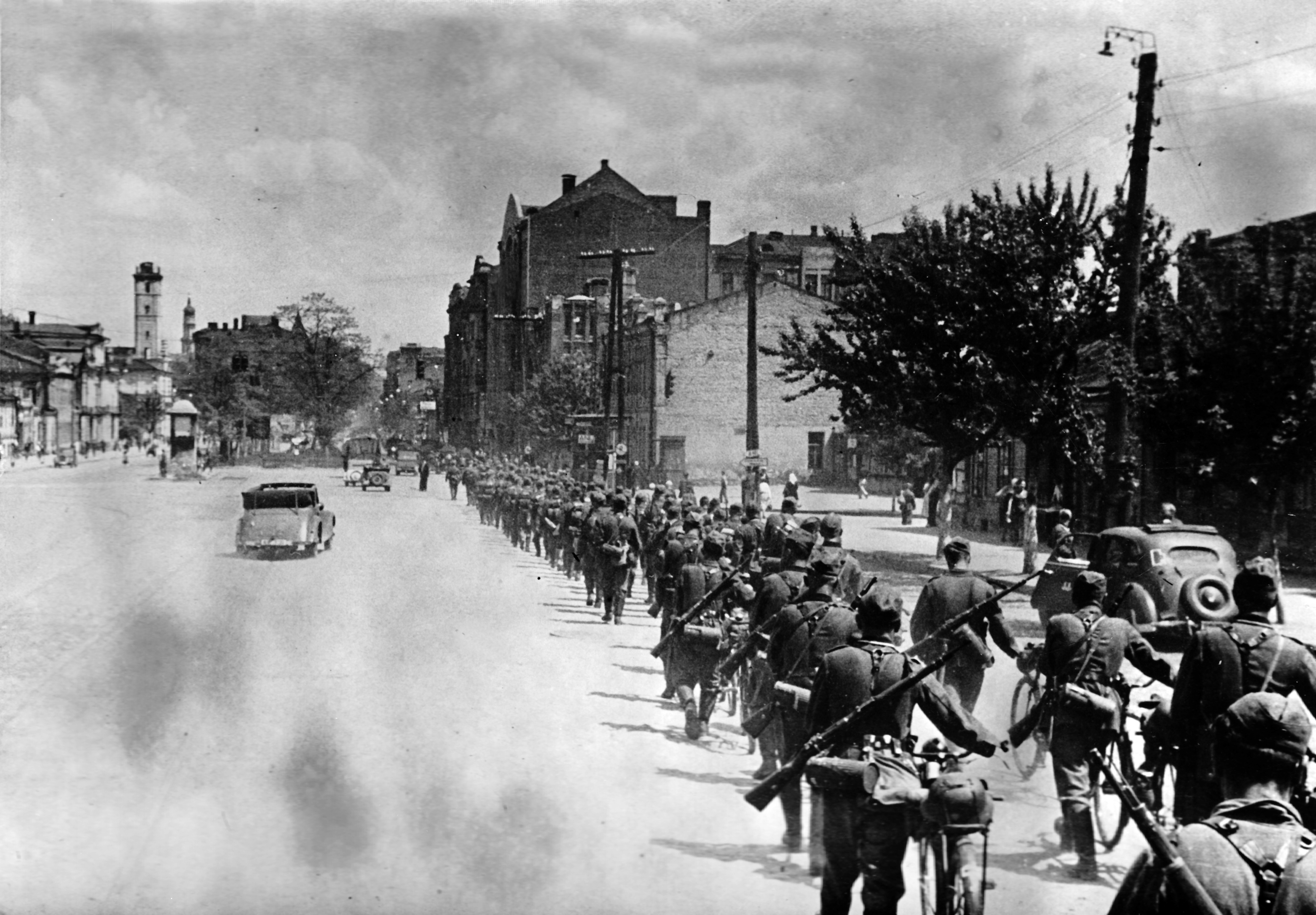
.jpg) The German invasion of the Soviet Union in June 1941 is remembered as Hitler’s most catastrophic military mistake. But in 1941 it didn’t seem to be a mistake at all. “Everyone thought at the beginning that the war will result in the complete defeat of the Soviet Union,” said Aleksey Bris, who was an 18-year-old Ukrainian student in 1941. “When the war broke out between Germany and the Soviet Union, the population thought that things would change for the better. There was a feeling that the Soviet Union might collapse. The collapse that happened in the 1990s could have happened at that time.”
The German invasion of the Soviet Union in June 1941 is remembered as Hitler’s most catastrophic military mistake. But in 1941 it didn’t seem to be a mistake at all. “Everyone thought at the beginning that the war will result in the complete defeat of the Soviet Union,” said Aleksey Bris, who was an 18-year-old Ukrainian student in 1941. “When the war broke out between Germany and the Soviet Union, the population thought that things would change for the better. There was a feeling that the Soviet Union might collapse. The collapse that happened in the 1990s could have happened at that time.”
Far from being frightened by the arrival of the Nazis, Bris and his friends welcomed them. “Ukrainians could see a different way of life. They saw they could go to dances and have different clothes and that there was free communication between people.”
When I heard Bris say these words, as he sat in his small house near his home village of Horokhiv, they opened up for me a sudden vision of what might have been. Maybe he was right, maybe the whole course of the Nazi occupation of the Soviet Union could have been different.
But then, after a moment’s reflection, I realized that this could never have happened. The whole nature of Nazism meant that after the initial euphoria of their “liberation” from Soviet rule wore off, Ukrainians were destined to experience the Nazis as some of the cruelest conquerors in history.
Consider the words of Erich Koch, Reich commissioner of the Ukraine and one of Hitler’s closest and oldest comrades: “We are a master race that must remember that the lowliest German worker is racially and biologically a thousand times more valuable than the population here.” Bris soon found out just what those words meant. He found a job translating for the Nazis, and even struck up a friendship with a German secretary. But within months he had a conversation with his boss that proved to be a turning point. Bris asked to go to a university and improve his education, but was told, “We don’t need you Ukrainians as doctors or engineers. We need you as people to tend cows.”
Bris’s joy at the arrival of the Nazis was suddenly replaced by bitterness. And over the next few weeks his anger toward the Nazis grew so great that he felt “on the edge of a mental collapse.” Finally, one day in fall 1942, came the moment that changed his life. While walking through his village he saw a German policeman hit a Ukrainian villager with a cane. Bris grabbed the policeman’s arm and pushed him away. “The emotions come first,” he said, “and you don’t think about the consequences…?. I just hated that our nation was brought to slavery. When you feel that the whole nation is being humiliated you have to do something whether you like it or not, so I was ready to strike them.”
Pursued by the police, Bris fled to the safety of the forest. For the next two years he fought in one of history’s most brutal partisan struggles. With the nationalist Ukrainska Povstanska Armiia (Ukrainian Insurgent Army) he fought the Germans as well as Soviet partisans. No prisoners were taken on either side in this shadowy war and atrocities were commonplace. The Soviet partisans, in particular, were infamous for cutting out the tongues of some of the Ukrainian Insurgents they captured. By comparison, Bris remembers, the Germans “just” hanged prisoners, and didn’t usually torture them beforehand.
Aleksey Bris was fortunate enough to live to see the dream he once thought the Nazis would fulfill: Ukraine finally became an independent state in 1991.