The propeller boat S.P. Carter churned through the choppy waters of the Illinois River three miles below Peoria. Aboard, Captain Samuel Gill and eight stalwarts of his city police force peered into the darkness of the September night. Glimmers flitted like fireflies off the port bow not far ahead. The captain whispered, ‘That’s her,’ and signaled the pilot to cut the engine. Silent now but for the soft lapping of the water against her sides, S.P. Carter glided to shore some yards above the outline of a common keelboat about 50 feet long, moored to the bank. It was what the natives called a gunboat, familiar to the officers of the law. On the deck perched a house with four doors — one at each end, one on each side. There was no one to be seen, but gleams of light slanted through windows in the house, and the squeals of catgut and thumps of dancing feet rose and fell on the wind.
Captain Gill gathered his men around him and drew up a plan of action. With Officers O’Connor, Wason and Strong at his heels, he stole along the weed-strewn riverbank and slipped aboard the gunboat, his men fanning out, posting themselves next to three of the doors. The crew of S.P. Carter, which had drifted down on the current and anchored next to the other boat, guarded the last exit. Captain Gill edged up to a window and ran his eye over the scene within, illuminated by smoky lamplight. The bar, the dance floor, the revelers, the warren of sleeping quarters — all confirmed his suspicions.
For some days complaints had reached his ears about this boat tied up at Wesley Bend, beyond the city limits but by ordinance still within his jurisdiction. A young man from the lower end of Peoria had gone there night after night to carouse and then stagger home and abuse his mother; one of the denizens of the boat had marched into the uproarious Bunker Hill section of town and boldly stoned a house, settling old scores. And as if these scenes from Donnybrook Fair were not alarming enough, intimations even more troubling to civic rectitude had become public knowledge.
It would not do. In Captain Gill’s mind, the gunboat had overstayed its welcome. He put a patrol whistle to his lips and blew a sharp blast. His men charged through the four doors. The fiddler and the dancers scattered, but there was no escape. In one of the eight bedrooms, a man cursed and threw on his clothes, while the woman with him broke out in knowing laughter and told him to give up. He was well and truly caught. The police shouldered open other bedroom doors and pounced on the dazed and startled inhabitants of the floating brothel. Among them were the owner, an experienced pimp from Beardstown, 90 miles downriver, and in another room the owner’s bartender and right-hand man, a roughhouse slugger named Wyatt Earp, who’d brawled his way through the tie camps of the transcontinental railway a few years earlier, and Earp’s wife, Sarah.
GET HISTORY’S GREATEST TALES—RIGHT IN YOUR INBOX
Subscribe to our HistoryNet Now! newsletter for the best of the past, delivered every Monday and Thursday.
The Earps As Pimps And Patrons
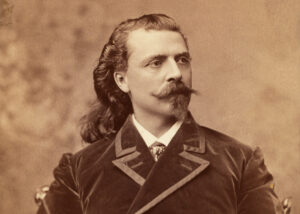
Events make clear that this was the Wyatt Berry Stapp Earp of O.K. Corral fame and enduring Western legend — a man in his mid-20s who was already acquiring a reputation, though of dubious prospect. And the gunboat incident of September 7, 1872, was not the first collision between him and the Peoria police that year.
On February 24, he and his brother Morgan had been seized in a raid on Jane Haspel’s brothel, in the city’s red-light district, close by the train yards, transient boardinghouses and hotels catering to commercial travelers. At a hearing shortly afterward, a prostitute nabbed with the Earps cinched their guilt, giving testimony to the effect that they had not been entrapped but had knowingly consorted with her, and each man paid a fine of $20 and costs. The raid was part of a campaign launched by the new mayor and his superintendent of police — Samuel Gill — to placate the “moral element” among their constituents by putting well-publicized pressure on the flesh trade. On this occasion, the amount of the fine suggests the Earps were convicted of being nothing more than ‘johns.’ However, Root’s Peoria City Directory for 1872-73 lists Wyatt Earp living at the same address as Jane Haspel — Washington Street near the corner of Hamilton. Since the city directory went to press on March 1, 1872, and canvassing for it would have taken at least several months, it is probable Wyatt was residing in the Haspel brothel, not merely patronizing it, at the time of his arrest.
Two months afterward, on April 24, the prostitute who had turned state’s evidence against the Earps — Minnie Randall — committed suicide by swallowing six grains of morphine. The Peoria Daily Transcript noted that she had been an inmate of the McClellan building on Main Street, a house of ill fame within several blocks of Jane Haspel’s. It further remarked that the deceased had been stopping at McClellan’s with the notorious prostitute Sally Haspel.
Less than three weeks later, Wyatt and Morgan Earp were again jailed by Captain Gill’s police force, as reported in the May 11, 1872, issue of the Daily Transcript: “That hotbed of iniquity, the McClellan Institute on Main Street near Water was pulled on Thursday night [May 9], and as usual quite a number of inmates transient and otherwise were found therein. Wyat [sic] Earp and his brother Morgan Earp were each fined $44.55 and as they had not the money and would not work, they languish in the cold and silent calaboose ….” The newspaper went on to editorialize: “It does seem strange that the owner of the house in question can not find a more respectable lot of tenants than he usually has there. Complaints arise from the whole neighborhood, and some of the merchants nearby there are annoyed by the inmates even during the day.”
The madam of the McClellan Institute was Jennie Green, whose previous residence had been a hovel situated in an alley near the corner of Washington and Hamilton streets, within spitting distance of Jane Haspel’s backdoor. The amount of the fines levied against Wyatt and Morgan suggests that the arresting officers considered them to be pimps and charged them as such.
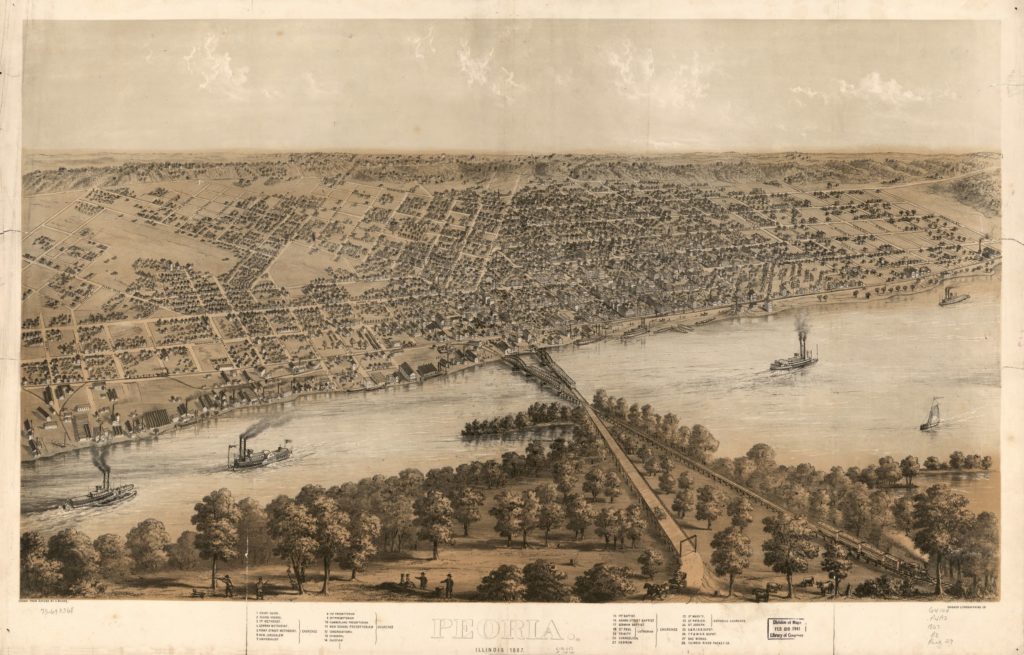
Behind Bars and BEYOND
The brothers cannot have relished the time spent in the city jail, however refractory they chose to be about working off their fines. A report in the Peoria Daily National Democrat of January 6, 1872, describes the jail in these terms: “The calaboose is in a wretched condition, and it is absolutely cruel to confine prisoners in it. In corners of the men’s and women’s departments are vaults, which are left uncovered, and the stench arising from them is horrible. There are ventilators, but these being obstructed, besides being poorly constructed, they are of no avail to carry off the effluvium. In addition to the deadly atmosphere of the apartments, there is not a sufficiency of bedding to render prisoners comfortable.”
It may be that after serving their sentences, Wyatt and Morgan left Peoria — Wyatt temporarily and Morgan for good. In a memoir, their sister Adelia recounts how on her 11th birthday, June 16, 1872, they visited her at the family farm in Missouri and gave her ‘a whole package of pretty clothes.’ By Adelia’s account, Wyatt and Morgan had returned from buffalo hunting with “quite a heap of money.”
Adelia’s memoir has yet to be authenticated, but Stuart Lake, author of the biography Wyatt Earp: Frontier Marshal, also claimed that Wyatt was buffalo hunting in the spring of 1872. According to Lake, Wyatt brought his hides into Caldwell, Kan., in April 1872 and sold them for $2,500. It is evident that the buffalo-hunting story is incorrect. Lake’s notes, in the Huntington Library collection, suggest the story came directly from conversations with Wyatt Earp the year before his death. The generally accurate recollections given by Earp when he had nothing to hide lead one to believe he concocted a plausible tale to account for the time he lingered in Peoria. Still, he and Morgan may have returned to his father’s farm in June 1872 and made a memorable appearance at their young sister’s birthday party. How they could have flashed “quite a heap of money” when neither could stump up enough to pay a $44.55 fine a month earlier is another matter.
If Wyatt did return to his family, the visit was a brief one, for probably no later than August he was back in Peoria or Beardstown or points in between. Somewhere he had to have teamed up with John T. Walton, owner of the floating brothel.
Wyatt Earp’s First Gunfight
Wyatt and Walton knew each other before 1872. Stuart Lake’s notes mention Wyatt’s first gunfight. In Beardstown, during the summer of 1869, a bully named Tom Piner mockingly called Wyatt ‘the California boy.’ They came face to face in Walden’s Hotel. They clinched, they scuffled and Wyatt tossed his adversary out the door. Piner was carrying a gun, and he jerked it out of his pocket. Wyatt armed himself, they exchanged shots and Piner fell with a hip wound.

this article first appeared in wild west magazine


Nicholas Earp, Wyatt’s father, had moved his family to Missouri from California, where they had lived since 1864. Wyatt and his brother Virgil had followed them, working at least part time hauling supplies for railroad construction crews. Instead of joining their father at once, however, Wyatt and Virgil visited relatives in Monmouth, Ill., their boyhood home. Then Wyatt moved on to Beardstown and the gunfight.
Walden’s Hotel, where the fracas occurred, was located near a set of tracks. The Rockford, Rock Island & St. Louis Railroad was in the process of laying rail through the center of Beardstown. The ‘hotel’ was in fact a brothel, operated by Walton, a 34-year-old Virginian. The bully with whom Wyatt battled, called Tom Piner in Lake’s notes, was actually a brakeman named Thomas D. Pinard. Although Lake never included this story in Wyatt Earp: Frontier Marshal (not to suggest he was aware of the details unflattering to Earp and suppressed them), it has the ring of authenticity: Records confirm that Walton and his gaggle of prostitutes were present in Beardstown; that Pinard was employed on a rail line between Chicago and western Illinois; and that construction excitement luring scavengers, sports and rowdy laborers was going strong that summer of 1869. And it is doubtful the story as Lake had it — accurate in general terms, deceptive in details — could have originated with anyone but Earp himself.
Did Wyatt seek out John Walton three years later in Beardstown, where the voyage of the gunboat began, or did they meet somewhere along the Illinois River? By late August 1872, the gunboat had passed Peoria and poled at least 35 miles farther upriver before turning and cruising back for its ill-starred rendezvous with Captain Gill and his flying squad.
The raid was part of a campaign launched by the new mayor and his superintendent of police to placate the ‘moral element’ among their constituents by putting well-publicized pressure on the flesh trade.
Wyatt’s Second Wife?
On September 9, 1872, two days after the seizure of the gunboat, the prisoners lined up before Police Magistrate James Cunningham in Peoria City Hall. Those charged totaled seven men and six women. The officers who had taken part in the raid boasted, “They were the quietest set of bawds and pimps they ever handled, they felt so cheap at their unexpected capture.” The Peoria Daily National Democrat, on September 10, reported: “Some of the women are said to be good looking, but all appear to be terribly depraved. John Walton, the skipper of the boat and Wyatt Earp, the Peoria bummer, were each fined $43.15….Sarah Earp, alias Sally Heckell, calls herself wife of Wyatt….”
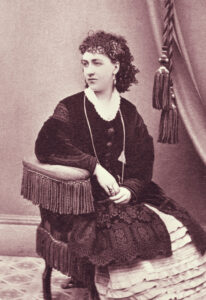
Could this woman indeed have been the wife of Wyatt Earp? It is generally assumed he was married three times, but a marriage license exists only for the union with his first wife, Rilla Sutherland. They were wed on January 10, 1870, in Lamar, Mo., and Rilla, the daughter of a local hotelkeeper, died less than a year later. No official record has been found uniting Wyatt with either of the other wives — Mattie Blaylock and Sadie Marcus — though he maintained a long-term relationship with each. Was Sarah Earp simply a prostitute who had taken the name of her protector, her pimp, or could she and Wyatt have known each other over a span of years? Who was she?
The newspaper article gives her ‘alias’ as Sally Heckell, but while that name may have been assumed, in whole or in part, it was equally likely to have been her real name or something close to it. During the early months of 1872, Wyatt Earp was in residence at the brothel of Jane Haspel. Minnie Randall was toiling in this brothel in February 1872 when Wyatt and Morgan Earp were arrested there. By April 1872, Minnie Randall had shifted her place of employment to the McClellan Institute a few blocks away, where it was said she was’stopping with Sally Haspell.’ That Wyatt was also living in the McClellan building at that time seems probable from the fact that he was arrested there less than three weeks later, described as an ‘inmate,’ and assessed a fine befitting a pimp.
Jane Haspel had three children by her first husband, a Civil War veteran, before she deserted him in 1863. The first child was a daughter named Sarah, born in Bloomington, Ill., in 1854. Sarah had a sister, Mary, born in 1860. The U.S. census of 1870 lists 10-year-old Mary Haspel as a domestic in the brothel of a woman named Thankful Sears, located in Peoria’s Sixth Ward. (The enumerator, in a rare display of partiality, wrote after Mary’s name, ‘God pity you.’) Also found in ‘Mother’ Sears’ house, occupation prostitute, was one Sally Haskell, age 16. It is quite likely that she was, in reality, Sally Haspel. The age, the birthplaces of the parents, the presence of her sister Mary, the nearly identical name, the fact that Jane Haspel is on record as being in Peoria as early as 1865 — these all strengthen the assumption. If Jane Haspel, herself a known madam, would turn her 10-year-old daughter out to do char work for another bawd, she would not stick at sacrificing the older sister to man and Mammon as well.
Wyatt Earp spent time in Beardstown during the summer of 1869. He had accompanied his brother Virgil to Illinois, and by early 1870, Virgil had found quarters in a square block of Peoria infamous for its lewd women and larcenous dives — Bunker Hill — and was earning his keep as a bartender there. A strong likelihood exists that Wyatt visited Peoria in 1868-69. Once again, Stuart Lake’s notes on the chronology of Wyatt’s life offer confirmation. And given Wyatt’s familiarity with the demimonde and his attraction to it, one must seriously consider the possibility that he met 15-year-old Sally Haspel at the Sears brothel, the largest in the city. This would go some distance toward explaining how he came to be a resident in Jane Haspel’s house in 1872 — if he had a prior acquaintance with Sally and her mother.
It was no simple matter to become a pimp at a major house of prostitution in Peoria. Some men in the profession had gained footholds during the years following the Civil War, many of them veterans for whom carnage had become second nature, and they continually made news for their violent exploits in a tough town, where slaughterhouses and distilleries were employers of first resort. If Wyatt Earp had not cultivated a previous acquaintance with the Haspels, he must have lived in Peoria for an extended period in 1871–72, long enough to earn a reputation as a hard case. A paper trail places him in Lamar, Mo., from November 1869 to November 1870, then in Indian Territory (present-day Oklahoma) during the late winter of 1870–71, and in Arkansas during April 1871, at which time he took part in a jailbreak at Fort Smith, where he was being held on a horse-theft charge. After that, nothing is heard of him until he turns up at Haspel’s in February 1872.
There is also the possibility that Wyatt settled where he did because of another connection to the Peoria underworld. In 1870, Virgil Earp was living and most likely working in the saloon of William Vansteel, a native of Denmark, who had made his home in Peoria before the Civil War and subsequently served two hitches in the 11th Illinois Cavalry. Vansteel had tasted his share of battlefield powder — at Pittsburg Landing, Bolivar, Lexington, Yazoo City — as Union forces scythed through the lower Mississippi Valley. The essence of carcasses from the meat market next door and the reek of hops from the brewery at the end of the block mingled with scarcely less pungent human odors in his saloon, on the bluff (north) side of Water Street. It was located in the center of Bunker Hill, an area denounced in various news accounts as a ‘wretched locality,’ ‘a notorious locality,’ ‘an infamous locality.’ The gin mills of the neighborhood raised a racket at all hours, and explosive frictions built up in them. Brawls were commonplace, often between prostitutes from the house in the rear of Vansteel’s establishment. And the very day Minnie Randall committed suicide at the McClellan building, with Sally Haspel and possibly Wyatt and Morgan Earp as witnesses, Sally’s mother, Jane, was facing arraignment for public drunkenness in Bunker Hill the previous night.
The VanSteel connection
By 1872, William Vansteel had relocated his place of business from the rookery on Water Street where Virgil had bunked to the corner of Washington and Hamilton streets, only a few doors from Jane Haspel’s brothel. Given Vansteel’s relationship with Virgil, it is not unlikely the saloon owner would have been acquainted with Wyatt as well, or at the very least Wyatt would have looked him up when he blew into town in 1872, putting half a nation between himself and a federal arrest warrant current in Indian Territory. Virgil and Wyatt had been together for much of the year after Virgil left Peoria and returned to his father’s Missouri homestead, and the brothers would surely have swapped tales about the characters and prospects in the Illinois River town dear to their hearts.
Another connection between the Earps and William Vansteel is also possible. The city directory provides evidence that Virgil could be found in Peoria early in 1870. But by May 28 he was in Lamar, Mo., giving his hand in marriage to a teenager named Rosillia Draggoo. Where this young woman came from and what happened to her has proved an enduring mystery in the chronicles of the Earp brothers. It is known she was living in Lamar as Virgil’s wife in September 1870, but thereafter she vanishes. By 1873, the year Virgil took up with Alvira Sullivan, the woman who would become his lifelong companion, he was a footloose, unattached stagecoach driver headquartered at Council Bluffs, Iowa. Between January and May 1870, there would have been scant opportunity for him to cull a prospective bride unless she was flowering under his nose all the while.
The maiden name of William Vansteel’s wife was Mary Jane Girot. Her mother, Catharine, resided with her in rooms attached to Vansteel’s Water Street saloon. Both Mary Jane and Catharine had emigrated from France, as had Rosillia Draggoo. It is possible Rosillia was associated with the Girot family or with Antoine Roehrig, another native of France, whose saloon stood around the corner, on Clay Street. If she were working or living in Vansteel’s saloon or in the neighborhood, that would explain how Virgil came to meet her, woo her and spirit her away to Missouri. Whatever Rosillia’s circumstances, a Peoria background is not out of the question for her, and the absence of a Draggoo family documented in and around Lamar at this period favors an argument for just such a background. So when Wyatt Earp began his Peoria adventure in 1872, he may have had what amounted to a family connection to William Vansteel and, through the saloonkeeper, secured entree to the house of Vansteel’s neighbor and soul sister, Jane Haspel.
There is abundant circumstantial evidence that Sarah Earp, Sally Heckell, Sally Haskell and Sally Haspel are one and the same person. Such a conclusion adds a chapter of more than a little relevance to Wyatt Earp’s biography. And it casts light on a shadowy figure who seemingly came into his life shortly after he left Peoria. By early 1874 Wyatt had turned up in the rip-roaring cattle town of Wichita, Kan. Municipal records show that a prostitute using the name Sally Earp operated a brothel with Wyatt Earp’s sister-in-law Bessie in Wichita from January 1874 to April 1876. Up to now speculation as to Sally’s identity has focused either on an unknown woman or Wyatt’s consort-to-be, Celia Ann ‘Mattie’ Blaylock. However, by January 1874, a Sally Earp had already entered his life, the girl from Peoria he may have known for as long as four years and whose company he kept for most of one year lost to history — Sarah Haspel. As late as September 1872 — little more than a year before Sally Earp first appears on the police court docket of Wichita — she was claiming to be his wife, and the last word on where she and Wyatt were bound was westward, as gunboat skipper John Walton said, ‘[for] deep water on the Mississippi, where they don’t fine decent people, sleeping in their beds at night.’
historynet magazines
Our 9 best-selling history titles feature in-depth storytelling and iconic imagery to engage and inform on the people, the wars, and the events that shaped America and the world.