
THE FULL CONTRIBUTION OF INTELLIGENCE to the winning of World War II is clear only now, nearly 75 years after that conflict. Over the intervening decades it has been discovered that throughout the war the intelligence services of the Western powers (particularly the British) intercepted, broke, and read significant portions of the German military’s top-secret message traffic. That cryptographic intelligence, disseminated to Allied commanders under the code name Ultra, played a significant role in the effort to defeat the Germans and achieve an Allied victory.
The breaking of the high-level German codes began with the efforts of the Polish secret service in the interwar period. By creating a copy of the basic German enciphering machine, the Poles managed to read German signal traffic throughout the 1930s with varying degrees of success. However, shortly before the Munich conference in September 1938, the Germans made alterations to their enciphering machine–the so-called Enigma machine–and in mid-September, darkness closed over German message traffic. The Poles continued their work, however, and after France and Britain’s guarantee of Polish independence in March 1939, they passed along to the British what they had thus far achieved. Considerable cooperation had also existed earlier between the Poles and the French. Building on what they had learned from their Continental allies, British cryptanalysts finally cracked some of the German codes in April 1940, just before the great offensive against France and the Low Countries.
Other successes soon followed and gave Allied intelligence officers and commanders valuable insights into German intentions and capabilities. Nevertheless, the British were only able to break a small proportion of the specific codes used by the Wehrmacht. At the end of 1943, the Kriegsmarine, for example, used up to 40 different ciphers, all requiring different Enigma machine settings. During the Battle of the Atlantic, the transmissions from U-boats to shore and from the commander of submarines to his boats received the highest priorities from cryptanalysts at Bletchley Park, the location of the British decoding efforts in Europe.
Even with the exceptional resources available there and at that time, it took experts several days and in some cases up to a week to find solutions for a particular day’s settings on the Enigma machine. The task of getting invaluable intelligence information out to the field where it could be of direct help was, of course, immensely difficult, especially given fears that if the Germans found out that their codes were being compromised on a daily basis, Ultra intelligence would dry up.
CHOOSE WISELY
Recommended for you
In 1940 during the Battle of Britain, this need for concealment was not great, but as the war spread throughout Europe and the Mediterranean, it became an increasing problem. Accordingly, the British and their American allies evolved a carefully segregated intelligence system that limited the flow of Ultra to a select number of senior officers. The Ultra information dissemination process lay outside normal intelligence channels. For example, the intelligence officers of the Eighth Air Force would not be aware of the existence of Ultra and would therefore not know the duties of the Ultra liaison officers. Those officers, in turn, would forward Ultra intelligence only to the commanders of the Eighth and Ninth Air Forces. The system seems to have worked, for the Germans never caught on to how extensively their ciphers had been compromised.
Unfortunately, there were drawbacks. Intelligence is used only if it reaches those who understand its significance. Three specific incidents underline this point with great clarity. The first occurred in early September 1944, as Allied armies pursued the beaten Wehrmacht to the Third Reich’s frontiers. On September 5, Bletchley Park made the following decryption available to Allied commanders in Western Europe:
For rest and refit of panzer formations, Heeresgruppe Baker [Army Group B] ordered afternoon fourth [September 4] to remain in operation with battleworthy elements: two panzer, one-six panzer [Second, Sixteenth Panzer Divisions], nine SS and one nought [Ninth, Tenth] SS panzer divisions, elements not operating to be transferred by AOK [controlling army] five for rest and refit in area Venloo-Arnhem-Hertogenbosch.
This intelligence, along with a second confirmation on September 6, indicated that at the very time when the British-planned Operation Market-Garden was moving forward, some of Germany’s best panzer divisions would be refitting in the town selected as the goal of the British First Airborne Division and the operation’s final objective on the Rhine–Arnhem. Putting this message together with intelligence that soon emerged from the Dutch underground in Holland that SS panzer units were refitting in the neighborhood of Arnhem, Allied commanders should have recognized that Operation Market-Garden had little prospect of success. Unfortunately, they did not put these pieces together, and officers at the highest level at Field Marshal Sir Bernard L. Montgomery’s headquarters who had access to Ultra also failed to draw the correct conclusions.
GET HISTORY’S GREATEST TALES—RIGHT IN YOUR INBOX
Subscribe to our HistoryNet Now! newsletter for the best of the past, delivered every Monday and Thursday.
FALSE LEGENDS
A second example comes from a period three months after Operation Market-Garden, in December 1944. An unfortunate result of the rush to publish after the existence of Ultra became known to the public in the early 1970s has been the appearance of a number of legends. One of the most persistent is the belief that Ultra gave no advance warning to Allied commanders in December 1944 that the Germans were about to launch a major thrust through the Ardennes. Admittedly, Hitler’s intuition suggested to him that German security had been compromised and led him to undertake a series of unprecedented measures to veil the Ardennes attack. Still, there were overt indications even in the high-level codes about German operational intentions. Ultra, however, pointed to a number of other indicators. These suggested that the Wehrmacht was moving supplies of ammunition and fuel into the region behind the Ardennes. Since the Germans were desperately low on such materiel, the allocations of resources could only portend major operations to come in the Ardennes. The German high command had no reason to expect that the Allies were planning to launch a major offensive in this area, especially since they were so obviously trying to kick in the door to the Reich at so many other points. Unfortunately, the mood in the higher Allied headquarters and in intelligence circles was euphoric–the war was almost over, and the Germans could not possibly launch an offensive.
The third case of Ultra information not being used occurred during the Battle of the Atlantic. By 1943 the Allies were using Ultra, when available, in moving their convoys across the North Atlantic, so that the great formations of merchant shipping could avoid submarine patrol lines. In one particular case, decodings had picked up a heavy concentration of German submarines north of the Azores. Thus, a major convoy of aviation fuel tankers from the refineries at Trinidad to the Mediterranean was rerouted to the south of the Azores. Unfortunately, because his escorts needed refueling and the weather was better north of those islands, the convoy commander disregarded his instructions, sailed north of the Azores, and ran smack into the U-boats. Only two tankers reached port. What made the episode even more surprising was the fact that the convoy commander had just served a tour of duty in the Admiralty’s convoy and routing section, where he surely must have had some awareness of the reasons for rerouting convoys.
Selective use
If some commanders occasionally misused Ultra intelligence, such instances were the exception rather than the rule. It is, however, difficult to assess Ultra’s full impact on the conflict. At times, particularly early in the war, no matter how much Ultra informed the British of German intentions, the Wehrmacht’s overwhelming superiority made successful use of the information virtually impossible. For example, decoded Enigma messages in the spring of 1941 warned the British about German intentions against the Balkan states, first Greece and then–after the anti-German coup in Yugoslavia–against that country as well. Such intelligence, of course, was of extremely limited value due to the overwhelming forces that Hitler deployed in the region.
On the other hand, the intercepts and decrypts in the summers of 1941 and 1942 gave the British government, and Churchill in particular, an accurate picture of Erwin Rommel’s tank strength. That information indicated that the British army had considerable superiority in numbers in the North African theater against the Afrika Korps. These quantitative returns could not indicate, however, such factors as the technological superiority of German tanks and particularly the qualitative edge in doctrine and training that the Germans enjoyed. The intercepts, however, explain why Churchill kept consistent pressure on British Eighth Army commanders to attack the Afrika Korps.
War beneath the sea
In war, so many factors other than good intelligence impinge on operations that it is difficult to single out any one battle or period in which Ultra alone was of decisive import. Yet there was least one instance in which decrypted German codes did play a decisive role in mitigating enemy capabilities.
By the first half of 1941, as more and more U-boats were coming on line, the German submarine force was beginning to have a shattering impact on the trade routes on which the survival of Britain depended. The number of of British, Allied, and neutral ships sunk climbed ominously upward.
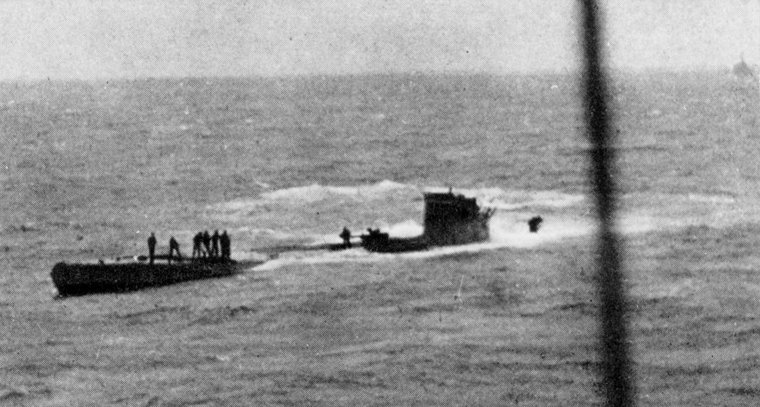
Through spring 1941, the British had had little luck in solving the Kriegsmarine’s ciphers. But in mid-May 1941, they captured not only a German weather trawler with considerable material detailing settings for naval codes but also a U-boat, U-110, with its cipher machine and all accompanying material. With these seizures, British intelligence gained the navy Enigma settings for the next two months. As a result, the British were able to break into U-boat message traffic at the end of May. Because German submarines were closely controlled from shore, and a massive amount of signaling went back and forth to coordinate movement of ‘wolfpacks (groups of U-boats), the British gained invaluable information ranging from the number of U-boats available, to tactical dispositions and patrol lines. Moreover, once they had two months’ experience reading the naval message traffic, British cryptologists continued breaking submarine transmissions for the next five months. The impact of this intelligence on the Battle of the Atlantic was immediate and crucial.
The dramatic decline in sinkings (compared with those that had occurred during the first five months of 1941) cannot be explained other than that Ultra gave the British a crucial edge over their undersea opponents. No new technology, no increase in escorts, and no extension of air coverage can be credited. Ultra alone made the difference.
New Key
Unfortunately for the Anglo-American powers, within two months of the United States’ entry into the war the Germans introduced an entirely new Enigma key setting, Triton, that closed off Ultra decryptions for the remainder of 1942. Thus, right when the vulnerable eastern and southern coasts of the United States opened up to U-boat attacks, Ultra intelligence on German intentions and operations ceased. Direction-finding intelligence was available, of course, but it remained of limited assistance. The Battle of the Atlantic in 1942 was a disaster for the Allies.
When the Germans turned their full attention back to the North Atlantic in early 1943, enormous convoy battles occurred with increasing frequency. Grand Admiral Karl Dönitz had nearly 100 submarines in the North Atlantic. In opposition, the Allies possessed greater numbers of escort vessels, including escort carriers whose aircraft now made the shadowing of convoys by U-boats almost impossible. Moreover, long-range aircraft from Newfoundland, Iceland, and Northern Ireland were reaching farther into the Atlantic.
At the beginning of 1943, the Allied naval commanders enjoyed one further advantage. Bletchley Park had once again broken the German naval ciphers. That intelligence was not quite as useful as the Ultra intelligence of 1941 that had allowed the British to steer convoys around U-boat concentrations. At times, the Allies were able to carry out similar evasive operations, but the number of German submarines at sea at any given point made such maneuvers increasingly difficult and often impossible. From March to May 1943, the U-boat onslaught badly battered Allied convoys. In May, however, the Allies smashed the U-boat threat so decisively that Dönitz ended the battle. Ultra intelligence played a major role in the turnaround. Because of increases in Allied escort strength and long-range aircraft patrols, one must hesitate in identifying Ultra as decisive by itself. Yet the leading German expert on the Battle of the Atlantic, Jrgen Rohwer, does note:
I am sure that without the work of many unknown experts at Bletchley Park…the turning point of the Battle of the Atlantic could not have come as it did in May 1943, but months, perhaps many months, later. In that case the Allied invasion of Normandy could not have been possible in June 1944, and there would have ensued a chain of developments very different from the ones which we have experienced.
Late Impact
Belatedly, Ultra began affecting the air war on both the tactical and the strategic levels. British decoding capabilities during the Battle of Britain did not provide major help to Fighter Command. Similarly, for the first three years of Bomber Command’s war over the Continent, Ultra yielded little useful intelligence. On the other hand, throughout 1942 and 1943, Ultra provided valuable insights into what the Germans and Italians were doing in the Mediterranean and supplied Allied naval and air commanders with detailed, specific information on the movement of Axis convoys from Italy to North Africa. By March 1943, Anglo-American air forces operating in the Mediterranean had succeeded in shutting down Axis seaborne convoys to Tunisia. Allied information was so good, in fact, that after a convoy had been hit, the German air corps located in Tunisia reported to its higher headquarters, ironically in a message that was intercepted and decoded:
The enemy activity today in the air and on the sea must in [the] view of Fliegerkorps Tunis, lead to the conclusion that the course envisaged for convoy D and C was betrayed to the enemy. At 0845 hours a comparatively strong four-engine aircraft formation was north of Bizerte. Also a warship formation consisting of light cruisers and destroyers lay north of Bizerte, although no enemy warships had been sighted in the sea area for weeks.
As was to be the case throughout the war, the Germans then drew the conclusion that traitors either in their own high command or elsewhere–in this case, in the Commando Supremo, the Italian high command–had betrayed the course of the convoys.
In the battles for control of the air over Sicily, Ultra proved equally beneficial. It enabled the Allies to take advantage of German fuel and ammunition shortages and to spot Axis dispositions on the airfields of Sicily and southern Italy.
When Ultra hurt rather than helped
In regard to U.S. strategic bombing, however, Ultra may have exerted a counterproductive influence in 1943. Luftwaffe message-traffic intercepts indicated quite correctly how seriously Allied air attacks were affecting the German air wing, but these intercepts may have prompted Lt. Gen. Ira Eaker, the U.S. Eighth Air Force’s commander, to go to the well once too often. The second great attack on Schweinfurt in October 1943, as well as the other great bomber raids of that month, proved disastrous for the Eighth Air Force crews who flew the missions. The Eighth lost sixty bombers in the Schweinfurt run.
Moreover, the U.S. Army Air Forces’ theories about the vulnerability of the German economy to precision bombing proved somewhat unrealistic. While bomber attacks did inflict heavy damage on German aircraft factories, the industry was in no sense destroyed. Likewise, attacks on ball-bearing plants failed to have a decisive impact. True, damage to Schweinfurt caused the Germans some difficulties, but the batterings that the Eighth’s bombers sustained in the August and October raids were such that, despite intelligence information that the Germans would be back in business quickly, the Eighth could not afford to again repeat the mission.
In 1944, however, the Eighth’s capabilities and target selection changed. Most important, the Eighth Air Force received long-range fighter support to make deep penetration raids possible. The initial emphasis in American strategic bombing attacks in late winter and early spring 1944 lay first on hitting the German aircraft industry and then on preparing the way for the invasion of the Continent. In May, Lt. Gen. Carl Spaatz, commander in chief of U.S. Strategic Air Forces in Europe, persuaded Allied commander Dwight D. Eisenhower that he possessed sufficient bomber strength to support both the invasion and a new offensive that would be aimed at taking out Germany’s oil industry. In attacking that industry, Spaatz hit the Germans at their most vulnerable economic point. Not only did attacks on the oil facilities have an immediate impact on the Wehrmacht’s mobility, but fuel shortages soon prevented the Germans from training a new generation of pilots to replace those who were lost in the air battles of the spring.
On May 12, 1944, 935 B-24s attacked synthetic oil plants throughout Germany. Almost immediately, the Eighth’s commanders received confirmation from Ultra that these strikes had threatened Germany’s strategic position. On May 16, Bletchley Park forwarded to the Eighth an intercept canceling a general staff order that Luftflotten (Air Fleets) 1 and 6 surrender five heavy and four light or medium flak batteries each to Luftflotte 3, which was defending France. Those flak batteries were to move instead to protect the hydrogenation plant at Troglitz, a crucial German synthetic fuel facility. In addition, four heavy flak batteries from Oschersleben, four from Wiener Neustadt, and two from Leipzig-Erla, where they were defending aircraft factories, were ordered to move to defend other synthetic fuel plants.
reallocation and reassessment
This major reallocation of air defense resources was a clear indication of German worries about Allied attacks on the oil industry. On May 21, another Ultra decrypt noted: Consumption of mineral oil in every form [must] be substantially reduced…in view of effects of Allied action in Rumania and on German hydrogenation plants; extensive failures in mineral oil production and a considerable reduction in the June allocation of fuel, oil, etc., were to be expected. On May 28 and 29, 1944, the Eighth Air Force returned to launch another attack on the oil industry. These two attacks, combined with raids that the Italy-based Fifteenth Air Force had launched against Ploesti, reduced German fuel production by 50 percent. On June 6, Bletchley Park passed along the following decrypted statement:
Following according to OKL [German Air Force high command] on Fifth [of June]. As a result of renewed interference with production of aircraft fuel by Allied actions, most essential requirements for training and carrying out production plans can scarcely be covered by quantities of aircraft fuel available. Baker four allocations only possible to air officers for bombers, fighters and ground attack, and director general of supply. No other quota holders can be considered in June. To assure defense of Reich and to prevent gradual collapse of German air force in east, it has been necessary to break into OKW [German Armed Forces high command] reserves.
Throughout the summer, German engineers and construction gangs scrambled to put Germany’s oil plants back together. Allied bombers, however, promptly returned to undo their efforts. During the remainder of the year, Allied eyes, particularly those of American bomber commanders, remained fixed on Germany’s oil production. The punishing, sustained bombing attacks prevented the Germans from ever making a lasting recovery in production of synthetic fuel. Clearly, Ultra played a major role in keeping the focus of the bombing effort on those fuel plants. Albert Speer, the German minister of armaments and munitions, had warned Hitler after the first attack in May 1944: The enemy has struck us at one of our weakest points. If they persist at it this time, we will no longer have any fuel production worth mentioning. Our one hope is that the other side has an air force general staff as scatterbrained as ours.
Speer’s hopes were not realized, largely because Ultra relayed to Allied air commanders the size and successes of German reconstruction efforts, as well as the enormous damage and dislocations to Germany’s military forces that the bombing of the oil industry was causing. The intelligence officer who handled Ultra messages at the Eighth Air Force reported after the war that the intercepts indicated that shortages were general and not local. This fact, he testified, convinced all concerned that the air offensive had uncovered a weak spot in the German economy and led to [the] exploitation of this weakness to the fullest extent.
Operation Overlord
On the level of tactical intelligence, during the execution of Operation Overlord, Ultra also provided immensely useful information. Intercepts revealed a clear picture of German efforts and successes in attempting to repair damage that the Allied air campaign was causing to the railroad system of northern France. A mid-May staff appreciation signed by Field Marshal Gerd von Rundstedt, commander in chief West, warned that the Allies were aiming at the systematic destruction of the railway system and that the attacks had already hampered supply and troop movements. Ultra intelligence made clear to Allied tactical air commanders how effective the attacks on the bridge network throughout the invasion area were and the difficulties that German motorized and mechanized units were having in moving forward even at night.
Ultra also gave Western intelligence a glimpse of the location and strength of German fighter units, as well as the effectiveness of attacks carried out by Allied tactical aircraft on German air bases. Furthermore, these intercepts indicated when the Germans had completed repairs on damaged fields or whether they had decided to abandon operations permanently at particular locations. Armed with this information, the Allies pursued an intensive, well-orchestrated campaign that destroyed the Germans’ base structure near the English Channel and invasion beaches. These attacks forced the Germans to abandon efforts to prepare bases close to the Channel and instead to select airfields far to the southeast, thereby disrupting German plans to reinforce Luftflotte 3 in response to the cross-Channel invasion. When the Germans did begin a postinvasion buildup of Luftflotte 3, the destruction of forward operating bases forced it to select new and inadequately prepared sites for reinforcements arriving from the Reich. Ultra intercepts proceeded to pick up information on much of the move, which indicated bases and arrival times for the reinforcing aircraft. Another substantial contribution of Ultra to Allied success was its use in conjunction with air-to-ground attacks. Ultra intercepts on June 9 and 10 revealed to Allied intelligence the exact location of General Leo Geyr von Schweppenburg’s Panzer Group West headquarters. Obligingly, the Germans left their vehicles and radio equipment in the open. The subsequent air attack not only destroyed most of Panzer Group West’s communications equipment but also killed seventeen officers, including the chief of staff. The strike effectively eliminated the headquarters and robbed the Germans of the only army organization they had in the West that was capable of handling large numbers of mobile divisions.
Hiding in PLain Sight
Why were the British able to break some of the most important German codes with such great regularity and thereby achieve such an impact on the course of the war? The Germans seem to have realized midway through the conflict that the Allies were receiving highly accurate intelligence about their intentions. Nevertheless, like postwar historians, they looked everywhere but at their own encrypted transmissions. Enthralled with the technological expertise that had gone into the construction of Enigma, the Germans excluded the possibility that the British could decrypt their signals. After the sinking of the great battleship Bismarck in May 1941 and the rapid clearance of the supply ships sent out ahead of her from the high seas, the Kriegsmarine did order an inquiry. Headed by a signals man (obviously with a vested interest in the results), the board of inquiry determined that the British could not possibly have compromised the Enigma system. Rather, the panel chose to blame the disaster on the machinations of the fiendishly clever British secret services. By 1943, the success of British anti-submarine measures in the Atlantic once again aroused German suspicions that their ciphers had been compromised. In fact, the commander of U-boats suggested to German naval intelligence that the British Admiralty had broken the codes: B.D.U [the commander of U-boats] was invariably informed [in reply] that the ciphers were absolutely secure. Decrypting, if possible at all, could only be achieved with such an expenditure of effort and after so long a period of time that the results would be valueless. One British officer serving at Bletchley Park recalled that German cryptographic experts were asked to take a fresh look at the impregnability of the Enigma. I heard that the result of this ‘fresh look’ appeared in our decodes, and that it was an emphatic reassertion of impregnability.
The Germans made a bad situation worse by failing to take even the most basic security measures to protect their ciphers. In fact, a significant portion of Bletchley Park’s success was due to procedural mistakes that the Germans made in their message traffic. Among basic errors, the Germans started in midwar to reuse the discriminate and key sheets from previous months rather than generate new random selection tables. If that were not enough, they (particularly the Luftwaffe) provided a constant source of cribs, which were the presumed decrypted meanings of sections of intercepted text. They enabled the British to determine Enigma settings for codes already broken. The cribs turned up in the numerous, lengthy, and stereotyped official headings normally on routine reports and orders, all sent at regular times throughout the day. According to Gordon Welchman, who served at Bletchley Park for most of the war, We developed a very friendly feeling for a German officer who sat in the Qattara Depression in North Africa for quite a long time reporting every day with the utmost regularity that he had nothing to report.
The German navy proved no less susceptible to such mistakes. Dönitz’s close control of the U-boat war in the Atlantic depended on an enormous volume of radio traffic. The volume itself was of inestimable help to the cryptanalysts at Bletchley Park. Although the Germans introduced a fourth rotor into the Enigma in March 1943, thereby threatening once again to impose a blackout on their North Atlantic operations, the new machines employed only a small fraction of their technical possibilities. Unfortunately for the U-boats, there was also considerable overlap between old and new Enigmas. As a result of these and other technical errors, the British were back into U-boat radio transmissions within ten days of the changeover. Furthermore, at about the same time, Bletchley Park decrypted a signal to U-boat headquarters indicating that the Germans were breaking the Allied merchant code.
One final incident should serve to underline the high price of German carelessness where security discipline was concerned. Bismarck had broken out into the central Atlantic in May 1941 on a raiding expedition. After sinking the battle cruiser HMS Hood, the battleship managed to slip away from shadowing British cruisers. The pursuing British admiral decided at 1800 hours on May 25 that the German battleship was making for Brest. Within an hour, the Admiralty had confirmation of that opinion through a Luftwaffe, not Kriegsmarine, intercept. Luftwaffe authorities had radioed their chief of staff, then visiting Athens during the German invasion of Crete, that Bismarck was heading for Brest.
learning from the errors
Obviously, there are important lessons that we can draw from these German errors. To begin with, as Patrick Beesly, who worked closely with the naval Ultra throughout the war, notes, While each nation accepted the fact that its own cryptanalysts could read at least some of their enemy’s ciphers, they were curiously blind to the fact that they themselves were being subjected to exactly the same form of eavesdropping. Above all, the Germans seem to have been overly impressed with their presumed superiority in technology. Thus, not only did they make elemental mistakes in their communications discipline, but they arrogantly refused to believe that their enemies might have technological and intelligence capabilities comparable to their own.
In recent years, considerable interest has arisen regarding German operational and tactical competence on the field of battle. There is an important subheading to that competence. While historians and military analysts tell us that the Germans were extraordinarily proficient in the operational and tactical spheres, we should also recognize that the Germans were incredibly sloppy and careless in the fields of intelligence, communications, and logistics, and consistently (and ironically) held their opponents in contempt in those fields. We would be wise to examine the German example closely in all aspects of World War II. We can learn much from the Germans’ high level of competence in the tactical and operational fields. Equally, we have much to learn from their failures in other areas. Above all, the German defeat in World War II suggests that to underestimate the capabilities and intelligence of one’s enemies is to suffer dangerous and damaging consequences to one’s own forces.

this article first appeared in military history quarterly