
[dropcap]T[/dropcap]he liberation of Paris was the most romantic event of World War II. It was not necessarily the most dramatic or the most important. The D-Day invasion and the atomic bombing of Japan were surely more dramatic, while the defeat of France in 1940 and the cross-Channel evacuation from Dunkirk were certainly more important developments from a strategic standpoint. But for sheer romance, joy, delight, tears of happiness and emotional dizziness, the liberation of Paris surpassed all the other momentous events of the war. It was a moment of supreme elation.
The City of Light had been home to the American expatriates of the 1920s and ’30s—F. Scott Fitzgerald, Gertrude Stein, Sherwood Anderson and others. George Gershwin’s musical production An American in Paris and Josephine Baker’s extravagant exploits on the stage made the city a romantic dream to many Americans.
To the French, Maurice Chevalier’s Paris had long been the most beautiful place on earth, where love flourished and couples necked in the metro and kissed along the Seine River. Painters made Paris the center of the art world. The accordion was the typical musical instrument of the bal-musette, a slow dance in which men wore berets and held dead cigarette butts in the corners of their mouths. And the vistas! The Champs Elysées, the Place de la Concorde, the Place des Vosges. For sheer beauty, Paris was unrivaled.
All this was lost in June 1940 when the Germans occupied Paris. They were there for more than four years. Their presence was distasteful. Their signs to offices and headquarters were everywhere. Their restraints, like the curfew, plagued the population. They took hostages and forbade playing jazz. Paris, it seemed, no longer belonged to the Parisians.
And then the Allies arrived. In August 1944, when the Americans finally broke out of the Norman hedgerows and were on the move, many inhabitants who had left the capital hurried back to the city. The Americans had been bogged down far from Paris for far too long–ages, it seemed. Now they were on their way and the Parisians hastened to return. They did not want to miss the gladness of welcoming their liberators and the glorious spectacle of seeing the Germans go.
Many legends have arisen to explain how the liberation happened. One of the most entertaining is Ernest Hemingway’s, who claimed he entered the city, took command of the bars at the Crillon and Ritz hotels and let the champagne flow, thereby liberating all of Paris. S.L.A. Marshall corroborated Hemingway’s feat, for Marshall said he was there, too. Sam Marshall was the chief historian of the European theater and my boss during the war. I respected him a great deal, but, as everyone used to say, Sam never let a fact stand in the way of a good story.
Actually, the liberation was somewhat more complicated. It all started long before the invasion of Normandy. In 1943, the Allies listed a French division among the units earmarked to travel from England to the Continent. According to Allied planners, the reason was primarily so that there would be a major French formation present at the reoccupation of Paris. The 2nd French Armored Division was selected for the task. General Dwight D. Eisenhower, as supreme Allied commander, promised to use the division to liberate the capital.
The division commander was Major General Philippe Leclerc, the wartime pseudonym of Philippe François Marie de Hautecloque, an aristocrat and thorough patriot. Leclerc had served as a Regular army captain during the 1940 campaign. After the French surrender, he made his way to England and joined General Charles de Gaulle. Leclerc burned with desire to erase the shame of the French defeat. He was headstrong and impatient. He possessed a formidable will and generated an immense charisma.
De Gaulle sent Leclerc to Chad, where he raised and trained a column of mobile troops. He took his men through the interior of Africa to Libya, and at Koufra attacked and defeated the Italians. He then attached his outfit to Lieutenant General Bernard Montgomery’s Eighth Army and fought on its left flank. In the process, Leclerc advanced rapidly in rank and gained a legendary reputation. Having functioned in Africa more or less independently, he was ill-suited to the discipline of the chain of command.
Toward the end of 1943, de Gaulle instructed Leclerc to form the 2nd French Armored Division. Leclerc pulled the division together from a variety of sources. It contained Free French from the United Kingdom and Syria, soldiers from French North Africa and equatorial Africa, Catholics, Protestants, Jews, Muslims and Animists, all of whom mingled in friendship, as did Communists, Socialists, free thinkers, militant Christians and Quakers. Binding them together were hatred of the Germans, love of France and the spirit of Leclerc, who imparted a sense of adventure to men who exhibited the exuberance of freebooters.
After training in Algeria, the division moved to England. The troops knew that their mission was to cross the Channel and liberate Paris. They could hardly wait. “We shall not stop,” Leclerc said, “until the French flag flies over Strasbourg and Metz.” Along the route to the capitals of Alsace and Lorraine, Paris was a holy place. The division’s activity in metropolitan France would reach its climax in the freeing of Paris. Anticipation of the impending ecstasy, however, made the division difficult to control.
ON AUGUST 1, 1944, almost two months after D-Day, the 2nd French Armored Division arrived in Normandy at Utah Beach. It was to be part of Lieutenant General George S. Patton’s Third U.S. Army. Patton needed units, and he called Leclerc in for a talk. Patton offered Leclerc the opportunity to go into battle immediately instead of waiting to liberate Paris. According to Patton, the Germans were about to surrender. If Leclerc wanted to fight, he had better get started. Leclerc jumped at the chance.
Patton put Leclerc and his division into the XV Corps. Its commander was Major General Wade Hampton Haislip, a well-heeled Virginian who had been a student at the Ecole de Guerre, the war college in Paris. Patton and Haislip, who also spoke French fluently, were especially welcoming to Leclerc. They tried to make him feel at home.
Leclerc was skeptical of Americans. His service with the British in North Africa had given him something of an anti-American bias. Like many of his British associates, Leclerc considered the Americans newcomers to the war, green, untried and not very savvy. Leclerc believed that solutions to battlefield problems came to him in an instant, whereas Americans required time and paperwork to grasp military situations. If the Americans committed stupidities, he claimed, the French ought to avoid doing the same. Leclerc announced to his principal subordinates, “If an American is an ass, there is no reason for a Frenchman to be one, too.”
Part of Leclerc’s outlook came from resentment. The French were the proprietors of France, but the Americans were running the show. Leclerc would try Haislip’s and Patton’s patience, and he would get on the nerves of all of his American superiors—Lieutenant Generals Omar Bradley, the Twelfth Army Group commander; Courtney Hodges, the First U.S. Army commander; and Leonard Gerow, the V Corps commander.
The 2nd French Armored Division traveled to Le Mans and took its place on the southern jaw of the Allied advance, moving north to close what became known as the Argentan-Falaise pocket, the maneuver to surround the Germans in Normandy. Against little opposition, the division advanced well, covering about 30 miles to the town of Alençon. The French on the left and an American armored division, the 5th, on the right continued together toward Argentan. Ahead of them was an upland forest. Haislip instructed them to avoid this difficult terrain. Instead, the French were to go around the left side of the town, the Americans around the right.
In a defiant, yet inexcusable, gesture of disobedience–or perhaps because he was inexperienced, having never commanded a division in combat—Leclerc disregarded Haislip’s order. Instead of continuing on his assigned route, the impetuous French commander sent his vehicles around the left side, through the middle, and around the right of the town. Those Frenchmen traveling on the right used a road Haislip had reserved for the Americans.
It took Leclerc’s men six hours to get through the forest. During this time, they blocked the American armored division and prevented it from hurrying to Argentan. Amid the ensuing confusion, three panzer divisions arrived in Argentan to defend the town. They kept the Allies out. Leclerc and his men then found themselves stuck on the outskirts of Argentan, maintaining the southern jaw of the Falaise pocket. Paris was a hundred miles away.
On the following day, August 14, Patton sent part of the XV Corps, but not Leclerc’s division, to the east and toward the Seine River. Leclerc asked Patton when the French could go to Paris. Patton bluntly told Leclerc to remain where he was.
On August 15, Patton recorded in his diary: “Leclerc came in very much excited. He said, among other things, that if he were not allowed to advance on Paris, he would resign. I told him in my best French that he was a baby and said I had left him in the most dangerous place on the front. We parted friends.”
After his audience Leclerc wrote to Patton. Argentan, he said, was quiet. It was probably time for him to assemble his troops for movement to Paris. Patton wrote in his diary, “Leclerc cut up again today.” In his journal entry, Patton wondered whether Leclerc would obey orders.
Leclerc visited Patton’s headquarters that evening and found Bradley there. Both Bradley and Patton assured Leclerc that he would have the honor of liberating Paris when the time came.
These promises did not reassure Leclerc. American troops were closer to Paris than he was. Haislip’s XV Corps crossed the Seine River on August 19, 25 miles below the city. Major General Walton H. Walker’s XX Corps at Chartres and Major General Gilbert Cook’s XII Corps at Orléans were within shouting distance of the city. If Eisenhower had to liberate Paris quickly, one of these forces would be able to reach the city much sooner than Leclerc.
With Haislip’s corps headquarters gone, Gerow’s V Corps headquarters—part of First Army—took over the Argentan area. Hodges invited Leclerc to lunch on August 20. All the Frenchman could talk about was Paris. Hodges was disgusted with him. Yet he noted in his diary that he would send Leclerc to liberate the capital.
On August 21, when British troops swept into Argentan and took over from V Corps, Gerow moved his units into assembly areas for rest. Leclerc decided to act. That evening he sent about 150 men in 10 light tanks, 10 armored cars and 10 personnel carriers toward the capital. This small contingent was to reconnoiter the routes to Paris. If the Allies decided to enter the city without the 2nd French Armored Division, these few men were to accompany the liberating troops as representatives of de Gaulle’s provisional government.
Leclerc wrote to de Gaulle that evening. Unfortunately, he said, he could not send the bulk of his division to the capital because the Americans furnished him with food and fuel and also because of what he called “the rules of military subordination.” Sending the small group toward Paris, however, was already a serious insubordination.
On August 22, Leclerc sent an officer to explain to Gerow the rationale for what he had done. Gerow had already received a testy message from Patton’s Third Army headquarters, wanting to know what French troops were doing outside of their authorized First Army area. The message implicitly questioned Gerow’s ability to control one of his units.
Gerow presented Leclerc’s officer with a letter for the French general. “I desire to make it clear to you,” Gerow wrote, “that the 2nd French Armored Division is under my command for all purposes and no part of it will be employed by you except in the execution of missions assigned by this headquarters.” He directed Leclerc to recall his detachment. Unwilling to do so, Leclerc hastened to the First Army headquarters. There he learned that Bradley was conferring with Eisenhower on Paris. Leclerc decided to wait.
Earlier Eisenhower had decided to defer the liberation of Paris. Taking the city would delay the advance toward Germany and might result in the destruction of the French capital and its historic and cultural monuments. Furthermore, there was a scarcity of food and coal in the city. Diverting these materials from the combat troops to Paris on humanitarian grounds would complicate an already difficult supply situation.
Adolf Hitler wanted Paris defended to the last man. The city’s 70-odd bridges were to be prepared for demolition. Paris, Hitler instructed, must not fall into the enemy’s hands except as “a field of ruins.”
The military commander of Paris, General of Infantry Dietrich von Choltitz, had erected strong defenses outside the city that were manned by about 20,000 troops. Another 5,000 men remained inside the city. Choltitz, however, had no intention of seeing Paris destroyed. He loved its physical beauty as well as its cultural significance. He was appalled by the destruction he could unleash. Had fate selected him for infamy as the man who had devastated the French capital? He hoped not.
Sarcastically, he explained to his superiors that he had placed three tons of explosive in the cathedral of Notre Dame, two tons in the Invalides, one in the Palais Bourbon. He was ready to level the Arc de Triomphe and clear a field of fire. He was prepared to destroy the Opera and the Madeleine church. He planned to dynamite the Eiffel Tower and use it as an entanglement to block the Seine. At dinner with his staff one evening, he said, “Ever since our enemies have refused to listen to and obey our Führer, the whole war has gone badly.”
Paris was also the prize in a contest for power within the French Resistance. The city was the hub of national administration and politics, the center of the railroad system, the communication lines and the highways. It was the only place from which the country could be governed. The overall aim of the Resistance, to get rid of the Germans, bound men of conflicting philosophies and interests together. But there were political differences among them. De Gaulle had organized the Resistance outside France to support his provisional government. But inside France, a large and vociferous contingent of the left contested de Gaulle’s leadership.
De Gaulle had named General Marie Pierre Joseph François Koenig head of the Resistance and placed him under Eisenhower’s command. Rumors of civil unrest in Paris and talk of a liberation initiated by the inhabitants prompted Koenig to try to stop activities that might cause social and political upheaval. A revolt in Paris might provoke bloody repression by the Germans. A bloody insurrection could place de Gaulle’s opponents in power. Civil disorder might grow into full-scale revolution.
DESPITE KOENIG’S INSTRUCTION, the approach of American troops promoted patriotic excitement in the city. By August 18, more than half the railroad workers were on strike and the city was at a standstill. Virtually all the policemen had disappeared from the streets. Several anti-German demonstrations took place, and armed Resistance members appeared openly. The German reaction was less than forthright prompting small, local Resistance groups, without central direction or discipline, to take possession the very next day of police stations, town halls, national ministries, newspaper buildings and the Hôtel de Ville.
There were perhaps 20,000 Resistance members in Paris, but few were armed. Nevertheless, they destroyed road signs, punctured the tires of German vehicles, cut communication lines, bombed gasoline depots and attacked isolated pockets of German soldiers. But being inadequately armed, members of the Resistance feared open warfare. To avoid it, Resistance leaders persuaded Raoul Nordling, the Swedish counsel general in Paris, to negotiate with Choltitz. That evening, August 19, the two men arranged a truce, at first for a few hours, then extended it indefinitely.
The arrangement was somewhat nebulous. Choltitz agreed to recognize certain parts of Paris as belonging to the Resistance. The Resistance, meanwhile, consented to leave particular areas of Paris free to German troops. But no boundaries were drawn, and neither the Germans nor the French were clear about their respective areas. The armistice expired on the 24th.
The truce was advantageous to the French because the Resistance was uncertain when Allied troops would arrive. Their leaders knew the Resistance’s weakness, hoped to preserve the capital from damage and were anxious to prevent repressive German countermeasures. The truce was advantageous to the Germans because it maintained order in the city and let Choltitz devote his attention to defending the outskirts of Paris against Allied troops without having to worry about a civilian insurrection within.
During his negotiations with Nordling, Choltitz had made a significant pronouncement. He could not be expected, he said, to surrender to irregular troops like the French Resistance. This appeared to mean that in order to save his honor and protect his family he would make a show of fighting before capitulating to Regular forces.
Resistance emissaries left the French capital to seek Allied commanders and de Gaulle. Some made contact and delivered exaggerated reports of disorder in Paris. But the most important messages said that Choltitz would surrender his garrison as soon as Allied troops entered the city and seized his headquarters in the Hôtel Meurice on the Rue de Rivoli.
De Gaulle feared civil unrest in the city. It might cause violent German reaction. It might bring unreliable radical Resistance elements to power. The parties of the left were especially strong in Paris. The commander of the Resistance in the capital was a Communist. De Gaulle was sensitive to the ancient dictum, ‘He who holds Paris holds France.’
The solution to everyone’s problem, it seemed, was to get Allied troops into the capital. On August 21, de Gaulle and Koenig conferred with Eisenhower. The Supreme commander told them of his intention to bypass Paris. He promised to use Leclerc’s division for the liberation when the time was right.
Later that same day, de Gaulle sent Eisenhower a hand-carried letter. In it, de Gaulle threatened politely to order Leclerc to Paris himself. After Eisenhower read the letter, he jotted on the margin of the note that he would probably “be compelled to go into Paris.”
Several days earlier, on August 16, the Combined Chiefs of Staff had informed Eisenhower that there was no objection to de Gaulle’s entry into the capital. The Allies would then recognize de Gaulle’s provisional government as the de facto government of France. Most Frenchmen, it was becoming increasingly clear, approved of de Gaulle.
On August 21, Eisenhower telephoned Bradley and asked him to come and meet with him on the following morning. The meeting was intended to be a discussion on the previous position on liberating Paris.
Before Bradley arrived, Eisenhower wrote to Army Chief of Staff General George C. Marshall to explain his dilemma. It was desirable, Eisenhower said, to defer the capture of Paris, but it seemed this was no longer possible. If the Germans held Paris in strength, they would menace the flanks of the Allied troops bypassing the capital. If the Germans conceded the place, “It falls into our hands whether we like it or not,” he wrote.
Eisenhower’s problem was this: He conducted operations on military grounds alone and could not act to fulfill a political motive. He could turn Leclerc loose to liberate the capital any way the French desired, but he could not approve a political diversion of part of his military forces. Nor could he afford to lose control of the 2nd French Armored Division. He had to have a military reason why the Allies should liberate the city.
If the Germans were ready to quit the city without giving battle, the Allies should enter—for the prestige involved, to maintain order in the capital, to satisfy French requests and to secure important Seine River crossing sites. According to de Gaulle, a few cannon shots would disperse the Germans. Bradley agreed.
As Eisenhower and Bradley talked, conflicting rumors of the state of affairs in the city continued to arrive. Was Choltitz ready to capitulate or destroy the city? According to Resistance envoys, they controlled most of the city and all of the bridges. The bulk of the Germans had already gone, the defenses outside Paris were inconsequential. The armistice expired at noon on the following day, August 23. To avoid bloodshed and destruction, Allied troops had to enter the capital immediately.
The information supplied by the Resistance provided Eisenhower with the military reason he needed for liberating Paris. His solution was to send reinforcements to the French Resistance in order to repay “their great assistance in the campaign.” He also ordered an immediate shipment of food and coal to the city.
Since reinforcement was a military action, the liberation was to be Allied rather than French. Leclerc was to liberate Paris, Bradley said, “to help the French recapture their pride after four years of occupation.” But Allied troops were to accompany the French into the capital.
EARLY IN THE AFTERNOON, Bradley flew to Hodges’ First Army headquarters in order to get the liberation started. When he landed, Bradley found Leclerc waiting, as he had been all morning. Bradley told Leclerc to start immediately for Paris. Leclerc gave a joyous shout, then immediately jumped into his own airplane and flew back to his division.
Bradley then asked Hodges what troops could accompany Leclerc. Hodges said Gerow’s V Corps could go. It would be fair for Gerow to liberate Paris, Hodges said, because Gerow and Major General J. Lawton Collins had been D-Day commanders. Since then, Collins had had the honor of liberating Cherbourg. Now Gerow was to have his moment of glory. Liberating Paris was no longer a strictly French occasion–it was an Allied event.
Gerow would command Leclerc’s 2nd French Armored Division, the 4th Infantry Division, some American reconnaissance and engineer troops and whatever British unit turned up. Eisenhower had telephoned Montgomery and asked him to send a British contingent. Leclerc and his men were to have the honor of the initial entry, but American and British troops would also enter. All were to display their national flags.
That evening, Gerow telephoned Leclerc and told him he expected no serious opposition. He ordered the Frenchman to start for Paris that night. Contrary to this order, however, Leclerc waited until early on the morning of August 23 to move.
Gerow’s force traveled toward Paris on two routes. The northern column, expected to be the main effort, consisted of the bulk of the French division in the lead, some American reconnaissance and engineer troops and four battalions of the V Corps’ artillery. The southern column consisted of a French combat command, most of the U.S. cavalry, the V Corps headquarters and the 4th Infantry Division, in that order. British troops failed to show up.
The columns made good progress. By nightfall on the 23rd they were less than 20 miles from the capital. The northern column was beyond Rambouillet on the road to Versailles. The southern column was in similar position. Just short of their goal, however, the French met German opposition.
Leclerc reached Rambouillet in the evening and learned from reconnaissance elements and French civilians that the Germans had set up a solid defensive line outside of Paris. Getting into the city would be no easy matter. Trying to speed up his advance, Leclerc changed his main effort from the northern column to the southern by sending a combat command from the northern force to the southern.
His decision was unfortunate in three respects. He inadvertently chose to make his main effort at the place where the German defenses were the strongest and in the greatest depth. He put his main effort out of range of supporting artillery in the northern column. And finally, he impinged on the route of advance reserved for the 4th Infantry Division.
Why did Leclerc do so? Perhaps he was reluctant to attack through Versailles and endanger that national monument. Maybe he was attracted to the wide Orléans-Paris highway. Probably he was displaying his independence and his resentment of American control in a matter he considered to be strictly French.
The division attacked at dawn on August 24. The northern column fought fiercely to gain about 15 miles. By evening, the troops had reached the Pont de Sevres, a wide bridge across the Seine. It was still intact, and a few tanks crossed the river and entered the suburb of Boulogne-Billancourt. Paris proper was less than two miles away at the Porte de Saint-Cloud. But the troops stayed where they were, as enthusiastic civilians swarmed over them in eager welcome, pressing flowers, kisses and wine on their liberators. The main column in the south advanced about 13 miles with great difficulty. The head of the column was still about five miles from the closest entrance, the Porte d’Orléans; seven miles from the final objective, the Panthéon; and about eight miles from the Ile de la Cité and Notre Dame, the center of the capital.
The supposed expiration of the armistice at noon on the 24th was very much on the minds of the Americans. It was incredible to them that the French were making such little progress. They seemed to be procrastinating. French troops, Bradley later said, “stumbled reluctantly through a Gallic wall as townsfolk…slowed the French advance with wine and celebration.”
To Gerow, Leclerc’s attack seemed halfhearted. Hoping to shame the French into greater effort, Gerow asked Bradley whether he could send the 4th Division into the city. Bradley was angry. How long could Choltitz wait for regular troops before destroying the capital? Bradley said he could not let the French “dance their way to Paris.” He told Gerow, “To hell with prestige. Tell the 4th to slam on in and take the liberation.”
Gerow informed Major General Raymond O. Barton, the 4th’s commander, and Leclerc that precedence in favor of the French no longer applied. Barton’s 4th Division was to enter the city, too.
On receipt of this information, Leclerc made one more attempt to get his troops into Paris during the night of August 24. It was impossible for him to order the northern column to continue beyond the Sevres bridge because, as the French reported, “liaison between the columns for all practical purposes no longer exists.” This, too, was a mistake or an oversight by Leclerc, an error due to inexperience. So Leclerc, who was with his main effort in the south, sent a detachment of tanks and halftracks forward.
This small force, under Captain Raymond Dronne, rolled along side roads and back streets, crossed the Seine by the Pont d’Austerlitz, drove along the quays on the right bank and reached the Hôtel de Ville just before midnight, August 24.
The bells of nearby Notre Dame began to ring joyously. Another church took up the refrain and then another. Soon all the churches in Paris were ringing their bells in celebration. A cascade of sound washed over the city.
Not many Parisians had gone to sleep that night. The telephones had been working, and everyone knew that soldiers were in the suburbs. The bells of the churches could mean only one thing: The liberators had arrived.
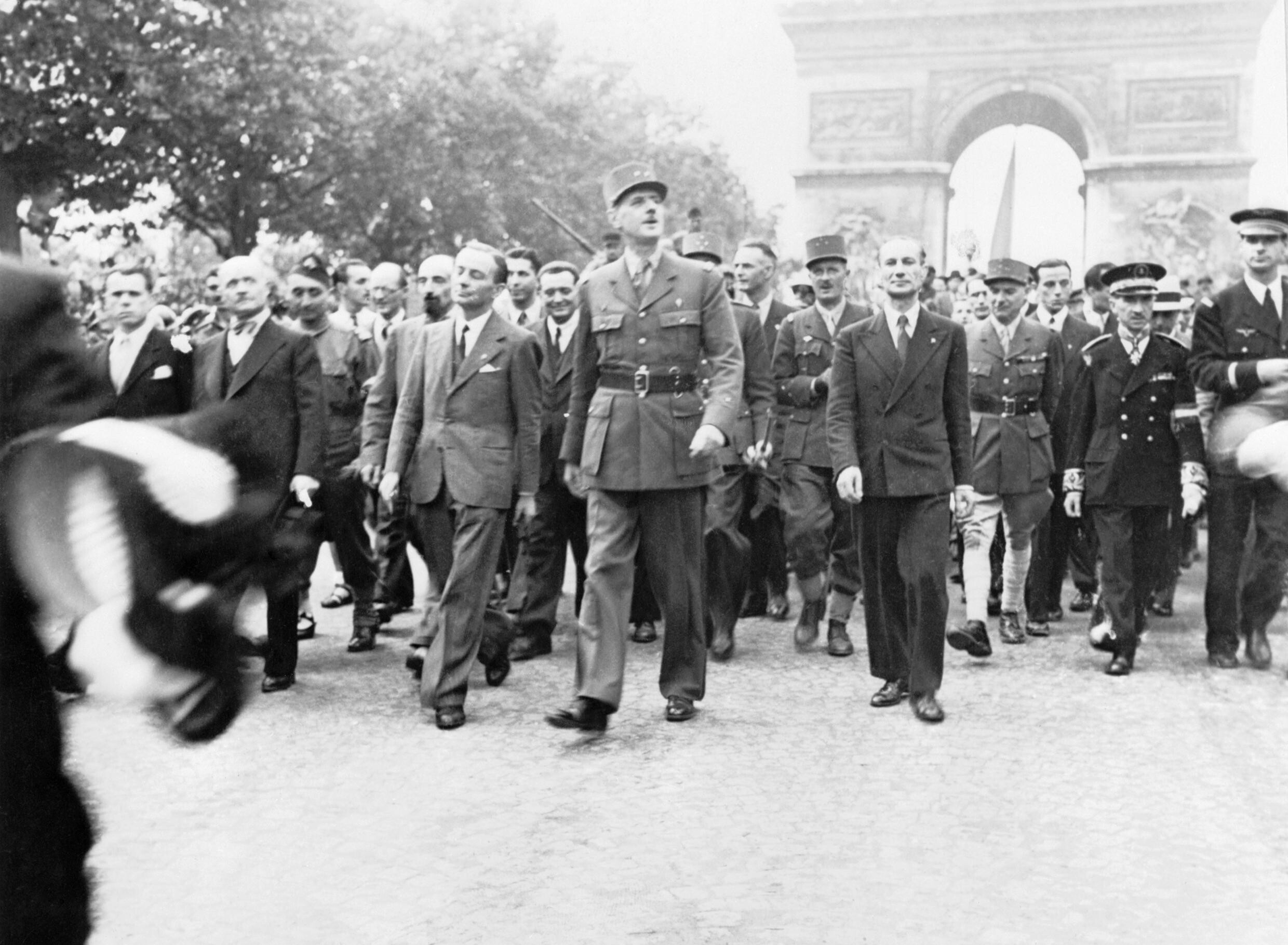
ON THE FOLLOWING MORNING, the official day of liberation, an enormous crowd of joyous Parisians welcomed the arrival of the 2nd French Armored Division, which swept the western part of Paris, including the Arc de Triomphe and the Champs Elysées, while the Americans cleared the eastern part. The Germans had melted away during the previous night. Two thousand of them remained in the Bois de Boulogne, and 700 more were in the Luxembourg Gardens. But most had fled or simply awaited capture.
Early in the afternoon of August 25, under the arcades of the Rue de Rivoli, a young French officer sprang into the Hôtel Meurice. He burst into Choltitz’s room. In his excitement, he shouted, “Do you speak German?”
Choltitz replied coolly, “Probably better than you.” He then allowed himself to be taken prisoner.
In the presence of Leclerc and the commander of the French Resistance in Paris, Choltitz signed a formal act of capitulation. He surrendered, not to the Supreme Allied Command but rather to representatives of the provisional government of France. Teams of French and German officers circulated copies of the document to the scattered groups of Germans still in the city.
As for the political situation, de Gaulle’s supporters proved to be more astute and better disciplined than their opponents. Taking advantage of the insurrection that began on August 19, they had seized and occupied many of the government buildings and secured the reins of political control.
On the day following the liberation, de Gaulle wrote Eisenhower and thanked him for letting Leclerc liberate Paris. That afternoon, with cheering crowds present, de Gaulle, Koenig and Leclerc paraded from the Etoile, now named the Place de Général de Gaulle, down the Champs Elysées to the Place de la Concorde. Some scattered gunfire came from the rooftops. Nobody knows who fired. Then de Gaulle proceeded to the Cathedral of Notre Dame, where a packed church took part in a mass of celebration and thanks.
When Hitler learned that Allied troops were entering Paris, he asked whether it was burning. Enraged by the negative response, he ordered artillery, V weapons and planes to destroy the city. His military commanders, however, were busy trying to come to grips with the collapsing military situation in France and making preparations to keep the Allies from entering Germany.
To make it clear that Paris had been liberated through the strength of Allied arms, Eisenhower planned to march the 28th Infantry Division through Paris to the front. On August 29, the division made its way through the city. Eisenhower, Bradley, Gerow, de Gaulle, Koenig and Leclerc reviewed the parade from an improvised platform, an upside-down Bailey bridge. Eisenhower had invited Montgomery to attend, but the British general said he was too busy to come.
Leclerc had, by that time, learned how to work more harmoniously with the Americans. He rejoined Haislip’s XV Corps in eastern France and gained great respect from American commanders with whom he worked during subsequent joint operations. After the war, he was promoted to field marshal.
Gerow, the senior military commander in Paris, sought to exercise control in the city, but Koenig and Leclerc blocked him constantly. Koenig, as military governor of Paris, took hold of civil affairs without even bothering to check with Gerow as a matter of courtesy. Three days after Paris’ liberation, when Gerow formally turned the city over to Koenig, the Frenchman flatly stated, “The French authorities alone have handled the administration of the city of Paris since its liberation.”
The restoration of French dignity was implicit in the liberation of Paris. If the Americans spoiled it somewhat by forcing the French to share it with their troops, they regarded the prestige as small repayment for the soldiers killed between the beaches of Normandy and the gates of the capital. The Americans were astonished when the gratitude they expected for their assistance became instead resentment and insubordination. Eisenhower, as usual, understood. He was charitable. “We shouldn’t blame them,” he later wrote, “for being a bit hysterical.”
The British, whether by accident or design, refrained from participating. Perhaps they regarded the occasion as primarily a French matter. More likely, they were aware of an undercurrent of anti-British feeling among the French.
The complications, misunderstandings and cross-purposes at work threatened to spoil the wonderful joy and delight of the liberation. It was perhaps better to say nothing of the intrigue behind the scenes. Certainly it was simpler to believe the legend that emerged immediately afterward: The Resistance in Paris liberated the capital without outside help.
But this has changed over the years. As the French commemorated and celebrated the arrival of Allied forces at the Normandy beaches on D-Day, as they became aware of the Allied role in liberating France, they came to acknowledge and to understand the American presence in the liberation of their capital. Only good friends, they have now decided, could share that privilege, that romantic happening, that splendid moment. It was all right for the Americans to be there.
This article was written by Martin Blumenson and originally appeared in the September 2000 issue of World War II magazine. For more great articles subscribe to World War II magazine today!