
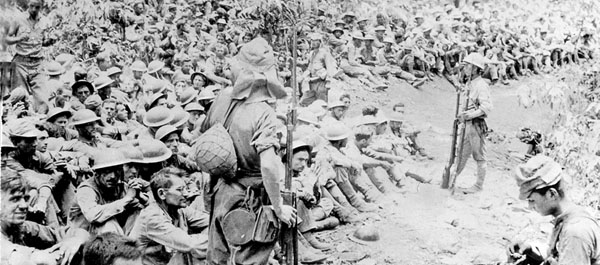
At 12:30 p.m. on April 9, 1942, Brig. Gen. Edward King, commanding officer at Bataan in the Philippines, surrendered to the Japanese. The victorious Japanese then forced more than 10,000 American and 65,000 Filipino survivors of Bataan’s garrison to march 100 kilometers in blazing heat from Mariveles to San Fernando. Already weary from months of fighting, the Filipinos and Americans also suffered from malaria, hunger and thirst. Those who fell along the way were beaten and clubbed—often to death—by their captors.
Six hundred to 650 Americans and 5,000 to 10,000 Filipinos died on the trek.
At San Fernando, the survivors were crowded into stifling, sealed railroad boxcars, in which many more died. When the men arrived four hours later in Capas, Tarlac province, they were forced to get off and begin a 10-kilometer walk to Camp O’Donnell. During the first 40 days in prison, about 1,570 Americans died from malnutrition, disease and beatings. More than 25,000 Filipinos died in about four months, until the Japanese began paroling Philippine army personnel in July 1942. But Philippine Scouts, who were part of the U.S. Army, were kept in captivity.
On June 6, 1942, the American survivors of Camp O’Donnell—except for about 500, who were held primarily for burial detail—moved once again, to Camp Cabanatuan. About 3,000 more Americans would die there, mostly from the lingering effects of the fighting on Bataan, the Death March and Camp O’Donnell.
Retired U.S. Army Maj. Richard M. Gordon was a defender of Bataan and is a survivor of the Death March, Camp O’Donnell, Camp Cabanatuan and three years’ captivity in Mitsushima, Japan. As the founder of a group known as the “Battling Bastards of Bataan,” whose motto is “In Pursuit of Truth,” Gordon has worked hard to dispel some of the myths surrounding the infamous Death March.
“Less than 1,000 survivors of Bataan are alive today,” he said. “In perhaps 10 years, they will all be gone. Most, if not all, would like to leave behind them the truth that was Bataan. To do less would dishonor those men who died on Bataan, in Camp O’Donnell and Cabanatuan, aboard the hell ships taking them to Japan and Manchuria, and in prison camps all over those countries.”
In an interview with John P. Cervone, Gordon recalled those terrible events.
Military History: How did you come to be on Bataan?
Gordon: I joined the Regular Army on August 5, 1940. When I enlisted, I requested the 31st U.S. Infantry Regiment in Manila. I was first sent to Fort Slocum, N.Y., where we received some introductory training. I remained there until September 7, 1940. At the time, Fort Slocum was a staging area for those going on overseas assignments, including Panama, Puerto Rico, Hawaii and the Philippines. From Fort Slocum our unit was taken by tugboat down the Hudson River to the Brooklyn Army Base, where we boarded the U.S. Army transport Grant on September 14, bound for the Philippines. The trip, counting a week stopover at Fort McDowell in San Francisco, took 48 days.
MH: What did you do upon arrival?
Gordon: I received basic training in Manila. I was assigned to Company F and lived in the Estado Mayor Barracks, formerly the home of the Spanish army cavalry when they occupied the Philippines in 1898. At the time, I was paid $21 per month, with an increase to $30 after four months.
MH: What was it like to be stationed there?
Gordon: Being in the Philippines before the war was great. We lived much like the British soldiers in India. Due to the heat, we only trained until noon, except when in the field for jungle training. Rifle marksmanship was a two-week period, once a year. Lack of funds prohibited further firing. This was our routine for 15 months before the war broke out.
MH: What was the general reaction when war started on December 7, 1941?
Gordon: We knew war was coming to the Philippines months before it happened, so it was no surprise. As Americans, we felt unbeatable and thought the skirmish would be short-lived. We looked upon the Japanese soldier with contempt—clearly a mistake.
MH: What did your outfit do in those first days of the invasion?
Gordon: On December 10, 1941, my unit moved into the field from our peacetime post at Fort William McKinley. We moved north with the North Luzon Force, then commanded by Maj. Gen. Jonathan M. Wainwright, acting as the security force for his headquarters and staff. Within two weeks our unit had divided into forward and rear command posts [CPs]. I was assigned to the forward CP. Our platoon, under the command of Lieutenant Henry G. Lee (a noted poet of the time), acted as a skirmish line to contend with Japanese infiltrators.
MH: When did you move to Bataan?
Gordon: We moved into the Bataan Peninsula on New Year’s Eve. The battle for Bataan began officially on January 2, 1942. After we assumed our first major line of defense, the PilarBagac line, we held our ground for nearly two months. The Japanese were defeated trying to crack this line, and things settled down until their replacements arrived. It was during this period that Brig. Gen. Maxon S. Lough of Palo Alto, Calif., assumed command of the Philippine Division, of which the 31st was a part. Events were also set in motion that would set the stage for the next few years. The United States could not decide whether to fight or evacuate the Philippines. In December 1941 Secretary of War Henry Stimson was asked about plans for Bataan and replied, ‘There are times when men must die.’ In early January our rations were cut in half, and in February they were halved again. By March we were existing on 1,000 calories a day, eating salmon and rice. Quinine, used to ward off malaria, disappeared by March 1, and dysentery was running rampant. Much of our ammunition was from World War I. Of 10 grenades, three might detonate. We had mortars, but no ammunition for them.
MH: When did the Japanese offensive resume in earnest?
Gordon: Enemy pressure began to build again in March 1942, with the arrival of replacements. Our division CP began to move backward on a regular basis—we seldom held one area for very long. Gen. Lough never believed in leaving his command post any sooner than necessary. As a result, each night we were required to establish new defensive positions around the CP. During those last nights on Bataan we often heard the Japanese trying to infiltrate our lines. One morning General Lough was entering his staff car just as a unit of Japanese came around a bend in the road. We slowed them up until he was safely away.

this article first appeared in Military History magazine


MH: How long were you able to hold the line?
Gordon: We remained there—on several different lines of resistance—until the final Japanese breakthrough on April 3, 1942.
MH: How did you feel about the surrender?
Gordon: I was captured—I did not surrender. Most of my fellow soldiers felt as I did—that we could not lose. We believed it was just a question of when the promised reinforcements would arrive. We were lied to—but by Washington, not by Gen. Douglas MacArthur. We never knew defeat was imminent until our commanding general told us he had surrendered. At the time, no one believed him, and when they found out it was true, many were in tears. We felt we indeed had been “expendable.” During a later prison camp session held by our Bataan garrison CO, Maj. Gen. Edward P. King, Jr., before he was shipped out to Mukden, Manchuria, he told us we had been asked to lay down a bunt to gain time. The baseball metaphor was probably the best way to explain why we were there in the first place.
MH: How were you taken prisoner?
Gordon: Gen. Lough gave us the word of our unit’s surrender. After hearing this, we camped in combat positions on Mount Bataan, known at the time as Signal Hill. A small group of us went farther up the mountain, in an effort to avoid surrender. Several days passed with no sign of the enemy. Hungry and in need of provisions, Cpl.l Elmer Parks (of Oklahoma) and I volunteered to drive down the hill to our last position in search of supplies. Elmer was driving and I was riding shotgun in a Dodge pickup truck. We gathered up a number of Garand M1 rifles at our former position, left behind by the Japanese, who did not want to use them. Loading the rifles aboard the truck, we decided to go a little farther down the road to where other units had been. Driving down the mountain road, we came upon a huge Philippine banyan tree, so large it served as a road divider. As we approached the tree, a lone Japanese soldier holding a rifle stepped out from behind it. Elmer stopped the truck, and we stared at one another, wondering what to do next. The thought of attempting to run occurred to both of us, as did the thought of picking up one of the newly acquired Garand M1s. But neither of us did a thing, other than stare at the Japanese soldier. Finally, he motioned to us to get out of the truck. At that moment 10 or 15 more Japanese came out from the brush lining the road. They surely had us in their sights all the time and probably would have enjoyed shooting us more than capturing us and adding to their burden. These were front-line troops, scouring the area for enemy resistance. Once we were out of the truck, they took turns hitting us with the butts of their rifles. We were searched, and whatever valuables we had—like wristwatches, cigarette lighters and wallets—were taken. On our way down the mountain I saw our battalion commander, Maj. James Ivy, bare from the waist up and dead, with countless bayonet holes in his back. It was then that Elmer and I knew we were in trouble.
MH: What was it like being marched back by the Japanese?
Gordon: Walking down that mountain, we passed American and Filipino corpses along the roadside. The stench was almost unbearable. Finally, as it was growing dark, we came to where the mountain road leveled off into the West Road of Bataan. Our captors turned us over to another group of soldiers. Unable to see us well in the dark, they felt our shoulders and pushed us through an opening in the bush lining the road. We later found out that the shoulder and collar inspection was to determine if the prisoner was an officer. If he was, he was kicked through the same opening instead of being pushed. That night was so dark and confused that I immediately lost contact with Elmer. I assumed he had died. I never saw him again until a reunion 47 years later at Fort Sill, Okla.
MH: What happened during your first night in captivity?
Gordon: That night in the encampment we were searched and beaten about the head several times. There were so many men crowded into that field that finding a place to lie down was almost impossible. I eventually found a spot near a “field latrine,” in reality, just an open ditch. All night long a stream of sick, diseased soldiers beat a path to that trench over and over again.
MH: Can you describe the march out of Bataan?
Gordon: The very next day, probably the 11th or 12th of April, I began marching out of Bataan. Not one of my fellow soldiers was known to me, American or Filipino. Our first day’s march took us up the infamous Zig Zag Trail, which seemed to last for miles and miles until it leveled off in flat country. Yet it was the first leg of the march, and we were in much better shape than we would be in four or five days. Anyone captured north of Mariveles was fortunate to miss this tortuous leg of the march. Hundreds of bodies were strewn along the side of the trail, men who could not make the steep climb. During that climb, I saw an old friend of mine, Sgt. Florence Hardesty. He had taught me to ride a motorcycle just before the war. Hardesty reminded me of the Lincoln Memorial in Washington, D.C., sitting, in death, against some sort of wall. He was entirely covered in the white dust that blanketed the trees, the road and the marchers. I almost broke down and cried. Hardesty was an old soldier, and I thought of him as a father figure. I have carried his image with me ever since I first saw him.
MH: What happened once you got to the end of the Zig Zag Trail?
Gordon: We were momentarily elated when we reached the top of that climb—we actually felt we had the worst behind us. Walking became much easier. But depression soon set in when we discovered there was no food or water to be had. Some attempted escape on that second day; others continued to fall, unable to keep up. These soldiers were shot, beheaded or bayoneted and left to die on the side of the road. Each night we were placed in a field and allowed to fend for ourselves. We expected water, if not food, but received neither. When dawn broke and we were put back on the road, a number of bodies were always left behind littering our sleeping field. In some ways, they were the lucky ones. Their miseries were over. For the rest of us, our agonies had just begun.
MH: Is that the way the rest of the march went?
Gordon: Days went by with no change in the routine established by the Japanese. We would stop in an open field and be forced to take off our hats during the hottest part of the day while the Japanese had their lunch—ostensibly to assure that we did not hide contraband under them, but also a deliberate act to cause us more hardship. We were required to sit there for an hour or more. Those caught with Japanese money, diaries, photos or anything taken from dead Japanese soldiers—despite the warning to dispose of such items—were usually executed on the spot. Fortunately, I had absolutely nothing of value left, although those with nothing were often cuffed about the ears as punishment. On the third day, we were marched backward and stopped alongside the road in daylight, in plain sight of Corregidor and the American guns. The guns of Corregidor opened up on the Japanese artillery positions alongside the road. We were being used as human shields. I saw a direct hit on a Japanese 105mm gun—it went up in the air like a toy. Score one for Corregidor! A number of prisoners were hit by the American gunfire, including me. I received a gash across my left leg, which surprisingly did not bleed that much. I covered it with my handkerchief, my last personal object.
MH: Where did you go from there?
Gordon: Days seemed to run together, and I lost track of time. Looking around during those first few days, I saw officers carrying duffel bags to hold their personal possessions. One lieutenant, named Olsen, walked by in his most prized possession, his riding boots. A day or so later, I passed Olsen’s duffel bag, with his name stenciled on it, on the side of road. The next day I passed his boots, which nobody seemed to want. Finally, on the third day I passed Olsen, dead on the side of the road. I was amazed that some officers tried to take things with them, adding to their burden of walking in the extreme heat and humidity. These items invariably led to their deaths.
MH: When did you reach a town or village?
Gordon: I don’t remember what day I arrived in Lubao. In that small town there was a sheet-metal warehouse about the size of a football field. Many prisoners were pushed inside the warehouse to sleep that night until there was room for no more. Unfortunately, I was among that group. There were so many men inside that place that sitting down, let alone lying down, was impossible. The heat beating down on that tin had sent the temperature soaring to 120 degrees and then some. Men stood all night, shoulder to shoulder, among the groans of the sick and dying. The next day dozens of men were carried out dead and left along the road as we began another day of the march. Everyone was dehydrated, with no chance to replenish the lost water.
MH: Where did you stop next?
Gordon: Within a day or two, I found myself in the town of San Fernando, a railroad junction in Pampanga province. Here again I had to sleep in the schoolhouse, with conditions almost equaling those in Lubao, but we were promised food the following morning. When morning came we were moved out, again without food or water, and put aboard the boxcars that would take us to Capas and Camp O’Donnell, our next destination.
MH: How did you survive?
Gordon: Words cannot really describe those days or the thousands of individual horrors. Suffice it to say, I went nine days without food and with very little water. My training as an infantryman paid off. I conserved water in my canteen by taking a sip, swishing it around in my mouth and letting a little drip down my throat. I would do this until I reached the next potable water spot. Others, untrained and dying for water, would prostrate themselves along the side of the road and drink water from puddles. All this water was contaminated with flies and fly feces and brought on death from dysentery. Thousands of Filipinos and several hundred Americans died this way. The Japanese beat any who attempted to break ranks and obtain water, killing a number of them in the process. Japanese tanks, moving south to take up positions to attack Corregidor as we marched north, would deliberately drive over the dead and dying on the side of the road.
MH: Did you and your colleagues try to help one another get through the march?
Gordon: No. There was a complete lack of assistance on the part of our fellow Americans. I did not witness a single act of kindness. The desire to survive overcame any idea of helping one another. I was a stretcher-bearer for a wounded officer, having volunteered to do so—out of sense of duty and responsibility. After one complete day of carrying the man, we could not get another four volunteers to relieve us, despite what amounted to begging on our part. That night, when compelled to stop, we left the officer to himself. He was later seen by a friend begging for help along the way. Even fellow officers who had originally carried him deserted him. I believe a lack of discipline led to this horrific situation. Most of our American soldiers had recently arrived in the Philippines, and very few had the discipline necessary for this.
MH: What was it like after you had completed the march?
Gordon: The train ride to Capas was another horrific experience, as men were jammed into each boxcar and the doors closed tightly. Men died standing up. One of our guards did open the door to let a little air in during the slow ride. Filipinos attempted to throw food into the car when it slowed down. Those standing in the doorway caught the food and ate all they could catch—nothing was passed back to anyone. Another instance of every man for himself. Arriving in Capas, we unloaded seven dead men from my car and proceeded to march another 10 kilometers to Camp O’Donnell.
MH: After having survived the Death March, how did you end up in Japan?
Gordon: Our first extended stop was in Camp O’Donnell, and it was there that I almost died from malaria. A buddy of mine, Fred Pavia of New Jersey, stole some quinine and saved my life, only to succumb to malaria and die himself three weeks later. My next “home” was Camp Cabanatuan, where I was placed on the grave-digging detail. The guards at Cabanatuan placed the head of a soldier who attempted to escape on a 20-foot pole, which they marched down the center of the camp as a warning. Soon after this grim reminder, we prisoners were placed in groups of 10. If one man escaped, the remaining nine in his group were shot. My malaria returned at Cabanatuan, and I became so ill that an American doctor recommended I volunteer for a work party going to Japan. On his recommendation, I was moved to Bilibid Civil Prison in Manila on October 31, 1942, awaiting shipment to Japan. Housed in this prison was a complete dental unit that had been captured on Corregidor. Imagine, Army and Navy dentists, with all their equipment, including dental chairs, and clean starched uniforms! For a while, we actually imagined we were back home in a dental clinic. Prisoners being moved to Japan were offered the chance to have their teeth checked. For me that meant a half-hour in a chair while two teeth were pulled and one was filled. In my three years in Japan, I never had a toothache.
MH: What was the voyage to Japan like?
Gordon: My ship, Nagato Maru, sailed on November 7, 1942. I was three decks below, in the pitch-black hold of the ship. For 20 days we suffered with no toilet facilities, save for five-gallon buckets that they would pass down to us every four or five hours. We were given rice and fish for the first few days and then just rice. Water was passed down in five-gallon drums once a day. Thirteen men died during that voyage. Just outside Manila we were attacked by a submarine. The Japanese took the few life preservers left in the hold and put them on boxes containing the ashes of their own dead. We survived the attack, but by this time many were hoping a torpedo would have hit us.
MH: What awaited you in Japan?
Gordon: My new home was Mitsushima, a village in the town of Hiraoka, where I would spend the next three years—three years of misery, freezing every winter. We had no heat and scarce rations. We were employed as slave laborers, building a hydroelectric power dam, which is still in use today. Eventually, I was placed in charge of a 40-man work detail for a civilian contractor handling cement for the dam and was held responsible in every way for their actions. On one occasion a number of the men refused to do some extra work. We were all taken into the camp and forced to stand at attention until the main body of the prisoners returned. Then we were beaten in front of the inmates. I was placed in solitary confinement for three days and two nights because of my men’s refusal to work.
No one knows what freedom means until one loses it.
Retired Army Maj. Richard Gordon
MH: Can you describe your feelings when you were released?
Gordon: I was returned to American military control on September 4, 1945, after more than 3 1/2 years of captivity. We were taken to Arai, a town on the Japanese coast. There we were met by U.S. Navy personnel wearing strange-looking helmets and carrying strange-looking weapons, which turned out to be M1 carbines. Placed in landing ships, we saw the American flag for the first time in more than three years. It was at that moment that I realized how much my country meant to me. We had placed our faith in our country, and our country had kept that faith by bringing us home. I don’t think there was a dry eye in the boat after seeing the Stars and Stripes. From that moment on, I was on a high and did not come down for a year.
MH: Corregidor has sometimes been associated with the Bataan Death March, but you have said that that is not true. How so?
Gordon: In 1982, a joint resolution of Congress honored the men of Bataan and Corregidor who made the Death March, but Congress was unaware that Corregidor had not surrendered until May 6, by which time the Death March was over. Nobody in its garrison participated in that march. For the past 40-odd years, many have assumed Bataan, Corregidor and the Death March to be interrelated. In fact, Corregidor had no connection with the Death March whatsoever.
MH: Any final comments on your experience?
Gordon: No one knows what freedom means until one loses it. Most Americans take it for granted, forgetting that thousands and thousands of their fellow Americans died to give them that freedom. We in Bataan paid our price for our country’s freedom, and most of us would do it all over again if we had to. Many returned sick and died shortly after the war. Many, even today, are seeking something from their country to ‘pay’ for their suffering. They, too, have forgotten that freedom is not free. For my part, I was a Regular Army soldier. I enlisted. I asked for the Philippines. Everything that happened was of my doing. I have no regrets, and my country does not owe me anything.
Each April, the Annual Memorial Bataan Death March is held in White Sands, N.M. Individuals from all over the world march for 25 miles in the White Sands Desert to honor the memory of Bataan’s defenders.
This article was written by John P. Cervone and originally published in the December ’99 issue of Military History magazine. Sergeant John P. Cervone is a a charter member of the Philippine Scouts Heritage Society, an organization dedicated to the troops who fought in the Philippines during WWII. For further reading, try: Give Us This Day, by Sidney Stewart; and Surviving Bataan and Beyond: Colonel Irwin Alexander’s Odyssey as a Japanese Prisoner of War, edited by Dominic J. Caraccilo.For more great articles be sure to subscribe to Military History magazine today!