
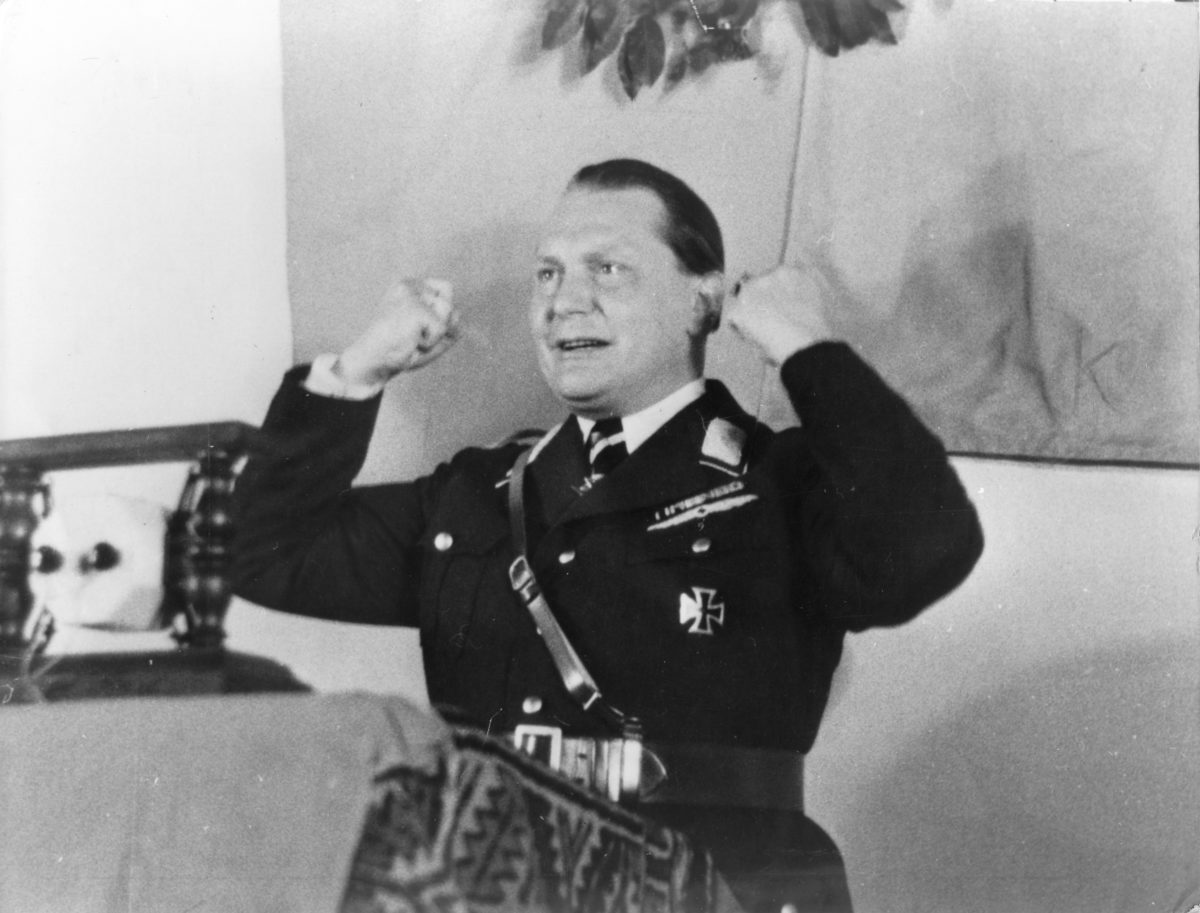
By May 1945, Lester Leggett had seen his fair share of combat. As a member of the 636th Tank Destroyer Battalion, an element of the 36th Infantry Division, the grizzled GI had fought all the way up the Italian Peninsula and into southern France. Along the way he was wounded by shell fragments, buzzed by a pair of Messerschmitt Me-109s in farm country, ran headlong into a German convoy in woods and tumbled down a steep mountain embankment when the road gave way under his jeep. Still, it was an unexpected mission to seize Reichsmarshall Hermann Göring in the days immediately after the shooting stopped that he remembers as among his most tense and potentially hazardous. In an interview with David Lesjak, Leggett shares his memories of the raid to bag the bigwig and the controversy over his capture that lingers to this day.
Where were you when you received word the war was over?
My reconnaissance platoon was six miles south of Bad Tölz, where we had earlier fired at a German convoy traversing a road at a higher elevation. The night of May 5 we were out of the vehicles walking on gravel trying not to make any noise. As we were walking, the radio came on and said: ‘All companies. German Army Group G has surrendered effective 1200, 06 May 1945. All units halt in place. Do not fire unless fired upon.’ We were stunned. We made a radio transmission asking if we could come on in. They said affirmative; so we turned the lights on and drove in to Kufstein.
What happened when you reached Kufstein?
Each of our platoons was given a small hostel. They had sleeping rooms and a place to eat. Two Austrian women said they had beer in the basement. The guys got that beer up in a hurry, and with the beer and being tired, it didn’t take long before everybody but the guards were out.
What was it like knowing the war was over?
The next morning it was a beautiful day. Austria had not been torn up like Germany had. It was really beautiful. I crawled out on the roof and was looking at the colors. I didn’t hear any birds singing, but the sounds of war were nonexistent. It was just a new day.
Your unit was quickly given a new assignment. How did that come about?
On May 7, our acting first sergeant, Staff Sgt. Hank Probst, told us to get three to five days of rations and ammunition together and be sure we had plenty of gas and water. He said we had a mission.
You had just found out that the war was over. How did these new orders make you feel?
Leggett: That surprised us. We had no idea what they were talking about. They said to be ready to go in two hours. Well, in one hour we left. Probst went with us on this mission. He came down to the hostel and told us what to do. He got the information from 1st Lt. Golden Sill, our company commander.
Who gave Sill his orders?
Leggett: Sill was called in by the 36th Infantry Division’s assistant division commander, Brig. Gen. Robert I. Stack. He briefed Sill that he needed a combat unit to go with him. Stack said we were going to follow a senior German officer farther into Austria to accept a surrender.
Did you have any idea at that time who your target was?
The enlisted men in the platoon didn’t know who we were going after. We knew he was a senior officer. It could have been a general, it could have been a colonel, we didn’t know. They didn’t tell us. The rumor got started that it was Heinrich Himmler.
Were you excited about the possibility of arresting a high-ranking Nazi?
No. There were all kinds of them being picked up. It was sort of a feeding frenzy. They were really groping around trying to get as many as they could.
What happened to you next?
We took off following a Mercedes. It turns out a Mercedes came in under a white flag with letters from Reichsmarshall Hermann Göring to General Dwight D. Eisenhower. They couldn’t get through to the north so they came our way. Göring was interested in surrendering. He thought he would sit down with Eisenhower and work out the means of surrendering the rest of the German forces and revitalize Germany to assist the Allies, because the Germans thought we’d be fighting the Russians.
Who was the man in the Mercedes?
Göring’s senior aide Oberst [Colonel] Berndt von Brauchitsch. He left with his Mercedes leading with himself, a captain and a driver. General Stack followed in the staff car with his aide, 1st Lt. Harold Bond, and then a jeep following him.
Who else was in the group that set out?
Sill was given command of the escort. There was a 2nd Lt. Shapiro with two jeeps. A total of five men begged to go along. General Stack told Sill, ‘If you want them to go it’s all right.’ Sill said that he told him, ‘We’re going to need all the help we can get,’ and he let them come along. Shapiro followed the general in the staff car. My company commander and his jeep driver, Pfc Jewel Wright, got in behind them and then my platoon followed: two M-8 armored cars and four jeeps. The entire party went 84 kilometers into occupied territory the day before the war was officially over.
It must have been eerie moving so deep into territory still held by an enemy you had fought for so long.
It was a little strange taking off down that dusty road and seeing German units in the field, parking vehicles, bringing up artillery pieces. I saw a lot of armored self-propelled guns. We fought them as much as we fought tanks. Some of the Germans closer to the road waved at us and others saluted us with an army salute.
Did you sense any hostility as you drove past them?
They weren’t antagonistic. We turned the turret on the M-8 to the rear and elevated the gun. The guys also stood up in the turrets so that their bodies were halfway out.
I understand you lost contact with the forward elements of your group as it moved along.
We were going pretty fast trying to stay up with those automobiles. The road started climbing. Eventually we went through the Thurn Pass, which had an elevation of 1,274 meters. We had lost all the vehicles in front of us, including the jeeps. They left our 9-ton armored cars in the dust.
How did you know which roads to stay on?
The strange thing was, at every intersection there was a German guard with his rifle slung. Some of them had white armbands on. We would later find out that General Karl Koller of the Luftwaffe had gone ahead and prepared this route. He also requisitioned Fischhorn Castle, deciding that would be the best place for Göring to meet with General Stack for the surrender. We got a radio message to keep on rolling until we saw a guard at a castle entrance — at a road entrance is the way they put it.
Where was the castle?
If you have a map of Austria find Salzburg. South of that is Berchtesgaden and still farther south you’ll see a lake and Zell am See. Fischhorn Castle is near the south end of the lake.
What happened when you arrived at the castle?
A guide waved us through a gap in a stone fence and we followed a little dirt road. The road went in a straight line past a stone house that was not right at the road but back farther. The road turned and went behind the castle. The road on the castle grounds was in the shape of a question mark that hooked around the backside of the castle. We saw some outbuildings.
I understand you had a bit of a shock when you arrived at the castle?
When we turned that corner and went into the little clearing behind the castle, we realized we were right smack in the middle of an SS headquarters. There were maybe 50 or 60 men. All of them had their weapons.
You were all experienced soldiers, many with years in combat. How did you react?
We thought we might have some problems there. We were just stunned. Nobody had told us on the radio to expect that. It was real fortunate that we didn’t have somebody start shooting.
How did your former foes react?
There was no aggressiveness. These people were not aiming anything at us. They weren’t drawn up in ranks. They were walking between buildings, just going about their business, which in itself was strange. Our first sergeant went into the castle to find out what was going on. He found out that all the SS were sent from the castle except an old caretaker.
What did you find out about the SS unit you were now sharing space with?
SS Colonel Waldemar Fegelein was there. He was the brother of SS Lt. Gen. Hermann Fegelein, who had been in Adolf Hitler’s bunker and was executed by the Führer for his alleged treachery. The unit at the castle was the SS Florian Geyer Cavalry Division that had been cut up pretty badly on the Eastern Front. Supposedly they had pulled back to this area and this was the division headquarters. Fegelein was the division’s chief of staff. He had quite a few headquarters type troops around there.
How did you find out what your role would now be in this unusual scenario?
When Probst came out of the castle, he said we were to set up at least three guard posts. The person on the guard post at that big door into the courtyard was to keep notes on who came in and who left. The only vehicles in the courtyard were the Mercedes that von Brauchitsch had led in, General Stack’s Plymouth staff car and three jeeps — the one belonging to Lieutenant Sill and two from the 142nd Intelligence and Reconnaissance Platoon that belonged to Shapiro.
Where were the armored cars and the jeeps from your platoon positioned?
We originally had three guard posts: the castle road gate, courtyard entrance and a steel-door entrance around a corner from the castle entrance. The two M-8s were at entrances near the castle. The gate at the road — it really wasn’t a gate that had to be opened, it was just an opening in a wall at the main highway — had one of the jeeps with a radio and a machine gun on it at night. The M-8s were sited in to give us the best protection. There would not be any SS coming and going into the castle at all. The only real entrance into the castle was that big double gate into the courtyard. The castle was a thick-walled fortress, and we were prepared to pull inside the courtyard and man the walls. My job and first section sergeant Richard Snell’s job was to run the guard posts and to keep note of what went on outside. We had to stand guard like everyone else.
What about Shapiro’s men?
Shapiro’s people never helped us. They stayed to themselves and hung around their vehicles in the courtyard.
Was Göring at the castle?
Göring was not at the castle. General Stack got a hold of Göring’s senior aide and said, ‘Can you find him?’ Brauchitsch said: ‘I’m making phone calls. I think I’ve found him on the road between here and Mauterndorf. He’s somewhere on the road trying to get here.’ Göring was cluttered up on the road someplace. There were people all over those roads — homeless people, German soldiers trying to get back home or to their unit. It was a mess. There were all nationalities of POWs in the area as well as concentration camp people.
Members of your platoon stood guard duty alongside some of the SS. How did this come about?
There was an SS HauptsturmFührer (captain) that spoke perfect English. He went around with Sill and showed him the castle grounds. The SS officer suggested that because we couldn’t provide any protection for his unit, we should have one armed SS and one armed American on every post. So that’s what we did.
Once Göring’s approximate location was discovered, what happened next?
General Stack — and this is one of the things that gripes me — wrote that he went forward from the castle at about 4 o’clock in the afternoon looking for Göring. I’m going to tell you, Snell and I were the only ones that knew who left and who came into that castle. We had a message book. We’d write down when a vehicle left and when a vehicle came in and who it was, if it was a senior American officer or a lieutenant or what. General Stack did not leave.
If General Stack didn’t go out to find Göring, who did?
The general called 2nd Lt. Shapiro in and asked 1st Lt. Sill to leave the room. Evidently Stack told Shapiro to take his sedan and his driver and let Göring’s senior aide go forward in that vehicle to find Göring on the road. And that’s what they did. That Plymouth station sedan and one jeep with two of Shapiro’s men left with von Brauchitsch. Stack was still in the castle.
Were you on active guard duty that evening?
I happened to be on the gate. The SS guy with me was just a kid. He had a carbine slung over his back. He couldn’t speak English and I couldn’t speak German. He did say ‘Ost.’ Everybody knew that meant ‘east.’ He’d been hurt over there. A submachine gun hung from my web sling over my shoulder. I was always ready.
Where were you when Göring finally arrived at the castle?
At about 11:30 we saw all these vehicles with lights on approaching. There were about 13 followed by the Plymouth. The first vehicle was one of our jeeps. The second was Göring’s Mercedes 770 150-W, better known as the 7.7-liter Mercedes. He had his driver, his wife, his daughter, a nurse and an officer with him.
What did you do when that convoy reached your post, which was at the entrance driveway to the castle?
I had one of those old Army flashlights. I shined my light in there. I was looking for attitude and weapons. I shined it in there and saw there were ranking people and their families. I didn’t know what Göring looked like, but I did know he was the chief of the Luftwaffe.
It sounds like Göring arrived in a caravan. Can you describe some of the rest of the group?
There were some cars, trucks and buses and we just waved them in. The G 2 [intelligence] journal for that day listed the people — there are only about 26 of them in the report. Good Lord, there were 75 or 80 Germans that came in with Göring. They arrived in 13 vehicles and dribbled in all night long until there were about 25 vehicles in all. The trucks were parked in a clearing about 75 yards from the castle.
You maintain that General Stack did not go out in his staff car to find Göring as he later claimed. When did Stack see Göring for the first time and what proof do you have to back up this claim?
Sill later wrote to me that he and the general walked out of the castle and into the clearing and that was the first time the general had laid eyes on Göring. That is not what Stack wrote later. That’s the way that Göring surrendered.
Given the fact that Göring had been arrested by the SS on orders from Hitler, how did he react once he found out he was in the midst of an SS unit?
Göring told General Stack that the SS previously had him under arrest. He also said that Waldemar Fegelein was the brother of one of his deadly enemies in Hitler’s bunker. Stack allowed Göring and his men to keep their weapons. Göring had a side arm and two additional machine pistols that he wanted for the night. He wore a white armband and he had his Reichsmarshall‘s baton in a little canvaslike sack. Stack and Göring went into the castle. Then we had another guard post to worry about because in that clearing we had Luftwaffe people who were at odds with the SS because of their chief. We had two factions of Germans staring down one another — both armed.
Did you sense any animosity between the two groups?
Yes. You could see it in the way they talked to one another. I guess they kind of felt a little animosity toward the SS troops. There were usually hard feelings between the SS and almost anybody else. We had an uneasy night.
What did you do, knowing that you had two groups of armed men who weren’t too fond of each other?
We wound up putting another guard post with a Luftwaffe soldier and an American soldier at the truck clearing. That was going to make it tough on us for the rest of the night. We had all of those vehicles full of weapons. We dismounted our machine guns from at least two of our jeeps and had those in an area to cover the clearing.
How did the night progress after Göring entered the castle?
I had been at the gate when he came in. I was relieved at 12. They were in the castle when I got back up there. Snell took over. We were kind of keyed up. We got the guy that we went up there to get, but we still didn’t know any of the details. We were just standing guard keeping the Germans in their area, and we were guarding the castle. Everybody was tired. They were tired, we were tired and I was worried about all of those vehicles full of weapons that came in. It was dicey. We couldn’t cover it all and we knew that. We didn’t have enough people.
Where was Göring at this time?
Göring was on the second floor of the castle.
Did you ever get inside the castle proper?
We slept in the halls. They had big thick carpet runners on the floors and on the stairs. That’s where we slept at night. There was a bust of Hitler on one of the landings on the big staircase.
What happened to Göring’s entourage?
Some of those people were considered high ranking and they went into the castle, along with the womenfolk.
Were there any problems with the Germans that night?
So far there had been no fighting between anybody. But, as the Germans retired to a small warehouse and a longer building near an open clearing across from the castle, they got kind of loud. They were drinking and then they started shooting through the roof. That made us uneasy. They weren’t shooting in our direction. We were set to return fire but we were surrounded by Germans. We had Germans in the countryside, Germans on our right and Germans on our left. We didn’t have many guns. The Luftwaffe worked with us very well, and we got where we would rely on those guys that came in with Göring.
It sounds like you were busy outside the castle keeping the different factions apart. When did you realize that the person Stack had met in the castle was, in fact, Hermann Göring?
I knew since landing in Italy that Göring was the head of the Luftwaffe. I didn’t know what he looked like until after I saw all 240 pounds of him in that Mercedes at my guard post on May 7.
It sounds like a pretty tense evening. What happened when the sun finally came up?
We were out in the courtyard. General Stack said, ‘Take as many pictures as you can, because there’s not going to be any newspaper people here.’ That’s why years later a lot of controversy came up over the picture of Göring standing in front of the Texas flag. It was said it was taken at Fischhorn. I maintain it was not, because we would have known if any press photographers came up there on that first night. Göring only spent one night there. He went back with the general in the Plymouth staff car to division headquarters at Kitzbühel. That’s when the picture was taken, at division headquarters. Besides Göring, they also loaded up the senior German officers.
How did you feel at this point?
I thought we picked a plum off the tree. But there’s something else I felt — we didn’t have him back yet. We were still up there in a position where something was mighty strange. The SS had always evoked fear and loathing when encountered. These guys were deadly. They were strangely quiet, and it gave you a feeling they were there for some other purpose.
You had a feeling the reason the SS unit didn’t do anything was because they had an ulterior motive for being at the castle. Can you explain this?
In retrospect I feel that perhaps these guys were guarding something. It turns out that [controversial historian] David Irving wrote quite a book about Göring. Of course he’s been in trouble with some historians over some things he’s written in his life, but in a footnote to his biography, Irving said the Counter Intelligence Corps [CIC] found a trunk, secreted in the basement of Fischhorn, that had all kinds of records and letters between Hitler and Eva Braun. Braun’s brother-in-law was the Fegelein who had been shot in Hitler’s bunker. That trunk later disappeared after CIC found it.
So you think the Fegelein brothers, Hermann at the Chancellery Bunker and Waldemar at Fischhorn Castle, were entrusted to look after some of Eva Braun’s personal belongings?
Yes. Eva’s sister Gretl married Hermann, who was in the Berlin bunker with Hitler. Eva moved into the bunker bringing her belongings with her. Hitler said he didn’t want any of his private belongings to fall into the hands of the enemy. Before Hitler committed suicide on April 30, he wanted to know where Fegelein was. I believe Braun had given Fegelein some of this stuff for safekeeping. They started looking for Fegelein. The story goes that he was found in his apartment, dressed in civilian clothes. They brought him back to the bunker. Hitler was going to court-martial him. They didn’t really have a trial; they just took him out into the courtyard and executed him.
Why do you think Fegelein was executed at the Reich Chancellery?
I think one of the reasons was because they questioned him to find out where the diaries and the letters that belonged to Eva Braun were, and he told them he had sent them to his brother at Fischhorn. What lends credence to my analysis is SS Sturmbannführer [Colonel] Johannes Göhler, who was assigned as an SS liaison to Hitler’s bunker, was at Fischhorn when Göring surrendered. He was with Waldemar Fegelein. Maybe one of the reasons Fegelein was executed at the bunker was because Hitler found out he had sent these items to his brother at Fischhorn. That would explain why the SS at the castle weren’t antagonized at our appearance — they were doing something else other than worrying about us picking up Göring. They were worried about whatever was in that trunk falling into the hands of the Americans.
You think that perhaps Göhler was the one who transported the documents from Berlin to Fischhorn Castle?
Yes.
Back to the morning of the 8th, who were some of the other people in Göring’s entourage that caught your eye?
I noticed a woman who had an Oceanic-type radio. It was obviously a military radio. She would come out into the courtyard to smoke. We had a couple of lieutenants who came up on the 8th. They were trying to talk to this woman. They found out she was American. I heard her say she had lived in New York at one time, but that she had thrown in her lot with the Germans. These guys lost interest. After reading about [propaganda broadcaster] Axis Sally (see World War II, November 1995), I said that’s who it was. That had to be her. I think we had Axis Sally, but since there were no counterintelligence people with our platoon, we didn’t realize who she was.
Did you stay behind at the castle after the crowds departed?
Yes. All of us who were up there stayed behind to guard those who were left at the castle.
But several important Germans in the group were initially overlooked, including Hitler’s Chancellery chief, Philip Bouhler, the architect of Operation T4, the Nazi euthanasia program.Why was that?
They didn’t take Philip Bouhler or his wife. They found out they were in the entourage after May 10, when we turned the castle over to the 42nd. They came to get him, and he killed himself. His wife also committed suicide.
There has been some confusion as to the exact date Göring was captured. Why is this?
The Germans were out of our division’s zone of responsibility. When our division commander decided to go after Göring, he decided to go without telling XXI Corps Headquarters or Seventh Army. They wanted to get him first. Staff journals record the story as starting on May 8, not May 7, when it actually happened. We had Göring the night of the 7th. The night of the 8th he was at Kitzbühel, the night of the 9th he was back at Seventh Army headquarters. We crossed boundary lines and were probably in the 101st Airborne Division’s area. The 101st was at Berchtesgaden. There was no way they could get down to Zell am See because the roads and the bridges were out. Stack and Maj. Gen. John E. Dahlquist, the 36th’s division commander, decided we would go get him, and we did. We had him on the night of the 7th but they reported that all of that had happened on the 8th. By the 10th, the 42nd Infantry Division moved in and took over that area. We left Fischhorn and turned it over to them. We went back to Hopfgarten.
What did your unit do once war was officially declared as being over?
They’d send us out to [see] the various mayors in the little villages to get them to turn in all of the weapons they had. Then we were sent farther back to Kirchheim, Germany. I left the unit on points to go home on May 27. I was back in Fort Worth after having been discharged at Fort Sam Houston and was at home on July 12, 1945.
How did you feel knowing you had helped to capture the second-ranking Nazi?
I’m not sure at that stage it had the same importance as the fact that the war was over. We had put up with so much. We always needed a bath. We didn’t have the food we yearned for. It didn’t really set in with us at first that this was a historical event.
Looking back on it now, how do you feel?
I think it was wonderful that I was involved with the taking of the most important prisoner arrested in World War II. As far as I am concerned, it was sort of the cherry on top of the cake.
Lester Leggett later received a commission in the Texas National Guard and subsequently served with the 2nd Armored Cavalry Regiment, became an Army aviation ground school instructor, served in Taiwan as a member of the Military Army Advisory Group, flew helicopters in Vietnam, graduated from the U.S. Army Command and General Staff College and commanded the 503rd Army Aviation Battalion, 3rd Armored Division. He retired after 26 years of service. Leggett is currently writing a book titled To Zell and Back, which documents the U.S. Seventh Army’s exploits between Operation Dragoon and the capture of Göring.
this article first appeared in world war II magazine