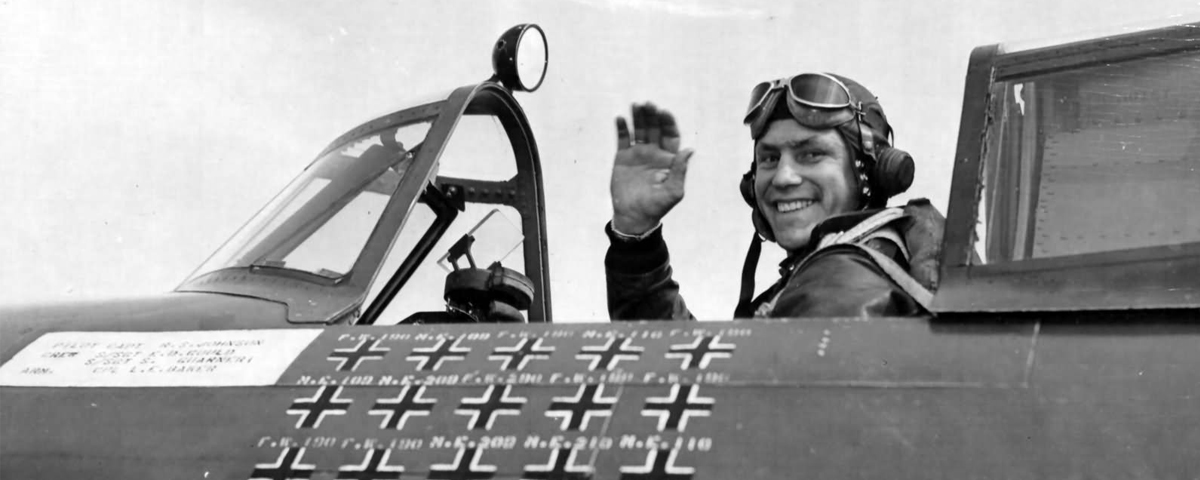
When one thinks of the traditional straightforward, quiet hero of World War II, Robert Samuel Johnson is someone who naturally comes to mind. Bob Johnson served with the 56th Fighter Group, known on both sides of the Channel as ‘Zemke’s Wolfpack, so named for its colorful leader, Lieutenant Colonel Hubert Zemke. That group would produce some of the highest-scoring fighter pilots in the U.S. Army Air Forces during the war in Europe–including Johnson, with 27 aerial victories.
Johnson frequently has traveled around the country educating young people about the reasons for America’s involvement in World War II. In this way he has preserved interest in the men who fought; he makes us remember the sacrifices of those who never returned, regardless of their nationality.
The interview was conducted before his death in December 1998.
Military History: Tell us some details of your family and childhood.
Johnson: I was born on February 21, 1920, in Lawton in southwestern Oklahoma, 52 miles north of the Red River. I had no siblings. I went through high school, plus two years of junior college at Cameron College, which is now Cameron University. I majored in engineering, did some boxing and played football. As for further education, I joined the Army Air Forces in World War II, where I went through several courses. I never had any further schooling.
MH: How did you develop your interest in flying?
Johnson: I was sitting on my dad’s shoulders at Post Field near Lawton one day. I had always been, as most kids were in those days, interested in becoming a cowboy or a railroad engineer. I was at this airshow given by the military in 1928 with the old fabric-covered biplanes. They had three little fighters in a V-formation, and they did all kinds of stunts, twisting and turning below 5,000 feet. Then and there I changed my goal from cowboy or engineer to Army aviator. I started flying when I was 13 and got my first license, which I still have, the day before I turned 16. As soon as the civilian pilot training program was started, about 1939 or 1940, I went through that. I borrowed money from the dean of the college, and I paid him back with interest. Then came the time when Adolf Hitler was overrunning all of Europe, so our football team went Army, Navy, Army Air Forces and Marines, everywhere. I went through Sikeston, Missouri, for primary training, flying open-cockpit Stearmans in about 5 degrees below zero in December 1941. I then went to Randolph Field for the next session, and then to Kelly Field near San Antonio, Texas, for the final training. I initially trained as a bomber pilot, thank God, because we ended up in England, where we had to fly instruments and in close formation. I had no gunnery training except for my little .22-caliber rifle, shooting rabbits from the fender of a Model T Ford. Well, upon graduation I requested Douglas A-20 Havoc bombers, with duty near home at Oklahoma City. My second choice was Seattle, Washington, and third choice was Florida. I got Republic P-47s in Connecticut. Wherever the people are needed, that’s where the bodies go! Well, I was just tickled to death, and we were the first ones to get P-47 Thunderbolts.
MH: Which model of the P-47 were you flying?
Johnson: The B model, which killed a couple of boys in training. Then we went to the C and later D models. We left the United States on January 5, 1943, and arrived in England on the original Queen Elizabeth liner on about January 13. Our planes were given to the 4th Fighter Group, whose three squadrons had already been in the war as the Eagle Squadrons, flying Supermarine Spitfires for the Royal Air Force. We instructed them on how to fly our planes, they showed us a little bit about combat, and later we received our own planes.
MH: When was your first mission in the P-47B?
Johnson: That was in mid-April 1943. On June 13, I got one of the very first enemy aircraft destroyed by our unit and broke all the rules and regulations to do it. I was supposed to fly top cover, but I flew past Colonel Hubert Zemke to shoot down the leader of an eight-plane formation of Focke-Wulf Fw-190s. With more experience I might have been able to shoot down two more. I arrived home late because I was looking for more enemy planes, and upon my arrival I was thoroughly chewed out by my squadron and group commanders. I was congratulated for getting the kill; then I got the reprimand. They were right and I was wrong.
MH: Tell us about some of the types of missions that the 56th Fighter Group performed.
Johnson: We started flying bomber escort. The first missions were just flights over the coastline into France to get a feel for the terrain and the enemy-controlled area. We occasionally met the enemy over the North Sea, and sometimes they came over to visit us. They would strafe the fields and that type of thing. As time went on, we pushed them back from the coastline, but that comes later in the story. That was where I received my combat and aerial gunnery training, against the best the Germans had.
MH: That’s true, you were flying against Jagdgeschwader 2 (JG.2) and JG.26 a lot–and they were definitely a sharp group of pilots.
Johnson: Yes, that’s correct. They were at Abbeville and along the coast, right across from us.
MH: I understand that Oberstleutnant Hans Philipp, leader of JG.1, was one of your victories?
Johnson: That was on October 8, 1943. My wingman and I had become separated, as sometimes happens in combat. We were trying to find some friendly airplanes to fly home with. I had just shot down a Messerschmitt Bf-110, which was my fourth kill. As I pulled up from that dive I saw four Fw-190s attacking the bombers. I rolled over until I was upside down so I could watch them, as they were some 5,000 feet below me. I was inverted and continued my dive, shooting while pushing the nose forward to give the necessary lead for my bullets to intercept one of the planes. I was shooting at the leader, and his number three or four man pulled his nose up, shooting at me as I was coming down. I continued the attack, and just as I hit the leader, knocking him down, I felt a thump in my airplane. How badly I was hit I didn’t know, as I was very busy. I leveled out after that, and I found out 50 years later that my fifth victory was Hans Philipp, a 206-victory ace from the Russian Front. I pulled up right in the path of a group of Bf-110s and Fw-190s coming in behind the four I had engaged. I immediately threw the stick left and dropped the nose. Nothing happened when I hit left rudder, and then I knew that my rudder cable was shot away. I had no rudder control at all, only trim tabs.
MH: What went through your mind at that time?
Johnson: Well, the main thing was to get clear of that cluster of enemy fighters. I dived away with the throttle wide open, and I saw some friendly P-47s and joined up with them. My first thought was to bail out, but I pulled up alongside them and found I could still fly, even with 35 feet of rudder cable piled up in the cockpit. Those planes were from the 62nd Squadron, part of our group. They said, Sure, come aboard. Ralph Johnson turned out to be leading the flight. I still had the throttle wide open, and he said, Jesus Christ, Johnson, cut it back! I was running away from them. Well, I chopped the throttle back and we returned to England, landing at Boxsted, which was the first base we came to. Ironically, we were later stationed there as a group. There was one little opening in the clouds below, and I saw there were some runways. At the time, we had a bomber and a Piper Cubtype airplane ahead of us, and we let them land first. They said, Bob, since you’re banged up, you go in first. I told them: No, I have plenty of fuel, and if I mess it up none of you could get in. I’ll just stay up here and come in last. They all landed and got out of the way. I came in a little hot, but I still had aileron control–no problem there. I came in, touched the wheels first, then the tail wheel dropped. I had to hold the left rudder cable in my hand so that I could get to my brakes. The minute I touched down I was pulling on the cable, using the brakes, and was able to stop. I pulled off the runway in case anyone had to come in behind me. I climbed out and walked the entire perimeter of that base; I could not see due to the foggy weather. I later found the other guys at the control tower, waiting on me. The next morning we looked at the airplane, which was only 50 yards from the tower, but I had walked in the opposite direction for about 2.5 miles to get to that point. We had some guys come over and put a new rudder cable in.
MH: How many combat sorties did you fly, and what was your final victory count?
Johnson: I flew 91 missions and got my 26th and 27th victories–a Bf-109G and an Fw-190–on my last mission, May 8, 1944. Later, they gave me credit for an additional airplane, which made number 28. About a year ago, however, I was informed that they had gone through and recounted the records, and I was officially credited with 27. They had given me credit for two on one mission, and Ralph Johnson one. Actually, it should have been reversed; I got the one. I didn’t fly on the day of the double victory.
MH: Well, 27 victories in 91 missions was phenomenal in any case. Only one pilot in Europe did better, and he was another 56th man, right?
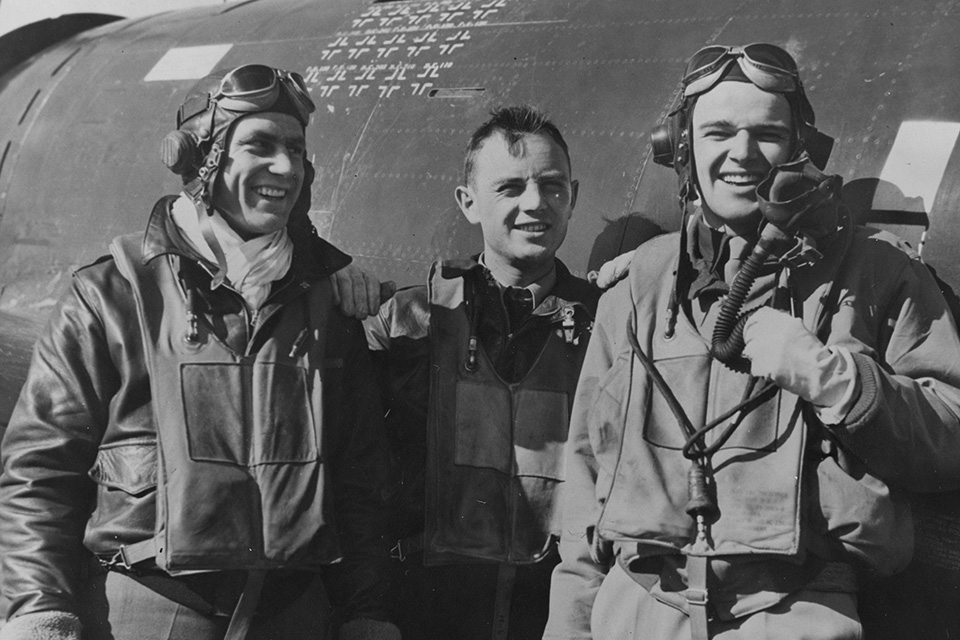
Johnson: Yes–Francis S. Gabreski continued to fly after I had left. He went down on July 20, 1944, soon after scoring his 28th victory, and was taken prisoner. As you know, he also became an ace in Korea, with 6.5 more victories.
MH: Were you around when Colonel Zemke was shot down and became a POW?
Johnson: No, I had already left by that time. I left our base on May 8, 1944, coming home on June 6. I was kept in a rest and recuperation home, where I damn near went nuts. There was nothing to do; it was a miserable place. They did that so I could be in England on D-Day, but I was not aware of that until it happened. I tried in every possible way to fly combat for two more weeks. Their answer was, No, go home and get fat. I was never allowed to fly combat again.
MH: Why do you think they did that?
Johnson: I had broken Eddie Rickenbacker’s World War I record, and they did not want to take that away from me. Perhaps that is one reason I’m still here.
MH: Tell us about some of your most memorable combat missions.
Johnson: Well, four P-47 groups pushed the Germans back from the French and Dutch coasts to about a north-south line from Kiel to Hanover. They knew what our range was because they had captured a couple of P-47s and they knew it was a big gas eater. They set their defensive line at the limit of our operational range, where we had to turn back. On March 6, however, we had one of the biggest aerial battles right over Dümmer Lake. They attacked the bombers, and about 69 of the heavies were shot down. I had eight guys to protect the bombers against about 150 German fighters, so we were not very effective at that time. We were split into groups A and B, spreading ourselves thin since the Germans had not come up to fight. They showed up then on March 6, 8 and 15, and I was on all three missions. I was in Group B on March 8 and Group A on the other days, which was right up in front. I was the lead plane on those occasions. We lost 34 bombers on March 8, and on the 15th I was the lead plane moving north trying to find the Germans. Well, I found them. There were three groups of Germans with about 50 planes per group, and the eight of us went right into them head on. Two groups were level, coming horizontally, and the third was up high as top cover. We went in, since we had no choice, and fired line abreast. That stalled them a little bit. I was pushing every button I could find on my radio, including SOS. I gave the location where I found the Germans and what they were. In just a matter of minutes we had scores of planes–P-47s, North American P-51s and Lockheed P-38s. It was a big turmoil, but we lost only one bomber that day, due to flak. Usually when we could find no Germans in the air on the way home, we would drop down near the treetops and strafe anything of military value–airfields, marshaling yards, trains, boats, anything like that. Later, the Ninth Air Force took that up as they pushed ahead of our ground forces.
MH: I know that ground attack was not considered a choice assignment.
Johnson: I think that is another good reason why I’m still alive. An awful lot of guys who flew aerial combat with me ended up either as POWs or badly shot up doing that kind of business. Also, after my first victory I had a reputation as a sort of a wild man, and other pilots would say, Don’t fly with Johnson, he’ll get you killed. Later they decided to make me a flight leader and then a squadron leader. I felt that even though I was a leader, the other guys were as good as I was, and we decided that if they were in a good firing position, they should have the lead. In our one flight of eight boys we had the four leading aces in Europe. Then we got aggressive, and everyone became competitive. We were competing not only against the guys in our squadron but also against other squadrons. Later, it was our group against other groups, that kind of thing. We had Gabby Gabreski, myself, Jerry Johnson, Bud Mahurin and Joe Powers, who was one of our leaders at that time. He was killed in Korea when his engine was hit as he was trying to make it back across Inchon Bay on January 18, 1951. He went down with his plane.
MH: Pilots generally swear by their aircraft. Günther Rall and Erich Hartmann praised the Messerschmitt Bf-109, Erich Rudorffer and Johannes Steinhoff the Me-262, and Buddy Haydon the P-51 Mustang. I have to say after seeing all of the old photos of the various Thunderbolts and others that were shot up, I can’t imagine any other plane absorbing that much damage and still flying. What is your opinion of your aircraft?
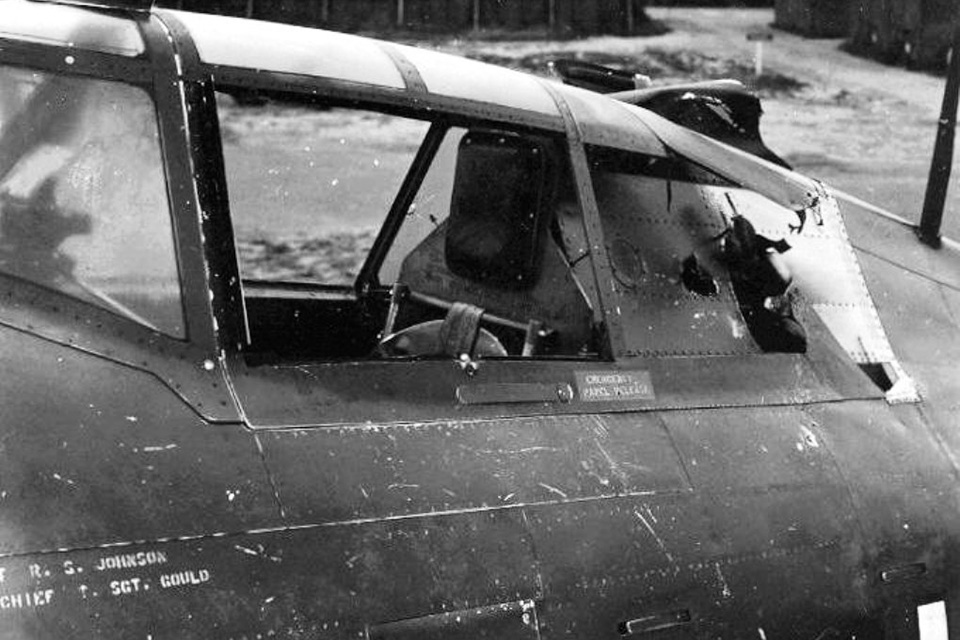
Johnson: This is very similar to the German debate. As far as the 109, all of the German pilots loved that plane, but the Fw-190 was harder to shoot down. Just like the controversy over the P-51 and P-47. The P-47 was faster; it just did not have the climb and range the Mustang did. But it had speed, roll, dive and the necessary ruggedness that allowed it to do such a great job in the Ninth Air Force. As far as aerial kills go, we met and beat the best the Luftwaffe had when we first got there. It was the P-47 groups that pushed them back, as I said before. The P-51s had the advantage of longer range, and they were able to hit even the training schools, hitting boys just learning to fly. As the war dragged on, many of the old German veterans had been killed–so much of the experience was gone. As far as the 109 versus 190 argument, the 109 had the liquid-cooled engine whereas the 190 had an air-cooled radial engine, much like ours. One hit in the cooling system of a Messerschmitt and he was going down. Also, none of the German fighters were as rugged as a P-47. When I was badly shot up on June 26, 1943, I had 21 20mm cannon shells in that airplane, and more than 200 7.92mm machine-gun bullets. One nicked my nose and another entered my right leg, where the bullet split in half. I still have those two little pieces, by the way; they went in just under the skin. I had been hurt worse playing football and boxing. However, I had never been that scared, I’ll tell you that. I was always scared–that was what made me move quick. Hub Zemke liked the P-51 because it had great range, but he put one in a dive and when he pulled out he ripped the wings off that airplane–that was how he became a POW. Adolf Galland, who was a very good friend of mine and who I had known since 1949, flew the Me-262 and loved it, but he still swore by the 109, although it was still easier to shoot down.
MH: What was it like for you when you came home from the war?
Johnson: When I came home, Dick Bong from the Pacific theater had just shot down his 27th plane about two weeks before I got mine, and was already home when I returned. He was a quiet guy and did not like all of the publicity. He just did not like the questioning by the press. When I walked in, he said: God, am I glad to see you! Take a little of the pressure off of me! We were both given regular commissions and were assigned new airplanes. I flew across the country giving talks at universities, businesses, political gatherings, what have you. We were primarily trying to boost support for the boys still fighting the war over there, selling war bonds and the like. We were both sent to gunnery school shortly after this, and Bong did well with his computing gunsight, and I found I could do pretty well, too. I felt that as far as staying in the service, I could do more for the pilots in the aircraft industry, rather than being stuck on some base in Okinawa as an Air Force officer. When I left to go to work for Republic, I stayed in the reserve. The first thing I did was work on the standardized cockpit for pilots, rather than for engineers. That helped the pilots see the weather outside and the gauges inside–all of the instruments with just a slight drop of the head or a raising of the eyes. I spent 18 years with Republic Aviation; then Republic was bought out by Fairchild. I was just about to go with Northrop when someone talked me into the insurance and securities business. I am very happy they did, from a financial standpoint. I have basically retired from that, but I am still available to some of my old clients. I travel quite a lot and I enjoy it, but sometimes the pressure gets to be too much. I will give you an idea of what I’m talking about. I was at Oshkosh, Wisconsin, for the air show last week, then I went to McDill Air Force Base for the last flight and the breakup of the 56th Fighter Group. Two of the squadrons are out at Luke Air Force Base in Arizona now, and they may be coming back. I hope they do. I came home for a couple of days, then I was off to Knoxville, Tennessee, for a P-47 fighter pilots’ reunion. That’s the way it’s been going.
MH: Colonel Gabreski was quite lucky to get through the war in Korea. You also were in Korea, weren’t you?
Johnson: Yes, that’s right. I visited Korea in December 1951. I was in uniform half the time, and at other times in civilian clothes representing Republic Aviation. As a lieutenant colonel I was an observer at Panmunjom. That battle is still going on, and it may never end. We must be very cognizant of their nuclear capability.
MH: Since retirement, you’ve spent a lot of time on the lecture circuit.
Johnson: Yes, I’m still doing that–going around to schools talking about World War II, what happened and why. Generally I get my expenses paid, but I never ask for money. Unfortunately, they keep me pretty busy.
MH: Reflecting on how times have changed since your youth, what is your opinion on the future of the youth of America?
Johnson: Good question. Well, today we don’t have the standard family, the mother taking care of the kids at home; so the young ones have little or no guidance. They take their lead from other little kids, and that’s not good. We all admit it–and I think it’s true–that the mother had a lot to do with the taming of mankind.
MH: If you had any advice for today’s youth, what would it be?
Johnson: I would tell them to look forward to where they want to go, what they want to be, and work toward that. What can they do to improve the world? First, as they go through school, find their favorite subjects and push that to the limit. Drive to be the best! They have to realize that they are going to be on their own one of these days, and, in fact, they are going to have people depending on them. If they are nothing but bums, who can they help and what can they do? You have to fight hard for what you want.
MH: What would you say contributed to your success and longevity?
Johnson: I guess you could say I’m a fatalist, a strong believer that when your time is up you’re gone, out of here. Why worry about that?
Robert S. Johnson died December 27, 1998.
This article was written by Colin D. Heaton and originally published in the August 1996 issue of Military History magazine. For more great articles be sure to subscribe to Military History magazine today!