
Womens Rights
Information and Articles About Women’s Rights in America, an important movement in women’s history
The women’s rights movement summary: Women’s rights is the fight for the idea that women should have equal rights with men. Over history, this has taken the form of gaining property rights, the women’s suffrage, or the right of women to vote, reproductive rights, and the right to work for for equal pay.
Women’s Rights Timeline: Here is a timeline of important events in the struggle for women’s liberation in the United States
Pre-settlement: Iroquois women have the power to nominate—and depose—council elders and chiefs.
1647: Margaret Brent demands two votes from the Maryland Assembly: one as a landowner and one as the legal representative of the colony’s proprietor, Lord Baltimore. She is refused.
1790: New Jersey gives the vote to “all free inhabitants” of the state. It is revoked from women in 1807.
1838: Kentucky allows widows to vote in local school elections, but only if they have no children enrolled.
1840: Lucretia Mott and Elizabeth Cady Stanton meet in London, where they are among the women delegates refused credentials to the World Anti-Slavery Convention. Women are very active abolitionists but are rarely in leadership positions.
1848: Mott and Stanton organize the Woman’s Rights Convention in Seneca Falls, N.Y., and take a cue from the Founding Fathers in issuing the Declaration of Sentiments: “We hold these truths to be self-evident: that all men and women are created equal.”
1868: The 14th Amendment guarantees civil rights to all citizens but gives the vote to men only.
1869: Wyoming Territory gives women the right to vote. The national suffrage movement splits into two factions: one that supports the 14th Amendment and the franchise for black men and one that calls for woman suffrage above all else.
1887: Federal legislation to end polygamy in Utah contains a measure to disenfranchise women, who had won the vote there in 1870. They wouldn’t get it back until 1895.

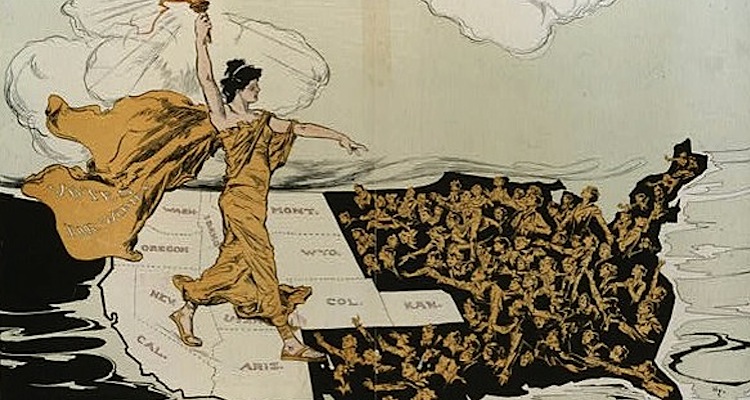
Western women bear the suffrage torch for their Eastern sisters in “The Awakening,” a 1915 cartoon from Puck magazine. (Library of Congress)

Not every woman supported suffrage. The “Anti” in this 1915 Puck cartoon is backed by morally corrupt interests (“Procurer,” “Child Labor Employer”) and others who supposedly would benefit from denying women the vote. (Library of Congress)
1913: Some 8,000 marchers turn out for the first national suffrage parade in Washington, D.C., the day before Wilson’s inauguration.
1915: Suffrage referendums are defeated in Massachusetts, New York, New Jersey and Pennsylvania.
1916: Jeannette Rankin of Montana is the first woman elected to the U.S. House of Representatives.
1917: Suffragists picket the newly reelected Wilson in front of the White House, the first time a public demonstration has targeted the presidential home. Throughout the summer, activists are arrested and imprisoned in the Occoquan Workhouse in Virginia where they were kept in isolation, beaten and force-fed.
1918: Wilson endorses the 19th Amendment to the Constitution mandating woman suffrage. It narrowly passes in the House, but fails by two votes in the Senate.
1919: On May 21, the Senate defeats the suffrage amendment for a second time by one vote. On June 4, the Senate passes the 19th Amendment by a two-vote margin and sends it to the states for ratification.
1920: On August 18, Tennessee is the 36th state to ratify the 19th Amendment, and “The right of citizens of the United States to vote shall not be denied or abridged by the United States or by any State on account of sex” becomes the law of the land.
Articles Featuring Women’s Rights From History Net Magazines
Women Can't Vote
On June 18, 1873 Susan B. Anthony (shown here standing next to Elizabeth Cady Stanton) is fined $100 for attempting to vote for president.
Photo: Library of Congress…
Jeanette Rankin
On November 6, 1916, lifelong feminist and pacifist Jeanette Rankin of Montana became the first woman to be elected to the U.S. Congress. As legislative secretary of the National American Woman Suffrage Association, Rankin helped the women of …
The hunger strike was one of the most formidable weapons in the arsenal of suffragettes in Britain and America. In July 1909, imprisoned English suffragette Marion Dunlop refused to eat. Prison officials, afraid that she might die and become a …
The Woman Suffrage Movement
By the second decade of the 20th century, woman suffrage–women's right to vote–had become an issue of national importance in America. To win public support for their cause, two rival women's organizations conducted a massive campaign …
Nineteenth-century reformer Amelia Jenks Bloomer, (1818-1894) of Seneca Falls, N.Y., was the editor of The Lily, a periodical 'devoted to the interests of women.'Along with her support of woman suffrage and temperance, Bloomer was an advocate of dress reform. …
Helen Keller, on the left, with the faithful help of teacher Annie Mansfield Sullivan, graduated cum laude from Radcliffe College at age 24 on September 1, 1904. This accomplishment was particularly remarkable because Keller had lost both sight and hearing …
On August 26, 1920, the Nineteenth Amendment to the Constitution was passed, giving American women the right to vote. The amendment had been first introduced in Congress in 1878, setting in motion supporters who demonstrated, lobbied, marched and spoke out …
Elizabeth Cady Stanton & the Seneca Falls Convention
Elizabeth Cady Stanton made her first public speech at the Woman's Rights Convention in Seneca Falls, New York, on July 19, 1848. After Cady Stanton was denied participation in an anti-slavery convention …
The Thirteenth Amendment
On February 1, 1865 Lincoln's home state of Illinois became the first to ratify the Thirteenth Amendment abolishing slavery throughout the United States. President Abraham Lincoln had issued the Emancipation Proclamation two years earlier, but it had …
From the Editor
America's Civil War
For one brief moment, President Andrew Johnson was more popular with Radical Republicans than Abraham Lincoln.
Given the fact that he was soon to become the first American president to be impeached, it is …
By Grit & Grace, Eleven Women Who Shaped the American West, edited by Glenda Riley and Richard W. Etulain, Fulcrum Publishing, Golden, Colo., 1997, $22.95 paperback.
By Grit & Grace is the first offering in a new series called "Notable …
THE READER'S COMPANION TO U.S. WOMEN'S HISTORY, edited by Wilma Mankiller, Gwendolyn Mink, Marysa Navarro, Barbara Smith, and Gloria Steinem, Houghton Mifflin, 672 pages, $45.
This is the first book of its kind "devoted to exploring moments, topics, and events …
MAPPING AMERICA'S PAST: A HISTORICAL ATLAS, edited by Mark C. Carnes and John A. Garraty, with Patrick Williams (Henry Holt and Company, 287 pages, $50.00).
Nearly four hundred color maps created especially for this book, along with more than 120 …
WE AMERICANS: CELEBRATING A NATION, ITS PEOPLE, AND ITS PAST, National Geographic Books, $40.00.
THE events that have shaped America are well detailed in this visually outstanding book featuring more than 400 photographs and illustrations from the collections of the …
LABORERS FOR LIBERTY: AMERICAN WOMEN 1865-1890
by Harriet Sigerman (Oxford University Press, 144 pages, $22.00). Published as one of 11 books for young adults in the series The Young Oxford History of Women in the United States, this volume examines …
A VOICE OF OUR OWN: LEADING AMERICAN WOMEN CELEBRATE THE RIGHT TO VOTE
edited by Nancy M. Neuman (Jossey-Bass Publishers, 265 pages, $24.00). To commemorate last year's seventy-fifth anniversary of the 1920 ratification of the Nineteenth Amendment–which declared that no …
WOMEN FIRST & FOREMOST
(The Monterey Movie Company, $24.95 each or $69.95 for the set). Narrated by Rita Moreno and Dee Wallace Stone, this three-cassette video set highlights some of the many stories of women who left their mark on …
Undermining the Molly McGuires
A series of violent crimes was plaguing Pennsylvania's coal country. Mine owners placed the blame on a secret society of Irishmen–and took steps to wipe it out.
by Joseph H. Bloom
On October 27, 1873, a …
UNDERSTANDING AMERICA: THE GREAT SPEECHES, SERMONS, DOCUMENTS AND NARRATIVES OF THE AMERICAN EXPERIENCE (Freeman and Cashill, $18.50)
The words of such notables as Pilgrim leaderWilliam Bradford (1590-1657), poet Anne Dudley Bradstreet (1612-72), scientistand statesman Benjamin Franklin (1706-90), Shawnee chief Tecumseh(1768?-1813), …
Camp William Penn's Black Soldiers In Blue
By Donald Scott
Under the stern but sympathetic gaze of Lt. Col. Louis Wagner, some 11,000 African-American soldiers trained to fight for their freedom at Philadelphia's Camp William Penn. Three Medal of Honor …
Letters - Submit
Civil War Times
THE WOMEN'S WAR
Finally a leading Civil War magazine recognizes the fact that Rosie the Riveter started many years before World War II ("Women in the Civil War," special issue, August 1999), when American …
WHEAT'S TIGERS Confederate Zouaves at First Manassas
By Gary Schreckengost
Recruited from New Orleans' teeming waterfront by soldier of fortune Roberdeau Wheat, the 1st Louisiana Special Battalion more than lived up to its pugnacious nickname–Wheat's Tigers–at the First Battle of …
All men & women are created equal
Over one hundred and fifty years ago the people attending the first Women's Rights Convention adopted this radical proposition.
by Constance Rynder
The announcement of an upcoming "Woman's Rights Convention" in the Seneca …
Thoughts on History
Magazine editors love a good anniversary. Give us an event that happened 50, 100, or 200 years ago and chances are we'll find someone to write about it. There's something seductive about a nice round block of …
Ruhleben Prison Camp
British citizens in Germany at the onset of WWIsoon found themselves in the Ruhleben prison camp. Before long their genius for setting up rules for living and improving theircircumstances proved nearly boundless.
By Herman Herst Jr.
It …


