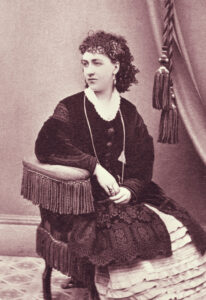

In 1810, when she was sixteen, Rebecca Pennock was a dreamy, romantic girl, fond of appreciating nature’s picturesque beauty from the back of a horse and bounding “over hill and dale as wild, happy, and joyous as youth could make me.” By 1840, however, Rebecca Pennock Lukens had become a businesswoman renowned for her shrewdness–an entrepreneur on the cusp of the Industrial Revolution in the United States and the owner of a thriving steel mill on the banks of Pennsylvania’s Brandywine River.
Rebecca was born on January 6, 1794 to Martha and Isaac Pennock, whose family had been in Pennsylvania since the days of William Penn. Although Isaac had been deeded three hundred acres of farmland by his father in 1792, he saw opportunity in the iron business and wanted nothing to do with farming. Recognizing that the new United States, free from restrictions that had been imposed during the colonial era, would no longer have to buy industrial wares from Great Britain, he proceeded to establish an iron works known as the Federal Slitting Mill on Bucks Run some four miles from Coatesville.*
Another area resident, Jesse Kersey, was inspired by the opening of the Lancaster Turnpike to develop a community on land owned by his father-in-law, Moses Coates that would attract residents and industry. He formed a partnership with Isaac Pennock in 1810 and together they purchased 110 acres of Coates’s land. Pennock converted a saw mill on the property into an iron works, calling it the Brandywine Iron Works and Nail Factory after the pleasant river that ran alongside it and provided the water power that kept the machinery humming. By 1817 Isaac had become the sole proprietor of the business.
As a child, Rebecca enjoyed considerable freedom, finding special pleasure in the company of three nearby older cousins, a boy and two girls. With them she roved the countryside, and from them she acquired her first taste of the joys of learning. At twelve she was sent to boarding school and then a year later to another institution, where, she later recalled, “life began to open new charms to me.”
When she returned home at sixteen, Rebecca, as the oldest child, was called upon to help raise her six younger siblings, especially the baby. She took a liking to the infant, but missed her studies and garnered solace in solitary reading. Soon permitted to return to a school in Wilmington, Delaware, she demonstrated a characteristic mix of practicality and romance by excelling in chemistry and French.
When Rebecca met Dr. Charles Lloyd Lukens, he had a medical practice in Abington, Pennsylvania. At their first meeting, Rebecca wrote, he “bowed with a peculiar grace, and for a moment my eyes rested on his interesting face and his tall and commanding figure.” She was smitten and never ceased to regard Dr. Lukens with anything but deep love. They were married in 1813.
Dr. Lukens gave up his medical practice and joined his new father-in-law’s iron business. By around 1817–the same time that Isaac became the sole owner of the works–he leased the operation to Lukens, explaining to Rebecca that she would inherit the business when he died.** The former physician set about transforming himself into an iron-maker.
The United States was then entering an expansive, optimistic period. Although the country was already feeling the frictions that would later lead to civil war, its mood was progressive and forthright, as states west of the Alleghenies were ushered into the Union. Mills and factories sprouted as the young republic began developing its industrial muscle. An enterprising man could go far, and Lukens was well positioned.
This was the beginning of the Age of Steam. And, steam power requires boilers, which, in turn, require iron plate. In 1818, Lukens’s mill became the first in the United States to roll iron boiler plate. Orders came in from steamboat manufacturers, and the Brandywine Iron Works became one of the world’s most renowned makers of rolled iron and steel.
In late March 1825, Lukens received his most prestigious commission. John Elgar of York, Pennsylvania needed iron “of the best quality and sound” in order to build an iron-hulled steamboat to ply the Susquehanna River. Lukens iron fit the bill. The Codorus, the first steamer to operate on the river, was launched in November, but Lukens was not there to see it. That summer, he died at age thirty-nine, leaving Rebecca with two children and one more on the way.
Lukens’s love for his wife, it seems, also included a keen appreciation of her talents. For it was his idea–and his dying request–that she carry on the business. For Rebecca, it was not only a time of grief, but a time of peril. The iron works was in debt and in need of repair. As well, her family was not happy about her running the firm. As she later put it, “necessity is a stern taskmistress; my every want gave me courage.” Lukens’s brother Solomon took over the supervision of the business’s day-to-day affairs, but Rebecca was the sole manager and owner.
So far, most of Brandywine Iron Works’ business was in the making of iron plate for ships, but only a year after Rebecca took over the firm, the first railway steam locomotive in the United States was run on a small track in Hoboken, New Jersey. Rebecca had the foresight to see in the new railways–such as the Philadelphia & Columbia Railroad begun in the 1830s–opportunity for her business, and Brandywine started manufacturing iron for locomotives.
During the Panic of 1837–in reality a full-blown depression that plagued the country for six years–Rebecca refused to lay workers off, but instead set them to repairing the mill or working on her farm. When there was no cash, she paid them in produce. “The difficulties of the times throw a gloom on everything,” she wrote. “All is paralyzed–business at a stand.”
Rebecca survived, and by the mid-1840s she was able to think about stepping down. She had paid off all debts, solved the legal problems caused by her father’s ambiguous will, and turned the business into the top boiler-plate company in the United States. Moreover, two of her daughters had married husbands who were well able to shoulder the firm’s burdens. As she contemplated her achievements, she said, “I had built a very superior mill, though a plain one, and our character for making boiler iron stood first in the market, hence we had as much business as we could do. . . . There was difficulty and danger on every side. Now I look back and wonder at my daring.”
On December 10, 1854, five years after she retired from managing the firm, Rebecca died. The company that she built–Lukens Steel–still thrives on the banks of the Brandywine River and is renowned for steel plate. Rebecca herself has not been forgotten. January 6, 1994–the bicentennial of her birth–was proclaimed “Rebecca Lukens Day” by the Pennsylvania State Senate. Three months later, she was inducted into the National Business Hall of Fame at a banquet in New York City.
*A slitting mill was so named because it produced iron sheets that were then slit into strips to make such items as barrel hoops and wheel rims.*Isaac Pennock died in 1824.
**Issac Pennock died in 1824.
New York writer Joseph Gustaitis is a frequent contributor to American History magazine.