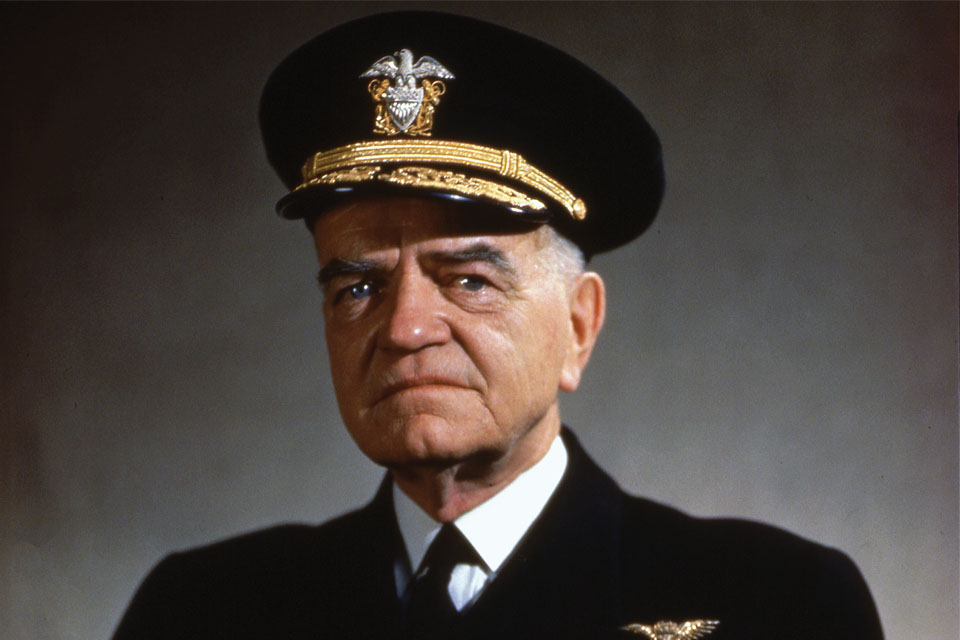
William F. Halsey was a sailor born and bred. His heart was Navy blue and gold, and it pumped salt water each of his seventy-six years. As a first to last combatant of the Pacific War, he launched aircraft into the Sunday surprise on December 7, 1941, and forty-five months later stood witness to the end of Imperial Japan on the deck of the battleship Missouri. Along the way Halsey became America’s most acclaimed fighting admiral and his own worst enemy.
His strengths were manifest in his faults: extreme aggressiveness driven by instinct rather than intellect. Historians still ponder the what-ifs of his career: the ailment that prevented him from commanding during the battle at Midway, the lapses that led to unnecessary losses at Leyte Gulf and “Halsey’s Typhoon,” the December 1944 storm that sank three destroyers and wrecked much of his Third Fleet.
Halsey was born into a navy family and, like so many navy juniors, followed the same path as his father, graduating the Naval Academy in 1904, forty-second in a class of sixty-two. In the years to follow he accumulated an enormous amount of seagoing experience. From 1909 to 1932 he was captain of twelve different torpedo boats and destroyers, commanded three destroyer divisions, and served as executive officer of the battleship Wyoming. His shore duty included naval intelligence, Annapolis, and attaché duty in Europe during the 1920s.
Naval aviation was meanwhile steadily growing in size and importance, and Congress had decreed that all aviation units of the U.S. Navy be commanded by a naval aviator. Recognizing the shortage of qualified commanders to fill these roles, the navy offered a quick course at Pensacola, Florida, where senior officers could earn their wings. In 1934, at the age of fifty-one and with a waiver permitting him to fly with glasses, Halsey became one of these “JCLs”—Johnny Come Latelys—as the young pilots called them. He completed the course in May 1935, the last in his class to solo, and, after commanding the carrier Saratoga for two years, continued his career as an aviation officer, commanding the Pensacola Naval Air Station in 1937.
Halsey was a captain for eleven years, from 1927 to 1938—not unusual during the dolorous Depression years. Upon elevation to flag rank he commanded carrier divisions in the Atlantic and Pacific. Receiving his third star in June 1940, Vice Admiral Halsey commanded Aircraft, Battle Force, based in Hawaii—the premier peacetime carrier assignment. It became his wartime ticket to fame.
Halsey’s superior in Hawaii was his Naval Academy classmate Adm. Husband Kimmel, commander of the Pacific Fleet. As tensions increased with Japan, Kimmel reinforced outlying bases such as Wake Island and Midway, obvious targets in the event of war. On one such mission, Halsey left Pearl Harbor on November 28, 1941, flying his pennant on the carrier Enterprise, and delivered marine fighters to Wake six days later.
Early on December 7, on the way home, the carrier launched aircraft to scout ahead. They arrived at Pearl Harbor in the middle of the Japanese attack and several were shot from the sky. The next day when Enterprise returned there, Halsey glowered at the wreckage and exclaimed, “Before we’re through with them, the Japanese language will be spoken only in hell.”
He meant it from his core. Halsey detested the Japanese Empire and seldom missed an opportunity to excoriate the enemy while encouraging his men to slay the foe in increasing numbers. Halsey was about results, and his priorities were expressed in visceral terms: “Kill Japs! Kill Japs! Kill more Japs!” Later in the war he told a stateside audience, “The only good Jap is one that’s been dead six months.”
The smoke had barely cleared at Pearl Harbor when Adm. Chester A. Nimitz replaced Kimmel. The new Pacific Fleet commander quickly learned who was motivated. When a difficult job popped up, it often went Halsey’s way. If he was not the brightest admiral in the Pacific Fleet, he was eager to fight—an attitude that endeared him to Nimitz, whose own job was on the line.
Halsey’s Enterprise task force began a series of hit-and-run raids against the periphery of the Japanese Empire: the Gilbert and Marshall islands in February, Wake and Marcus in March. Although the early raids inflicted little damage on the enemy, the public welcomed any American offensive—and Halsey made good copy. When “some drunken correspondent,” in Halsey’s words, changed “Bill” Halsey to “Bull,” the name stuck. Certainly he did not shun publicity. He enjoyed playing the seadog, wearing a sou’wester with his face in the wind or donning an absurdly long-billed cap with starched khakis.
Halsey’s command of the famous Doolittle Raid against Tokyo in April 1942 powerfully enhanced his public image (in some quarters it was even the “Halsey–Doolittle” Raid). Then, in May, just as the biggest battle of the war was shaping up, Halsey contracted advanced dermatitis. Frustrated beyond reckoning, he was “beached” in Hawaii.
Nimitz’s code breakers learned that month of Japan’s plan to seize Midway Atoll, only 1,100 miles from Oahu, making a counterstroke essential. Nimitz asked Halsey who should take over Task Force 16, and his response was immediate: Rear Adm. Raymond Spruance, who had commanded Halsey’s screen for months. Enterprise and Hornet sailed for Midway in late May, followed by Yorktown with Task Force 17.
Spruance, a nonaviator, relied on Halsey’s staff for aviation expertise and was not well served. The chief of staff was Capt. Miles Browning, an egotistical airman who had lost touch with advancing technology. When the pilots of the Enterprise air group rightly questioned his order for an excessively long-range strike, Browning interpreted it as a coup. Spruance backed the pilots, leading Browning to throw a fit and sulk in his cabin. Nevertheless, though Task Force 17 returned minus Yorktown and a destroyer, Spruance won a historic victory.
In mid-October 1942 Nimitz selected Halsey, still recovering from dermatitis, to relieve Vice Adm. Robert L. Ghormley as commander of the South Pacific area. Ghormley was an old friend of Halsey’s, but however painful the turnover, Halsey immediately set to work in New Caledonia, along with many of his Enterprise staffers—including the erratic Captain Browning.
As South Pacific commander, Halsey was responsible for much more than Guadalcanal. While the island necessarily remained his focus, he inherited a vast area east of the 160th meridian.
After ten months of war Halsey’s professional instincts had only sharpened. He saw the war as a gut-level conflict and ordered his priorities accordingly. Reportedly shortly after landing at Nouméa he declared, “If it helps kill Japs it’s important. If it doesn’t help kill Japs it’s not important.”
ithin days of Halsey’s arrival, the Japanese navy and army launched a rare combined operation, a truly joint effort to secure Guadalcanal once and for all. While the Japanese army strove to capture Henderson Field, the emperor’s “sea eagles” rose from four carriers well at sea. The outcome became the Battle of the Santa Cruz Islands.
The American commander’s exhortation to his forces was vintage Halsey: “Strike, repeat, strike!”
The carrier engagement on October 26, 1942, resulted in an American tactical defeat: Hornet was sunk in exchange for damage of two Japanese flattops. But the outcome benefited the larger campaign since events at sea did not alter the situation ashore. Henderson Field remained under management of the U.S. Marines, and Japanese carrier aircraft losses gave the Americans air superiority in the subsequent showdown.
As the sanguinary Guadalcanal campaign approached its peak, Halsey committed as many assets as he could scrape together—land, sea, and air. It proved barely enough. The slugfest known as the Naval Battle of Guadalcanal was fought and won on November 12–15. The combined surface and air action proved costly for both sides: nine American warships and thirty-six aircraft versus two Japanese battleships, four other warships, eleven transports, and sixty-four aircraft. But Tokyo finally had enough: within weeks the emperor’s forces sought to extricate themselves from the sinkhole of Guadalcanal.
Halsey was promoted to full admiral that month, in acknowledgment of the South Pacific’s growing importance. The Japanese evacuated their remaining troops from Guadalcanal in February 1943, permitting the Allies to consolidate their hold in the Solomons. Subsequently Halsey became the first practitioner of the bypass strategy. After the bloody campaign on New Georgia, he executed the first “leapfrog” when he bypassed Kolombangara for Vella Lavella. It was a major contribution to American strategy, and Gen. Douglas MacArthur took note. Although the concept had been discussed previously, Halsey was the one to do it. It was perhaps the best example that he could be more than an instinctual fighter.
Halsey remained at the helm of the South Pacific theater until early 1944, occasionally coordinating with MacArthur’s adjoining Southwest Pacific theater. The two commanders would work together again, and not entirely for the best.
Allied grand strategy in the Pacific required a two-pronged advance toward Tokyo: Nimitz’s largely naval command advancing through the Central Pacific and MacArthur’s mainly army command through the New Guinea–Philippines approach. Toward that end, in mid-1944, Nimitz established two huge and “separate but equal” fleets: the Third under Halsey and the Fifth under Spruance. The genius of the arrangement was that Third and Fifth Fleet staffs alternated in planning and conducting operations with essentially the same units, notably the Fast Carrier Task Force. Meanwhile, Vice Adm. Thomas C. Kinkaid’s Seventh Fleet supported MacArthur’s amphibious operations.
In June 1944 the Fifth Fleet seized the Marianas, putting B-29s within range of Tokyo. At the end of the operation, Halsey stepped up with Third Fleet, placing his cross hairs on Japanese bases in a series of powerful strikes before the two Pacific paths intersected in the Philippines.
The 1944 operations dwarfed anything Halsey had commanded two years previously. As South Pacific commander he had disposed of perhaps three carriers and two battleships at a time: now he had four task groups, each with that many ships or more. There was nothing on earth to match Task Force 38, let alone the entire Third Fleet. He commanded his huge fleet from the new battleship New Jersey.
Halsey craved a shot at the main Japanese fleet, which had not been seen since late 1942. But Third Fleet’s primary responsibility was protecting the amphibious forces. Nevertheless, in planning the Philippines attack for October 1944, Nimitz threw the old seadog a bone by adding, “In case opportunity for destruction of a major portion of the enemy fleet is offered or can be created, such destruction becomes the primary task.”
Nimitz knew he was trying to have it both ways: keeping Halsey on a short leash yet trusting that he would break the panic snap when provoked to attack. But he hadn’t anticipated just how far afield the Bull would go when he did break loose.
A widely unappreciated factor in the chaotic Battle of Leyte Gulf was the responsibility the theater commander bore for the mess that ensued. MacArthur had required that messages between Halsey and Kinkaid go through his headquarters in the Admiralty Islands. It was an absurd arrangement and unnecessarily complex—MacArthur’s staff could have merely monitored naval traffic without the onerous task of receiving it, sorting it, and deciding which messages among hundreds should be forwarded immediately. The end result was a delay of hours, when minutes counted. Both Halsey and Kinkaid can be faulted for accepting the arrangement, however. Kinkaid was more of a company man than the Bull, but apparently neither appealed the communication plan to MacArthur or to Nimitz.
Running up to Leyte, the army and navy both botched intelligence estimates. MacArthur’s staff expected no substantial opposition to the landings while Halsey predicted small operations similar to the Solomons’ “Tokyo Express.”
So the drama played out. Kinkaid’s amphibious craft went ashore at Leyte on October 20, and four days later Third Fleet air strikes sank the monster battleship Musashi in the Sibuyan Sea.
With the enemy’s reported withdrawal, Halsey was buoyant. On the afternoon of the twenty-fourth, scouts from Task Force 34 found Vice Adm. Jisaburo Ozawa’s four carriers off the northeast end of Luzon. Never suspecting they were a deliberate decoy, the Bull wanted to pursue immediately but needed the rest of the day to consolidate his task groups. By the next morning Halsey’s entire striking force—fast carriers and battleships—was steaming north to destroy Ozawa. Halsey went to bed that night confident of a bigger bag on the morrow. At that moment Bull Halsey committed the sin of complacency, and men not under his command would pay the penance.
Meanwhile, during the night, Avengers from the light carrier Independence’s nocturnal air group tracked Japanese fleet units in San Bernardino Strait and found that rather than retreating they had reversed course and were steaming back to threaten the amphibious beachhead at Leyte. The tailhookers made a timely report and returned to their roost. But for reasons still unknown, Halsey’s staff failed to act on this vital intelligence.
In the wee hours of the twenty-fifth, the last major surface action in naval warfare history occurred in Surigao Strait, between Leyte and Mindanao. It cost Japan two battleships, a cruiser, and three destroyers in exchange for an American PT boat. The American southern flank was secure.
Shortly past dawn, Seventh Fleet units off Samar saw pagoda masts on the horizon. It was Vice Adm. Takeo Kurita’s Center Force. Four battlewagons, eight swift cruisers, and eleven destroyers had defied the Americans’ serene confidence and completed their transit of San Bernardino in the dark.
Thus began “The Battle of the Taffies,” named for the call sign of Kinkaid’s escort carrier groups. Directly imperiled was Rear Adm. Clifton “Ziggy” Sprague’s Taffy 3 with six escort carriers and seven support ships. Sprague did the only thing he could: make smoke, turn away, launch aircraft, and holler for help.
At that point the entire American command structure had failed. MacArthur’s insistence on running naval messages through his headquarters complicated an already dire situation, but more trouble was soon apparent. In Hawaii, Nimitz tried to make sense of the confused situation and dispatched one of the most famous messages in naval history.
To confuse enemy cryptanalysts, radio messages contained nonsensical phrases or “padding.” But when New Jersey’s radio watch decoded the message, it retained the end padding: “Where repeat where is Task Force 34? The world wonders.”
Unfortunately, the second sentence appeared logical in context, and when Halsey read it, he went into shock. Chester Nimitz, a gentleman to his core, had seemingly jabbed Bill Halsey with a bitterly sarcastic rebuke.
Meanwhile, Seventh Fleet waited three hours for clarification that Halsey’s battleships were charging northward to engage Ozawa. Clifton Sprague was largely on his own. Halsey dithered for over an hour before he even replied to the dire message from the south. The delay remains inexplicable and condemns him to history. He indulged himself in what a later generation would call a hissy fit, venting his anger and frustration while American sailors died under Japanese guns two hundred miles away.
Third Fleet’s staff watched the spectacle in stunned alarm. At length Rear Adm. Robert “Mick” Carney confronted his boss: “Stop it! What the hell’s the matter with you?” The subordinate literally ordered the admiralissimo to pull himself together.
In that dreadful hour, William Halsey proved himself unsuited to high command. He could not lead a fleet because he could not control himself. It was almost noon before he ordered some of his heavy units to reverse helm and head south—an action that he later regretted because his battleships were so close to Ozawa.
At that point it mattered little that Task Force 38 sank all four of Ozawa’s decoy carriers. Kinkaid’s vulnerable forces only escaped destruction when Kurita unexpectedly broke contact with Taffy 3 and retired westward. But the outcome was bad enough: an escort carrier and three other ships were lost, and another escort carrier was sunk that day by kamikazes. “The Battle off Samar was for a time the victory whose name the navy dared not speak,” Historian Jim Hornfischer noted. Since the navy had lauded Halsey for so long, it was felt that full disclosure of the story would besmirch the admiral and the service.
Meanwhile, Nimitz wrote to the chief of naval operations, Adm. Ernest J. King, conceding, “It never occurred to me that Halsey, knowing the composition of the ships in the Sibuyan Sea, would leave San Bernardino Strait unguarded.”
In his memoir, Halsey sacrificed his long friendship with Kinkaid by writing, “I wondered how Kinkaid had let ‘Ziggy’ Sprague get caught like this.” While Kinkaid was not without fault—he could have posted a picket destroyer in the strait—Halsey had failed in his responsibility to protect the amphibious craft and tried to pass the blame. And he got away with it.
Nor was that all. After Leyte Gulf, which cost Japan four carriers, three battleships, and twenty other combatants, Halsey kept attacking in the Philippines. While supporting operations against Luzon he faced a more formidable opponent than the Imperial Navy. It was nature herself, and this time Bull Halsey was completely outmatched. On December 17 a fleet refueling was interrupted by worsening weather. Halsey, aggressive as ever, chose to ignore some of the signs and remained in position to support the Mindoro landings. In fairness, he received conflicting information from Pearl Harbor and his own staff. The Hawaiian weathermen predicted a northerly path for the storm, which would have cleared Task Force 38 by some two hundred miles. Eventually his own staff was far closer to the mark with a westerly direction but Halsey played the odds, declining to cancel planned operations. The next day the storm had mutated into a full-grown typhoon, with heaving seas and ninety-knot winds.
New Jersey’s weathermen noted a precipitous barometric drop at 10:00 a.m., sure sign of a typhoon. Only just before noon did Halsey order the fleet to steer southeast, away from the growing wind. Almost two hours later Third Fleet issued a typhoon warning, by which time three of his destroyers had capsized with 790 sailors and 146 aircraft lost.
A court of inquiry found Halsey responsible for the losses, citing “errors of judgment committed under stress of war operations.” Nimitz softened the blow, inserting a passage about “insufficient information” in the final report.
In January 1945, Halsey turned his command over to Spruance in the Third Fleet–Fifth Fleet rotation. Then from May onward Halsey presided over the final naval campaign, steering his fleet into another typhoon on June 5. King and Nimitz probably would not have tolerated such a poor showing from another flag officer, but Halsey’s public popularity insulated him from accountability. Thus, he was present when Japan surrendered aboard Missouri on September 2. It brought an eerie symmetry to Halsey’s career, as his first assignment out of Annapolis had been on Missouri’s namesake predecessor four decades before.
In December 1945 Halsey was promoted to Fleet Admiral, a year after King, Nimitz, and White House chief of staff William D. Leahy. The promotion still is controversial considering that between Leyte and the typhoon, Halsey was responsible for the loss of seven warships and 1,450 men, without accountability. In vivid contrast, Lt. Gen. George Patton had been sidelined for nearly two years after slapping two GIs in Italy. But Halsey had allies if not always friends in high places. Nimitz apparently felt a lingering loyalty to the Bull of 1942, and whereas King was notably unsentimental, he refused to hand the army a talking point when the postwar political climate clearly showed more feuds over budgets, roles, and missions.
Today, the dwindling number of men who sailed under Halsey remain divided in their opinion of the leader, if not the man. His failures at Leyte and “Halsey’s Typhoon” evoke either tolerance or contempt. But his elevation to five-star rank is especially resented by survivors of Taffy 3, many of whom see his promotion as a denigration of their shipmates’ sacrifice—an insult that no amount of political rationalization can justify.
This article was written by Barrett Tillman and originally published in the July/August 2007 issue of World War II Magazine. For more great articles, subscribe to World War II magazine today!