
WITH A SIX-GUN ON HIS hip and a Winchester pump-gun in his hands, the young cowpuncher faced another claim-jumper. They had reached the ground together, blustered the second man. He demanded an even split of the lush grassy quarter-section on which they stood, he to get the larger parcel, the youngster, of course, to have the smaller.
The boy stood his ground. ‘A hundred and sixty acres or six feet,’ he said, ‘and I don’t give a damn which it is…’ The boy–and his Winchester–made his point, and the kid held his own piece of the new Eden in the wildest, the biggest, rush for new land in U.S. history.
It began April 22, 1889, a perfect spring day–bright, balmy and cloudless. The Oklahoma prairie was green with the new year, a little glimpse of paradise to the thousands of land-starved pioneers.
Along the borders of the Indian Territory‘s so-called Unassigned Lands seethed a hive of excited people, waiting impatiently, praying, quarreling, jostling for position. They had eyes only for the great prize before them: 160 acres of government land, free to whomever first staked a claim…and could hold it. They waited in wagons and buggies of every kind, on horseback, even on foot. The able-bodied waited next to the blind, the old and the sick. The rushers were black and white, native and immigrant.
For some it was purely a chance at profit, a chance to seize prime land and sell it later. For others, it was the chance of a lifetime, perhaps the last chance to find a home. For many, especially the young men, it was a chance for adventure.

For more than a few it was a chance to rob and steal, to bully weaker people. Against these vultures the rushers relied mostly on their Colts and Winchesters, for the law was spread very thin in the Unassigned Lands. Even God-fearing, honest people oiled and checked their weapons. The Ten Commandments had little force between the North and South Forks of the Canadian; a bullet was surer by far.
The explosive opening of the Unassigned Lands had been a long time coming. This broad, fertile country had been promised to the Indian by treaty, ‘…as long as the grass grows or the water runs…’ But as America drove West after the Civil War, the pioneers coveted these same green, empty lands, and a bill appeared in Congress annually from 1884 on, designed to permit opening of the wide-open Indian Territory to public settlement.
For a time, the Cherokees and other tribes successfully held off all attempts to open their land, but in the end the pressure was too strong. Ironically, a Cherokee lawyer and Confederate veteran, Colonel E.C. Boudinot, was one of the first to urge opening of the two million acres of prime land left unassigned by the 1866 treaties.
The agitation increased, in and out of Congress. In addition to continuing attempts to legislate free settlement of the Unassigned Lands, a settlement movement grew up in Kansas, Missouri, Texas and Arkansas. The Boomers, as members of this movement were called, bombarded Congress with repeated appeals to open Oklahoma, especially after the Santa Fe built its railroad line straight across the coveted ground, from Arkansas City, Kans., to Gainsville, Texas.
When Congress did not act, parties of Boomers tried again and again to move into the Unassigned Lands–dugouts and shanties began to appear across the lush prairie. They did not stay. The long-suffering U.S. Cavalry evicted them as often as they settled, burning their fragile buildings, and on occasion the confrontations came perilously close to shooting.
The Boomers were persistent, returning as often as the tiny units of blue-shined soldiers threw them out. By March of 1889 a substantial group had settled on the railroad around Oklahoma Station, the site of present-day Oklahoma City. Repeated evictions here led to scuffles and violence, settled by the soldiers with carbine and pistol butt. In spite of all the soldiers could do, many Boomers simply scattered and hid until the Army left. Oklahoma station, and a dozen other scruffy little settlements, were founded to stay.
And by now the tide of westward movement and settlement was too strong for anyone to buck; finally the Congress would feel it, too, and on March 2, 1889, passed the annual Indian Appropriations Bill. It contained language placing the Unassigned Lands in the public domain, the first step toward opening them for public settlement. That opening would be left to a proclamation by President-elect Benjamin Harrison, due to take office two days later.
The news raced to the Boomer camps along the Kansas border, where it was greeted with bonfires and gleeful shots. It remained only for the President to make his proclamation, and on the 23rd of March it came: some 10,000 quarter-sections of the promised land would be open to settlement at noon on April 22. With the great news came a quiet warning. Nobody who jumped the gun before the ‘hour herein before fixed, will ever be permitted to enter any of the said lands, or to acquire any rights thereto…’
The government reserved two one-acre plots to itself. The first was on the Chisholm Trail, near an old stage relay station called Kingfisher. The other was near Guthrie station on the railroad. Here there would be land offices, for the registration of claims. There also were two sections per township reserved for public schools. And now the hopeful came from every corner of America, lured by the stories that appeared in newspapers all across the country. There were Mormons from Utah, miners from
Pennsylvania, blacks from Arkansas and North Carolina, three separate groups from Chicago. All of these rubbed elbows with men and women from Tennessee, Alabama, Georgia and Mississippi, an Italian immigrant contingent from New York, and a party of 30 men from Terre Haute, all decked out in yellow slickers and carrying white valises.
And still they came, organized groups of old soldiers, immigrants from Scotland and Sweden and other places, whole groups organized to found towns and corner the market on town lots. There were tenderfeet in new city clothing, wives in calico and bonnets, and one skinny Missourian in overalls stamped with little American flags and trousers of red, white and blue. It is not recorded that anybody laughed at his original costume, perhaps because he also wore two monstrous Colt Navies, and a knife to boot.
Many of these people were well-equipped. Others, down on their luck, brought little but hope with them. Almost everybody, however, was armed–the waiting throng bristled with sixguns, rifles, shotguns and a variety of knives. Those hardy enough to try their whole future in an unsettled and unknown land were not shrinking violets; what they took they intended to hold, law or no law.

And the newspapers loved it. Correspondents descended on the Unassigned Lands from all directions, from papers in San Francisco and New York and Chicago and dozens of towns between. They wrote hundreds of thousands of words, filling their papers with stories of the rush to come, of all the things that happened, and of some that didn’t.
They wrote reams about the wonderful country to be opened and about the people who waited to take it. There were stories serious and funny. There was even a story, probably made up by the correspondent on a slow news day, of four Indiana men who waited, camped in the Antelope Hills, ready to descend on choice claims ahead of the competition–by balloon. And the news stories further fueled the fires of excitement about the opening. More and more people turned away from their old lives and headed for the Oklahoma Country.
The rushers waited impatiently in all the little towns just outside the new lands: Darlington, Buffalo Springs, Silver City and Purcell. Purcell was jammed with hopeful people from everywhere, 2,000 to 10,000 of them.
Armed to the teeth, they thronged the tiny raw town, without sidewalks or lights or any other convenience, where the gambling halls ran far into the night, and liquor ran freely, in spite of federal law banning alcohol from these Chickasaw lands. And still more came, by wagon and train and horseback and foot, eager and hopeful and ready to compete for land they could call home.
All the while they were stalked by legions of confidence-men and criminals. One railway detective said he knew of 42 thieves in Arkansas City, and thought there were at least twice that many in town. A more sophisticated class of criminal were the ‘town companies,’ whose aim was to stake out complete townsites before the official start of the Run, and sell later at a huge profit.
For those who had no transportation of their own, there were the railroad, some locally-formed wagon companies, and a whole fleet of old stagecoaches, specially brought back into service and painted in vivid colors for the event. A ‘land office’ business was done in groceries and supplies, and in every sort of conveyance, including some wagons so feeble that even the ‘horses hung their heads in shame’ when hitched to them.
For those who would use their own transport, there was every means of conveyance except balloons. In Caldwell, to the north, there was even a wagon carrying a ready-built house made out of sheet iron, fully equipped with chickens, cattle and other livestock.
Already the new territory was crawling with those who had tried to steal a march. These were the ‘Sooners,’ who hoped to claim prime land and pretend they had staked it out legally. The Cavalry and U.S. marshals hunted them, driving back across the start line whomever they found. It was not always easy work.
At Purcell, on April 13th, as a marshal’s posse rounded up a group of Sooners, the lawmen were struck by a volley of gunfire that slightly wounded one deputy. In the firefight that followed, the possemen flanked their attackers, ending the fight by pouring rifle fire into them from the rear. The lawmen took some 25 prisoners, mostly Texans, some of them wounded, and returned the entire party to a makeshift stockade near Purcell.
But there were never enough soldiers and marshals, and no end to the land-desperate people who would pay any price for those 160 acres. And there was nothing like enough of the precious land to go around. The new country contained about 12,000 quarter-sections, but anywhere from 50,000 to 100,000 eager people were poised for the rush. They waited all around the 300-mile perimeter of the Promised Land, although most of them were massed along the territory’s northern border.
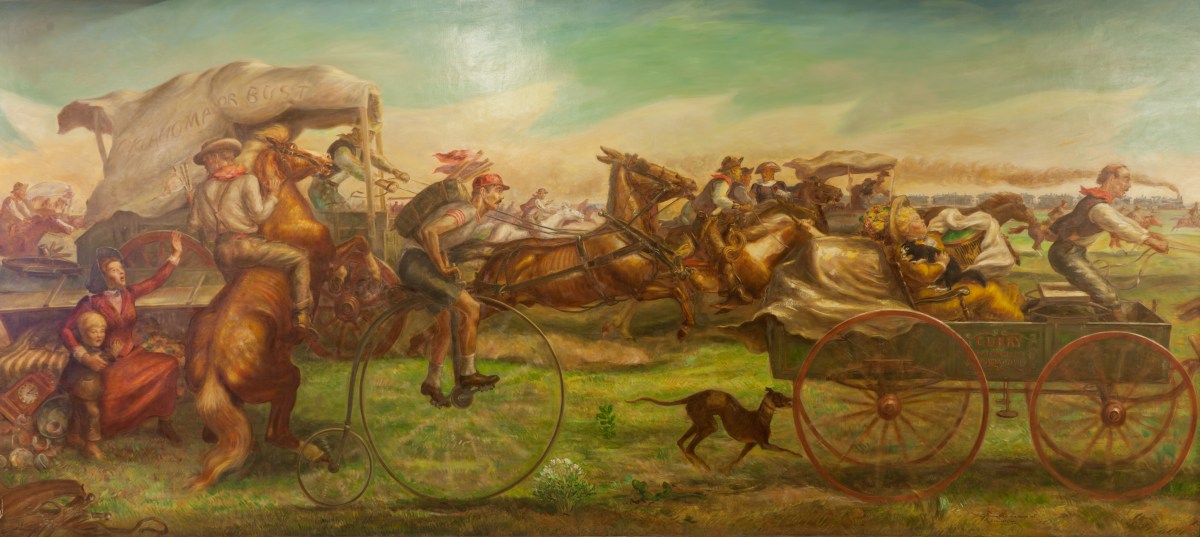
They waited with strings of thoroughbred horses, in buggies with fringed tops, on prairie schooners festooned with crates of chickens and bundles of farm tools, beside stubborn, durable Missouri mules, next to creaking wagons drawn by teams of oxen. Some, grim and determined, would go on foot, hoping something would be left for them. Incredibly, a few hardy souls showed great faith in their sense of balance by daring the prairie on tall, teetering, high-wheeled bicycles.
For many it was one last chance after repeated failures to find a home. One wagon sign put it plainly: ‘Chinz buged in Illinoy, sicloned in Newbrasky, white caped in Missoury, prohibited in Kansas, Oaklahomy or Bust.’
And so they waited out the last day, Easter Sunday, some in worship, and many in worry, and all in last-minute preparation. Tomorrow would bring their dreams to life, or smash them, perhaps forever.
The day was cloudless and sunny, with a stiff southerly breeze. The prairie was carpeted in green, the lush grass spotted with wild flowers as far as a man could see. Out along the boundary waited a thin picket-line of the faithful Cavalry, doing what it could to hold the increasing stream of Sooners–men dishonest or only hungry–trying to steal a march on their competition.
By nine o’clock the rushers were massing along the line, and a great buzz went up from them of excited talk, song, or argument. The sound, said one observer, ‘wasn’t human at all, but like thousands of wild animals penned up.’
The railroad stations were jammed. In Arkansas City, 10,000 or more people pushed and shoved for places on the 15 trains due to leave that day. For the Santa Fe had collected everything that would roll on tracks for the occasion. There were all kinds of coaches, flat cars, cattle cars, even an old baggage car crammed with reporters and railroad officials who had turned out for the event.
The cars overflowed with excited, sweating, chattering humanity, with people sitting and standing both inside and on the platforms, or clinging to the handholds on the outside corners of the cars. One fortunate Englishman, hanging on to the running gear beneath the press car, was rescued by some reporters and rode the rest of the way in style, plied with drink and made the subject of news stories on their way to papers all over the country.
At last the moment came. Along the boundary at Arkansas City, young Lieutenant Henry Waite of D Troop, 5th Cavalry, sat his horse calmly in front of the line of troopers holding back the milling mob. In his hand the officer held his watch while the eager throng of rushers watched their own timepieces, most of which had earlier been set to agree with the Lieutenant’s.
As the hands of the officer’s watch closed on noon, he signaled to his buglers, and the clear notes of, of all things, ‘mess call,’ echoed over the green prairie. The rush was on.
In a colossal cloud of red dust, the torrent of shouting riders and frightened horses, clattering buggies and bouncing, ponderous wagons, flowed over the boundary, fanning out across the new country…The rumbling of wagons and carts, and the yelling of the crowd, sounded to one rusher ‘like ten thousand head of cattle on a stampede.’
The fast horsemen were quickly far in front, bent over their mounts’ necks. In their hands they clutched claim-stakes about two feet long, their initials carved or painted on the top, ready to drive into the waiting soil of Oklahoma. Each quarter-section had been surveyed, and its corners marked with stones, but the markers were often difficult or impossible to find. There was much guesswork, and every rusher had to hope he or she had not staked one of the sections reserved for public schools.
Some rushers had been into the new country before, however illegally, and headed directly for specific parcels. Others took the first unoccupied 160 acres they came upon. For still others, where they settled depended on where their horses’ strength gave out.

Quickly the prairie became spotted with wrecked wagons and buggies, as the ravines and buffalo wallows took their toll. Horses, galloped too hard too long, fell and could not rise again. One rider went down with his horse, and became the first casualty of the race, dead of a broken neck. Another died when struck by a shot fired by another rusher to speed up his horses.
The fastest riders made the mile-and-a-half into the stage-relay station, Kingfisher, in about four minutes, dashing through the town on frantic, lathered horses. Many had already fallen trying to cross a deep ravine west of the little town. Behind them was a long line of 40 stages, crammed with people inside and on top.
The Sooners were already there before them, hiding in thickets and ravines, hurrying to claim the best parcels. Some even lathered their horses with soap, pretending they had entered legally and simply outdistanced their competition. Ugly confrontations festered between regular rushers and Sooners, between legitimate claimants and late-coming claim jumpers. One woman rusher, staking her claim near the railroad, was shot by a claim-jumping Santa Fe engineer, but managed both to survive the bullet and to hold onto her claim.
Two men on fast horses were astonished to come upon an old man already settled deep in the center of the new country. When they arrived, he had already plowed a field with his ox-team, and in his garden onions stood three or four inches high.
Why, of course there was an explanation, the old man said. He was no Sooner, not at all. It was just that his oxen were the fastest in the world, and the soil was so rich that his onions had grown that high in only 15 minutes.
Wisps of smoke began to rise into the dean blue sky as rusher camps popped up all across the prairie. On Big Turkey Creek, fertile, virgin prairie, lush with grass six to eight inches high that morning, was by evening turn into wagon-ruts a foot deep.
Those who had the least trouble were bands of men who rode into the new land together and vowed to support and protect each other’s claims. One tired claimant found a pretty place and began to cut his initials into a tree to claim the land. He looked up to find a big, red-whiskered man watching him, armed with a rifle and two six-guns.
‘Thinking of staying?’ said the red-bearded man.
‘Well, it’s a pretty place,’ replied the newcomer, ‘but I’m just letting my horse rest a while.’
‘That would be all right,’ said the man with the Winchester. ‘But I wouldn’t stay long if I were you. Sixteen of us in here have an oath to stick together. It’s really quite an unhealthy place. There is lots of malaria, and some people even die of lead poisoning…’ And the newcomer promptly decided there was much better land farther along.
Along Big Turkey, two men faced with waves of envious latecomers dug four-foot rifle-pits, prepared to defend their new titles with hot lead. In the end, they did not have to fight. All the same, holding the land was tense, exhausting work. After backing down still another claim-jumper, one tired settler wearily remarked: ‘Hits sure hell to get things regulated in a new country.’
It was indeed, and nobody knew it better than the hard-riding, overworked U.S. Marshals. For inevitably there was killing. In a claim dispute west of Guthrie, a legitimate rusher died with three Sooner bullets in his body. The killer got away clean, well ahead of the pursuing marshals.
But when three claim-jumpers killed a Missouri pilgrim north of Guthrie, a local posse took the law into its own hands. Cornering one of the killers on the Cimarron River, they dealt with him without the sanction of the law. When he declined their generous summons to surrender, they ‘filled him with lead.’ It was simple Western justice, carried out without ceremony, loss of time or cost to the taxpayers.
Sometimes men competing for the same claim could solve their problem without fighting. There were incidents of real generosity, in which young, vigorous men gave up a claim to families, or older people in desperate need of a home. Sometimes one claimant would buy the other out on the spot.
But even willingness to compromise sometimes did not save the peaceful settler. At Alfred, a little station north of Guthrie, a Kansas rusher named Stevens tried to persuade two other claimants to share the land until the authorities could sort out its ownership. But lead outweighed reason, and Stevens died in his wife’s arms with a bullet through his lungs.
Legendary U.S. Marshal Heck Thomas, who already had arrested two murderers, galloped after Stevens’ killers, but they had left the territory at a high lope. And even as Thomas carried on his futile chase, another man died in Oklahoma City in a claim dispute. Again, the killer escaped.
Thomas and the rest of the handful of lawmen did their best, sweeping up herds of thieves, whiskey-sellers and other parasites for the federal courts at Muskogee and Paris, Texas. Their number was legion: the Muskogee docket for June 1889 listed 186 cases.
Some of the rushers claimed their land in spectacular fashion. Nanitta Daisey, a tiny, pistol-packing Kentuckian, left Edmond Station riding on the cowcatcher of a trainload of rushers. Nanitta, sometime reporter for the Dallas Morning News, jumped from the slow-moving train some two miles north of Edmond, ran to her chosen plot, planted her stakes and fired her pistol into the air in celebration. Then she scurried back to the train to the cheering of the passengers, to be pulled aboard the last car by a fellow News reporter.
The first trains disgorged great mobs of rushers, who scattered in all directions like ants from a smashed anthill, none of them having any idea which way or how far to go. Guthrie was a seething hive of people, who found some 500 of the best lots already claimed by Sooners. Nevertheless, many did find town lots, among them a Louisiana black man in his 60s, and two Arkansas City widows seeking a new life.
Others instantly turned to commerce, including those enterprising souls who sold thirsty rushers muddy creek water at a nickel a glass. For a dime the parched pilgrim could buy the same dirty water enriched by a little sugar and whiskey. Down at Guthrie, a gambler-turned-entrepreneur took over the Santa Fe water tank, the only source of ready water in town, clutching a tin cup and a Colt and prepared to charge all comers for a drink. He changed his mind only when the Cavalry appeared and invited him to depart.
Makeshift stores sprang up everywhere, and restaurants appeared magically, at least one of them run from the bed of a wagon. By the afternoon of the 22nd, banks opened in both Guthrie and Oklahoma City. Many more would follow, and many of those would fail.

By the morning of the 23rd the empty lands were peopled. At Guthrie a speck on the prairie had become, overnight, a city of some 10,000 persons, living in 500 or so shanties and a forest of tents. Some enterprising rushers had brought in entire buildings by wagon, all pre-cut and ready for assembly. All over the territory new towns appeared like toadstools after a rain: Norman, El Reno, Edmond, Oklahoma City.
By mid-June, Oklahoma City would have some 6,000 inhabitants, including ’53 physicians, 97 lawyers, 47 barbers, 28 surveyors, 29 real estate agents, 11 dentists, [and] 2 lightning rod men…’
The U.S. land offices were mobbed, both in Kingfisher and in Guthrie. Monstrous lines appeared instantly outside both, as men stood, usually for days, to register their land. Some enterprising people stood in line just to sell their places.
The baggage office wrestled manfully with a gigantic pile of thousands of trunks and other luggage, and in his tent office the lone U.S. postmaster at Guthrie struggled desperately with an ocean of 4,000 to 5,000 pieces of mail.
The telegraph office was equally overwhelmed and had to establish priorities: first place went to government messages; then came the press; ordinary private wires got last place. Only telegrams telling of a death received preferential treatment. Even the press could not get its messages out with speed. Some reporters got Santa Fe trainmen to take their stories to Arkansas City, to be sent from there. Two reporters hired Cheyenne Indian scouts to carry their stories out.
Some rushers found their dreams through some unusual practical arrangements. One young woman from Kentucky found herself stranded in Arkansas City, alone and on foot. There she met a widower with three children and the two struck a bargain. She would care for the children, and he would try to stake a claim. If he succeeded, he would return and they would be married. He did, and they did, and their married life began in a covered wagon in the new land.
There would be years of controversy over many of the new claims. There would be much litigation and a great deal of false swearing and bitterness. Bad men would often prevail through perjury and good men lose what they had rightfully claimed. There would be drought and grasshoppers and illness, too. One carper commented that people who came to Oklahoma were like ‘children who put beans in their noses– they seem determined on getting the beans put in…but when they had accomplished their purpose, they wished they hadn’t done it.’
But such Jeremiahs were a tiny minority. Most of the rushers would hold their land, and stay, and build for the future. Private schools sprang up everywhere, and the first public school opened in Guthrie in mid-October. Church and women’s organizations quickly brought a veneer of civilization, and commercial and lodge associations were not far behind.
The foundation had been laid for a state, and today ‘Sooner’ is the state’s nickname, and the official title of the University of Oklahoma’s athletic teams. Thus the name’s bad connotation has been buried in the past, along with a time when anyone with a fast horse and a quick gun could grab a piece of Oklahoma.
This article was written by Robert Barr Smith and originally published in February 1999 issue of Wild West Magazine. For more great articles be sure to subscribe to Wild West magazine today!