
By the end of World War I, railroads were regarded as the preeminent method for fielding super-heavy artillery.
From the days of catapults and trebuchets, military men have dreamed of the ultimate weapon that could smash an enemy’s wall, castle, or defensive stronghold. For a span of eighty-five years, that weapon was the railroad gun, large enough to do substantial damage but also movable to wherever railroad tracks could go.
Railroad guns had a shorter life span than other practical military technologies spawned during the American Civil War, such as submarines, repeating rifles, and machine guns. Yet from 1862 to 1945, they earned a reputation as a bunker buster without equal, and terrorized civilians by firing on cities from afar, without warning.
That the railroad gun’s reputation did not always comport with reality was not universally recognized at the time. Germany in particular spent considerable time and expense well into the twentieth century developing varied railroad guns that, while record-setting in size, range, and ordnance, consumed resources in the service of missions that could have been more efficiently and effectively accomplished by other means. The Germans were not alone in this pursuit, but in the end, the railroad gun’s usefulness did not live up to its reputation.
The “railroad battery” was first used in Maj. Gen. George B. McClellan’s Peninsula campaign in 1862. Confederates bolted a 32-pounder Brooke naval rifle to a flatcar protected by an iron casemate, the finished car looking much like a land version of the ironclad CSS Virginia. It engaged in artillery duels before the Battle of Fair Oaks.
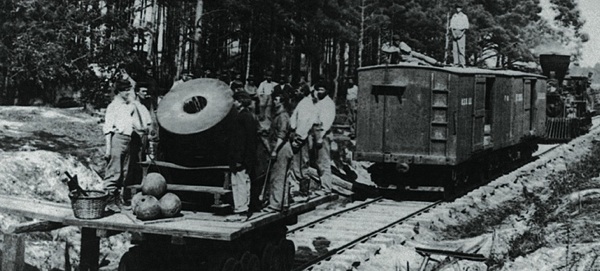
The Union used similar railroad mountings during the 1864 siege of Petersburg. The most famous of these was Dictator, a thirteen-inch seacoast mortar on an eight-wheeled flatcar. Lobbing 218-pound shells as far as forty-two hundred yards, this behemoth bombarded Southern batteries and bombproofs with telling effect.
Apart from experiments conducted by the French during the siege of Paris in 1870 and by the British Royal Navy’s Capt. John Fisher (of Dreadnought fame) in 1881 and 1882, there were few advancements in railroad guns until the late nineteenth and early twentieth centuries, when French firms experimented with mounting large artillery pieces—originally designed as the main armament of warships—on large railroad carriages. The French so emplaced not only 320mm guns and 200mm howitzers but even pieces as small as 155mm howitzers. During the war to come, naval or coast artillery crews would man many such railroad guns.
The German and Austro-Hungarian militaries were also experimenting, in greatest secrecy, on mammoth siege guns—Krupp’s 420mm Dicke Bertha (Big Bertha) and Skoda’s 305mm Schlanke Emma (Skinny Emma) howitzers—which were later deployed with admirable accuracy and power against Belgian and French fortifications. The limitations of Europe’s road networks, coupled with the French experiments in railroad guns, may have encouraged Germany to combine the technical strengths of Krupp’s artillery bureau with those of the Eisenbahnpioniere, perhaps the most impressive and professional military rail service in Europe at the time.
By 1915, Krupp’s Professor Fritz Rausenberger had successfully mated several modified naval gun designs with railroad mountings to develop the first in a series of long-range railroad guns. Two of these 380mm Max E guns were deployed as part of the enormous artillery forces (over 1,220 guns) arrayed against Verdun. These pieces heralded the German offensive on February 21, 1916. One opened fire on the city of Verdun from twenty miles away; its first shell hit part of the Bishop’s Palace. Its sister’s first salvos were far more effective. According to author William G. Dooly Jr., “after a few shots, the rails of the marshalling yard were standing in the air like twisted fragments of wire.”
At Verdun, both sides deployed railroad guns for rear-area bombardments and to destroy both fortifications and deep tunnel and bunker complexes. France’s gigantic 400mm Schneider railroad guns were used to support the retaking of Fort Douaumont. At Third Ypres, two British fourteen-inch railway guns named Boche-Buster and Scene-Shifter carried out similar long-range interdiction bombardments.
Five American fourteen-inch guns—developed for U.S. Navy superdreadnoughts and featuring fully enclosed, armored mounts built by the Baldwin Locomotive Works—were fielded with navy crews under gunnery expert Capt. C. P. Plunkett. The only American-designed heavy artillery used by the American Expeditionary Force, Plunkett guns had a maximum range of twenty-four miles. Beginning in September 1918, they were used to preempt German troop movements and bomb logistics facilities.
By the end of World War I, railroads were regarded as the preeminent method for fielding super-heavy artillery. By Armistice Day, the U.S. Coast Artillery had deployed seventy-one railroad guns in ten regiments in Europe. They ranged in size from fourteen-inch weapons to the 190mm. Almost all were made in France.
The pinnacle of railroad artillery’s long-range role was the Pariskanone, or Paris gun. Misidentified as “Big Bertha” by Parisians, it was officially named the Wilhelmgeschütz in the kaiser’s honor. Actually a series of replaceable gun tubes, the Paris guns were developed by Rausenberger’s team in cooperation with the German navy. With a 280mm naval gun as a base, each barrel was sleeved down to 210mm or, later, using reconditioned barrels, to 240mm. The modified tubes were then extended and heavily braced. Each tube could fire only twenty to fifty shells before its rifling and accuracy deteriorated substantially.
As a terror weapon, however, the Pariskanone is best viewed as a progenitor of the V-weapons of World War II. Originally placed in the Forest of St. Gobain in March 1918, the Paris guns fired relatively light projectiles some sixty-eight miles into the City of Light. Its most infamous achievement was on March 29, 1918—Good Friday—when a single shell struck the Church of St. Gervais and killed eighty-eight people. Impressive though they were, however, the Paris guns achieved little of military significance. As strict attention to barrel wear was not maintained, one of the Paris guns’ tubes burst, and the Allied counteroffensives of August 1918 forced the Germans to abandon their last gun. Despite firing some 350 shells, the Paris guns’ bombardments caused only 876 casualties and 256 deaths, largely to civilians.
Major powers continued to maintain super-heavy railroad guns in the interwar period in spite of the threats posed by early bomber aircraft. The Americans largely viewed railroad guns as a supplement to fixed coast defense artillery. Likewise, the British looked to such weapons to fill gaps along the Channel coast, particularly once they were faced with the threat of Operation Sealion (the planned invasion of Britain by the Nazis). The Soviets used railroad guns against the Finns, and later, the Germans. Although the Treaty of Versailles prohibited German offensive weaponry and heavy artillery, the Reichswehr explored the capabilities of railroad guns in secret. When Hitler renounced the treaty’s limitations, Krupp resumed construction of such artillery for the Wehrmacht.
During World War II, Germany was the premier builder and user of super-heavy railroad guns. Allied intelligence identified some twelve different types of German-made railway artillery, ranging from 150mm to 800mm, by 1945. Captured Czech and French pieces were also widely used. Germans based 280mm guns on Cap Griz Nez, on the northern coast of France, in 1940 to batter the English coast and provide cover for the abortive Operation Sealion. Because such weapons were impossible to camouflage well, the Nazis’ Organisation Todt built gigantic, igloo-shaped bunkers to protect the guns, which still stand. In spite of the Red Army’s advance into Poland, the Germans continued to deploy railroad guns and Karl-series caterpillar-tracked mortars to pummel Warsaw during the Uprising of late summer 1944.
Perhaps the most successful German railroad artillery was the 280mm K5(E) series of rail guns, of which some twenty-five units were built. Two of these 218-ton mammoths, Robert and Leopold (known to the Allies as “Anzio Express” and “Anzio Annie,” respectively), achieved infamy during the 1944 battles for Anzio. Firing 550-pound shells to a range of over thirty miles, these K5(E)s played havoc with beachhead operations but were only fired sporadically in the daylight, taking advantage of concealment in railway tunnels. Despite intelligence as to their positions, Allied air power never neutralized either gun and only occasionally interrupted ammunition supply trains.
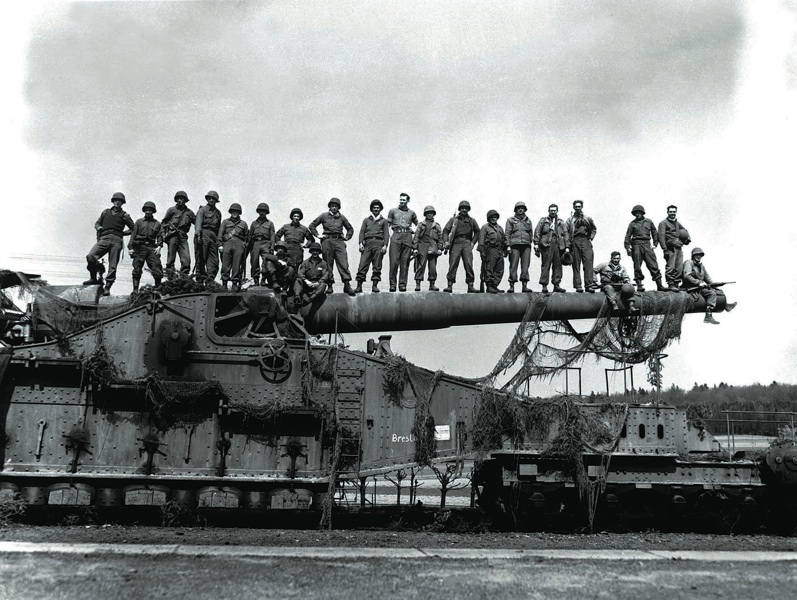 Germany fielded the largest railroad guns—in fact, the largest land artillery pieces—of all time. Intended to defeat the Maginot Line, Krupp’s 800mm Schwere Gustav and Dora guns weighed 1,350 tons, fired 4-ton shells from a 90-foot barrel up to 29 miles, and required a crew of 1,420 commanded by a major general. Gustav was only used once in combat; Dora, never. Gustav’s first and apparently only action was when it fired fewer than fifty projectiles against Sevastopol’s fortifications in 1942. Its cumbersome size, paired with the complicated logistics required to bring it into action—the gun required two parallel rail tracks (four rails total) to be laid for it to be brought into position—drastically curtailed its role from the outset. As Germany lost air supremacy, Gustav was dismantled, and Dora was relegated to a Wehrmacht testing range, where American forces found it in spring 1945. Even in the war’s waning days, the Germans still used their remaining railroad guns: one pummeled units of the American 101st Airborne at Hagenau, France, in February 1945, while others fired rocket-propelled “arrow” projectiles toward Maastricht and Belgium.
Before the rise of bombers, missiles, and precision munitions, investments in railroad guns were perhaps justified. In World War I, the guns frequently proved to be fort-cracking artillery par excellence, and superb for long-range bombardment. By the 1930s, their days were numbered: armed forces turned to air power to shatter fortresses (and the guns themselves); to drop paratroops behind fortified lines; and to sever rail links, the guns’ umbilical cord. Ponderous size, camouflage difficulties, and logistical constraints all made the guns vulnerable to air attack. While a viable role remained for cannon artillery on many battlefields into the early twenty-first century, World War II’s end rang the death knell for super-heavy artillery, of which the railroad gun marked the apotheosis.
The surviving Plunkett gun can be found at the Washington Navy Yard, and several 305mm Soviet railway guns may be found in Russian museums. Leopold, one of the K5(E)s used at Anzio, is permanently displayed at Aberdeen Proving Ground, and another K5(E) can be found at Batterie Todt near the Pas de Calais. MHQ
[hr]
This article originally appeared in the Autumn 2008 issue (Vol. 21, No. 1) of MHQ—The Quarterly Journal of Military History with the headline: When Railroad Guns Ruled
Want to have the lavishly illustrated, premium-quality print edition of MHQ delivered directly to you four times a year? Subscribe now at special savings!