
Historynet/feed historynet feedback facebook link Weider History Group RSS feed Weider Subscriptions Historynet Home page

What If Germany Had Developed the Atomic Bomb?

By Mark Grimsley 
Originally published by World War II magazine. Published Online: November 28, 2011 
Print Friendly
10 comments FONT +  FONT -

In the Star Trek episode "The City on the Edge of Forever," a temporarily insane Doctor McCoy passes through a time portal. The landing party sent to retrieve him discovers that it has lost contact with the orbiting starship Enterprise. Implacably, the guardian of the portal explains, "Your vessel, your beginning—all that you knew—is gone." McCoy had somehow changed Earth's history, with catastrophic results.

In desperation, Kirk and Spock go back in time to find McCoy, determine how he changed history, and stop him. Eventually Spock discovers that history pivots on the moment when McCoy saves a remarkable woman, Edith Keeler, from a fatal accident. Keeler went on to found a pacifist movement so powerful it delayed U.S. entry into World War II, allowing Nazi Ger­many time to develop the atomic bomb first. "With their A-bombs, and with their V-2 rockets to carry them," Spock explains, "Germany captured the world."

Subscribe Today

Subscribe to World War II magazine

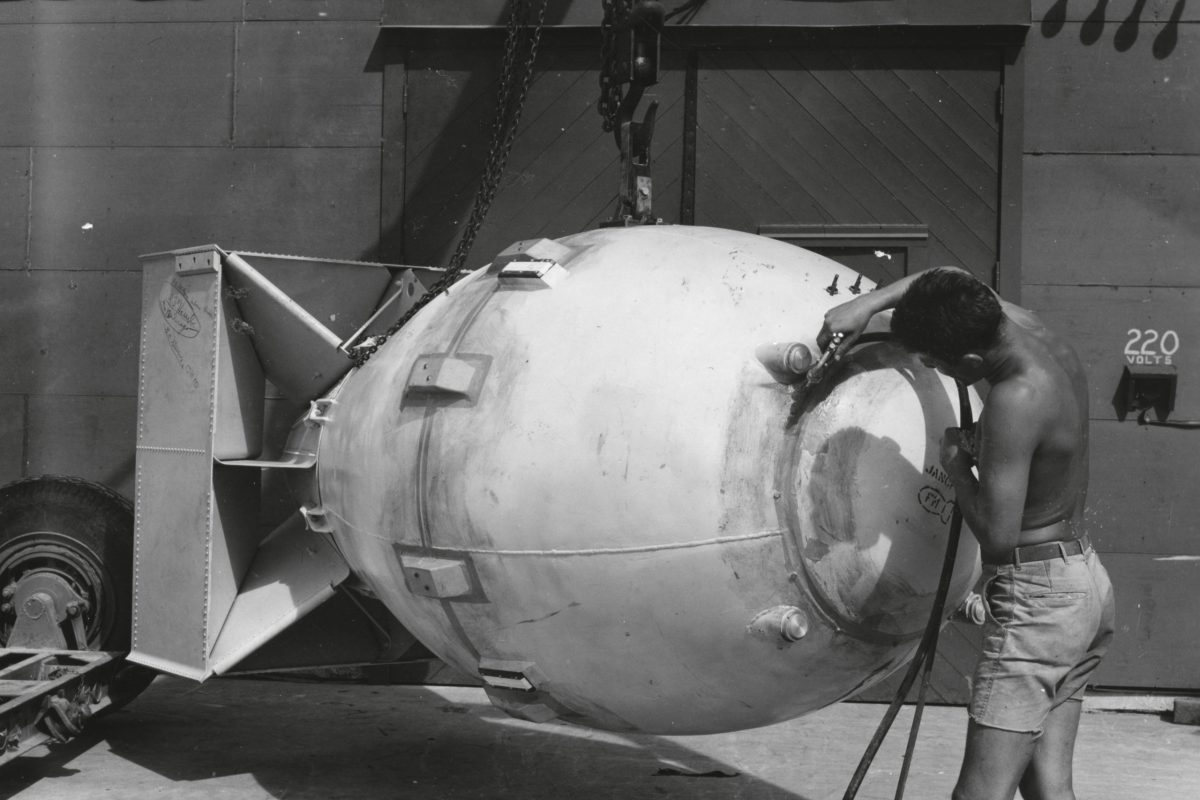
This imagined possibility provides one of the most compelling moments of the entire Star Trek series—and has provoked the imagination of many a history buff as well. But a determined spoilsport can poke a number of holes in it. To begin with, the Nazis never seriously pursued an atomic weapon. Even had they done so, limits on the production rate of fissionable material meant that at best, it would have required several weeks to manufacture a single atomic bomb. The massive rain of atomic bombs implicit in the Star Trek scenario was therefore out of the question. In any event, V-2 rockets could not have carried the immensely heavy early atomic bombs. The Nazis did not have a bomber with sufficient lift to carry them, either.

Moreover, if the Nazis had somehow reached cities in England and Russia, that would not necessarily have compelled these adversaries to surrender. Two atomic bombs barely sufficed to defeat Japan, and then only after the Japanese had suffered irreversible battlefield defeats and the fire-bombing of most of their cities. In telling contrast, historically the Red Army—although buffeted by disaster upon disaster—eluded strategic defeat and eventually assumed the offensive. Underscoring Soviet resilience was the fact they suffered 20 million dead—the equivalent of 200 Hiroshimas—and still continued to fight.

Yet another questionable assumption is that a German bomb would have been equivalent to the Hiroshima bomb. It could easily have been much less. India's first nuclear test in 1974, for example, yielded only four kilotons (versus the 20 kilotons of the Hiroshima bomb).

It is also a virtual certainty that the shock of a German bomb would have shaken the United States from its pacifist reverie and sparked the launch of the Manhattan Project. Shielded from Nazi attack by the Atlantic Ocean, America would have eventually developed a bomb of its own, and used it either to deter further Nazi gains or, from bases in Britain or the Soviet Union, rained destruction upon Germany.

Thus it is impossible, even in the Star Trek universe, to imagine a plausible scenario by which Nazi Germany would have "captured the world."

The probability of German victory through use of atomic bombs diminishes still further when one considers events as they actually unfolded, with America's entry into the war in December 1941. Even granting Nazi acquisition of the bomb in July 1943—two years before the United States achieved this feat—and arbitrarily giving the Germans a bomber with a range and payload comparable to Britain's Lan-caster heavy bomber, the Third Reich would have faced not a single adversary comparable to 1945 Japan, but rather three nations firmly on the offensive and demonstrably winning the war. In such circumstances, a handful of atomic bombs would scarcely have compelled the Grand Alliance to surrender. Given that reality, how could Germany have best wielded its newly acquired weapon?

The most obvious approach, the destruction of cities á la Hiroshima, was in fact problematic. An attack on American cities was out of the question. The phenomenal capacity of the Soviet Union to absorb destruction would argue against the efficacy of simply destroying Russian cities. (Historically, the Siege of Leningrad claimed eight times the number of civilians killed in Nagasaki.) In any event, not even a Lancaster-like bomber could have reached the Soviet industrial centers beyond the Ural Mountains. London and a few other British cities might have been leveled, but would this have caused the British government to make a separate peace? Even had this occurred, would the United States have withdrawn from Britain? Or would it have taken the course adopted historically by Germany when Italy surrendered in 1943: assume de facto control over its former ally and use it as a platform on which to continue the fight?

A better approach, considering the numerous reversals of Germany's fortune on the battlefield, would have been the tactical use of the bomb against enemy armies. For ideological reasons, the Nazis would have been tempted to target Soviet forces: from the outset, the Nazis had regarded Bolshevism as a menace that must be totally eradicated. But the fact that the Soviets had continued fighting despite the destruction of entire armies ought to have suggested that even nuclear attacks would not have stopped the Red Army.

The Western Allies would have made better targets, since they could only get at Germany via amphibious landings. Of necessity, such landings had to be geographically concentrated, making them ideal targets. German's mere possession of an atomic bomb would therefore have rendered D-Day and a second front out of the question. Faced with this reality, it is just possible that the Soviets might have negotiated a separate peace with Germany.

What becomes highly probable, then, is that a protracted stalemate would have settled over Europe, finally disrupted when the United States acquired the bomb in July 1945 and employed it against Germany. World War II, not a hypothetical World War III, would thus have become the first nuclear conflict.


10 Responses to “What If Germany Had Developed the Atomic Bomb?”


  1. 1
    John Shepherd says:

    Add to the above the fact that Germany never bought into the idea of strategic bombing as embraced by the U.S. and Britain. The Luftwaffe was a force tailored to support the ground forces with "flying artillery" and what we'd today call Battlefield Air Interdiction.

    • 1.1
      Gary Wedig says:

      John is correct re the "design" of the Luftwaffe but Hitler obviously required the Luftwaffe to engage in strategic bombing in the Battle of Britain. Later when the V-1 and V-2 missles became operational, he again targeted British cities. The infamous "secret weapons" were not used tactically. I believe that if Germany had developed the ultimate "secret weapon", the A-bomb, it would most certainly have been used against its enemies' cities. For a very interesting fiction of what may have happened given a delayed US entry into WWII, see Gingrich's "1945".

  2. 2
    Curt in Canada says:

    Given the strength of German aeronautical engineering at the time, which was at par if not above those of the allies I would assume a concurrent program to develop a 4 engine bomber or other delivery system could have been undertaken.

    There is also the possibility of having a nuclear device on a 'true' submarine able to avoid detection, the Elektroboot, sailing into the Hudson river and detonating it's payload. While not causing damage equivalent to an airdrop the psychological effects of a mushroom cloud in NY's harbor a la Operation Crossroads would probably have much of the populace reconsidering their stance on the war against Germany.

  3. 3
    Archie Milagan says:

    Almost. They have the materials and the Heavy Water in Scandinavia needed. But Neils Bohr, (student of Einstein) escaped from Belgium to Sweden(with Allied help) and was flown from Sweden to England. There, he was forwarded to the U.S. Hitler made him believe that his cause was right and just. After thorough debriefing and shown the Holocaust Hitler was doing. He was convinced he should help the Allies win the war. The First Atom Bomb was developed and tested in the desert of New Mexico. Try to imagine if Hitler beat the allied force in making the bomb? What further catasthrophic destruction he would have wrought.

  4. 4
    Archie Milagan says:

    Neils Bohr was under house arrest by the Germans in Carlsberg. Assign to help opther scientist to try to make the atom bomb.

  5. 5
    Tom Holzel says:

    But the reality was that the effort to make the first a-bombs was HUGE–far in excess of anything the impoverished Germans could have mustered.

    In my new novel, Ballard's War, an alternate reality look at WW-II, I have the Germans destroy Oak Ridge to stop the nuclear effort, only to have the Brits take over with the inevitable result…

  6. 6
    Vincenzo says:

    Quite an interesting article. It indeed underlines the crucial role of Soviet Union in WW2. Had she agreed a separate peace with Germany in 1941 or 1942, or, even worse, collapsed, the war in Europe would have stalled for years, with Germany in full controll of the Continent, his army at full strenght, not considering the immense popularity gained by Hitler. With her east-backyard safe, and access to the vast mineral and oil resources of (part of) the Soviet Union, Germany would have dominated Europe unrivalled, with the possibility to deploy strategic enterprises out of range of allied bombers. Non considering the possibble contact of German and Japanese forces trough Russia. And hence, only several years later and using plenty of atomic bombs over Europe by the USA Germany, pheraps would have collapsed.
    So, if the World has not seen Adolf Hitler to die old and honoured in his bed, or, alternatively, an atomic desert on the whole European continent, we know who thank.

  7. 7
    Simon Gunson says:

    The Junkers Ju-390 had the range to reach New York and back, but was unsuited because it was so slow flying and lacked a proper bomb bay. It's fuel consumption above 21,000 feet due to automatic superchargers was unacceptable, thus forced to fly low where it was vulnerable to US air defences. Ironically one Ju-390 crashed in the sea 2.5 miles southwest from Owl's Head, Maine USA on 17/18 September 1944. undoubtedly it's target was New York and the fact it was a lone aircraft raises a big question whether it was an intended nuclear attack. The wreck of this 6 engined aircraft is still there on the seabed according to at least one diver.

    The aircraft actually intended for the Amerika Bomber raid had been the He-274 manufactured at Toulouse which was lost to the Germans with the fall of France. The Germans also had the He-277 in early production for high altitude bombing of the UK. That aircraft was capable of a prodigious 49,500 service ceiling. No good for precision bombing but perfect for delivering strategic weapons.

    Compelling evidence has begun to emerge, much cited in the 2005 book by Rainer Karlsch, "Hitler's Bomb," especially that of eyewitnesses to nuclear test blasts at Rugen in October 1944 and later at Ohrdruf in March 1945. The October 1944 blasts in particular have several independent corroborations.

    Upon his release from Nazi slave labour at an atomic-bomb fabrication plant on Bornholm Island, Professor Paul Rivet gave an intriguing press statement at Paris on 14 October 1945, cited by the Toronto Daily Star the next day, in which Rivet claimed that the Germans had the Atomic bomb since June 1944, however they lacked the resources to develop it. Bornholm had an enormous but now sealed uranium mine said to be beneath Hammershus fortress.

    • 7.1
      Morten Hansen says:

      "Upon his release from Nazi slave labour at an atomic-bomb fabrication plant on Bornholm Island, Professor Paul Rivet gave an intriguing press statement at Paris on 14 October 1945, cited by the Toronto Daily Star the next day, in which Rivet claimed that the Germans had the Atomic bomb since June 1944, however they lacked the resources to develop it. Bornholm had an enormous but now sealed uranium mine said to be beneath Hammershus fortress."

      Which just goes to show that this story which I've just discovered floating on the the 'Interwebz' is so much BS.

      Having grown up on the island, including during the 50 years' anniversary of the liberation, when media were plastered with "all things WW2 & Bornholm", and not having heard anything about this tale before today, I can assure you that this is pure invention.

      I've also visited said castle numerous times (as have thousands, if not millions of tourists) and there's not a hint of any uranium mine.

      I doubt whether Bornholm even posses uranium deposits of a type which would yield viable ore.

      The only sources for this story seems to be a number of newspaper stories 1945 (plus one possibly derivative stories from 1946 and one from 1948). I guarantee that if this was true it would loom very large in not just local WW2 history, but in Danish WW2 history as well. Yet not a single historian has written anything on this spurious claim.

  8. 8
    Ruben Whittemore says:

    Some say the Germans had area denial nuclear weapons: dirty bombs and tested fuel air explosives. Having found evidence of Ju 390 crash in
    Maine on 17/18 September 1944.

    One the Germans planed to bomb New York to stop shipping, and test weapon in area where radiation would have little effects on them!

    Second something happened in Brandenburg Zoo Venus House: bomb
    or fire distroyed their weapon grade supplies. MI?/and OSS.


Leave a Reply

Human Verification: In order to verify that you are a human and not a spam bot, please enter the answer into the following box below based on the instructions contained in the graphic.


Related Articles


History Net Images Spacer
History net Spacer
History net Spacer
History Net Daily Activities
History net Spacer
History net Spacer
Historynet Spacer
HISTORYNET READERS' POLL

Which of these defensive lines best served its purpose?

View Results | See previous polls

Loading ... Loading ...
History net Spacer
STAY CONNECTED WITH US
RSS Feed Daily Email Update
History net Spacer History net Spacer

What is HistoryNet?

The HistoryNet.com is brought to you by the Weider History Group, the world's largest publisher of history magazines. HistoryNet.com contains daily features, photo galleries and over 5,000 articles originally published in our various magazines.

If you are interested in a specific history subject, try searching our archives, you are bound to find something to pique your interest.

From Our Magazines
Weider History Group

Weider History Network:  HistoryNet | Armchair General | Achtung Panzer!
Today in History | Ask Mr. History | Picture of the Day | Daily History Quiz | Contact Us

Copyright © 2012 Weider History Group. All rights reserved. Reproduction in whole or in part without permission is prohibited.
Advertise With Us | Subscription Help | Privacy Policy