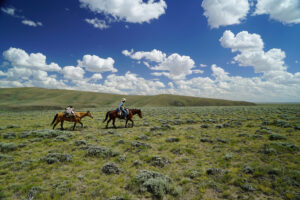
The warrior Nana may have been an octogenarian, but his unrestrained presence in southwestern New Mexico Territory in the summer of 1881 filled white folks with old fears as quickly as a flash flood fills an arroyo. By mid-August, a combined military and civilian party had taken the field to stop or at least contain the Warm Springs Apache leader and his marauders. Nana, believed to be about 80 and afflicted with arthritis, had launched a spectacular raid that June in response to wrongs that he had suffered. Most of Nana’s resentment stemmed from a mid-October 1880 Mexican militia ambush at Tres Castillos in Old Mexico. The great Mimbres Chief Victorio and close to 80 other Apaches had been massacred there, though Nana and his followers had been able to evade the ambushers and escape into the Sierra Madre. If, 10 months later, the makeshift American posse hoped to achieve another “Tres Castillos,” Nana had other ideas. He planned to turn the tables on them and remind them that Apaches knew a thing or two about carrying out an ambush.
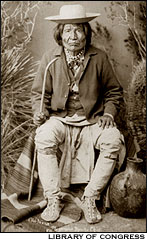
Although not a chief, Nana was an important Mimbres leader who was as old as the hills at the time of his famous raid.
Nana’s raid began when he and his wide-ranging warriors (less than 40) attacked a surveying crew in northern Chihuahua, Mexico, in late June 1881. They then fought their way north through the Sacramento, San Andreas, San Mateo and Black Range mountains. By August 17, the ancient warrior was in the vicinity of Hillsboro, New Mexico Territory. On the 18th, the Apaches shot their way through the small mining community of Gold Dust without injuring anyone. The raiders then half-heartedly struck the Trujillo Ranch, about five miles south of Hillsboro. The half-blood owner was suspected of supplying the Apaches with arms and ammunition. Nobody was injured there either, but the Indians continued south to attack Perry Ousley’s ranch; they burned his place and killed him.
Next, the raiders moved past Tierra Blanca Creek to Absolom D. Irwin’s ranch, about three miles north of Lake Valley. (The present-day ghost town of Lake Valley is at a different site.) Absolom was away on business, but his wife, Sally, and their five children made a run for it. Some of them got away, but Sally was severely beaten and a baby was snatched from her arms. Although Absolom arrived in time to put out the ranch house fire, his family was gone. Believing them captured, he rode to Lake Valley to give the alarm.
In response to the recent atrocities, a posse formed at Hillsboro and arrived at Lake Valley by the night of the 18th. When someone reported seeing Indians seven miles away on Berrenda Creek, the Lake Valley Mining Company superintendent, George Daly, took charge of the posse. Support was solicited from Lieutenant George Washington Smith at a nearby military encampment. Smith had been dispatched with elements of Companies B and H of the 9th Cavalry, with orders to block the Apaches’ passage south. Somewhat reluctantly, Smith and the black troopers joined up with Daly’s civilian posse, some of whose members were full of bravado by the time they left William Cotton’s saloon shortly after midnight. Accounts vary as to the number in the party, but a fair estimate would be 16 to 20 so-called buffalo soldiers and 20 civilians.
The force followed Berrenda Creek and then a creek known today as Pollock Creek, which dipped into Dry Gavilan Canyon. That canyon in turn ran into Gavilan Canyon, which is where, at 10:30 a.m. on August 19, Nana ambushed the Americans. Accounts vary as to exactly what happened, but it is certain that Lieutenant Smith and Daly, the leaders, were killed in the opening salvos. Apparently, Smith was unhorsed in the first volley, but he was helped back on his mount, only to be mortally shot. Bullets struck several other soldiers and civilians as well, causing some of the men — including Sergeant William Baker of Company H — to flee. Sergeant Brent Woods of Company B rallied what men he could and even advanced before calling for an orderly retreat. The wounded were also evacuated. Under Woods’ direction, the ambushed party threw up rock barricades and fought the Apaches for about six hours.
One or two more civilians were killed after Daly’s death, and several others were wounded, including newlywed miner George Gamble, of Lake Valley. His beautiful bride, Jesusita Pachedo de Parra, and her parents were told that George was dead, but he later showed up at their door, which was lined with black crepe. Among the soldiers, saddler Thomas Golding and Privates James Brown and Monroe Overstreet of Company B were killed. Two other “B” privates were wounded — William Hollins took a bullet through the lungs but would survive (and be discharged when his term expired five months later), and John William was shot in the thigh (and four months later his leg was amputated). Wesley Harris of Company H was shot in the right breast.
Indian casualties were not reported, but small pools of blood in the canyon battlefield indicated that at least a few of the warriors had been killed or wounded. Realizing that more 9th Cavalry soldiers were on their way, Nana fled late in the afternoon of the 19th with many of his pursuers’ horses, some of their supplies and about 1,000 rounds of ammunition. Indeed, Sergeant Richard Anderson of Company H came along with the balance of the late Lieutenant Smith’s command, and they were joined by Lieutenant Charles Taylor and Captain Byron Dawson. Daly was found shot four or five times and mutilated, with sticks stuck into his body. Smith was found lying on his face with his back and arms burnt. His face had been slashed, with his nose, ears and other body parts cut off. The lieutenant’s mustache was found hanging in a nearby bush. Both the civilians and soldiers on the scene heaped praise on Sergeant Woods, agreeing that the 30-year-old sergeant’s performance had prevented total disaster. Thirteen years later, Woods received the Medal of Honor for his actions in Gavilan Canyon.
Although it was late in the day, the reinforced military-civilian force continued its pursuit of Nana, while Sergeant George Turpin of Company H transported the dead and wounded to Fort Bayard. While Turpin’s escort detachment was stopped at John Brockman’s Mill, on the bank of the Mimbres River, one of the wounded men died.
Late on the 19th, near Lake Valley, Apaches mortally wounded a Mexican sheepherder while his companion made his way to the village of El Colorado. Other parting shots before Nana returned to Mexico were fired between Cooke’s Canyon and Mule Springs, when the Apaches reportedly attacked a group of woodcutters, killing at least four of them. The raiders captured 12-year-old Manuel Chacon and 14-year-old Juan Chacon. In Las Cruces, Apaches attacked a wagon, killing six Mexicans and severely wounding the lone survivor.
In two months, old but relentless Nana and his followers had ridden about 3,000 miles and fought a number of battles and skirmishes while suffering minimal casualties. Much of the stock that had been taken at Gavilan Canyon was eventually traded to Juh’s band when the two Apache groups met in the mountains of Mexico a few months later. Nana would surrender to Brig. Gen. George Crook in March 1883, bolt the reservation with Geronimo two years later, and surrender again to Crook in March 1886. After spending the last 10 years of his life as a prisoner, Nana would die at Fort Sill, Oklahoma Territory, in 1896.
This article was written by Lee A. Silva and originally appeared in the December 2006 issue of Wild West magazine. For more great articles be sure to subscribe to Wild West magazine today!