
It was the start of a friendship that would alter the course of European history. On the afternoon of June 10, 1704, John Churchill, Duke of Marlborough, and supreme commander of the English army, met his ally, Prince François-Eugène of Savoy-Carignan, in Mannheim, a sleepy little village in southern Germany. It was the second year of the War of Spanish Succession, a conflict that pitted King Louis XIV’s France against England, the Republic of the United Seven Netherlands and the Hapsburg Holy Roman Emperor Leopold I. Marlborough and Eugene of Savoy were the principal generals in the anti-French coalition, and what they decided at Mannheim would determine the course of the campaign.
The rendezvous was conducted with a kind of Baroque splendor that typified the age. Bewigged and beribboned officers bowed low and doffed their hats, and the air was filled with courtly compliments. All eyes were drawn to Marlborough and Eugene as the main actors in the unfolding drama — and the contrasts between the two men could not have been more startling.
Prince Eugene of Savoy was 41, a swarthy little man of mixed Italian-French extraction. His long hawkish face and prominent nose were framed by a luxuriant peruke, yet his shabby brown coat gave him an almost monkish appearance — ironic, since Louis XIV had once called him ‘le petit abbé.’ As he talked, Eugene would plunge his hands deep into the lining of his coat pocket to extract the finely-ground Spanish snuff he carried therein. As a general in Hapsburg service, however, the unimpressive-looking Eugene had carved out a formidable military reputation.
The Duke of Marlborough was 54, a relatively old man by the life expectancy of the day. By all accounts, he was still a handsome man, youthful in looks, courtly in manner and graceful in carriage. He had a pink complexion and the slight hint of jowls, counterbalanced by a commanding gaze. Due in part to suspicions regarding his loyalty on the part of the late king of England, William III, he had seen little active campaigning in the past 10 years, but there was something about the man that inspired confidence. Since 1703, his taking of the fortresses at Venlo and Roermond in the Spanish Netherlands, and his overrunning two of Louis’ allies, the Electorate of Cologne and the Bishopric of Liège had led to his elevation from Earl to 1st Duke of Marlborough.
Marlborough played his role as host to perfection, and Eugene began to warm to this ruddy faced Englishman. The duke escorted his new friend to a lavish banquet — the diners supped on the finest silver plate and drank the choicest vintages. Amid the flickering banquet candles, a partnership was forged that would have far-reaching consequences in the future.
The war had begun when the dying king of Spain, Charles II, bequeathed his throne and overseas empire to Philippe de Bourbon, Duke of Anjou, the 17-year-old grandson of Louis XIV, and his ministers promptly declared young Philip king of Spain and the Indies. In Vienna, however, Emperor Leopold I fretted that the Spanish throne, so long a Hapsburg possession, was about to be lost to his family forever. Without a moment’s hesitation, the haughty Hapsburg declared that the Spanish throne should go to his son, Archduke Charles of Austria, who was also cousin to King Charles II of Spain. When negotiations over the disputed crown broke down, Leopold and Louis made preparations for war.
At first England and the Netherlands stood aloof, and only their participation could ignite a general European conflagration. Events took an ominous turn, however, when French troops invaded the Spanish Netherlands — present-day Belgium — and seized important border fortresses. For 40 years Louis XIV, the ‘Sun King,’ was the richest and most powerful monarch in Europe, and his brilliant reign illuminated the entire continent. Thanks to his powerful patronage, French language and culture spread throughout Europe, but if he was admired, he was also greatly feared. Louis’ seizure of the fortresses seemed a blatant act of aggression, a first step toward his achieving complete domination over Europe.
To counter French moves, a Grand Alliance of England, the Netherlands and the Empire (Austria and some smaller German states) was formed in 1701. War with France followed in 1702. The chief architect of the alliance, King William III of England, died soon after the outbreak of hostilities, but the new monarch, Queen Anne, supported his bellicose aims. Anne retained John Churchill as captain-general of English forces and minister extraordinary to the Netherlands — and, as further mark of royal favor, created him Duke of Marlborough a few months later. The queen thus made Marlborough supreme in both military and diplomatic spheres, a crucial distinction. As events would show, he needed every bit of his authority to overcome internal opposition and lead his forces to victory.
By early 1704, the war had been raging for almost two years — a time of ever-mounting frustration for Marlborough. His Dutch allies were a volatile lot, united only in their hatred of Louis. Time and again, the duke’s brilliant campaign plans were dashed on the rocks of Dutch intransigence. On four separate occasions, powerful maneuvers—maneuvers designed to seize important objectives and bring the French army to bay — came to grief due to backstage Dutch opposition.
While fighting flared in Spain and Italy, there were really only two decisive fronts: Flanders and southern Germany. In Flanders, Marlborough guarded Holland from a French army of 46,000 under Marshal François de Neufville, duc de Villeroi. In southern Germany, Elector Maximilian II Emmanuel of Bavaria had lately joined France, lured by Louis’ promise of making him emperor in place of Leopold. A Franco-Bavarian army of about 45,000 men hovered around Ulm, jointly commanded by the elector and Marshal Ferdinand, comte de Marsin. In order to protect the French lines of communication, some 30,000 French troops were stationed at Strasbourg with Marshal Camille comte de Taillard. In April, Tallard led 10,000 reinforcements to the elector and Marsin, boosting their numbers to at least 55,000 troops.
Poring over his maps, Marlborough could see that Vienna was threatened and if that linchpin fell, the coalition would collapse like a house of cards. With the Franco-Bavarian forces poised on the very edge of Austria, the troops under Prince Eugene and Margrave Ludwig Wilhelm of Baden might be overwhelmed. Only Elector Emmanuel’s short-sighted greed had saved Vienna thus far — over French objections, he delayed attacking the city and tried to annex the Tyrol instead — but such a respite, Marlborough knew, was only temporary.
The crisis was a tonic for Marlborough, sharpening his genius as nothing else could. In response to the French menace and against all expectations, he would leave the Netherlands and march 300 miles south to relive Vienna. The proposed march was one of the boldest military designs ever conceived: a long, potentially arduous trek that exposed the flank of his army nearly the entire length of the journey.
Given the transportation and supply systems of the time, the march might well be a logistical nightmare, but if Marlborough could destroy the Franco-Bavarian army, the whole strategic picture would change. Vienna would be saved and with it the Grand Alliance. With luck, Bavaria might even be persuaded to switch sides and cast its lot with the Allies.
Once Marlborough decided on that course of action, planning proceeded under the heavy cloak of secrecy. To mask his intentions form the Dutch, who feared the French would overrun them in the English duke’s absence, Marlborough proposed a limited German campaign on the Moselle River. After some foot-dragging, the Dutch reluctantly agreed. For his part, Marlborough had no fears for Holland’s safety — he surmised the French would rather follow him than invade the Netherlands.
Marlborough selected the town of Bedburg, some 20 miles northeast of Cologne, as the starting point for his grand design. The duke began the march with 31 squadrons and 66 battalions — about 21,000 men, of whom about 16,000 were English. Like rivulets combining to form a mighty river, Marlborough’s force would be augmented by Allied troops en route, including contingents form Austria, Prussia and Denmark. By the time he reached the Danube, his numbers would swell to at least 40,000 — and that figure did not include and Imperial Austrian army under Prince Eugene.
At first light on May 20, 1704, the English army departed Bedburg for the Rhineland town of Coblenz, the first major lap of the journey. The cavalry led the way, and next came the long snakes of red-coated infantry, muskets swaying on their shoulders, gaitered legs kicking up dust swirls as they went. A series of wagon convoys followed the troops, a rattling procession that eventually stretched for miles. First, there were the supply carts whose axles groaned under the weight of nails, ropes saddlery, medical supplies and bricks to make bread ovens. Hundreds of ammunition wagons also moved along the rutted track. Finally, officers’ baggage carts brought up the rear, filled to the brim with furniture, silver plate and candle sticks — in short, all the things a gentleman needed while engaged on active campaign.
As they trundled along, the men were cheered by the thought of leaving Holland with its flat terrain and all-too-familiar campaigning grounds. A spirit of adventure pervaded the ranks, and before long the rough-hewn soldiers swapped jokes and stories and peppered the air with the most profane oaths. Marlborough, however, was haunted by fears of arriving too late. The specter of Prince Eugene being overwhelmed and Vienna taken dominated his thoughts — so much so that he decided to take the cavalry and press on ahead.
The English army soon approached Coblenz, a multi-spired town at the confluence of the Rhine and the Moselle. The cavalry crossed a bobbing bridge of boats over the Moselle and continued southward, followed two days later by the bulk of the army. Once past Coblenz, the route of march paralleled the great Rhine River itself for a time, revealing magnificent vistas at every turn. It was a paradise to men used to more northerly climes. As the soldiers went through small German villages, their footfalls reverberating off the narrow, cobblestoned streets, sturdy German burghers would emerge from their half-timbered houses to gape at the martial spectacle passing before their eyes.
Marlborough’s meticulous planning was beginning to produce results. Provisions were funneled in at selected points all along the march, and local German settlers were well-paid for their services, a startling contrast to the French habit of foraging (often pillaging) for supplies. Given the primitive transportation systems of the time, the duke and his staff had worked wonders. Apart from the men’s needs, Marlborough had 14,000 cavalry horses, 5,000 artillery horses and 4,000 draft animals to provide for. The horses alone needed 100 tons of oats a day to remain in good health.
Nothing escaped Marlborough’s methodical eye. When the army arrived in Heidelberg, the infantry found fresh footwear waiting for them. Weeks before, the duke’s funds had set German cobblers to work, resulting in a full 14 battalions of men being newly shod.
To avoid fatigue, Marlborough established a daily routine that was unprecedented among European armies. The march would begin about 3 a.m., when the cool of the night protected the men from the sweltering heat of the day and the cover of darkness hid their movements from the French. As soon as a halt was called at about 9 a.m., the men pitched their tents, broke out cooking kettles and spent the balance of the day at their leisure.
The march continued at a steady pace, though during its later staged the columns were pelted by cold rains that transformed the roads into quagmires. On June 27, Marlborough’s army reached the vicinity of Ulm. The march had been brought to a successful conclusion: in 35 days, the duke’s troops had traversed nearly 300 miles and were as fresh as when they began the journey. Marlborough now had a force to be reckoned with, amounting to nearly 50,000 men. The captain-general was also in contact with Margrave Ludwig Wilhelm’s Baden army.
While the British columns trudged south, confusion had reigned in the French camp. True to Marlborough’s prediction, Marshal Villeroi left the Netherlands and followed the duke, on a parallel course and at a very respectful distance. Villeroi linked up with Tallard, and together they awaited further developments at Landau in Lorraine. The French were thrown into a panic when they discovered that Marlborough was on the Danube; in effect he was between the Villeroi-Tallard army at Landau and the elector’s forces in Bavaria. After some deliberation, King Louis decreed that Marshal Tallard would take some of the finest French regiments available, some 35,000 men, and rush to the elector’s aid. Tallard complied, but his haste was his undoing. German peasants, enraged by French looting, killed many stragglers, and hundreds of the entirely essential French cavalry horses were filled by a disease called glanders.
Now that Marlborough was on the Danube, the next question revolved around his future intentions. An invasion of Bavaria was contemplated, but first the key fortress of Schellenburg would have to be taken. Time was growing short — if the Franco-Bavarian army was not brought to battle soon, Vienna could still be lost. Marlborough ordered that the fortress be taken by storm. Tough the Fran co-Bavarian garrison resisted fiercely, Dutch and English infantry took Schellenburg after heavy fighting.
For the next few weeks there was a lull in the campaign. Hoping to ‘persuade’ the elector to abandon the French alliance, Marlborough sent out parties that burned and ravaged Bavarian villages. While destructive, the effort was half-hearted and produced none of the desired results.
On August 6, Tallard’s 35,000 men affected a junction with the elector and Marsin, boosting the Franco-Bavarian army to 60,000. With the French and Bavarians concentrated at last, Marlborough decided it was time to strike. After dispatching Margrave Ludwig with 15,000 men to besiege Ingolstadt (some believed they had done it to get rid of an obstinate fool), Marlborough and Eugene proceeded to the vicinity of Hchstadt. Of the 53,000 troops under their joint command, only 9,000 were English, but Marlborough enjoyed the full cooperation of all the Allied units.
With Eugene at his side, Marolborough rode out to the village of Tapfheim for a look at the enemy dispositions. The church tower of the hamlet afforded an excellent view of the Franco-Bavarian camps, a sea of tents that filled the horizon.
Tallard had a reputation of being a dilettante at war, but nevertheless he had chosen a very strong topographical position. On the far right the mighty Danube flowed, its banks fringed by reeds and its surface broken by small islands and shoals. On the extreme left, undulating ground formed a series of small hills, many of them clothed with verdant stands of pine. A small sluggish stream, the Nebel, fronted much of the French line, its brackish waters following a meandering course until emptying into the Danube.
The French right rested on the village of Blenheim (locally, ‘Blindheim’), a cluster of red-roofed stone cottages that nestled where the Nebel flowed into the Danube. In many ways, Blenheim was the key to the French position — if the village could be taken, Tallard’s line could be rolled up in short order.
From Blenheim to the next village, Oberglau, there stretched a plain of about four miles. Its rich alluvial soil, dark brown and fertile, was covered by vast expanses of wheat fields, now cut to stubble by local harvesters. The stubble fields, yellow-golden in the August sun, were ideal places to deploy troops — if the marshy Nebel could be crossed first. From Oberglau to the next hamlet, Lutzingen, the terrain was an attacker’s nightmare, seamed as it was by ditches, broken by low hills and carpeted by woods, thickets and brambles.
In the chill pre-dawn hours of August 13, 1704, the Allied army roused itself for the coming battle. Amid the flurry of activity, Marlborough made his way to Eugene’s tent and together they refined the Allied battle plan.
The duke would attack where he was least expected, right across the Nebel and directly in front of the French center. Before the main assault was launched, Lt. Gen. John Cutts, Baron of Gowran (nicknamed ‘Salamander’ because of his relish for the hottest fire), would be given the task of attacking the French right at Blenheim in concert with Prince Eugene’s assaults on the French left. With the enemy flanks tied down, Marlborough’s hands would be free to deliver the deciding blow in the center.
As an added ‘bonus,’ strong Allied attacks on the French flanks might panic the enemy into weakening his center. Once French troops were siphoned off, Marlborough would bridge the Nebel, deploy in the stubble fields beyond, then punch through the French defenses before Tallard knew what was happening. It was an admirable plan, but it entailed enormous risks: if Marlborough was caught in mid-crossing, his forces could be divided and utterly destroyed.
Meanwhile, behind the marshy moat of the Nebel, the Franco-Bavarian camps slept untroubled by dreams of impending doom. All was tranquil save for outlying districts where French pickets noticed the bustle in the Allied camp, but when they reported it, Tallard convinced himself the activity signaled an Allied retreat.
Jean-Philippe Eugène, compte de Merode et marquis de Westerloo, a Flemish cavalry commander in French service, was asleep in a barn when he was rudely wakened by his servant. The man was in a high fever of excitement and babbled something about the enemy being upon them. When Merode-Westerloo laughingly expressed disbelief, the servant threw open the barn door to let the count see for himself. In the far distance, beyond the Nebel, he could see the Allied army could be seen advancing at a measured pace. Serried ranks of infantry in blue and scarlet, bayonets fixed and at the ready, moved forward with parade-ground precision.
As the alarm spread, the Franco-Bavarian camps seethed with activity. Aides-de-camp rode to and fro, cavalrymen scrambled into the saddle and French officers kicked their sleeping men into ranks. Two French cannons were fired to recall the foragers, and Marshal Tallard held a hasty conference with Elector Max Emmanuel and Marshal Marsin.
Fortunately for the French, Marlborough was forced to call a halt at the approached to the Nebel while he waited for news of Eugene — until the prince was in position on the Allied right, the battle proper could not being. Relieved to be given this precious respite, the French commanders outlined their course of action. Since time did not permit complicated maneuvers, they decided that the Franco-Bavarian troops would fight where they had camped the day before. Opinion was divided over how to deal with Marlborough’s threat over the Nebel. Tallard decided to allow Marlborough to cross in strength, then launch a heavy frontal attack in concert with French flank attacks from Blenheim and Oberglau. The elector, who had a healthy respect for the disciplined firepower of the English infantry, remained skeptical of that plan, but his pleas that the Nebel line should be defended fell on deaf ears.
In the meantime, Marlborough was growing concerned as to Eugene’s whereabouts. As an indication of his worry, he dispatched his most trusted lieutenant, Quartermaster General William Cadogan, to find out what befell the prince. While they waited, the Allied troops were ordered to stand down, and since this was a Sunday, chaplains began to conduct worship services.
Suddenly, an iron cannonball crashed into the infantry ranks, tearing a bloody gap as it bounded forward. The shot had come from a French battery near Blenheim and signaled the start of a general bombardment of Marlborough’s whole line. Unruffled by that turn of events, chaplains continued the services, offering prayers to the Prince of Peace amid the carnage of war. Hymns mingled with the screams of the wounded and the booming reports of the cannons. Allied cannons flamed in counterbattery, but since Marlborough had less artillery, his men took the worst of the encounter.
Toward midday, the Allied troops sat down to eat, though an iron hail fell upon their ranks. Finally, a courier galloped up with the heartening news: in spite of the rough terrain, Eugene’s men were in position. Marlborough mounted his horse, turned to the circle of bewigged officers around him and said simply, ‘Gentlemen, to your posts.’ The Battle of Blenheim was about to begin. If all went well, Marlborough’s brother, General Charles Churchill, would led Allied infantry over the Nebel while Eugene contained the French left and Lord Cutts attacked the French right at Blenheim.
Of all the participants, Cutts had perhaps the most difficult assignment. Blenheim was an immensely strong position, and the peculiar architecture of its 300-odd stone houses made it even more so. Since each dwelling was a self-contained unit, housing living quarters and stables under one roof, the cottages could be transformed into small fortresses with relative ease. To bolster an already strong defense, the French threw up barricades of overturned carts and wagons, barn doors and furniture in the village streets. To garrison Blenheim, Tallard had allotted nine battalions and a further 18 battalions in reserve — a total of nearly 13,000 men.
It was past noon when Lord Cutts finally received the order to advance on Blenheim. For two hours and more his men had stoically endured a galling fire form a French battery near the village. Since the guns, commanded by a Swiss officer named Zurlauben, were particularly well served, even the depression of the Nebel stream bank afforded no protection to the Allied troops.
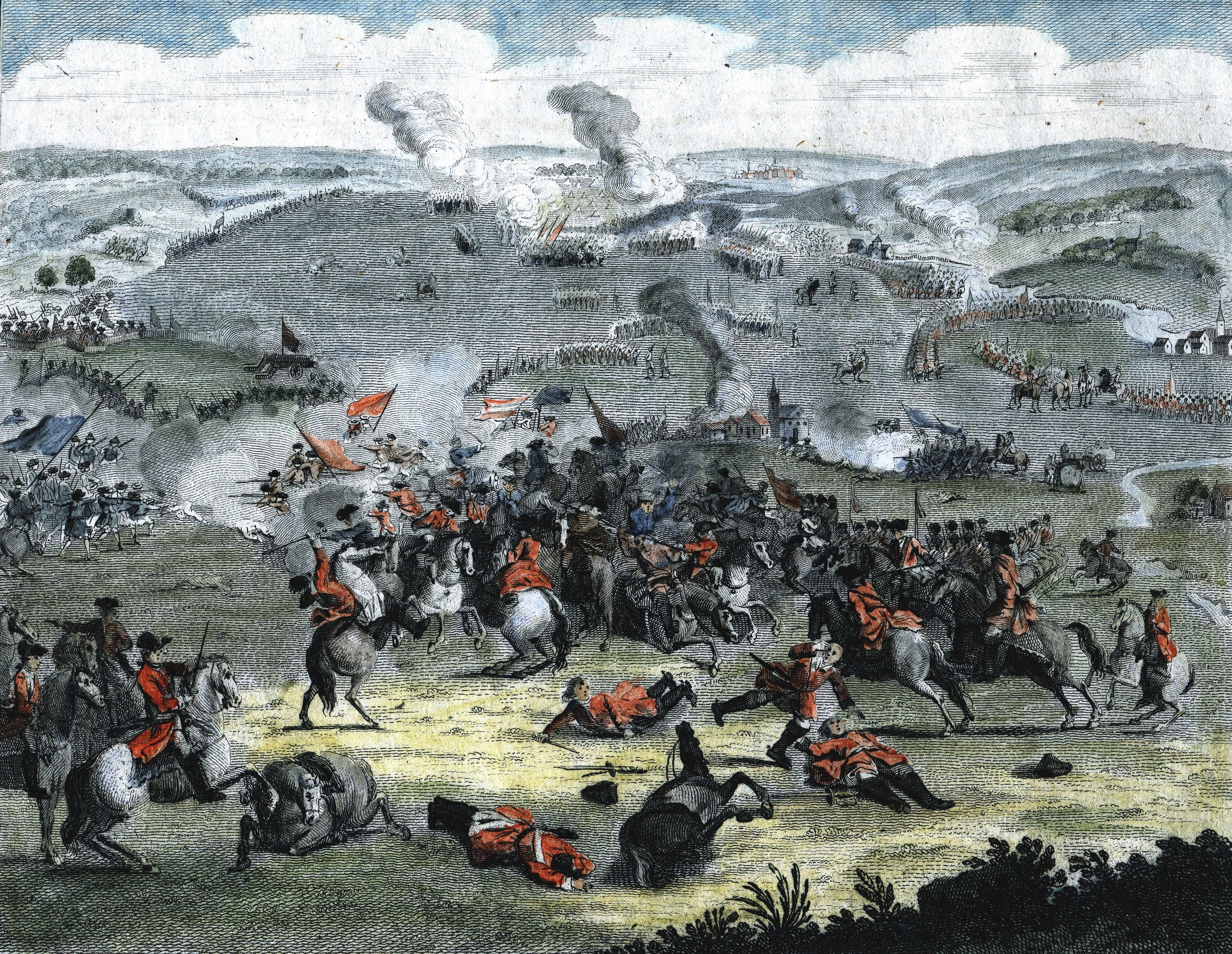
Cutts had four brigades — one English, one Hessian and one Hanoverian — at his disposal, and it was a crack English brigade, composed of five battalions of well-trained troops, that had the honor of leading the assault. As their scarlet columns drew closer to the objective, the French held their fire. Only when the leading ranks were a scant 30 paces from the town did the French unleash a devastating musket volley that shredded the approaching columns. The redcoats behind them, however, merely stepped over the bodies of their fallen comrades and pressed forward. Against all odds the survivors gained the fortifications while the French fusillade continued to cut through their ranks with grim impartiality. The English stabbed through cracks in the barricades with their bayonets, fired their muskets over the parapets and even tried to tear openings with their bare hands in their determination to succeed, but no body of troops, however disciplined, could long withstand the holocaust to which they had been subjected. Taking note as the battered English battalions began to fall back, several squadrons of elite French gendarmes advanced upon them, their upraised sabers poised to strike. Still reeling from their bloody repulse, the English were unable to mount an effective defense against that new threat. The fleeing soldiers fell like wheat before a scythe as the gendarmes sabered the terrified fugitives almost at will.
In the ensuring melee a Scots battalion — the 21st — lost its colors. Then the gendarmes ran headlong into the leveled muskets of a Hessian infantry brigade. A withering volley brought men and horses down in a tumbled heap, and in the resulting carnage the lost Scottish colors were retrieved.
The situation momentarily stabilized, Lord Cutts ordered a fresh assault on Blenheim. Once again, the Scarlet tide crashed against the village barricades, and though Blenheim remained in French hands, the heavily besieged garrison was hard-pressed. The French commander at Blenheim, Lt. Gen. François, marquis de Clérambault, was becoming rapidly unnerved by the persistence of the English attacks. Thousands of English voices, deep, resonant, terrifying, kept up a steady cheering amid the rattle of musketry and the screams of the wounded. Panicked by the din, the frightened marquis ordered 11 reserve battalions into Blenheim, exactly as Marlborough had hoped the French would do.
While the battle swirled and eddied around Blenheim, Marlborough was crossing the Nebel in front of the French center. Earlier, during the morning’s cannonade, the duke’s engineers had been at work bridging the marshy steam. Loads of brushwood carpeted its approaches, then pontoon bridges were thrown across it.
To help facilitate the crossing, Marlborough adopted an unorthodox formation. Cavalry and infantry were arranged in a ‘layered’ fashion: 9,000 foot soldiers led the way, followed by the massed squadrons of 8,000 cavalry troopers. An additional 6,000 infantry brought up the rear, completing the formation.
The French were puzzled by Marlborough’s deployment, but would discover its effectiveness before the day was out. A superb tactician, the duke placed great confidence in the platoon volleys of his infantry. Once over the river, those troops would form a barrier of bristling muskets, a wall behind which the rest of the formation could shelter as it completed the passage of the Nebel.
While the engineers hurried to complete their task, the French bombardment continued unabated. Whistling cannonballs chopped bloody holes in the waiting infantry, but the men merely closed ranks with each hit and sent the wounded to the rear. To steady his men, Marlborough, mounted on a magnificent charger, the star of the Order of the Garter sparking on his breast, calmly rode through the assembled regiments as if reviewing the troops at Hyde Park. Without warning a cannonball gouged the earth beneath his mount’s feet, kicking up a cloud of dust that temporarily obscured both horse and rider. For one heart-pounding moment, it seemed that the commander in chief was surely hit. But no, to everyone’s immense relief, Marlborough emerged unscathed, his peacock brilliance merely dulled by a coat of dust.
Near Blenheim, a cavalry action occurred that was the psychological turning point of the entire battle. It began when five squadrons of English dragoons splashed through the waters of the Nebel and arrayed themselves at the foot of a rise near the village. Eight squadrons of French gendarmes — the same elite troopers who had been bloodied earlier — spied the movement and rushed forward to expel the invaders. With pounding hooves and flowing manes, the French horses broke into full gallop, the downward slope of the hill giving them added momentum.
Instead of waiting for the anticipated shock, the English dragoons unsheathed their swords, divided up into three groups, then enveloped the onrushing Frenchmen in front and flank. After a flurry of swordplay, the gendarmes were utterly routed and fled the field with the dragoons in hot pursuit. Marshal Tallard witnessed the defeat of his proud regiment with upper disbelief. As he later attested, from that moment he lost faith in ultimate victory.
Still, a French triumph was yet a possibility, even at that late hour. About 3 p.m., the Maj. Gen. Anton Gnther, Prinz von Holstein-Beck led his men against the French at Oberglau’s cluster of farm buildings built around a church. When only two of Holstein-Beck’s 10 battalions were across the Nebel, the French attacked with all the troops they could muster, including the fire-eating ‘Wild Geese,’ Irish émigrés in French service. In short order Holstein Beck was mortally wounded and his troops cut to pieces. As the remnants were thrown back into the Nebel, it seemed the French were on the verge of driving a wedge between Marlborough and Eugene on the Allied right.
The crisis of the battle was now at hand. Marlborough, grasping the urgency of the situation, dispatched a courier to Eugene with a plea for aid. Prince Eugene was having troubles of his own — at his wing, the rocky ravines and brush-chokes ditches were hard to cross and hotly contested by the stubborn Franco-Bavarians. The prince was short in stature but a giant in courage; he personally led attacks, was nearly captured by the enemy and when he saw two deserters fleeing the field he shot them down with his own hand. His Prussian and Danish infantry gained ground, but when Marlborough’s appeal reached him he was still hard pressed. Nevertheless, he ordered his Imperial cuirassiers to attack the French breakthrough at Oberglau without a moment’s hesitation. Tanks to his generous and timely aid, the French were driven back and the Allied line saved. The friendship born weeks before at Mannheim had come to fruition.
With the situation eased, Marlborough could devote his attention to the French center. His massive crossing of the Nebel had been brought off without a hitch; no less than 28 infantry battalions, about 14,000 troops, and 71 squadrons of cavalry, about 5,000 horsemen, were poised to deliver the decisive blow. Against that formidable array, the French could muster perhaps 60 squadrons of cavalry, but only nine battalions of infantry. Moreover, the latter were raw conscripts, since Tallard’s best soldiers were at Blenheim, so packed in the smoky, sweltering streets that most couldn’t even raise their muskets to fire.
It was now past 5 p.m., and Marlborough, sensing perhaps that he was at the pinnacle of his career, placed himself at the head of his men and personally led them forward.
The Allies began their general advance with trumpets blowing and drums beating, great oblong blocks of blue and scarlet that stretched a full mile across. Though a slight rise fronted the French center, and clouds of smoke from cannon fire and burning buildings obscured parts of the field, the advancing troops managed to make good progress.
The marquis de Humières, resplendent in a golden cuirass, launched squadron after squadron against Marlborough’s infantry, but the harried French cavalry could make little impression on the solid walls of bayonets. The French infantry, brave but unseasoned, were also swept way by the steady volleys of Allied soldiers.
Marlborough now massed his cavalry into two parallel lines that ran nearly three miles across and ordered them forward to administer the coup de grace. The ground reverberated with the pounding of thousands of hooves as the Allied troopers galloped inexorably toward the weakening French center. Awaiting them, the formidable Maison du Roy, or King’s Household cavalrymen, noted for their pride and panache, seemed about to accept the challenge when they suddenly drew rein, fired a ragged pistol volley and then turned and fled. With their precipitous flight, what was left of Tallard’s center evaporated like a morning mist.
When news of the center’s disintegration reached Elector Emmanuel and Marshal Marsin, they broke off the engagement with Prince Eugene in good order, bloodied but unbowed. Others were not so fortunate. Allied troops completely invested Blenheim, trapping thousands of French soldiers who still swarmed in its houses and gardens. In a fit of despair or an addled attempt to escape, the Marquis de Clérambault, the man who had done so much to ensure French defeat by his panic, plunged into the Danube and drowned.
The trapped Blenheim garrison included some of the proudest regiments in the French army — Provence, Artois, Navarre, La Reine — names that echoed through the years as a roll call of ‘La Gloire.’ After an attempt to break out failed, the marooned regiments accepted their fate and surrendered en masse to the Allies. With tears coursing down their cheeks, the soldiers of the Navarre Regiment burned their colors rather than deliver them as trophies to their enemies. A total of 23 battalions and four dragoon regiments surrendered in Blenheim, as did their commander in chief, Tallard.
Even before the surrender, an exhausted Marlborough, who had spent 17 hours in the saddle, hastily scribbled a note to his beloved wife Sarah telling her of the ‘Glorious Victory.’ And glorious victory it was. Estimate vary, but it seems the French lost 18,000 men killed, wounded and drowned, and a further 13,000 taken prisoner, for a total of 31,000 out of 60,000 engaged. The Allies, in comparison, suffered 4,500 troops killed and 7,500 wounded. An immense booty also fell into Allied hands, including 100 cannons, 3,600 tents, 34 coaches and eight casks of silver.
The effects of Blenheim were dramatic and far-reaching. Vienna was saved and with it the Grand Alliance. Most of all, the myth of French invincibility on the battlefield was shattered. Apart from a brief renaissance under Marshal Hermann Maurice, comte de Saxe, the French army went into a decline that lasted until the French Revolution — and Napoleon.
Blenheim was the first of several occasions in which two of history’s ‘great captains,’ the Duke of Marlborough and Prince Eugene of Savoy, demonstrated their ability to operate well together as a team. Indeed, it was that engagement that established Marlborough’s reputation as a ‘great captain.’ As one of his commanders, Lt. Gen. George Hamilton, Earl of Orkney, put it, the monumental Battle of Blenheim was ‘the greatest fought in 50 years.’
This article was written by Eric Niderost and originally published in the October 1988 issue of Military History magazine.
For more great articles be sure to subscribe to Military History magazine today!