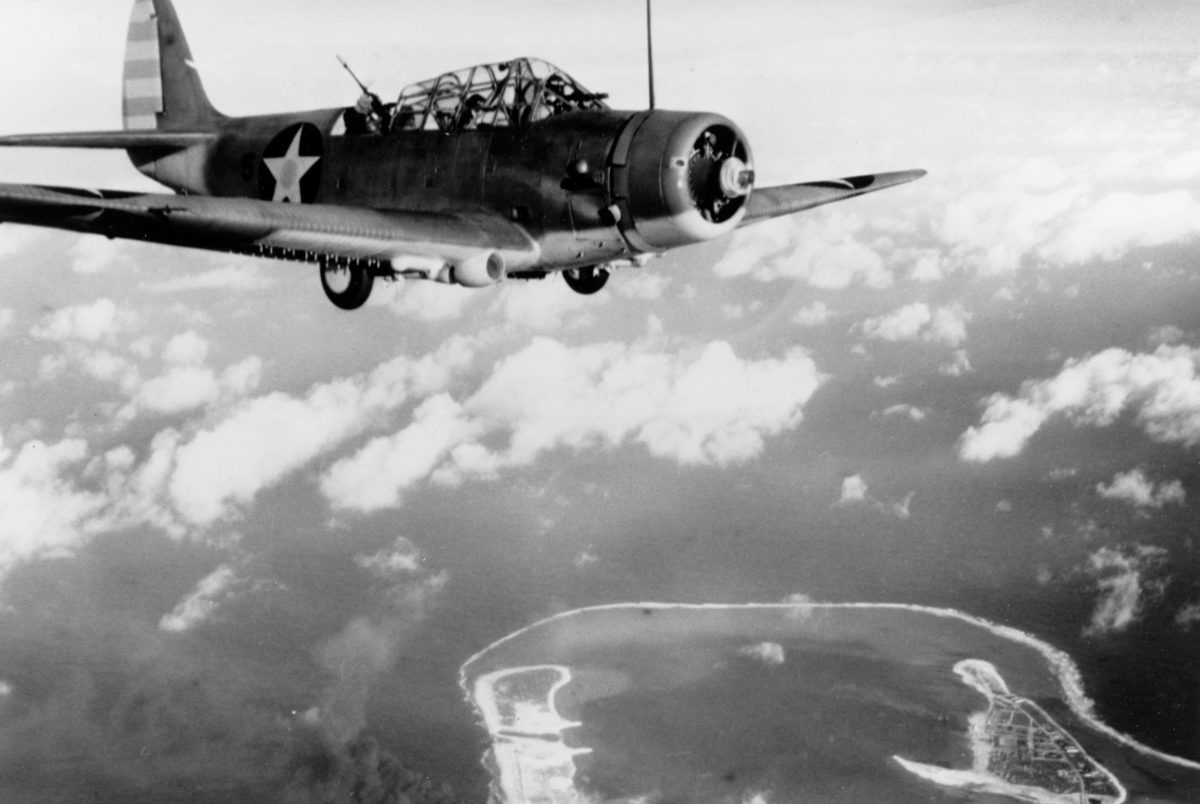
Early on the morning of December 8, 1941, Wake Island hummed with activity. For months, the wishbone-shaped Pacific atoll of three small islands—Wake, Wilkes and Peale—less than 10 miles long and barely above sea level, had been the site of construction work. Working feverishly to complete an airstrip and defensive fortifications were 449 U.S. Marines of the 1st Defense Battalion, commanded by Major James P.S. Devereux; Marine fighter squadron VMF-211, equipped with 12 Grumman F4F-3 Wildcats, led by Major Paul A. Putnam; 71 Naval personnel; a five-man Army radio detachment, commanded by Captain Henry S. Wilson; and 1,146 American civilian construction workers of the Contractors Pacific Naval Air Bases Company, managed by Dan Teters–all under the overall command of Commander Winfield S. Cunningham.
War with Japan was imminent, and an airstrip on Wake, about 2,000 miles west of Hawaii, would allow American heavy bombers to strike the Japanese-controlled Marshall Islands. And, if Guam were lost to the Japanese, Wake would be one of the closest American outposts to the Japanese mainland. Each day work began early and finished late. There were no other diversions on the tiny, barren atoll, and the defenders all realized that war could begin at any time.
Around 7 o’clock that morning an Army radio technician on Wake picked up a radio alert from Hawaii: ‘Hickam Field has been attacked by Jap dive bombers. This is the real thing.’ Devereux shouted for his bugler, Alvin J. Waronker, and soon the clear notes of ‘General Quarters’ sounded across the atoll.
At 8:50 the Marines raised the American flag on its staff, something Marines did every morning all over the world, and Waronker began to sound ‘To the Colors.’ In the past he had had trouble with the bugle call, never getting it quite right, but this time he did not miss a note, and for several minutes all activity stopped as each man stood at attention and saluted the flag. Devereux recalled: ‘The flag went up, and every note was proud and clear. It made a man’s throat tighten just to hear it.’ Not long after the flag raising, 36 Japanese Mitsubishi G3M2 Nell bombers crossed Wake in three V-formations. Soon their fragmentation bombs, accompanied by a steady drumming of machine-gun fire, tore the island to pieces. For Wake’s defenders, the war had begun.
Japanese land-based aircraft from Roi in the Marshalls, later joined by aircraft from approaching Japanese carriers, pounded the atoll day after day. Before each attack, a dwindling number of American Wildcat fighters rose to meet them. At 3 a.m. on December 11, a Japanese invasion task force commanded by Rear Adm. Sadamichi Kajioka, consisting of a light cruiser, six destroyers, two troop carriers and two armed merchantmen, confidently approached Wake’s beaches. Marine gunners let them close to 4,500 yards before their 5-inch naval guns opened fire. Their patience was rewarded with the sinking of one Japanese destroyer and damaging of the cruiser and three additional destroyers. Kajioka retreated, now knowing that Wake would not be taken without a fight.
By the 21st, the last of the Wildcats had been destroyed in dogfights over the atoll. With nothing left to fly, Putnam’s aviators were assigned duty as riflemen. Japanese airplanes now roamed over the island at will, pounding American positions in preparation for a renewed attempt to seize the atoll.
In the dark, rain-swept early morning hours of December 23rd, Kajioka returned, his fleet bolstered by four heavy cruisers and various other warships, including landing craft, to assault Wake’s beaches with more than 900 well-trained infantrymen of the Special Naval Landing Force. At 2:35 a.m., the first Japanese landing barge ground ashore. Soon a desperate battle was being fought across the atoll between groups of men fighting with rifles, bayonets, grenades and fists. The Americans fought hard, but more Japanese landed and pushed them toward the island’s center. Teters’ civilian construction workers, many of whom had manned anti-aircraft guns earlier in the fight, now took up rifles and grenades to fight beside the American servicemen.
At dawn, Devereux and Cunningham, separated but talking over the single phone line between the islands, took stock of the situation. The American flag still flew from a battered water tower, the highest point on Wake, but Japanese flags fluttered everywhere else. Reports from the three islands were discouraging; there were simply too many Japanese and too few Americans. Cunningham radioed Pearl Harbor: ‘Enemy on island. Issue in doubt.’
Meanwhile, enemy planes continued bombing and strafing while Japanese ships, beyond the range of the few remaining shore batteries, shelled pockets of American resistance. Devereux, unable to contact his remaining strongpoints, had no idea what was happening a few yards beyond his own command post. Later he would reflect: ‘I tried to think of something…we might do to keep going, but there wasn’t anything….We could keep on expending lives, but we could not buy anything with them.’
Cunningham, as the ranking officer, made the inevitable decision to surrender. The naval commander phoned Devereux to tell him the depressing news. The major gulped, then quietly agreed, ‘I’ll pass the word.’
Devereux and Sergeant Donald R. Malleck, who carried a white cloth tied to a mop handle, then walked across the island, ordering surviving Americans to lay down their weapons. Stunned defenders threw away rifle bolts, destroyed delicate range-finding instruments, drained hydraulic fluid from recoil cylinders and then surrendered. Eighty-one Marines, eight sailors and 82 civilian construction workers had been killed or wounded.
The Japanese, however, paid a heavy price for their victory. The fight for Wake Island had cost them two destroyers and one submarine sunk, seven additional ships damaged, 21 aircraft shot down and almost 1,000 men killed.
Enraged by their losses, the Japanese treated their prisoners–military and civilian–brutally. Some were stripped naked, others to their underwear. Most had their hands tied behind their backs with telephone wire, with a second wire looped tightly from their necks to their wrists so that if they lowered their arms they would strangle themselves. Personal valuables were taken and wounds ignored.
The prisoners were then jammed into two suffocating concrete ammunition bunkers. Later they were herded to the airstrip and made to sit, naked, on the blistering hot concrete. When the Japanese set up machine guns nearby, most of the prisoners expected to be executed. That night, bone-chilling winds replaced the heat. The prisoners sat there, still waiting for food, water or medical treatment. The unfortunate prisoners remained sitting on the airstrip for two days. Finally, they were given food, much of it spoiled by the heat, and water, contaminated from being placed in unclean gasoline drums. Piles of assorted clothing seized earlier were placed before them; an individual had little chance of finding his original clothing. Marines found themselves in civilian dress, civilian workers in Marine khaki. Private First Class Carl Stegman, Jr., was dressed in a bloodstained shirt, ill-fitting Marine trousers and a pair of sneakers. Lieutenant John Manning would begin his captivity in a pair of Marine trousers and two oversized, hip-length rubber work boots.
After returning his prisoners’ clothes, Kajioka, resplendent in white dress uniform and gleaming samurai sword, read a proclamation to the assembled prisoners. When he concluded, a Japanese interpreter informed the Americans that ‘the Emperor has graciously presented you with your lives.’ To which a resolute Marine croaked, ‘Well, thank the son of a bitch for me!’
During the next 10 days the prisoners were given small amounts of food taken from the remaining stores on the island. They cared for their own wounded with whatever supplies they could obtain.
On January 11, 1942, Kajioka informed the prisoners that they would soon be transferred. This was alarming news because although they had been poorly treated by their captors, both sides had come to some accommodation with one another. Now all that would change.
The next day most of the prisoners were taken to the merchant ship Nitta Maru. Before boarding, however, they were forced to run a gantlet of cursing and spitting Japanese sailors who struck them with clubs, fists and heavy belts. Crowded into the ship’s hold, they next confronted a Japanese officer who shouted the rules that would govern them.
Thousands of miles from home, crammed into Nitta Maru‘s dimly lit hold, with several buckets for toilets, no heat or ventilation and confronted by brutal guards, the prisoners’ future was bleak. Even so, they were luckier than the 380 prisoners the Japanese kept on Wake to rebuild the island’s defenses. Those unfortunates would slave away until October 1943, when, in retaliation for the strikes on the island by a U.S. Navy task force and fearful of an Allied invasion, the Japanese garrison murdered them all.
It took Nitta Maru six days to reach Yokohama, Japan. During that time the prisoners never left the ship’s hold and were given only tiny amounts of food. Not understanding Japanese was no excuse for prisoners who failed to instantly obey their captors’ shouted orders. Beatings were commonplace. In one instance a Japanese guard thought he saw Pfc Herman Todd talking without permission. The private was ordered to jump up and grab an overhanging beam. As Todd hung suspended above the deck, a Japanese bayonet was thrust at his stomach while a Japanese petty officer beat him with a pick handle.
Once they had reached Yokohama, eight American officers and 12 enlisted men were sent to a prison camp in Japan while the remainder of the men continued on to Shanghai, China. On the voyage to China, Lieutenant Toshio Sato, commander of the Japanese guard detachment, selected five Americans, three seamen and two Marines, at random, blindfolded and bound them, and took them on deck. There, surrounded by 150 Japanese sailors, the Americans were made to kneel. Sato then read to the Americans in Japanese: ‘You have killed many Japanese soldiers in battle. For what you have done you are now going to be killed…as representatives of American soldiers.’ The bewildered, frightened Americans understood none of his speech. Perhaps it was just as well, for when Sato finished speaking the five unfortunates were beheaded. Their bodies were then used for bayonet practice before being thrown overboard.
After landing at Woosung the prisoners were forced to march five miles to what the Japanese called the Shanghai War Prisoners Camp–seven gray, ramshackle single-story buildings with no fresh water or plumbing and limited electricity. To deter escape, the camp was surrounded by barbed wire, electric fences and four constantly manned guard towers.
The prisoners were housed in large, open rooms called sections. Within each section 36 men slept shoulder to shoulder on wooden pallets. Although the temperature seldom exceeded 20 degrees, most of the men wore ragged garments and many had no shoes. There was no heat. In the cold, crowded rooms disease spread quickly. Enforcement of prison rules was simple–if any man in a section misbehaved, all were punished.
At Woosung the Japanese commissary routinely issued food for only 300 prisoners. Rations provided only about 500-600 calories per man per day. Each of the Wake prisoners would lose at least 60 pounds during his captivity at the prison.
The Americans would never forget Woosung. The bleak loneliness, bitter cold winds whistling through their flimsy huts, wormy stone-studded rice and dawn-to-dusk work made a lasting impression. The excesses of the Japanese guards only added to their misery. Although a few of them adopted a live-and-let-live attitude toward the Americans, most of the guards were brutal.
The worst of the Japanese at Woosung was Isamu Isihara, a civilian interpreter who enjoyed beating the helpless Americans. Although he was a civilian who had once driven a taxi in Honolulu, Isihara wore a samurai sword and insisted that the prisoners treat him as an officer. Without reason or warning he would fly into a rage, and the prisoners dubbed him the ‘Beast of the East.’
Sergeant Bernard O. Ketner later recalled: ‘I was severely beaten by Isiehara [sic]. He struck me four times…with a saber….Later…the sentry held a bayonet against my abdomen [while] they beat me with their fists….I was kicked in the testicles twice. Isiehara spit in my face and called me a white American son of a bitch. I was then thrown into the brig…for four days, two of which I was given no food.’
When the former British governor general of Hong Kong, Sir Mark Young, refused to salute him, Isihara tried to behead Young with his sword. Finally Japanese military officers took the sword away. Instead, Isihara resorted to a leather riding crop with a leaded handle that could be used as a blackjack.
Commanding the Woosung prison camp was Colonel Goici Yuse, notorious for his violent and unpredictable temper. He organized the prisoners into 10-man’shooting squads,’ explaining that if ‘one man escapes, the other nine die.’
Yuse, whom the Marines called ‘Useless,’ died in March 1942, and was replaced by Colonel Satoshi Otera, dubbed ‘Handlebar Hank’ by the Marines for his moustache. Otera, more concerned with his personal comforts than with his duties, could also be very harsh. In one instance he discovered a hole in a 100-pound bag of sugar and in retaliation denied all of his prisoners food for 72 hours.
The Japanese captors’ attitude toward their prisoners was based on Bushido, the code of the samurai warrior. Bushido taught blind loyalty to the emperor and a disregard for death. A soldier should die before surrendering. Those who surrendered to the enemy surrendered everything, even their lives. Thus, the prisoner became the slave of his captor, to be spared or killed as the captor wished. As an interrogator explained to the prisoners, ‘You gave up everything when you surrendered. You do not even own the air that is in your bodies….You are the slaves of the Japanese.’
At Woosung life became a war of wills. Devereux recalled: ‘The main objective of the Japanese…was to break our spirit, and on our side was a stubborn determination to keep our self-respect whatever else they took from us….[That] struggle was almost as much a part of the war as was the battle we fought on Wake Island.’
Colonel William H. Ashurst, commander of the Marine detachment captured at the U.S. Legation at Tientsin; his executive officer, Major Luther A. Brown, and Devereux ensured that their fellow Marines would never succumb to their captors. Ashurst and Brown, using Brown’s battered copy of the Army field manual, The Rules for Land Warfare, repeatedly confronted Japanese officers with their violations of the Geneva Convention of 1929, prescribing proper treatment of prisoners of war.
Devereux insisted on the same military discipline found at a stateside Marine base. He also insisted that the Marines exercise every day, despite their weakening bodies. Some hated him for maintaining such practices, but later, when they saw that they were winning the mental battle with their captors, most respected him for leading the way.
Despite the terrible conditions inflicted on them, American prisoners saluted their officers, maintained their chain of command, and walked with pride and dignity. They held their own religious services and, using fellow prisoners as instructors, began a series of classes–including history, English, photography, beekeeping and navigation. They leveled a field for softball and soccer and began a vegetable garden.
Occasionally they scored small victories against their captors that encouraged them to fight on. Put to work repairing roads, the prisoners instead widened or deepened potholes or loose-packed the dirt so the holes would soon get worse. Assigned to clean weapons, they polished the metal until it was too thin to be safely fired, lost parts, hid bearings, loosened bolts or substituted incorrect parts.
Survival was never easy. Soon after their arrival at Woosung, the prisoners began to die of illness, untreated battle wounds and malnutrition. Others died more violently. In June 1942, a young Japanese sentry playfully pulled the trigger of his rifle, and Lonnie Riddle, a civilian construction worker, fell dead at his feet. Two months later Seaman Roy K. Hodgkins was electrocuted while trying to recover a softball from beneath an electrified fence. Later, Marine Corporal Carroll W. Boncher died when he accidentally fell against the same fence.
After nearly a year at Woosung, the Americans were moved to another prison camp at Kiang Wang. By now they were hardened to days with little or no food, brutal guards and backbreaking work, but it all became even worse upon their arrival at Kiang Wang, which Devereux called ‘the worst hellhole in our captivity.’
At Kiang Wang, Japanese engineers ordered the Americans to build what they described as a playground complex for Japanese children. The prisoners were forced to engage in a year-and-a-half’s labor to complete the complex, which they called the ‘Mount Fuji Project.’ Divided into six-man work teams, the prisoners first cleared an area 600 feet long by 200 feet wide, all by hand. Each team had a few crude spades and perhaps a mattock. They were forced to remove the soil in large woven baskets slung on their backs.
When they had cleared the large area, they began to build an earthen mound 45 feet high, a miniature Mount Fujiyama. As it grew, the prisoners laid a narrow-gauge railroad track up its slope. Then they pushed small mine cars, loaded with dirt and stone, to its summit.
When American officers realized that the ‘children’s playground’ really was to be a large rifle range for the Japanese army, they protested, citing Article 31 of the Geneva Convention forbidding prisoners of war to work on military projects. Otera, however, dismissed their complaint with a sharp retort, ‘Japan did not sign the Geneva Convention.’
By the summer of 1943, as a result of their sparse prison diet and 12-hour workdays, the prisoners were living skeletons, plagued by dysentery, tuberculosis, pellagra, influenza and malaria. Month after month of hunger, cold, pain, bone-weary fatigue, loneliness and despair were severely trying the prisoners. Despite the privation, there was only one rule–survive.
Many prisoners remembered that only the occasional delivery of packages of food, medicine and clothing from home, and the personal, and dangerous, intervention of two men saved their lives.
Loved ones heard little from the prisoners but continued sending them packages and letters. Most mail got as far as the prison camp but never reached the intended recipient. Japanese guards pilfered the packages or kept them in supply rooms for months before delivering them to the prisoners. By September 1943, an estimated 1,000-1,500 pieces of mail had reached the prison camp, but only 719 of them had been given to the prisoners. Christmas mail arrived on December 23, 1943, but was not delivered until April 12, 1944. Mail that did reach the men, however, kept them apprised of the war’s progress. Although Japanese censors read each letter and would not deliver obvious reports of Allied victories, some cleverly disguised messages slipped through. In one case, the prisoners learned of the American victory at Midway Island. ‘Uncle Joe and Uncle Sam met at the halfway house and had one hell of a fight. Uncle Sam won,’ read the letter.
Critical to the Americans’ survival was the intervention of Edouard Egle, a Swiss representative of the International Red Cross. Because they saw their Shanghai War Prisoner Camp as a model for the world, the Japanese allowed Egle far greater access to the American prisoners there than other camps. Egle was a very competent, compassionate man. Between 1942 and 1945, he constantly risked Japanese retaliation by insisting upon providing medical and dental help for the prisoners and by supplying them with food and medical packets. Although Japanese guards looted the packets, enough got through to help the Americans survive.
Egle also provided clothing for the ragged prisoners (critical during the bitter-cold winter months), some heating stoves, books, seeds and livestock for the prisoners’ farm. Learning that four American doctor-prisoners, aided by a kindly Chinese doctor, had set up a small hospital in the prison compound and were performing surgery with razor blades, closing incisions with common thread or fishing line, and treating dysentery with grains of burnt rice scraped from cooking pots, he provided them with medical instruments and other desperately needed supplies and equipment.
In March 1944, with the prisoners’ situation desperate, Egle personally delivered six food parcels and a pair of coveralls, a cap and a pair of boots to each prisoner. For some of the men it was their first change of clothing in two years.
The prisoners also remembered the kindness of an American civilian, ‘Shanghai Jimmy’ James, a Minnesotan who, at the outbreak of the war, owned four American-style restaurants in Shanghai that the Japanese somehow allowed to continue operating for some time. At Christmas 1942, Shanghai Jimmy provided a Christmas tree with trimmings, cigars, cigarettes and a hot turkey dinner for the Woosung prisoners, a tremendous boost to both health and morale. He continued to send food, medicine and other help to the prisoners until he, too, was interned in the prison camp.
In the spring of 1945 the Americans’ lot improved. The prisoners received a shipment of food and medical packets, and the Mount Fuji Project finally ended. More important, their captors saw that the war was winding down. The Allies’ drive across the Pacific was nearing Japan, and American warplanes had begun bombing Shanghai. The Japanese now knew that the war would soon end, and the Allies would be the victors. The guards now made the occasional friendly gesture to their prisoners.
Japanese frustration at the course of the war and at the prisoners’ continuing resistance, however, still made life hazardous and uncertain. The Kiang Wang prison was located between two military airfields. American airstrikes against these facilities endangered their countrymen. Sometimes Japanese guards, angered at the bombing, took out their frustration on the prisoners. On January 20, 1945, for example, when prisoners cheered U.S. North American P-51 fighter planes shooting down a Japanese plane, furious guards bayoneted three of them.
While listening to a clandestine radio, the prisoners learned that the Allies were nearing Japan. Then Boeing B-29s, en route to bomb Japanese installations around Shanghai, appeared overhead. On another occasion, American fighter planes buzzed the prison compound, so low that the prisoners reveled in the pilots’ waves of encouragement. The Americans were getting too close for the Japanese, who were not about to release the Kiang Wang prisoners. On May 9, 1945, they loaded them aboard a train for a five-day trip to Fengtai, eight miles southwest of Peking. During the long train trip from Kiang Wang to Fengtai the only successful escape occurred. Five Americans–two Marines captured from the legation at Tientsin, two Wake Island Marines and one aviator–jumped from the prison train. Finally found by Chinese Communist troops, they walked for 42 days through more than 700 miles of occupied China before reaching friendly territory and freedom.
The Fengtai prison, a large brick warehouse surrounded by a moat, barbed wire and guard towers, held more than 1,000 prisoners in an area 200 yards long by 146 yards wide. Prisoners slept on Fengtai’s hard concrete floor and used a single spigot for water.
Fortunately, the Americans’ stay in Fengtai was brief. On June 19, they again were crowded into boxcars for another hard ride, this one to Pusan, Korea, where they were held in shacks, stables and warehouses until a ship could be found to carry them across the Tsushima Strait to Japan.
At dusk on June 28, the prisoners boarded a small coastal steamer for the hazardous 12-hour trip across the strait to Shimonoseki, on the southwestern tip of Honshu. At Shimonoseki they were crowded into another train.
Seeing the mass destruction American bombers were wreaking everywhere on the Japanese homeland while riding on the train, one Marine exclaimed, ‘I never saw such destruction in all my life.’ They were in Osaka during a B-29 raid and, while changing trains in Tokyo, narrowly escaped death or injury when an angry civilian mob attacked them as their Japanese guards looked the other way.
At Osaka some of the prisoners were diverted to a prison camp at Sendai. Most of them, however, continued to the northern tip of Honshu, where they were ferried across narrow Tsugaru Strait to Hakodate, site of the group’s final prison.
Hakodate’s guards were brutal. A Marine recalled: ‘The Japanese required every prisoner to stand up and bow or salute every member of the guard whenever they passed by….If the prisoner was…slow…the guards beat him….Prisoners were beaten because they could not understand the Japanese language….’
Most of the prisoners worked 12-hour shifts in a coal mine; others worked in a lumberyard. Some Marine prisoners labored in an iron mine seven days a week, with a daily ration of three small bowls of rice and soybeans or a small teacup of soup made from weeds. Civilian foremen beat prisoners to encourage better production or, it seemed to the Americans, for the fun of it. In one instance, three Japanese civilians were beating Marine Sergeant Bernard H. Manning when Pfc Norman H. Kaz interfered. Japanese guards then beat Kaz senseless before tying him to a pit timber at the bottom of the mine shaft. Then, for two weeks he was beaten every day, emerging with a pair of black eyes, a broken nose and several teeth knocked out.
After they had been at Hakodate for several weeks, however, the Americans noticed that the attitudes of their guards and civilian supervisors changed. The brutal interrogations and beatings ended, prisoners were fed a bit better, and their captors even began to smile cordially at them. One day a Japanese guard explained to one of the prisoners, ‘Very soon we will all be friends again.’
In late July 1945, Japanese officers treated American officers to a formal dinner at which they offered many toasts to their guests, bowed often and professed friendship with the Americans. Finally, a senior Japanese officer stood and proposed a toast to ‘everlasting friendship between America and Japan.’ The other Japanese smiled, nodded and waited for an appropriate response from the Marines.
The American officers sat quietly for a long moment, the gaunt, haggard men looking uncertainly at each other. Then, Major Luther A. Brown, for so long a thorn in his captors’ side, stood, looked about and said matter-of-factly, ‘If you behave yourselves, you’ll get fair treatment.’
There were other encouraging signs. On August 15 a mine official suggested that Leonard Mettscher work in another part of the mine because it would be ‘less dangerous there.’ And on the same day, the prisoners’ work ended early, an unprecedented gesture. From scraps of a Japanese newspaper they also learned that the Soviet Union had entered the war, attacking Japanese-held Manchuria.
The next day the prisoners woke to find their prison unguarded. Fearful of reprisals by local civilians, the Americans stayed inside the camp. Later that day, Japanese boy-soldiers, so small that the tips of their bayonets stood high above their heads, appeared at the camp’s perimeter, apparently more intent on protecting the prisoners from civilian assault than in preventing their escape. That night the prisoners’ rations were increased.
On the 17th they learned about the atomic bomb attacks on Hiroshima and Nagasaki. On the 23rd several Marines scaled the prison’s fence and ventured around the nearby village. Seeing them, young Japanese guards begged them to return to the safety of the camp. The following morning, a Japanese army colonel assembled the prisoners to announce that Japan had surrendered to prevent further bloodshed.
The prisoners now decided to wait for the U.S. Army’s arrival rather than wander around the countryside of a defeated nation. On August 28 and 30, B-29s parachute-dropped 55-gallon drums crammed with food, medicine and clothing to the war-weary prisoners, a sure sign that their rescue was near. Many of the men, so long deprived of adequate food, became sick from the feast that followed.
On September 1, Hakodate’s prisoners used colorful cargo chutes to fashion an American flag and, using a Japanese bugle, for the first time in three years, nine months and 21 days Marines sounded ‘To the Colors’ as they hoisted their makeshift flag above the prison camp. Cautiously, more adventuresome Americans now began to explore the area outside their prison. On September 9, during the last airdrop of clothing and provisions, a parachute bearing a fuel drum packed with supplies malfunctioned, killing a Marine and two Army prisoners. They were the last Wake Island prisoner casualties of the war.
Several days after these final tragic deaths, troopers from the 1st Cavalry Division reached Hakodate. For the prisoners there, the long war was at last over.
This article was written by James W. Wensyel and originally appeared in the November 2001 issue of World War II magazine. For more great articles subscribe to World War II magazine today!