As 1969 began, the military situation in the northern I Corps tactical zone of South Vietnam—the closest to the Demilitarized Zone—appeared relatively quiet. The previous year had been the bloodiest of the war, and the North Vietnamese Army and Viet Cong had both suffered losses that would be difficult to replace. Still, appearances were deceiving. Each year, the Communists had launched a spring offensive in I Corps, and the pronounced lack of combat activity at the very start of the year suggested to the U.S. command in Saigon that 1969 would be no different.
Evidence of enemy intentions began to accumulate. Reconnaissance uncovered road work being done on Route 548 in the A Shau Valley and its extension, Route 922 in Laos. As January progressed, as many as 1,000 trucks a day were observed on these roads, moving supplies south and east toward vital objectives inside South Vietnam. Activity at North Vietnamese Army Base Area 611 in Laos suggested that major elements of the NVA’s 6th and 9th Regiments were moving east through the A Shau Valley. In response, American and South Vietnamese forces probed farther into the mountains of western Quang Tri Province and near the DMZ, seeking to upset the enemy’s plans.
The U.S. 3rd Marine Division was responsible for defending Quang Tri Province. An element of the division, Task Force Hotel, operated out of Vandegrift Combat Base in western Quang Tri. Major Gen. Raymond G. Davis, a veteran of World War II and Korea, and a Medal of Honor recipient for his actions at Chosin Reservoir in 1950, commanded the division. He had taken charge in May 1968, and immediately set out to improve the unit’s combat effectiveness. “We had something like two dozen battalions up there all tied down (with little exception) to these fixed positions, and the situation didn’t demand it,” he later stated. “The way to get it done was to get out of these fixed positions and get mobility, to go and destroy the enemy on our terms—not sit there and absorb the shot and shell and frequent penetrations that he was able to mount.”
The 9th Marines, commanded by Colonel Robert H. Barrow, was the division’s swing regiment, the one most easily redeployed to meet any contingency. Barrow noted that the enemy’s first requirement was to “move all the things of war; all of their logistics forward from the sanctuaries of North Vietnam, just across the DMZ, or from Laos….We must do everything we can to find that stuff, wherever it exists, and obviously destroy it. And if we miss any of it, we must attempt by vigorous patrolling, radio intercept, signal intelligence, recon team inserts, and whatever else, to find out when any troops were moving in.”
The Communist technique was to pre-position supplies, then move in quickly with troops at the appointed time to marry up with the supplies and launch an attack. Clearly, as the Marines observed the increase in pre-positioning of supplies in forward areas, the need to preempt a Communist attack was becoming paramount. As the Marines’ official history notes, “A victory, even against one or more limited objectives of minor or temporary tactical value, could have significant impact upon the civilian population, and a more far-reaching effect upon bargaining positions at the ongoing Paris Peace Talks. The enemy’s jungle logistics system therefore would have to be destroyed before it could be used.”
At the time, General Davis was more direct about the situation: “It makes me sick to sit on this hill and watch those 1,000 trucks go down those roads in Laos, hauling ammunition down south to kill Americans with.”
Air interdiction of the supply routes had yielded only limited success, and the growing volume of anti-aircraft fire along the routes further indicated that the NVA was protecting something important. On January 14, General Davis ordered Brig. Gen. Frank E. Garretson, commander of Task Force Hotel at Vandegrift, to plan for a regiment-size search and clear operation into the Song Da Krong Valley, just northwest of the A Shau Valley, and north of NVA Base Area 611 in Laos. This would become Operation Dewey Canyon, whose primary purpose was not only to kill the enemy and deny him supplies, but also to block his access to the densely populated areas of the coastal lowlands.
The 9th Marines were well prepared to launch this operation, as they had spent the previous eight months honing their mountain warfare skills in combat in Quang Tri Province. However, the operational planning was a hurry-up affair. As Barrow remarked later, “Dewey Canyon was planned, including command reconnaissances and support arrangements, and launched in five days.” Nevertheless, he said, “The force that entered Dewey Canyon was about as ready as any force could possibly be.”
Dewey Canyon would be a three-phase operation. In Phase I, the regiment would move into the area of operations and establish fire support bases for the supporting artillery of the 2nd Battalion, 12th Marines (2/12). Phase II would consist of patrolling near the fire support bases and aligning the infantry units for a jump-off into the next phase. Phase III called for a conventional three-battalion advance southward, with the infantry units moving overland rather than by helicopter because heavy anti-aircraft defenses in the area of the Phase III objectives made movement by foot preferable to General Davis’ usual concept of high-mobility heliborne operations. But because the area was in the remote southwest corner of Quang Tri Province, helicopters would still be critical in the early phases and in resupplying the troops on the ground.
The upper Song Da Krong Valley is 62 kilometers west of Hue and 48 kilometers southwest of Quang Tri City, and the 9th Marines would be operating some 50 kilometers south of their main supply depot at Vandegrift Combat Base. The valley follows the course of the winding Da Krong River (Song Da Krong) and is surrounded by high mountains and ridgelines. Between it and the neighboring A Shau Valley to the south are two large hill masses, Tam Boi (Hill 1224) and Co A Nang (Hill 1228), the latter better known as Tiger Mountain. On the western edge of the valley stands a 1,500-meter-high razorback ridge named Co Ka Leuye. The eastern half of the valley is covered with dense jungle, while west of the river it is dominated by tall elephant grass and brushwood. The river itself runs east to west, then makes a sharp turn to the north.
Phase I began on January 19 with the reopening of Fire Support Base Henderson, eight kilometers southeast of Ca Lu. The next day, fire support bases Shiloh and Tun Tavern, which had been used by the 9th Marines in earlier operations, were reopened. On January 22, 2nd Battalion, 9th Marines (2/9) air-assaulted into the northern sector of the Dewey Canyon area of operations to establish Fire Support Base Razor, eight kilometers south-southeast of Shiloh, near the Da Krong River. In order to construct Razor, large trees had to be felled and bulldozers were brought in by helicopter to clear the area and prepare it for the insertion of artillery. On January 24, the 3/9 air-assaulted onto a razorback ridgeline about six kilometers south-southeast of Razor to build Cunningham and begin patrolling in the vicinity. Cunningham became the center of the Dewey Canyon operation as two batteries of 2/12 moved into it to complete Phase I. The Dewey Canyon area of operations was now well covered as the effective range of the artillery at Cunningham was 11 kilometers. Eventually the 9th Marines’ command post and that of the 2/12 moved to Cunningham to take advantage of its central location.
Enemy opposition to Phase I had been light. Accordingly, Phase II began without difficulty on January 24-25, when the 2nd and 3rd Battalions started intensive patrolling north of the Da Krong River. Almost immediately, 3/9 uncovered a four-strand North Vietnamese Army telephone line strung between trees running from Laos into enemy Base Area 101 farther east within South Vietnam. A special communications intelligence team was quickly brought in to tap the wires and break the code. A North Vietnamese hospital consisting of eight large permanent buildings—Field Hospital 88—near the Da Krong River, was discovered by 2/9. The complex, abandoned just a day before the Marines found it, contained large quantities of Russian-made surgical instruments and antibiotics.
Now the Marines positioned themselves to initiate Phase III. The 2nd Battalion patrolled the western flank of the operations area near Laos, while 3/9 maneuvered on the eastern flank. The plan was to bring 1/9 into the middle just as Phase III was about to jump off. But before Phase III could begin, 2/9 was given two additional tasks: Company G was to seize the important Co Ka Leuye ridgeline in the western extremity of 2/9’s sector, and Company F was to build an additional firebase, named Erskine, so the battalion could continue to operate under a protective artillery umbrella as it pushed southward. In 3/9’s sector, Company K began construction of Fire Support Base Lightning, east of Cunningham, which then received two battalions of the 2nd ARVN Regiment plus an ARVN artillery battalion late in January.
At the very end of January, bad weather became a serious factor. Visibility and cloud ceiling were both at zero. In early February, after several days of bad weather, Colonel Barrow instructed his battalions to pull their companies back to where they could be effectively supported from the fire support bases. Company G, which had completed its arduous climb to the top of Co Ka Leuye, now had to abandon that position.
As the company moved back down from the ridge on the morning of February 5, it stumbled into an ambush. Quickly, Captain Daniel A. Hitzelberger’s 2nd and 3rd platoons were pinned down by a hail of automatic weapons and rocket-propelled grenade fire. Hitzelberger committed his 1st Platoon in a flanking maneuver that eventually freed up the 3rd Platoon and forced the enemy to withdraw, but not before the company suffered five Marines killed and 18 wounded. Among the dead was Lance Corporal Thomas P. Noonan Jr., a rifleman who was posthumously awarded the Medal of Honor. Noonan had braved withering enemy fire to drag a seriously wounded comrade to safety, inspiring the rest of his platoon to charge the enemy positions and reach three other wounded men who had been cut off by the heavy volume of fire.
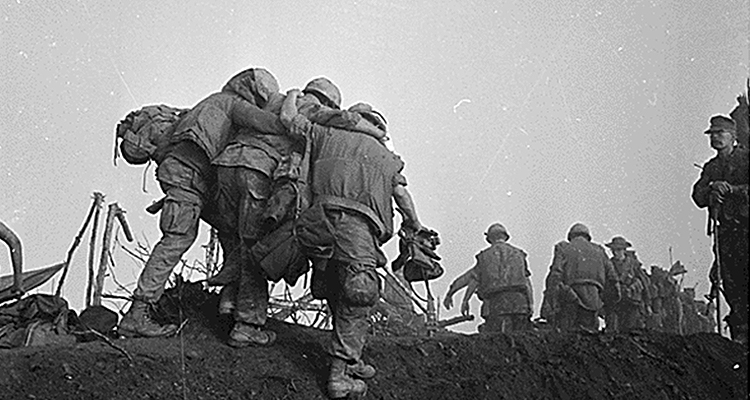
After this encounter, Company G continued its difficult trek down the mountain. Hitzelberger later reported that “the stretcher cases were moving up and down slopes in excess of 70 degrees. We had to use six, eight and, at times, ten men to carry a stretcher and it would take us over 30 minutes to move one stretcher case over one bad area.”
Upon reaching the bottom of a rocky cliff, the company was met by a relief platoon from Company E, which brought medical supplies and some much-needed rations. Still, it took another 11⁄2 days for Company G to reach the Da Krong. At that point, two Marine CH-46 helicopters, flying through dense fog and enemy fire, evacuated the most seriously wounded to Vandegrift Combat Base. By February 8, Company G finally reached the safety of Landing Zone Dallas, west of Cunningham. Battalion commander Lt. Col. George C. Fox noted that Company G’s ordeal on Co Ka Leuye “was a tremendous performance in leadership and fire discipline.”
Meanwhile, Fire Support Base Cunningham was shelled by enemy 122mm guns located in Laos, receiving 30 to 40 rounds that disabled a howitzer and knocked out a battery’s fire direction center on February 2, killing five Marines and leaving five more wounded. The enemy guns were beyond the range of the firebase’s own 155mm howitzers. Cunningham continued to take sporadic artillery fire throughout Dewey Canyon.
All told, the 9th Marines were sidetracked by bad weather for nine straight days. Consequently, the 1st Battalion’s airlift into the area of operations was delayed and the North Vietnamese had additional time to prepare and strengthen their defenses for the coming Marine assault into Base Area 611. It had been anticipated that operating during the monsoon would prove problematic and in fact the weather did cost the Marines crucial momentum. Finally, on February 10, the weather improved enough for elements of 1/9 to move forward from Vandegrift and Shiloh to Fire Support Base Erskine. Battery F, 2nd Battalion, 12th Marines was shifted by helicopter from Razor southward to Erskine. Phase III was set to begin.
Early on February 11, 3/9 crossed Phase Line Red and forded the Da Krong River. The 1st and 2nd battalions crossed the river the next day. Each battalion had its zone of operations about five kilometers wide and an objective eight kilometers beyond Phase Line Red. In the eastern sector, 3/9 was to move along ridgelines 2,000 meters apart, sending one company to take Tiger Mountain and two more to take Tam Boi. This would put 3/9 on the edge of the A Shau Valley. In the center, 1/9 would advance along two parallel ridges toward an objective on the Laotian border. Farther west, 2/9 was to move through a valley and the ridges just east of it, also with an objective on the Laotian border. Colonel Barrow’s plan was for each battalion to proceed with two companies in the van and two companies in trace.
After crossing the Da Krong, the Marines encountered strong enemy forces. On the eastern flank, Company M was mortared and attacked by a North Vietnamese Army platoon, suffering two dead while killing 18 enemy. The 1st Battalion ran into a large enemy force positioning to attack Erskine. Well-supported by artillery, 1/9 forced the North Vietnamese to withdraw, killing 25 and capturing numerous weapons. Company C engaged a reinforced North Vietnamese platoon on a hilltop, taking the hill while killing 12 of the enemy. An NVA effort to regain the position at night was successfully fought off by the Marines, using mortars and artillery. Overall, the enemy proved a tough adversary south of the Da Krong, sniping at the Marines from trees and attacking their positions at night in an attempt to delay the advance toward vital Route 922 in Laos.
The North Vietnamese efforts proved futile, however, as the Marines made good use of artillery and air strikes in pushing south. On February 17, 2/9’s Company G engaged in an all-day running firefight with a company of NVA, resulting in five Marine and 39 enemy dead. Also on February 17, before daybreak, the NVA launched a major attack on FSB Cunningham, with sappers breaching the wire and throwing grenades and satchel charges at the Marines in a wild dash toward the center of the base. The 3rd Battalion’s Company L and 2nd Battalion, 12th Marines fought hard to repel the intruders but sustained major damage in the first few minutes, losing centralized fire direction. Regaining control of the situation by sunrise, the Marines counted 37 North Vietnamese dead in and around the firebase. Four Marines were killed and 46 wounded in the fighting. The enemy sappers in this attack had been fortified by narcotics, which, a Marine lieutenant stated, “made them a lot harder to kill. Not one of the gooks we had inside the perimeter had less than three or four holes in him. Usually it took a grenade or something to stop him completely.”
February 18-22 saw the heaviest fighting in the southward advance. Five kilometers southeast of Erskine, 1/9 ran up against an NVA platoon dug into reinforced bunkers along a ridgeline. The enemy fought tenaciously but Company A overran the position, killing 30 defenders. This was followed by Company C’s assault against enemy hilltop positions the next day, which resulted in 30 more NVA dead. Continuing its attack on the same bunker complex on February 20, Company C encountered a large enemy force. After calling in air strikes, they took the bunkers, killing 71 North Vietnamese and capturing two 122mm artillery pieces and a tracked prime mover, at a cost of five Marines killed and 28 wounded.
With Marines approaching the Laotian border, the enemy kept up heavy shelling even while attempting to withdraw his artillery beyond the potential reach of the Marine advance. The ongoing enemy artillery attacks and concern over the vulnerability of the Marines’ western flank prompted a request from General Davis to Military Assistance Command, Vietnam, to redirect its Studies and Observations Group (SOG) reconnaissance efforts from the Laotian panhandle toward Base Area 611. MACV approved the request. But an earlier request from Davis, seeking approval to conduct offensive ground operations inside Laos, had been tabled by MACV. Nevertheless, the then-current rules of engagement did permit commanders to take “necessary counteractions against Viet Cong and North Vietnamese Army forces in the exercise of self-defense and to defend their units against armed attacks with all means at their disposal.” That language proved enough to justify the Marines crossing the border into—as deemed by the 1962 Geneva Accords—a neutral Laos.
Even so, Army Lt. Gen. Richard G. Stilwell, commanding XXIV Corps, of which the 3rd Marine Division was a part, saw ample reason to push for specific authorization from MACV to conduct a cross-border attack. On February 20, he recommended to his superior, Marine Lt. Gen. Robert E. Cushman, commanding III Marine Amphibious Force, that a limited raid into NVA Base Area 611 within Laos, to a depth of five kilometers along a 20-kilometer front, be authorized. Cushman endorsed the proposal and forwarded it to General Creighton W. Abrams at MACV the same day.
While the high command debated the political advisability of an incursion into supposedly neutral Laos, Colonel Barrow was taking matters into his own hands. On the afternoon of February 21, he ordered 2/9’s Company H commander, Captain David F. Winecoff, to set up an ambush that night along Route 922 inside Laos. Winecoff had been in position to observe truck movement on the road, and had called in artillery fire missions on it, but the NVA traffic continued. As Company H was tired from patrolling, Winecoff requested a 24-hour postponement of the ambush operation. Barrow denied the request and further instructed the captain to be back inside South Vietnam by 0630 hours February 22.
After darkness fell, Winecoff took two platoons into Laos toward the road, a distance of over half-a-mile. The men stayed off trails, moving along a creek bed and a ridgeline, trying to minimize the noise of their approach. When they reached a small river running parallel to Route 922, Winecoff sent a platoon commander and a sergeant ahead to reconnoiter for a good ambush site. While waiting for the two scouts to return, the Marines observed more movement along the road. The enemy searched the area with a spotlight but the Marines remained undiscovered.
With a good site finally located, Winecoff sent his men across the stream and 35 meters beyond the road to set up a linear ambush and wait for oncoming traffic. Claymore mines were set out, but a number of vehicles were allowed to pass while the ambush was made ready. Meanwhile, back inside South Vietnam, Barrow sought and obtained approval from Task Force Hotel at Vandegrift for the limited border violation, presenting General Garretson with something of a fait accompli. The North Vietnamese were using Route 922 to move artillery out of reach of the Marine infantry and to continue moving supplies forward, so traffic along the road could be heading either east or west. As Winecoff’s men lay in wait, at 0230 hours on February 22 the lights of eight trucks were seen on the road moving from the west. The first three trucks entered the killing zone, and then the column halted. Winecoff fired his claymore at the second truck, setting it ablaze and killing its occupants. The first truck also started burning and the third vehicle was forced off the road. The Marines poured automatic weapons fire into the hapless NVA trucks and called in artillery. After firing for several more minutes, the Marines moved back across the road and crossed the border back into South Vietnam. The ambush was a success, destroying three trucks and killing eight NVA troops while sustaining no casualties themselves. The III Marine Amphibious Force’s chief of staff exclaimed: “Hit ’em hard! Good news—who knows where the border is anyway?”
The success of the ambush led Colonel Barrow to request a continuation of operations within Laos. A message from General Abrams to III MAF only authorized SOG forces to be in Laos, but the Marines knew that a local commander still had the right to self-defense. Barrow told higher headquarters that “my forces should not be here if ground interdiction of Route 922 [is] not authorized.”
This prompted General Stilwell at XXIV Corps again to request authority from MACV for an advance into Laos “not exceeding two kilometers from the border at any point.” Given the circumstances, Abrams reluctantly agreed to a limited incursion on February 24. Thus, the 2nd Battalion, minus one company, moved into Laos and proceeded to advance eastward along Route 922, staying inside Laos until March 1. American Ambassador to Laos William H. Sullivan and the Laotian prime minister were not informed of this border violation until operations were well underway and, fearing possible international political repercussions, Abrams insisted that public discussion of the incursion by subordinates be severely restricted.
The Marines moved rapidly up Route 922, seeking to force the North Vietnamese Army into the path of 1/9 and 3/9, still in South Vietnam. Along the way, 2/9 engaged in several significant firefights with enemy troops and captured a number of artillery pieces, plus large quantities of ammunition and foodstuffs: “It was an exhilarating feeling for Marines to be in the exploitive phase of a battle and raiding the enemy’s supply dump/rear area,” Captain Winecoff later wrote. “In this author’s 27 months in Vietnam, this was the one time where intelligence was available down at the company level, the one time that operational plans were based upon a competent intelligence plan.”
Officially, 2/9 lost eight men killed and 33 wounded while operating in Laos. During one NVA attack, Corporal William D. Morgan of Company H came to the aid of two wounded Marines by single-handedly assaulting an enemy bunker. Killed in the assault, Morgan’s actions allowed the rest of his patrol to rescue the wounded men. He was posthumously awarded the Medal of Honor—with the place of action listed as “southeast of Vandegrift Combat Base, Quang Tri Province, Republic of Vietnam,” rather than where his heroism had actually occurred, inside Laos.
In 1/9’s sector in the center of the Dewey Canyon area of operations, Lieutenant Wesley L. Fox’s Company A engaged in heavy fighting on February 22. After overrunning a North Vietnamese Army squad located in bunkers, Fox requested that battalion send its water detail down to a nearby creek for badly needed replenishment. While the 20-man detail was filling canteens, it came under mortar and machine gun fire. Fox broke off the watering operation and began moving his company forward to attack the enemy. A platoon ran up against a heavily fortified bunker complex, backed by rocket-propelled grenade, machine gun and mortar emplacements on a ridge. Fox committed three platoons to the fighting, but was unable to make effective use of artillery because of poor visibility, terrain, and the closeness of the combat.
The company command group took a direct hit from a mortar round, killing or wounding everyone in it except the executive officer. Nevertheless, Fox continued in command and personally killed an enemy sniper with his M-16 rifle and destroyed an NVA position. With two dead radiomen, he took charge of the radios and took personal command of his 3rd Platoon after its platoon leader was killed. In fighting off a final enemy assault, Fox was again wounded, but refused all medical aid. Company D eventually came to beleaguered Company A’s assistance, and by the time the smoke cleared, 105 North Vietnamese dead littered the battlefield. The Marines also captured 25 automatic weapons. Eleven Marines were killed and 72 wounded in the desperate fight.
Lieutenant (later Colonel) Fox, who had spent 16 years as an enlisted Marine and had extended his Vietnam tour of duty, received the Medal of Honor for his brilliant leadership during this battle. Three Navy Crosses and six Silver Stars were also awarded to Marines of Company A for their actions on February 22.
The 1st Battalion now moved eastward in the direction of Hills 1044 and 1224 (Tam Boi) and along South Vietnam’s Route 548. On the slopes of Hill 1044 on February 27, Company D uncovered and destroyed one of the largest NVA arms caches of the war. The supply depot held 629 rifles, 60 machine guns, 14 mortars, 15 recoilless rifles, 19 antiaircraft guns and over 100 tons of munitions.
In the meantime, 3/9, responsible for the eastern flank of Dewey Canyon operations (all within South Vietnam), came across other important NVA facilities. At Tam Boi in late February, the Marines discovered a huge headquarters and administrative complex that comprised 11 major tunnels carved into solid rock and housed extensive repair shops, storage rooms and a hospital. These facilities could withstand direct hits from artillery and aerial bombs. After securing Tiger Mountain (Hill 1228) near the end of February, 3/9 established Fire Support Base Turnage to provide artillery support for continuing operations on the edge of the A Shau Valley.
By the first of March, Operation Dewey Canyon had met its most important objectives. The NVA was forced deeper into Laos, and a large quantity of enemy equipment and supplies were captured and destroyed. Among other items, the Marines had seized 12 122mm and four 85mm artillery pieces. Now it was time to begin the retraction of the 9th Marines and their supporting elements. The plan originally called for 2/9 to be airlifted to Vandegrift on March 3, followed by the other battalions and the artillery on succeeding days. But once again the weather intervened. Also, the 9th Marines were tasked with extracting SOG forces from Laos and destroying additional enemy weapons caches. Although the retraction of 2/9 was accomplished as originally conceived, everything else was delayed. It wasn’t until March 17 that all of 3/9 could be lifted out of the area of operations. On March 18, 1/9 was extracted from Tam Boi after fending off a mortar-supported company-strength NVA attack before dawn that morning. The helicopters transporting 1/9 were under constant enemy mortar and anti-aircraft fire, but none were lost. At 2000 hours on March 18, the last helicopter landed at Vandegrift and Operation Dewey Canyon came to an official end.
In the long history of the Vietnam War, Dewey Canyon stands as one of the most successful American operations. Casualties, however, were heavy for both sides. Officially, 1,617 NVA were reported killed and five captured, while 130 Marines were killed and 920 wounded. The Marines had effectively disrupted a major enemy logistical center in Base Area 611, including in their total haul more than 1,000 NVA small arms, some 807,000 rounds of ammunition and about 220,000 pounds of rice. Marine fixed-wing aircraft flew 461 close air support missions, and Marine helicopters flew nearly 1,200 sorties. U.S. Army helicopters also flew numerous sorties in support of the Marines. The artillery fired about 134,000 rounds during the operation. This expenditure of effort proved worth the cost, as NVA plans for a big 1969 spring offensive in the I Corps Tactical Zone were derailed and, in fact, the Communists could launch no such offensive in the northern provinces that entire year. A major enemy attempt to strike at the population centers east of Base Area 611 had been forestalled by Dewey Canyon.
Praise for the Marine effort was quick in coming. General Stilwell declared: “Dewey Canyon deserves some space in American military history by sole reason of audacity, guts and magnificent inter-service team play. A Marine regiment of extraordinary cohesion, skill in mountain warfare, and plain heart made Dewey Canyon a resounding success. As an independent regimental operation, projected 50 kilometers airline from the nearest base and sustained in combat for seven weeks, it may be unparalleled. Without question, the 9th Marines’ performance represents the very essence of professionalism.”
Several years after the operation and by then commanding general at Parris Island, Colonel Barrow, addressed his fellow Marines at a Dewey Canyon reunion. He recalled “weather was the factor of greatest influence during Dewey Canyon. It was completely unpredictable from day-to-day and within a day. Extremely thick and low cloud cover and ground fog were common conditions. We were totally dependent on helicopters and they, in turn, on good weather.” So, while at times the operation was critically slowed by weather conditions, Barrow pointed out that “the support of Dewey Canyon from within and from without was magnificent….The artillery, in a word, was superb. Helicopter support from the 1st Marine Aircraft Wing and the 101st Airborne Division was outstanding. Fixed-wing aircraft support and the B-52s made a great contribution.”
In addition, Barrow contended that surprise was a key element in the operation: “It appears that the enemy had deceived himself into believing that U.S. forces would not be so bold as to enter that remote area of Dewey Canyon. We didn’t deceive him, he deceived himself, as his actions revealed….That we did what we did was a complete surprise to the enemy, a fact borne out by the enormous quantities of ammunition, weapons, and supplies captured or destroyed.”
But not everyone saw Dewey Canyon in such a favorable light. The incursion into Laos was reported in the New York Times in early March 1969, with a story that noted, “Operation Dewey Canyon seems to indicate that allied commanders operating along borders may dip across lines to secure their flanks.”
Thrown onto the defensive by reporters at a Vietnam news conference, Secretary of Defense Melvin R. Laird said of Dewey Canyon, “I would not confirm that they were there now but I would certainly say that there have been operations in which it has been necessary in order to protect American fighting forces that—that border being a very indefinite border—it may have been transgressed by American forces in carrying out this responsibility.”
Ambassador Sullivan apologized to the Laotian prime minister for the incident. Responding to questions during 1973 Congressional hearings, Chairman of the Joint Chiefs of Staff Admiral Thomas H. Moorer testified, “This was the first and only time where United States ground combat forces went into Laos.”
And, in an early 1971 forum sponsored by the group Vietnam Veterans Against the War, Gordon Stewart, who had been a forward artillery observer with Company H, 2/9 in Laos, spoke about his experience: “The whole company had set up a base camp on a hill. For the next three days it was pretty much hell. We ran through a lot of contact and lost a lot of men….The men became quite embittered during this operation. It became easy to kill Vietnamese. You were just animalistic….When moving through Laos, taking our dead and wounded, we took a lot of casualties.”
Stewart’s statments seem to contradict both official casualty figures and contemporaneous news reports, which indicated that contact with the enemy while inside Laos had been comparatively light. But in the final analysis, it can be said that the actions taken by the 9th Marines during Operation Dewey Canyon, while controversial, were acceptable. Viewed through the prism of a very controversial war, Dewey Canyon yielded considerably more positives than negatives.
Marc D. Bernstein is the author of Hurricane at Biak: MacArthur Against the Japanese, May-August 1944, and numerous articles on military and naval history. For additional reading, see: U.S. Marines in Vietnam: High Mobility and Standdown, 1969, by Charles R. Smith; and Semper Fi Vietnam, by Edward F. Murphy.
This article was written by Marc Bernstein and originally published in the August 2007 issue of Vietnam Magazine. For more great articles, subscribe to Vietnam magazine today!