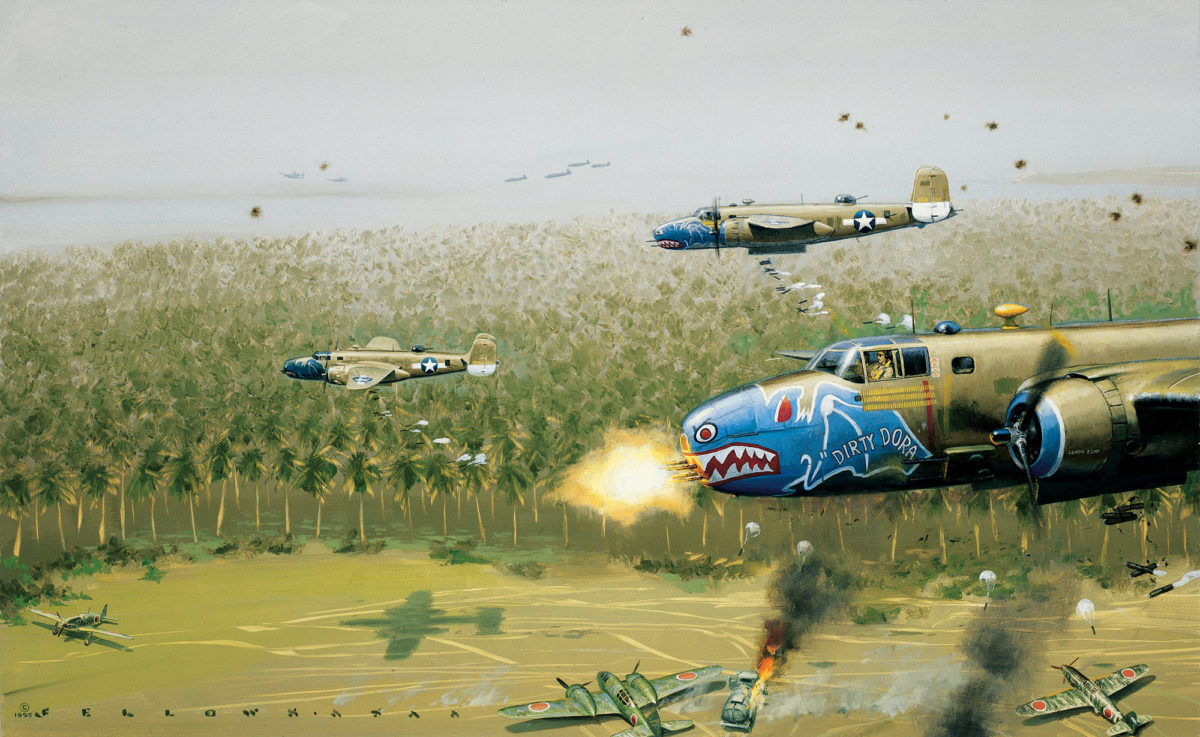
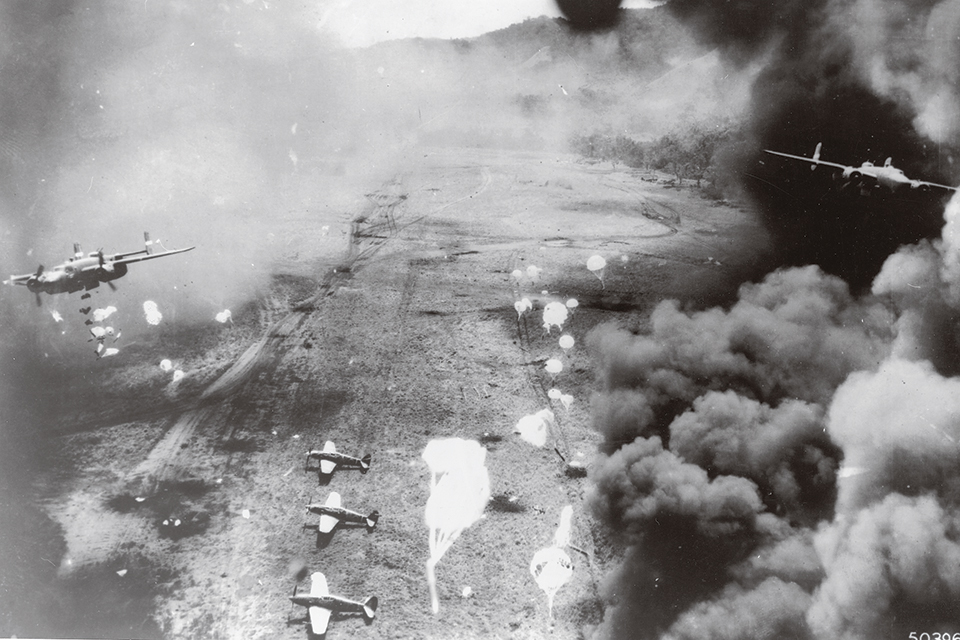
As he skimmed over the trees and lined up the sights of his North American B-25C Mitchell’s eight .50-caliber nose guns on the Japanese airstrip at Wewak, New Guinea, Lieutenant Vic Tatelman was astounded to see rows of Mitsubishi G4M ‘Betty’ bombers, Yokosuka D4Y ‘Judy’ dive bombers and Mitsubishi A6M ‘Zekes’ lined up wingtip to wingtip all along the tarmac. What a rare opportunity! All he would have to do was line up on the targets and squeeze off burst after burst. No time to check results or worry about AAA — just keep shooting! Co-pilot Lieutenant Willie Graham deployed parafrag bombs at intervals as the bomber, dubbed Dirty Dora, passed over the sitting ducks, completing a sort of double whammy that left chaos behind them on the ground.
The Japanese at Wewak were caught flatfooted on October 16, 1943, paying dearly for not having dispersed their newly arrived aircraft. The final tally was 82 enemy aircraft destroyed — a loss that enabled the Americans to make a successful raid on Rabaul two days later. All members of the 499th ‘Bats Outa Hell’ Bomb Squadron of the 345th ‘Air Apaches’ Group made it back to base that day, at Port Moresby, New Guinea, where their ground crews found lots of AAA holes to patch.
Not many people have heard of Victor Tatelman, who earned numerous Air Medals, two Distinguished Flying Crosses and a Purple Heart in nearly 120 combat missions piloting Mitchell bombers. Tatelman got his Army Air Forces pilot wings in June 1942 as a member of class 42F at West Coast Training Command, in Stockton, Calif. As a new second lieutenant, he and several others of his class were sent to Williams Field, at Chandler, Ariz., to fly bombardier cadets in Beechcraft AT-11s. On each flight he carried five bombardier cadets, who each got to drop a practice bomb on a target. Within six months he had become bored with that duty and asked for a combat assignment — unconcerned that reassignment might cost him his seniority.
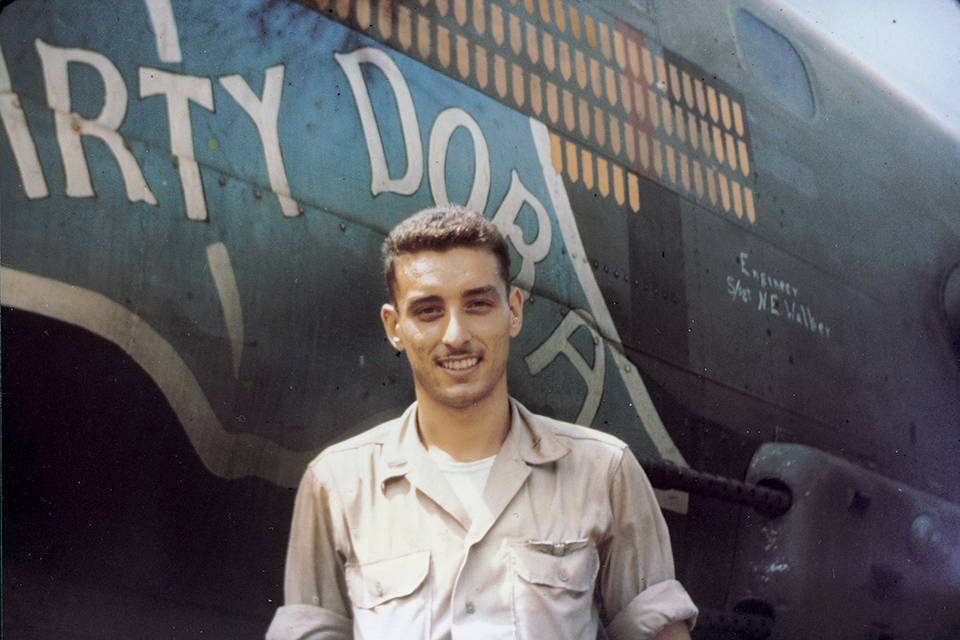
In November 1942 Tatelman was sent to Columbia Army Air Field at Columbia, S.C., where a new bomb group was being organized. There, the pilots were assigned to the 498th, 499th, 500th and 501st squadrons, which were to make up the 345th Bomb Group. At the 345th Group, assigning pilots to squadrons was a simple matter: The pilots were gathered in a room with four large tables and told to divide themselves equally among the four tables. Then each table was assigned a squadron number. The table Tatelman chose became the 499th Squadron.
During the first two months at Columbia, the pilots concentrated on familiarizing themselves with the Mitchell bomber, as well as practicing with bombardiers and navigators. Then the group moved to Walterboro, S.C., where the emphasis was on formation flying and bombing operations at altitudes of 8,000 to 10,000 feet. After that, they moved to Hunter Air Base, at Savannah, Ga., where they received their new planes and were outfitted for overseas. Years later, Tatelman recalled that when he left Savannah, in the excitement of heading for the West Coast on his way to combat, he forgot to set the mandatory 10 degrees takeoff flaps that all B-25s require. But when he began running out of runway, he quickly remembered. A quick pull on the flap handle and they were off the ground and on their way to Mather Field, at Sacramento, Calif. There, the latest combat modifications were made to the B-25s. All winter adaptations were removed, the flight crews turned in their winter flying suits and the ships were thoroughly tropicalized.
After its bomb-bay fuel tanks were installed at San Francisco’s Hamilton Field, the 499th left for Hickam Field, on Oahu. Tatelman remembered that he left Hamilton with 12 hours and 45 minutes of fuel aboard and had used 12 hours and 15 minutes’ worth when he arrived at Hickam. Of the 16 crews from the 499th that had set out from Hamilton, 14 reached Hickam. The squadron had already lost one-eighth of its strength, yet the 499th’s survivors were still half an ocean away from combat.
Only 15 years had passed since Lindbergh had flown the Atlantic, and shortly thereafter the Dole ‘Pineapple Derby’ had resulted in several deaths when a handful of daring aviators attempted to fly from California to the Hawaiian Islands. In 1942, it was still a chancy undertaking. Those who lived to tell about it usually recalled that it seemed as soon as they were out of sight of land their engines went into ‘auto-rough,’ and the navigators had the impression that their island destinations were shrinking in size. The 499th was only the second B-25 group to cross the Pacific, and the Army Air Forces was still learning.
After Oahu, their next stop was Christmas Island, followed by Samoa; Fiji; New Caledonia; Brisbane, Australia; and finally an airstrip at Reed River, near Townsville, Queensland, Australia. Altogether, the 345th Bomb Group’s Pacific trip took two weeks. At Reed River they waited for their ground crews — who had traveled by ship — to get to Port Moresby, New Guinea. Then they flew on to Port Moresby, set up camp and got ready for combat.
Allied troops had landed at Buna, on the north coast of New Guinea, in the fall of 1942. The 345th, now part of General George C. Kenney’s Fifth Air Force, was to support this effort. Their base at Port Moresby was ideally situated, only about 100 miles from Buna, across the mountainous backbone of New Guinea. The troops at Buna, mostly Australian infantry, were tasked with driving the Japanese out of Salamaua and taking Lae. Because they lacked a beach to set up a supply point by sea, they had to be supplied by airdrop, and the 345th got the job. It was not long before the 345th became known to the entire 5th Bomber Command as the ‘Biscuit Bombers.’ Once the ground troops had established themselves ashore and were advancing, however, the B-25s began dropping bombs instead of biscuits, with Salamaua, Lae and Finchhaven as their first targets.
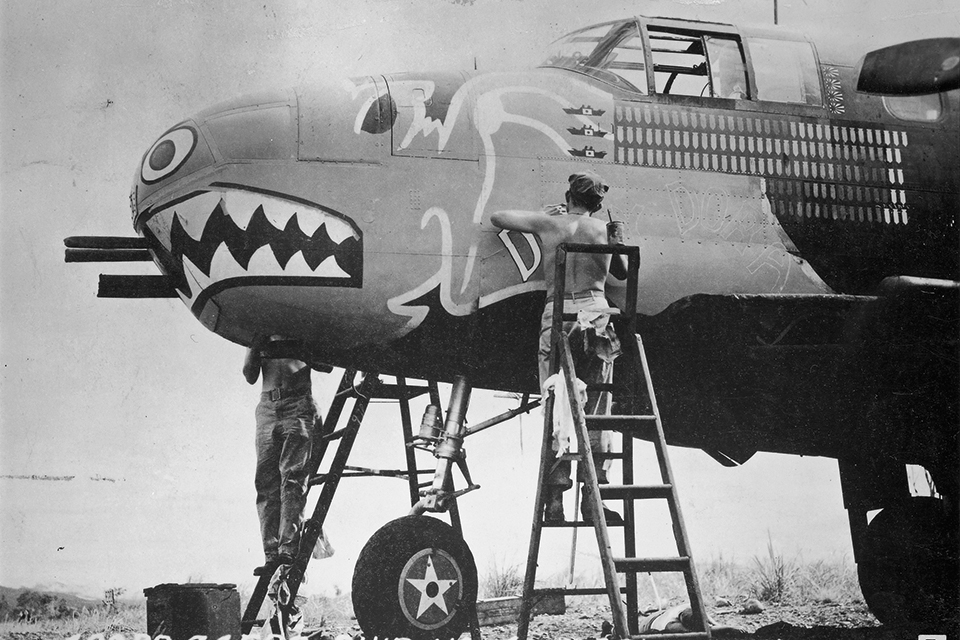
At that juncture an inventive character named Paul I. Gunn effectively changed the way Tatelman and the other B-25 pilots would approach operations in the Pacific. Gunn—known to most as ‘Pappy’—had run an airline in the Philippines and was put out of business when the Japanese occupied the islands. He then offered his services to General Douglas MacArthur, and General Kenney made him head of maintenance for the entire Fifth Air Force. Gunn contributed many useful ideas, among which was a method of reconfiguring the B-25s for low-level bombing. He believed they would be more effective in ground support if they operated at treetop level, and he convinced Kenney and MacArthur to try it. After six weeks of medium-level bombing, the B-25s were modified as Gunn suggested. The bombardier nose was removed and replaced with one containing eight .50-caliber fixed machine guns, fired by the pilot. A pilot bomb release was also installed.
The 499th Squadron, now known as the ‘Bats Outa Hell,’ took up its new mission of strafing and low-level bombing with enthusiasm, and Tatelman — along with the other pilots and crews — learned how to put the new weapons to good use. Tatelman’s aircraft, B-25C Serial No. 41-12971, was already dubbed Dirty Dora when he began flying missions in her. The plane had been transferred from the 38th Bomb Group and was received by the 499th Squadron in mid-1943.
Through a stroke of luck, Tatelman learned how Dora got her name. It was the policy of the Fifth Air Force that each of its combat flight crews received a week’s leave in Sidney, Australia, about every six weeks. At the time Sidney was largely devoid of young men, many of whom had been sent to North Africa to join British Field Marshal Bernard Montgomery’s campaign against German Field Marshal Erwin Rommel and his Afrika Korps. That meant visiting airmen were usually popular with the ladies in Australia. On one leave in Sydney, Tatelman met the 38th Bomb Group pilot who had originally flown Dirty Dora and had named her. He explained that the Mitchell was named after a young woman who had moved in with him for the week he was visiting Sydney. It seemed that the original Dora had a sensual temperament and would, at certain moments, scream out the most profane obscenities. Hence, the name ‘Dirty Dora.’
By October 1943, Dobodura, on the north side of New Guinea, had been secured by MacArthur’s forces, and staging airfields had been built. Now Rabaul, on the north end of New Britain, was within range of the Fifth Air Force B-25s. Rabaul was the most important Japanese strongpoint in the Southwest Pacific, because its air and naval forces threatened American forces in the Solomon Islands, on New Guinea and at sea. During the previous year, Rabaul had been hit more or less regularly by Boeing B-17 Flying Fortresses of the 19th Bomb Group and Martin B-26 Marauders of the 22nd Bomb Group. But the missions never consisted of more than a dozen airplanes, and the damage done to the enemy was seldom extensive. Aerial reconnaissance invariably reported more than 100 combat-ready Japanese aircraft in the Rabaul area.
The mission of October 18, 1943, was designed to destroy the enemy air forces at Rabaul. The plan was for two Consolidated B-24 Liberator groups with fighter escort to simulate an attack on Rabaul township that would draw up Japanese fighters to intercept them. The B-24s would turn and bomb all but two of the airstrips in the area. Then, when the Japanese fighters were refueling on the two undamaged strips, two groups of B-25s would arrive at treetop level and strafe and bomb them, as well as any Japanese bombers on the ground.
On October 17 the 345th Air Apaches flew to Dobodura, where their planes were prepared for an early morning departure the following day. The 36 planes of the 345th, joined by 18 of the 38th Bomb Group and three squadrons of Lockheed P-38 Lightning fighters over Buna, then set course for Kabanga Bay, the initial point of attack.
As the mission progressed, the weather worsened. The front ahead appeared solid up to 12,000 feet. Lieutenant Colonel Clinton U. True, the mission leader, headed into the muck. Everyone in the formation pulled in tight so as not to lose sight of formation mates. True moved down to go through on the deck, and when a recall command from headquarters came through, he either did not hear the order or ignored it. When the bombers emerged from the clouds, no one seemed to have gotten lost, but the B-25 pilots then discovered that their fighter cover had been turned back due to the weather. Colonel True continued on. As they crossed the coast, the 38th Group planes headed for their targets and the four squadrons of the 345th arranged themselves in attack array, with the 499th and 500th falling back while the 498th and 501st went in first.
Tatelman took the west side of Ropopo airstrip, firing on targets as they appeared. Anti-aircraft fire from the base proved to be heavy but inaccurate. Smoke from targets hit by the 498th and 501st on their pass obscured some targets, but also gave Tatelman protection from the gunners on the ground. As the pilots in Tatelman’s group left the strip behind and crossed the beach, they saw what looked like a ferry boat in the bay, and all strafed it. Then the 345th B-25s were met by swarms of Zeke carrier fighters. Luckily for the 499th pilots and crews, the squadrons ahead of it attracted the most fighters. But the 499th was still not out of the woods. The Mitchells were jumped by 15 Zekes, three of which the B-25 gunners downed. Amazingly, all nine planes of the 499th returned safely to Dobodura.
The Allied forces on New Guinea alternately drove the Japanese back or leapfrogged them and cut them off from their supplies. By early March 1944, Allied troops were ready to make a leapfrog landing at Yalau Plantation, just south of Madang, on the north coast. As it happened, Yalau had the only beach in the area suitable for use by landing barges, but it was overlooked by Dumun village, a Japanese strongpoint. It was vital that a smokescreen be laid down between the village and the beach just before the landing began.
Tatelman, now a captain flying his 51st mission, led the flight assigned to drop white phosphorus bombs on Dumun to provide the smokescreen. Taking off before dawn, he led his flight through instrument weather for an hour, finally reaching better weather just opposite Yalau beach. Since he was five minutes early, he decided to dive under the low overcast to the southwest and strafe the village. He figured that he could do so safely by turning north, away from the mountains, as he turned off the target. He distracted the Japanese troops at Dumun with his strafing passes until 0725, when (according to the citation in his Distinguished Flying Cross award): ‘He very accurately placed his bombs on the village to totally obliterate any view by the enemy of the landing party at Yalau Plantation, two miles away. His bombs set fire to the village which was totally destroyed and ground forces later reported that enemy casualties from this bombing and strafing were high; the remainder of the enemy force had fled the area.’
That mission nominally completed Tatelman’s tour of duty. Because of his college engineering background, however, he was selected for a special mission. He was given a .45-caliber pistol, a briefcase was chained to his wrist, and he became a courier. He was told to report to a certain room number at the Pentagon in a week’s time. When he did so, he found himself involved in an intensive three-month training session on radar and radar countermeasures at such places as Wright Field, Massachusetts Institute of Technology, IBM and installations at Boca Raton and Orlando, Fla. A major U.S. concern was whether the Wurtzburg radar, developed in Germany for ranging anti-aircraft artillery, had been shared with the Japanese. An increase in the accuracy of Japanese anti-aircraft fire would clearly have been an unwelcome development in the Pacific theater at that juncture, and American authorities hoped to take steps to counteract it. Tatelman learned about chaff, rope, window and electronic countermeasures jamming that would be available in the Pacific if needed. He also learned how to tell what countermeasures would likely be required in a given situation.
Returning to the Pacific, Tatelman became a member of MacArthur’s Section 22 (Intelligence), now stationed in the Philippines. His job was to attend heavy bomber briefings and to brief airmen on countermeasures against radar-operated anti-aircraft emplacements. The captain soon learned that the bomber crews were not too concerned about the accuracy of AAA. What really did bother them was that the Japanese always seemed to know they were coming. The enemy could no longer be taken by surprise, it seemed. The Japanese appeared to have developed an early warning radar capability.
Remembering that Bell Labs had shown him equipment for homing on radar, Captain Tatelman proposed to his bosses that he obtain that equipment, then go after the early warning radar and destroy it. His proposal was approved, and Tatelman had it installed in a B-25D, which was configured in such a way that the homer could be conveniently placed in the now single-pilot cockpit. Within two weeks the aircraft was given a complete overhaul at Biak and outfitted with two new engines, an eight-gun nose, rocket launchers on the wings and a new name—Dirty Dora II.
The civilian expert who had installed the homing equipment in Dirty Dora II flew with Tatelman a few times to adjust the equipment and check out how well it was operating. The expert became so interested in the project that he volunteered to fly as the equipment operator in actual search operations during combat. That arrangement worked out so well that he continued to fly with Tatelman on subsequent missions.
As a practical matter, Tatelman got himself, his crew and Dirty Dora II assigned temporary duty with the 499th Bats Outa Hell for rations, quarters and aircraft maintenance, to which he did not have access as a member of MacArthur’s Section 22. His target areas were assigned through Bomber Command, generally in areas where B-24 crews had reported their suspicions that the Japanese were waiting for them, a giveaway that they had had an early warning. Tatelman would fly out to the area indicated and search for radar signals. If he discovered any, he followed them to their source, where he bombed, strafed and fired rockets at the transmitter. During 20 missions operating out of Clark Field, he and his crew destroyed eight radars, and after the first few they even brought back photographs of their attacks.
Tatelman earned a second DFC for proposing and carrying out the radar destruction missions, as well as a Purple Heart for a leg wound he suffered while overflying an enemy-held island north of Luzon. After that mission he recalled hearing a ‘pop’ and seeing a hole open up in the right wall of the cockpit. Later, when he reached into the knee pocket of his flying suit for a cigarette, he found the pocket full of blood. Whatever had made the hole in the cockpit wall had also grazed his knee — fortunately, without doing any severe damage. On one of those early radar-busting missions, a ground control unit in northern Luzon asked for help in taking out a tank that was holding up the infantry advance. They located the tank behind a barn, and Tatelman circled the tank while a waist gunner raked it with his .50-caliber machine gun, setting it on fire and putting it out of the fight. Using the waist gun saved nose gun ammunition for later use on a radar station. Tatelman got a commendation from the ground commander for that action.
By early 1945, the Allies had achieved complete air superiority in the Pacific, and the 499th was bombing Japan itself. Tatelman got himself transferred back to the 499th and served for the rest of the war as a flight leader. By the cease-fire on August 15, 1945, he had racked up 119 combat missions. Clearly, he was not only an aggressive pilot, but also a lucky one.
After the cease-fire, the Japanese were required to send envoys from the emperor to General MacArthur’s headquarters in Manila to make arrangements for the final surrender, which was to take place on Missouri in Tokyo Bay on September 2, 1945. They flew to Manila in two unarmed Betty bombers painted white with green crosses on wings and tails. Over Cape Sata Misaki (the southernmost point of Kyushu), they were met by two B-25 bombers, which escorted them to Ie Shima, where they landed at an American base and transferred to two Douglas C-54s, which flew them on to Manila. There, they met with MacArthur’s staff and worked out the surrender arrangements. The B-25s were provided by the 345th Bomb Group and flown by Major Jack McClure of the 498th Squadron and by Major Wendell D. Decker of the 499th Squadron — a singular honor for the B-25 pilots. Meeting the Bettys on August 19 and escorting them to Ie Shima went off without a hitch, as did transporting the envoys to Manila. At one point the negotiations were delayed when the Americans insisted the Japanese leave their swords outside the conference room. It was eventually agreed that all conferees would leave their swords and caps outside, and the conference got down to business.
The next day, when the envoys were flown back to Ie Shima, it was discovered that one of the Bettys was not airworthy. The other Japanese bomber, carrying half the envoys, was escorted back to Japan, while the remaining envoys had to wait for the second Betty to be repaired. The second planeload of Japanese was escorted home the next day by Victor Tatelman. As it happened, the first Betty ran short of fuel while returning and had to ditch in shallow water off the Home Islands, just short of Tokyo. Fortunately, no one was hurt. The second Betty arrived safely in Japan without incident.
Tatelman transferred to the Air Force Reserve in 1947, so he could pursue an aeronautical engineering degree. He received his degree just in time to be recalled to active duty in 1951. In the Korean War he flew Lockheed F-80 Shooting Stars and North American F-86 Sabres as part of a ground support unit. At the end of that conflict, he decided to make the Air Force his career. After an outstanding career, Tatelman retired as a lieutenant colonel, having served at the Pentagon in addition to many other assignments.
This feature originally appeared in the May 2002 issue of Aviation History. For additional reading, try: Into The Dragon’s Jaws: The Fifth Air Force Over Rabaul, 1943, by Lex McAulay; and Warpath Across the Pacific: The Illustrated History of the 345th Bombardment Group During World War II, by Lawrence J. Hickey.
To build your own “Dirty Dora” click here!
For more great articles subscribe to Aviation History today!