
By the end of the fourteenth century, Byzantium lacked any strategic importance and certainly represented no threat to the ambitions of the resurgent Ottoman Empire. Constantine’s great city, and what little remained of the crumbling Byzantine Empire, had never fully recovered from the Latin occupation from 1204 to 1261.
Despite its dilapidated condition, Constantinople was still the “Golden Apple,” the capital of the ancient Roman Empire. Muslims and Christians alike reckoned it to be the greatest power the world had ever known. For the Ottoman ruler Mehmed II, it was the most treasured prize of all, whose possession would make him master of the world. Constantinople was the capital of the oikoumene, the “inhabited world,” over which Mehmed, the Amir al-Mu’minin, “Commander of the Faithful,” and his descendents would soon rule until the end of creation.
On April 5, 1453, Mehmed’s army reached the outer walls of the city. His forces, according to the Venetian merchant Nicolò Barbaro, who saw them arrive, numbered some one hundred sixty thousand. Other accounts, all of them Christian, put the figure anywhere between two and four hundred thousand. Most were Muslims, marshaled from all over the empire, but their ranks were swollen by others in the expectation of rich pickings: Latins, a large contingent of Serbs, even some Greeks.
Inside Constantinople a state of terror now reigned. The able-bodied male population of the city numbered some thirty thousand, but the Byzantine statesman George Sphrantes estimated that fewer than five thousand of these were able and willing to fight.
Mehmed moved no fewer than fourteen batteries of artillery into place along the entire length of the outer line of walls, known as the Wall of Theodosius. Day after day, the Ottoman guns fired massive stone balls that carried away great chunks of masonry, sometimes entire towers. Although the entire population turned out each night to rebuild what they could, hour by hour the city’s defenses steadily crumbled.
About three hours before dawn on May 29, Mehmed gave the order for a final assault. The Greeks managed to drive back the first two waves of attackers. But the outer walls of the city were now virtually in ruins. The Janissaries, the sultan’s crack troops, broke through the Kerkoporta, or “Gate of the Circus,” and poured into the city. The fighting was fierce, but Ottoman victory was certain.
Recommended for you


For three days, Mehmed’s victorious army was allowed to pillage the city. The Greek chronicler Kristovoulos lamented that the Turks fell upon the defenseless population, “stealing, robbing, plundering, killing, insulting, taking and enslaving men, women, and children, old and young, priests and monks—in short, every age and class.” The blood ran in the streets “as if it had been raining,” wrote the merchant Barbaro, and “bodies were tossed into the sea like melons into the canals of Venice.”
Ever since the armies of the caliph Umar II had been forced to abandon the first sustained siege of Constantinople in 718, prophecies had spread throughout the Muslim world of the inevitable day when the great city, the last bastion of the ancient enemy, would pass into the dar al-Islam. Now, under a sultan who bore the name of the prophet himself, these predictions had finally come to pass. Thereafter both Muslims and Christians alike referred to Mehmed II as “the Conqueror.”
For the West, the fall of Constantinople was a calamity. It was not only a great Christian city, the last bastion of Constantine’s empire in the East, that had fallen. Gone too was the last living link with the ancient Greek world. And all this glittering past had been snuffed out by a horde of Muslim barbarians from the depths of Asia.
Mehmed was now—save for the tiresome presence of the Timurid Persian Empire to the east—ruler of all Muslim Asia. He could also now claim to be the legitimate heir of the succession of emperors—Solomon, Constantine, and Justinian—who in myth and reality had built and rebuilt the city, and to have fulfilled one part of the prophecy recorded in the Hadith, the oral traditions coming down from Muhammad, that the day would come when a Muslim emir would take both Constantinople and Rome. With the fall of the Golden Apple, the Ottomans became the only other state in the world to which the princes of Christendom were prepared to concede the title of “empire.”
Mehmed, perhaps more than any subsequent sultan, determined to rule over a united, prosperous, and above all disciplined people. To that end, he restored to the Orthodox Church the powers and privileges it had enjoyed under Byzantine rule, together with a large part of its property.
From beyond the Dardanelles, however, it seemed as though Eastern Christendom had now vanished for good. In its place stood the most imposing power to threaten the liberties of the peoples of Europe since the days of Xerxes. All Christendom waited to see what would happen next. Would Mehmed remain where he was and consolidate his gains? Were further conquests of the West to be expected? And if so, where would they stop? The sacred city of the West, the still-beating heart of Christianity, was of course Rome, and Muhammad himself had reportedly promised that one day Rome too would be incorporated into the dar al-Islam.
On September 30, 1453, Pope Nicholas V issued a bull to all the Christian princes of the West, enjoining them to shed their blood and the blood of their subjects in a new crusade against the anti-Christ now seated in Constantinople. Pleading insolvency or the pressure of domestic affairs, the princes of Christendom—Charles VII of France, Henry VI of England (now, in any case, out of his mind), King Alfonso V of Aragon, and Emperor Frederick III—all politely declined.
For Nicholas’ successor, Pope Pius II, the Turkish menace became something of an obsession. Shrewd and well traveled, he had a far broader vision of the possibilities and need for Christian unity than his predecessors. In 1459 he proclaimed a new crusade to retake Constantinople, but nothing came of it.
The pope also tried diplomacy and flattery, proposing not only to recognize Mehmed’s claim to be ruler of the Eastern Roman Empire but also to transfer to him the imperium of the West. All the sultan had to do was to convert to Christianity. It was an empty gesture, as he must have known.
Mehmed never did come to Rome. He spent most of the rest of his reign consolidating his hold over the Balkans and securing his eastern frontiers. The failure of Mehmed to make good on his alleged promise to march on Rome did not, however, lessen the fear of the West that this remained the ultimate objective of his successors. Ever since 1480, when Ottoman forces had sacked and occupied Otranto on the Puglian coast of Italy, the Turkish navy, backed by Barbary Coast pirates, had created an atmosphere of almost constant alarm. All along the coasts of southern Italy and Spain, towers were constructed, many of which are still standing, to maintain a permanent watch for the marauders.
The fear was not limited to the Mediterranean or to the eastern borders of Christendom. Even as far away as Iceland, Christians prayed to be delivered from “the terror of the Turk.” In 1627, Ottoman-backed corsairs from North Africa penetrated deep into the North Sea and carried off four hundred captives for sale in the slave markets of Algeria. For all those who still lived beyond its borders, the empire of the Turks had become, in the words of historian Richard Knowles, “the present terror of the world.”
Almost every Ottoman victory was greeted with calls to mount a new crusade, with the objective of pushing the Turks out of Europe, out of Constantinople, even possibly out of all that had once been the Byzantine Empire. Yet no pontiff could do more than pontificate—and raise a certain amount of money. If there was to be a new crusade, it would have to be manned and financed by the secular rulers of Europe. And whenever possible, they preferred diplomacy to conflict.
While its leaders wrangled among themselves, Christendom watched the Ottomans slowly encroach. By the end of 1461, all that remained of the Byzantine oikoumene—the Duchy of Athens, the Despotate of Morea, and the Empire of Trebizond—had passed into Turkish hands. Serbia capitulated in 1459 and Bosnia four years later. Albania was overrun in 1468. Across the Danube, the Transylvanian state of Wallachia, which had maintained a precarious independence under the infamous Prince Vlad Drakula, known as “the Impaler” because of his favorite method of disposing of his opponents, fell in 1462. The neighboring principality of Moldavia followed in 1504.
In 1521, an Ottoman army seized the Hungarian city of Belgrade, having failed before, in 1440 and again in 1456. In August 1526, Sultan Suleiman I defeated Louis II of Hungary and Bohemia in the marshes of Mohács, whose muddy waters closed over the unfortunate king’s head before he could escape the pursuing Ottoman cavalry.
At the time, the Battle of Mohács seemed like a magnificent victory for the Ottomans. But in the long run, it was to be something of a pyrrhic one. For the death of Louis brought to the Hungarian throne Ferdinand II, the Hapsburg archduke of Vienna, brother of Holy Roman Emperor Charles V and ruler of Spain, Spanish America, much of Italy, the Netherlands, and a great swath of central Europe.
The Ottomans now faced a far greater and more united Christian power than they had ever had to confront before. As the Italian poet Ludovico Ariosto put it, now there were “two suns” shining upon the globe and two rulers competing for universal supremacy: A Christian emperor in the West and a Muslim sultan in the East.
Suleiman I, called “the Magnificent” in Europe, saw himself as the heir of Alexander the Great, the “last world emperor” who would destroy his rival Charles V and then march west and conquer Rome. Like his competitors in the West, Suleiman was also eager to see himself as the beneficiary of an apocalyptic tradition, based loosely on the Book of Daniel, that foretold of a time toward the end of the sixteenth century when the Great Year would dawn, in which one true religion (Catholic Christianity for Charles V, Sunni Islam for Suleiman) would triumph over all others, ruled by one divinely appointed ruler—the sahib-kiran, “Emperor of the Last Age.”
In 1529, Suleiman marched west again, his sights now set on the emperor Ferdinand’s capital at Vienna. This time, however, the sultan overextended himself. The centralized nature of the Ottoman state demanded that the entire army, recruited from every province in the empire, muster outside Istanbul. This took months. Then, when the army finally was on the march, it was dragged down by heavy rains and floods and took more than four months to reach Vienna. By the time they arrived, the troops were demoralized and exhausted, and supplies were running out. After only three weeks, Suleiman called off the siege and retreated to Istanbul.
Yet, the sheer audacity of the siege and the devastation Suleiman’s armies had left in their wake staggered Western minds. If the sultan’s forces could reach that deep into the heart of Christendom, across daunting terrain crossed by mighty rivers, the Danube among them, might they not, rather more easily, seize another Christian capital such as Rome, which was easily accessible from the sea? Alarmed by this prospect, in 1534 Pope Paul III commissioned the architect Antonio da Sangallo to build a protective wall around the Eternal City with no fewer than eighteen bastions. Lack of funds finally forced him to abandon the project.
For Suleiman, Vienna was merely a setback. In 1551, the port of Tripoli, held by the Knights Hospitalers for Charles V, fell to a joint attack by the Ottoman imperial fleet and the legendary corsair Turgud Reis. That same year, Piri Reis, the Ottoman admiral who had commissioned a map of the Americas so that his master might see what new realms still waited to be conquered, sacked the Portuguese settlement at Ormuz, on the Persian Gulf.
In 1565, an Ottoman fleet besieged the island of Malta. It was beaten off, but the success was short-lived. The following years, it was the turn of Chios and Naxos. In August 1571, another Ottoman force took Cyprus from the Venetians after a lengthy campaign and massacred hundreds of Christians holding out in Famagusta, flaying alive the commander, Marco Antonio Bragadino, and hanging his lieutenant, Lorenzo Tiepolo. Six years later Samos was also captured.
A month after Cyprus capitulated, however, Christendom secured one of its greatest victories over the Ottomans, near Nafpaktos, in what was then called the Gulf of Lepanto. In May 1571, Venice, Spain, and the papacy had forged a somewhat shaky alliance in response to the attack on Cyprus and in the hope of preventing any further Ottoman incursions in the Mediterranean. A combined fleet was hastily assembled under the command of Don Juan of Austria, an illegitimate son of Charles V and half brother of Philip II of Spain.
With 170 Venetian war galleys, it was the largest single Christian fleet ever to venture into the Mediterranean. In the front line were also six bargelike oared ships known as galleasses, which the Ottomans had never encountered. Each carried nearly fifty cannons and could deliver more than six times as much shot as any of the largest galleys of the time.
On Sunday morning, October 7, Don Juan surprised a massive Ottoman fleet in the Gulf of Patras. The battle lasted a little over four hours. The galleasses disabled, destroyed, or scattered as much as a third of the numerically superior Ottoman fleet before the battle even began.
No sooner had the galleys engaged than La Reale, Don Juan’s flagship, succeeded in ramming the Ottoman admiral Müezzinzade Ali Pasha’s flagship, Sultana. A bullet to the brain killed Ali Pasha. The victorious Christians decapitated him and exhibited his head on a pike on La Reale’s quarterdeck. When the rest of the Ottoman fleet realized that their admiral was dead and his ship was in Christian hands, they scattered in panic. Some forty thousand men, both Christians and Muslims, died in the carnage, making it one of the bloodiest encounters in the history of European warfare. More than two-thirds of the mighty Ottoman fleet was sunk in flames or captured by Don Juan and his triumphant admirals.
The victory was hailed far and wide across Europe. A European Christian fleet had crushed an Eastern enemy and, once again, saved Europe and all the values it represented from the yoke of a despotic power. The analogies were, of course, entirely empty. The forces of Don Juan did not represent either Greek democratic freedom or Roman civility. The Spain of Philip II was hardly less despotic than the Ottoman Empire, and in many respects a good deal more so. The men who had powered the galleys at Salamis in 480 bc had been free men fighting for their cities. Those at Lepanto, on both sides, were slaves.
Furthermore, from the Ottoman point of view, Lepanto was far from being the victory the Christians claimed. The imperial fleet was largely rebuilt within a year. Don Juan put to sea again in 1572, and although the two fleets skirmished off the Peloponnesus, neither side could claim a victory. The Turks still dominated the eastern Mediterranean and still controlled most of Hungary.
With the death of Selim II in 1574, however, the Ottomans were more concerned with maintaining the peace within their own territories through years of unrest, palace intrigue, and a number of weak and incompetent sultans than they were with making any further advances against the West. Then there was the Persian question. The struggle between the Sunni Ottoman Empire and the Shiite Safavid Persian one lasted off and on for most of the sixteenth and seventeenth centuries.
For a while, one of the greatest of the Safavid rulers, Shah Abbas, actively sought support from the West. He was responsible for creating a great capital at Isfahan, which the English travelers who visited it in the late seventeenth century said rivaled London in size and opulence. With the help of two English adventurers, the brothers Anthony and Robert Shirley, he created a formidable and highly Westernized military machine.
After Shah Abbas’ death in 1629, however, the empire fell into the hands of a series of weak and quarrelsome rulers and went into precipitous decline. Freed from the need to maintain a constant presence along their eastern borders, the Ottomans resumed the offensive in the Mediterranean. In 1645, the Ottoman fleet attacked Crete. Parts of Venetian Dalmatia were seized in 1646 and then lost the following year. In 1665, a joint Maltese-Venetian fleet attacked the Ottomans off the Dardanelles. After a six-hour battle, the Ottomans withdrew, their forces still largely intact. Four years later Crete, which had been Venetian for four and a half centuries, surrendered to the forces of Sultan Mehmed IV.
On August 26, 1682, Mehmed IV decided, somewhat reluctantly, to yield to the insistence of the grand vizier, Kara Mustafa Pasha, that the time had come for a massive military campaign against the Hapsburgs. The sultan had signed a treaty with Emperor Leopold I in 1664 that was not due to expire until 1684, but treaties in the early modern world, in particular those between Christians and Muslims, were often flimsy affairs. The sultan also had the support of the Magyar rebel leader Imre Thököly, whom he recognized as “king of central Hungary” and had placed under Ottoman protection. The French, who had long preferred the Turks to the Hapsburgs, had promised not to intervene. The other Christian power on the Ottoman’s western flank, the Duchy of Muscovy, was eager to maintain the peace. The Hapsburgs, it would seem, were alone.
In October, the sultan’s insignia was mounted outside the Grand Seraglio in Istanbul, publicly proclaiming his intention to leave the city. By early December, he had reached Adrianople. Here Mehmed camped for four months while his forces gathered from every corner of the empire. On March 30, 1683, the sultan and his ever-expanding army began to move west toward Belgrade. Some hundred thousand people and the food needed to feed them were on the move. (The Hapsburg envoy Albert Caprara, who accompanied the sultan, estimated that thirty-two thousand pounds of meat and sixty thousand loaves were consumed daily.)
The going was tough. Torrential rains turned the roads to mud. Great flocks of sheep and herds of cattle, which frequently strayed or sank into the mud, followed the troops, together with innumerable carts and wagons. The inevitable train of hangers-on, wives, women, and concubines that accompanied every army trailed behind.
On May 3, the army finally reached Belgrade and pitched camp just northwest of the city at Zemun on the Danube. By the end of the month, they moved out again. As the Ottomans marched, they were joined by troops from Albania, Epirus, and Thessaly, even Egypt. “King” Thököly showed up with a sizable contingent, and some eighty thousand Tatars came along for the pickings.
On June 26, the army entered enemy territory and moved on the Hapsburg city of Györ. Caprara’s opinion of this massive but disparate and ill-coordinated force was dismal. It was, he said, outstanding only for its “weakness, disorder, and almost ludicrous armament.” (On this last point, he may well have been right. One Turkish observer claimed that they had only sixty cannons and mortars.) The sultan fielded only about twenty thousand fighting men; the rest were a rabble. Such a force, Caprara concluded, could never hope to defeat “the men of Germany.”
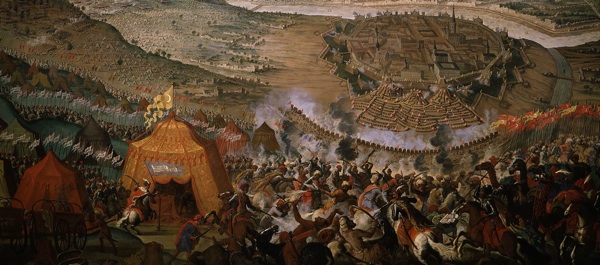
Emperor Leopold, however, thought otherwise. By now he was in no doubt as to the sultan’s ultimate objective, and on July 7, he and his court abandoned Vienna and retreated to Passau with all the treasure they could carry, pursued by Tatar cavalry. Nearly sixty thousand Viennese also fled. On July 14, the Ottoman army of roughly ninety thousand effectives set up camp in front of Vienna. An Ottoman envoy appeared at the gates with the demand that the Christians “accept Islam and live in peace under the Sultan!”
Count Ernst Rüdiger von Starhemberg, who had been left in command with about twelve thousand soldiers, cut him short, and a few hours later the bombardment began. Within two days, the Turks had completely surrounded the city and, by one contemporary estimate, were within a mere two thousand paces of the salient angles of the counterscarp. The grand vizier (Mehmet himself had stayed behind in Belgrade) set up a magnificent tent in the center of what was virtually another city outside the walls. There, in the company of an ostrich and a parakeet, he dispensed favors in complete confidence of an eventual victory, and sauntered forth each day to inspect the Turkish trenches.
The situation inside the city grew steadily more desperate as water ran low, garbage piled high in the streets, and little by little the familiar diseases of the besieged—cholera, typhus, dysentery, scurvy—took hold. Yet the defenders managed to hold out for two months. The Turks, as Caprara had rightly observed, possessed very little heavy artillery; what they had could kill people and damage buildings inside the city but made little impact on the massive walls, bastions, ravelins, glacis, caponières, palisades, counterscarps, and the other paraphernalia of sixteenth-century fortifications that ringed Vienna.
The Ottoman siege lines inched ever closer to the city walls, while miners dug elaborate caverns, hoping to place explosives that would blow gaps in the fortifications. In turn, the defenders dug countermines and occasionally exploded ordnance beneath Ottoman trenches. Eventually, mines were being set off daily, and the defenders fought hand-to-hand with attackers making desperate charges against the resulting breaches. Defenders also sortied outside the walls, but could not dislodge the Ottomans or spike their guns. In early September, Starhemberg had only about four thousand defenders left, and the city walls were imperiled at several points.
Meanwhile, a relief army of some sixty thousand men under the joint command of King John III Sobieski of Poland and the emperor’s brother-in-law, Charles Sixte of Lorraine, moved slowly toward the beleaguered city. It included forces from Saxony, Franconia, Bavaria, Bohemia, and Waldeck. Crossing the Danube at Tuln, they marched through the Wienerwald—a mountainous no man’s land covered in dense forest—to approach the city from the west. The Ottomans, assuming that no relief army of any size could possibly penetrate the Wienerwald, had left it largely undefended. It would be a fatal mistake.
The progress of the combined Christian army was slow, but by late Saturday, September 11, it had assembled along the ridges on the edge of the forest. The Ottomans had set up an observation post on the heights known as Kahlenberg, overlooking Vienna, but a small force drove them away and shot off a rocket, to alert the city’s defenders that help was at hand.
The following morning, the army swept down on the largely unprepared and poorly defended Turkish encampments below. Kara Mustafa had never been confronted by a relieving army bent on breaking a siege. He rejected the advice of some of his officers to abandon the siege and concentrate his full attention on the substantial force to his rear. Instead, the grand vizier kept up the pressure on Vienna, diverting only an estimated six thousand infantry and twenty-two thousand cavalry, backed by six cannons, from the siege.
They were not enough. Even though the Christian army could not get most of its artillery over the mountains and into place, its steady attack and greater numbers proved impossible to withstand. First, the Saxons and Imperial troops attacked from the Kahlenberg heights; then additional Imperial troops advanced on the Ottoman center. The Ottomans launched a counterattack, but in twenty minutes they had been beaten back. Because of deep ravines and other terrain problems, the Poles had been slow to engage, but when they came in on the Christian right, the battle was decided. At about 4 p.m., the various Christian forces advanced on all sides, Sobieski leading his “winged hussars” in what was a decisive charge against the Ottoman cavalry. By late afternoon, the Turkish lines began to waver. A desperate Kara Mustafa led his personal escort into the fray, hoping to withstand the Christian onslaught, but could do no more than rescue the flag of the Prophet.
“We came, we saw, and God conquered,” wrote Sobieski to Pope Innocent XI, echoing Julius Caesar’s famous remark on the conquest of Pontus, in modern Turkey. The siege was ended.
Those Turks who had not been killed or captured fled back toward Belgrade. Kara Mustafa succeeded in taking most of his treasure with him, but it would do him little good. As so often happened to those who had failed the sultan, he was strangled two months later.
Vienna, wrote one despairing Ottoman historian, had been a defeat “so great that there has never been its like since the first appearance of the Ottoman state.” He was almost right (the 1402 Battle of Ankara, in which Tamerlane’s Tatars captured the Ottoman leader Bayezid I, had been more devastating). And although neither he nor any of his contemporaries, Christian or Muslim, may have fully realized it, Mehmed’s failure was to be the first step in the steady but inexorable decline of what had for so long seemed the unstoppable advance of the Ottoman Empire.
After Vienna, the relationship between Christendom and Islam began to change. For centuries, the Christians had attempted to keep the Muslims at bay and, if possible, to recapture areas, most notably Palestine, that they considered to be sacred to their religion. Now, as Ottoman power visibly weakened, it became possible to imagine not merely limitations on Muslim power but its eventual elimination.
The Hapsburgs were quick to capitalize on their success. In March 1684, in an unusual show of solidarity, Austria, Venice, Poland-Lithuania, the Grand Duchy of Tuscany and Malta, and the papacy formed a Holy League against the Sublime Porte. Two years later, on September 2, 1686, they secured their first major victory when the Hungarian city of Buda, which since 1526 had stood on the frontier between Christendom and Islam, fell to a besieging Hapsburg army.
For the Ottomans, the loss was of immense psychological significance. The failure to take Vienna had been a crushing humiliation for the mighty Ottoman armies, but Vienna had always been a European Christian city. Buda, by contrast, was considered a Muslim city, part of the dar al-Islam.
The real threat to the continuing survival of the Ottomans, however, came not from the Austrians but from a relatively new Christian imperial power: Russia. The conversion of the Russians to Christianity in 988 had been one of the triumphs of the Greek Church. As the Byzantine Empire had slowly lost ground to the Turks, the Russians had been gaining territory from their former Mongol overlords, in a continuing struggle that, since it pitted Christians against Muslims, was also seen by the Christians as a crusade. With the fall of Constantinople and the disappearance of the Roman Empire in the East, Moscow had become, in Russian eyes, the sole bearer of Orthodox Christianity and consequently the true heir of the Roman Empire, now ruled by a prince who styled himself “tsar,” the equivalent of “Caesar.”
GET HISTORY’S GREATEST TALES—RIGHT IN YOUR INBOX
Subscribe to our Historynet Now! newsletter for the best of the past, delivered every Wednesday.
“The Christian Empires have fallen,” wrote the monk Philotheus in 1512 to Tsar Basil II. “In their stead stands only the Empire of our ruler….Two Romes have fallen, but the third stands and a fourth there will not be….Thou art the only Christian sovereign in the world, the lord of all faithful Christians.” Now prophecies about a blond race of warriors emerging from the north to drive out the Muslims began to appear throughout the Eastern Christian world. In 1657, one Orthodox patriarch, rash enough to predict the end of Islam and the return of the Church Triumphant, was hanged for his perverse optimism.
Yet, for all these claims, the peoples of Western Europe had never quite known what to make of the Russians. Russia’s vast size and the fact that so much of it had for so long been ruled by nomadic peoples had placed it, in the minds of many Europeans, beyond the formal limits of “civilization.” It remained in this way a stubbornly oriental despotism, firmly within Asia—the “Turk of the North,” as the German philosopher Gottfried Wilhelm Leibniz called it.
But beginning in the 1680s with Peter the Great, founder of St. Petersburg, who is described by Charles-Louis de Secondat, Baron de Montesquieu, as “having given the customs and manners of Europe to a European power,” the tsars began to modernize. Once its aristocracy took to wearing silk brocade and conversing in French, what had hitherto been looked upon as the backward empire of the steppe gradually came to seem inescapably European.
The modernization, or “Europeanization,” initiated by Peter had not only transformed an Asiatic people into a central European one. It had also greatly enhanced the military capabilities of the tsars. Now Russia moved to seize her portion from what was clearly a giant in distress.
On August 6, 1696, Peter the Great captured the Black Sea port of Azov. The Turks agreed for the first time in their history to discuss peace. In October, representatives of the two sides met at Carlowitz in the Voivodina. Finally, on January 22, 1699, with the help of British and Dutch mediators, a peace treaty was signed among the Ottomans, the Russians, and the various members of the Holy League.
The Treaty of Carlowitz was not a total surrender, but it deprived the Ottomans of territories in Eastern Europe: almost all of Hungary and Transylvania, which they considered not to be European or Christian at all but a fully integrated part of the Islamic world. More crushing still, it was the first time in history that a sultan, the “Commander of the Faithful” and heir presumptive to the caliphate, had been compelled to sign a treaty with his enemies. In so doing the sultan had in effect agreed to abide by the admittedly rough-and-ready tenets of international law, as it was understood in the West.
It was an unprecedented move for a political and religious culture for which war against all unbelievers was a necessary duty, the permanent obligation of every ruler. Muslims could and did enter into treaties with non-Muslim rulers. These might, for the sake of convenience, last for a very long time. But no Muslim ruler could accept a permanent settlement with a non-Muslim state, if only because the obligation of the jihad prevented them from recognizing that state’s very right to exist.
At Carlowitz, the sultan, the supreme leader of the Muslim world, had, implicitly at least, violated one of the precepts of the shari’a. It would change the nature of the Ottoman state forever. As long as Ottoman forces had been supreme, there had seemed to be little reason to question the established order. Now there was. Mehmed II might have adopted Byzantine and Latin modes of address and had himself depicted by Christian painters employing Western iconographical motifs. But no sultan before Mustafa II had had any compelling reason to suppose that the great empire over which he ruled would not go on until the day when the dar al-Islam would cover the entire world, one under Ottoman rule. This vision of the future began to fade after the Treaty of Carlowitz and continued thereafter to get dimmer and dimmer.
More than any previous event, Carlowitz forced upon the Ottomans a new awareness of the potential might of the West and the recognition that, if the empire was to survive, it would have to adopt new ways of dealing with the West, ways that would replace the simple force of the jihad with diplomacy. It marked, too, an unmistakable reversal of fortune. Now it would be the West—utterly transformed culturally, religiously, politically, and militarily from the squabbling assembly of states that had failed to stop first Mehmed II and then Suleiman—that would take the offensive. And from 1699 until 1918, when a contingent of British troops entered Istanbul, it would be the West that steadily but inexorably pushed back the frontiers of Islam. MHQ
Adapted from Worlds at War, by Anthony Pagden. ©2008 by Anthony Pagden. Published by arrangement with Random House, Inc.

this article first appeared in military history quarterly
Facebook: @MHQmag | Twitter: @MHQMagazine