
Each Spring, members of the acting profession and related disciplines are honored by their peers with awards that have come to symbolize the highest achievement in motion pictures or on the Broadway stage. Given the long history of the theater in New York City–a production of Richard III was mounted in a theater on Nassau Street in 1750–one might expect that Broadway’s Tony® Awards* had a longer tradition than Hollywood’s Oscars. The fact is, however, that the movie industry instituted the Oscars in 1929, when the new art form was barely a quarter-century old; the first Tony was not awarded for another 18 years. After almost two centuries, it was, by 1947, definitely time for the theater to recognize its own.
The statues presented by the Academy of Motion Picture Arts and Sciences are not actually named for anyone. For the first two years of their existence, they had no designation beyond “Academy Awards.” The nickname “Oscar” originated, so the story goes, when a secretary at the Academy gazed at the bald figure and exclaimed, “Why, he reminds me of my Uncle Oscar.”
A real person did, however, inspire the Tony. When actor and director Antoinette Perry died in 1946, her loss was so deeply felt on Broadway that conventional eulogies seemed inadequate; a permanent memorial would be necessary. And so the following year, the Tony Award was born.
Mary Antoinette Perry was born in Denver, Colorado, on June 27, 1888, the only child of lawyer William Russell Perry and his wife Minnie. Antoinette was enthralled by the stage at an early age. “I had an interest, for as long as I could remember, in theater,” she told an interviewer in 1935. “Why, when I was a child, I didn’t say, as most children do, that I was going to become an actress. I felt that I was an actress and no one could have convinced me that I wasn’t! I had wanted to act since I was six. There was a special urgency in my case, for an aunt had married an actor–something that wasn’t looked on with much favor in those days.”
Her aunt was the actress Mildred Hall, and when Antoinette was on vacation from Miss Wolcott’s School in Denver, she would travel with Hall and her husband, George Wessells, on cross-country tours. Wessells–who had, he said, once played on the same stage as the great American Shakespearean actor Edwin Booth–encouraged Antoinette’s talent and urged her to study the literature of the theater. Before long, she was staging plays on the lawn in front of her home.
But William Perry deemed the acting profession unsuitable for his only child. Less opposed to her having a musical career, he sent Antoinette to Miss Ely’s School in New York to study voice and piano. Although she did not continue in music professionally, she was later regarded by her theatrical peers as a fine pianist, and that instrument remained a cherished source of recreation and comfort for the rest of her life.
With the help of her aunt and uncle, the stage-struck teenager made her acting debut in Chicago on June 26, 1905–the eve of her seventeenth birthday–in Mrs. Temple’s Telegram. That same work served as the vehicle for Antoinette’s New York debut, which took place at the Madison Square Theatre later that year. In 1906, she again played in New York, in a work called Lady Jim, and though that production did not long endure, one critic called her “the sweetest, most piquant ingénue in Broadway.”
Between 1906-09, Antoinette appeared in New York productions of The Music Master and A Grand Army Man. In the latter, she starred opposite the celebrated actor/director David Warfield, of whom she once said: “I really learned from David. What a terrific actor he was! With David, there was always that sense of something struggling to break through. He makes me see what acting is.”
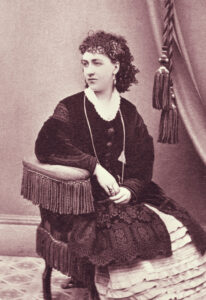
As her photographs show, Perry was an uncommonly pretty young woman with long, pinned-back blonde hair, a round chin, a perfectly straight nose, and crystal blue eyes, crowned with long lashes that must have been able to produce a provocative, stageworthy flutter. She considered good diction essential for a stage performer and worked hard to perfect her own. “What disqualifies young aspirants for the stage most often,” she wrote, “is their inability to speak with as fine a diction and pronunciation as the theater requires.” By her standards, the best diction in the United States could be heard in San Francisco; the worst belonged to “youngsters from the Middle West.”
Despite her promise, her noteworthy start, and her childhood ambition, on November 30, 1909, Antoinette gave up acting to marry Frank Wheatcroft Frueauff, then president of the Denver Gas and Electric Company. It was a decision, she later remarked, that she “never once regretted.” The wedding took place at the Perry family home on East Colfax Avenue in Denver, but the couple took up residence in Manhattan, where Frueauff was a partner in Henry L. Doherty & Co., a vice-president and cofounder of Cities Service Co., and a director of more than one hundred other firms. The marriage put the new Mrs. Frueauff in the upper range of the upper crust, with homes in New York City and Newport, Rhode Island, and a castle in England. Antoinette gave birth to three daughters–Margaret, who became an actress herself; Virginia, who died in infancy; and Elaine, a successful stage producer in the 1950s.
Tragedy struck the family in 1922, when Frueauff, overextended and overworked, succumbed to a heart attack. Left with an estate worth some $13 million, Antoinette had no need to work ever again. But the 34-year-old widow soon “tired of the life of social whirling dervish,” she said. “After my experience in the theater, it provided me with no impetus in life. I found no charm in a life of leisure. It was downright dull. I needed a change–something vital. There was only one option left, and I yearned to return to the theater.”
Antoinette Perry made her comeback on to the stage in January 1924, playing opposite Walter Huston in a production of Mr. Pitt by Zona Gale. Later that year, she starred in George S. Kaufman and Edna Ferber’s Minick, and in 1925, she performed in three more plays–The Dunce Boy, Engaged, and Caught.
While she was appearing in Caught at the 39th Street Theatre, journalist Percy N. Stone explained to his readers that “there aren’t many who would go on acting if they could clip coupons all day instead.” He wrote that he had asked Perry why she had returned to the stage. “There were tears threatening the mascara-ed lashes,” according to Stone, “as she said in a voice full of pathos, ‘Can’t anybody understand? Why do they say I don’t have to work? Women have come to this room just to tell me that I am taking bread out of some other person’s mouth. I don’t have to work? I am making a fight for my very existence.'”
One afternoon in 1921, a year before the death of her husband, Perry had gone to Carnegie Hall to attend a concert by the Russian piano virtuoso and composer, Sergei Rachmaninoff. Also in attendance that October Sunday was theatrical producer Brock Pemberton. “The great Russian was playing his first number when I arrived,” Pemberton later wrote, “and with scores of others I stood in the back until he had finished. I made a hasty survey of those around me. By far the most interesting and attractive person was a handsome woman leaning against the east wall just by the door. I remember she wore a huge bunch of violets. She was blonde and she was beautiful and it seemed a shame that she should stand when I had an extra ticket so, as I started down the aisle, I offered it to her. She hesitated a moment, smiled, accepted.”
After the concert, Antoinette invited Pemberton to her Fifth Avenue home to meet her husband. Thus was born a friendship that was pivotal to Perry’s life, for it eventually inspired a major change in her career. After her decision to return to the theater, Pemberton produced several of the plays in which Perry appeared, including Mr. Pitt, The Masque of Venice, and The Ladder.
It is not clear who initiated the idea, but at some point, Pemberton broached with Perry the possibility of her collaborating with him on a directing project. Their first joint venture was Ransom Rideout’s drama about interracial marriage, Goin’ Home, which opened at the Hudson Theatre in August 1928. They followed this with the smash hit, Strictly Dishonorable, by Preston Sturges, which premiered in September 1929 and ran for 557 performances, a very long run at a time when productions were so plentiful and competition so fierce. In fact, the 1927-28 season, just before the onslaught of talking pictures, marked Broadway’s historical peak, with an all-time high of no less than 264 shows opening in 76 theaters.
With Pemberton as her partner, Perry put acting behind her and became a full-fledged director, staging such works as Personal Appearance, 1934; Ceiling Zero, 1935; Kiss the Boys Goodbye, 1938; Lady in Waiting, 1940; and Janie, 1942. But her biggest hit was her 1944 smash, Harvey.
When Perry first read the script of Mary Coyle Chase’s comedy about a pacific boozer named Elwood P. Dowd and his chum Harvey, a six-foot-one-inch rabbit that only Elwood could see, Perry feared that staging it would be impossible. But she toiled on the project, helped whip the unpolished script into shape, and mounted a triumph starring Frank Fay that ran for 1,755 performances at the 48th Street Theater in New York.
Despite her achievements, neither Perry’s acting nor her directing skills explain the high esteem in which she was held by the theater community. Rather, it was her efforts as an activist, organizer, and promoter of causes that benefited and uplifted her Broadway “family.” As Pemberton put it, “Probably about a third of her life was given to our work, the other two-thirds to helping people individually or through the organizations she headed.”
In 1937, Perry chaired the American Theatre Council’s Committee of the Apprentice Theatre, and four years later, became president of Actors Equity’s Experimental Theatre. In both capacities, her job centered around finding and nurturing new theatrical talent. Her heart went out to the many struggling performers hoping to get a break. Among the actors she auditioned and promoted were David Wayne, Hugh Marlowe, and Montgomery Clift. As early as May 1938, her efforts were hailed with a gala, after-theater supper at the Ritz Carlton Hotel, during which she was lauded for having already helped more than a thousand young thespians.
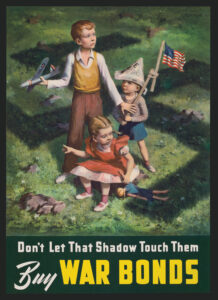
Perry also dedicated herself to the American Theatre Wing, the organization that today oversees the Tony Awards. Established in 1917 by playwright Rachel Crothers and six other women of the theater as the “Stage Women’s War Relief,” the Wing’s self-appointed duties included the collection of food and clothing for war relief, selling Liberty Bonds, and entertaining servicemen. After World War I, the Wing turned to helping civilians, but remained fairly dormant until 1939 and the beginning of World War II in Europe. Once again, Crothers summoned the women of Broadway, and the organization reemerged as a branch of the British War Relief Society. When the United States entered the war in 1941, the organization became independent, with such notables as Gertrude Lawrence, Helen Hayes, Josephine Hull, and Perry, assisting Crothers as officers.
The American Theatre Wing’s accomplishments on behalf of the war effort were many and, as befits the profession of its members, often creative. They held dances, teas, concerts, cruises, even celebrity dog shows, but the most illustrious of the Wing’s wartime activities was the initiation of the Stage Door Canteens. The idea for the canteens seems to have been mainly Perry’s; there is no doubt that she was their prime mover. The first canteen opened in the basement of New York’s 44th Street Theatre in March 1942. Branches were later established in Hollywood; Boston; Washington, D. C.; Philadelphia; Cleveland, Ohio; Newark, New Jersey; and San Francisco, as well as in Paris and London.
To say that a Stage Door Canteen was a place where a serviceman–as long as he was in uniform–could drop in for free relaxation and amusement would hardly do justice to these fabled locales. For this is where celebrities mixed with G.I. Joe. Where else would a member of the armed forces find Hume Cronyn checking coats, Dorothy Lamour taking drink orders (non-alcoholic only), or Tallulah Bankhead cleaning tables, or be able to listen to the songs of Al Jolson or Marlene Dietrich.
The success of the canteens led to a weekly radio show, Stage Door Canteen, in 1942. A year later, a movie of the same name was released, featuring cameo appearances by Paul Muni, Helen Hayes, Katharine Hepburn, Count Basie, Benny Goodman, and many others. The money earned from these ventures enabled the Theatre Wing to launch a series of traveling theatrical productions to entertain the troops overseas.
When the end of the war was in sight, the Wing saw the need for a mechanism to help returning veterans get back into the theater. This led to the establishment of the American Theatre Wing Professional Training School in July 1946. Among the students who took advantage of the classes that were offered were Tony Randall, Lee Marvin, Eli Wallach, Gordon MacRae, and Charlton Heston.
Unfortunately, Perry did not live to see the success of the school. She died from a heart attack at her home on Park Avenue, in New York, on June 28, 1946, one day after her fifty-eighth birthday. She had been ailing for some time, and after her death, associates remarked that she literally “gave her life” to the various war projects sponsored by the American Theatre Wing.
Members of the Broadway community concluded that some kind of memorial was essential for this remarkable woman of the theater. Sam Jaffe thought of naming his acting school after her, and there was talk of erecting a statue of Perry in Times Square. But finally, it was agreed that an annual awards ceremony, named in her honor, would be the best way to immortalize her memory. Brock Pemberton became the chairman of the committee charged with the task of its organization.
On April 6, 1947, some 1,200 guests attended a dinner at New York City’s Waldorf-Astoria Hotel, at which the first Tony Awards were presented. Best dramatic actor awards were shared by José Ferrer for his performance in Cyrano de Bergerac and Fredric March for Years Ago; best dramatic actress honors went to Helen Hayes for Happy Birthday and to Ingrid Bergman for Joan of Lorraine. For the first two years of the Tony Awards, winners received no trophy, taking home only a scroll and a token gift. The medallions now presented, which were first bestowed in 1949, bear the masks of comedy and tragedy on one side, with a likeness of Perry on the reverse.
This annual ceremony, now televised around the world, is familiar to millions, making the award much more famous than the person who inspired it. Consequently, each year a newspaper columnist or television broadcaster feels compelled to remind people that there was a living person behind Broadway’s most cherished prize. In 1962, at the fifteenth birthday celebration of the Tony Awards, the renowned theater critic Brooks Atkinson commented: “There have been a lot of changes [in the Tony Awards ceremony] since 1947. There is nothing informal about the occasion anymore. Although Antoinette Perry would probably be pleased, she would certainly be surprised. She was an imaginative, able, and selfless person. I don’t think there was anything she would not or could not do. Fame was not what she was after. She just loved theater.” *
New York writer Joseph Gustaitis is a frequent contributor to American History.