Just after 6 o’clock, early in the evening of May 10, 1864, near Spotsylvania Court House, Virginia, a Union officer waved a handkerchief; the Northern guns fell silent, and Colonel Emory Upton, the only officer on horseback, rode to the front of his troops. Twelve Union regiments, some 5,000 men whom Upton declared the best in the army, stood in four ranks, three regiments to a line, with bayonets fixed atop their muskets. Only the muskets of the front three regiments—men from Upton’s own 2nd Brigade —were primed for firing. Upton had given strict instructions that the men not stop for anything—not to fire, not to reload, not to help their wounded —until they breached the Muleshoe, a bulge in the arc of Rebel works around Laurel Hill.
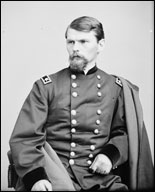
An aloof –some said arrogant —24-year-old combat veteran who had been wounded at First Manassas, commanded artillery in the Seven Days and Antietam battles and led troops at Fredericksburg, Colonel Upton had come to the attention of General Ulysses S. Grant six months earlier when the young tactician captured a Confederate bridgehead at Rappahannock Station. Abandoning the standard attack—a line of men charging in a wave—he condensed his troops into a human battering ram, a tight column of men surging at lightning speed with one aim: to breach the enemy’s entrenchments. If it had worked at Rappahannock Station, it would work here. Upton was sure of it.
Grant needed something to work at this juncture. Exactly two months had passed since the hero of the Western theater arrived in the East to assume the post of commanding general of all the Union armies. He’d found himself in an awkward command situation with General George Meade, technically still commander of the Army of the Potomac; he had discovered General Lee to be a more tenacious foe than he’d imagined, and he was making little if any progress toward ending the war in Virginia. With the Confederates now engaging his troops in ferocious trench warfare and casualty figures escalating on both sides, Grant was looking for a quick, efficient battle and a clean win. Upton’s tactic, he thought, might deliver that.
Decades later, historians and military experts would debate whether Upton’s human battering ram was a bad idea in search of a good one or simply a tactic ahead of its time, one that required more advanced communications technologies to ensure coordination among forces. But on the chaotic afternoon of May 10, 1864, facing the Confederates’ seemingly impenetrable fortification, General Grant figured he had nothing to lose in trying. How could he possibly have guessed that Upton’s plan for a swift, limited-loss encounter would devolve into one of the most primal battles of the entire Civil War.
Preparations for Upton’s assault began early in the afternoon of May 10. Lieutenant Ranald S. Mackenzie of the U.S. Corps of Engineers reconnoitered the field and recommended a site to Upton where his troops could mass undetected in the woods. From there, Upton spied the Confederate position and the engineering marvel that was the Rebels’ entrenchment—a single organic structure of interlocking parts. Head log traverses packed with soil zigzagged the terrain taking advantage of natural features and providing the men with cover from enfilading fire. Abatis were laid in front of the works to slow enemy infantrymen and make them easy pickings for riflemen behind the logs.
Soon the Union’s attacking force began to gather at Mackenzie’s site: three regiments from Upton’s Brigade—the 5th Maine, the 121st New York and the 96th Pennsylvania; the 43rd and 77th New York regiments from Colonel Daniel Bidwell’s brigade; and the 2nd, 5th and 6th Vermont regiments from Colonel Lewis Grant’s brigade. Lieutenant Colonel Martin McMahon, chief of staff to General John Sedgwick, who had been killed only the day before, chose nine additional regiments for the attack from several other brigades, including the 6th Maine, the 49th and 119th Pennsylvania and the 5th Wisconsin of Brig. Gen. Henry Eustis’ brigade. Their orders were simple and direct: race straight toward the Georgia Brigade of Brig. Gen. George Doles midway down the western face of the Muleshoe.
Generals Grant and Meade had originally planned to conduct coordinated assaults along the whole Confederate line around 5 p.m. Meade reported that the enemy was pressed along his entire front, but he neglected to mention that the Rebels’ offensive had been utterly uncoordinated. The attacks broke down completely by midafternoon when V Corps commander Maj. Gen. Gouverneur Warren was given permission by both Grant and Meade to attack the high ground—Laurel Hill—at around 3:45 p.m.
For Upton’s battering ram to succeed in breaking open the Muleshoe, his units needed support, and Brig. Gen. Gershom Mott’s II Corps Division was tapped for that job. Unfortunately for all concerned, communication and coordination was virtually nonexistent between Mott and Horatio Wright, who had stepped into Sedwick’s post at the head of the VI Corps. In fact, whether Mott was fully informed of his role in supporting Upton remains in doubt. Mott had the difficult job of managing a two-mile front while preparing an assault against a firmly entrenched enemy. And then there was the matter of timing. When Warren was repulsed at Laurel Hill, Upton’s attack was delayed until 6 p.m. Apparently, Upton received the orders to delay, but Mott did not. Mott was operating under earlier ambiguous orders to attack at 5 p.m. and support Upton, who by then would have breached the Confederate entrenchments. So Mott stormed across an open field some 600 yards toward the enemy works, where he was met with enfilading artillery fire. Finding neither Upton nor a breach in the line to support, Mott turned back.
Meanwhile, unaware of Mott’s confusion, the cocksure Upton remained supremely confident of success. If the Confederate works were intimidating, then the circumstances lent themselves perfectly to his approach. While 200 yards of open field was enough to give some pause, Upton perceived the distance as favorable when compared with the mile that Pickett’s troops charged at Gettysburg.
Convinced that speed and momentum were paramount if this battering ram was to punch through the west side of the Muleshoe, Upton left nothing to chance and coached the regimental officers to continuously repeat the command “Forward!” As he saw it, the combination of secrecy, speed, reduced enemy firepower and sheer force of Union numbers would allow the Union force to take the works and push enough men through to hold the position until supported.
At 6:10 p.m. Upton shook hands with Brig. Gen. David Russell and, operating under the mistaken impression that his troops would be supported by Mott, gave the signal to charge. “As soon as we began to run,” one soldier recalled, “the men, unmindful of, or forgetting orders, commenced to yell, and in a few steps farther the rifle pits were dotted with puffs of smoke and men began to fall rapidly and some began to fire at the works, thus losing the chance they had to do something when they reached the works to protect themselves.” According to Upton, the struggle at the entrenchments lasted only seconds with the sheer numbers of Union troops prevailing. The first Union men to reach and climb over the works were shot instantly; many were bayonetted by the Georgians who initially refused to give ground. The Union troops gave as good as they got: The flag bearer of the 44th Georgia was stabbed 14 times by Upton’s men.
The Union troops quickly descended on the other line of unfinished and lightly defended entrenchments about 60 to 75 yards inside the first line. Upton rode back over the field to activate the fourth line of Vermonters held in reserve only to find they had already taken the initiative to join their comrades. But the resilience and swift reaction of the Confederate II Corps surprised the Union troops. Another Rebel battery opened up on the Union troops. Upton asked for volunteers to take the battery, but no one came forward. As the sun set, Brig. Gen. Stephen D. Ramseur rallied his brigade of North Carolinians to mount a counterattack against the Union onslaught. Brigadier General Junius Daniel’s North Carolinians and Brig. Gen. Cullen Battle’s Alabamans joined the fray as well. And General Richard Ewell sent Brig. Gens. George H. Steuart and Robert D. Johnston’s brigades sprinting into the salient’s interior to shore up the gap and save the day for the Confederates.
The Union troops, unsupported and now outnumbered, were spent. By the end of the fighting all 12 of the regiments had fought inside or near the salient and had become so intertwined that they were under no one’s control, each man fighting for himself. Upton wrote, “Reinforcements arriving to the enemy, our front and both flanks were assailed. The impulsion of the charge being lost, nothing remained but to hold the ground. Our position was three quarters of a mile in advance of the army, and, without prospect of support, was untenable.” General Wright did not have the intestinal fortitude nor the military facility to snatch victory from defeat. Upton rode back to the edge of the woods and was granted permission by General Russell to retreat.
Giving up ground purchased so dearly gained was a painful, defeatist step for a soldier. The Vermonters would not retreat until repeatedly ordered to do so. One participant wrote, “I came back, tired out and heartsick. I sat down in the woods, and as I thought of the desolation and misery around me, my feelings overcame me and I cried like a little child.” Union losses were significant, about 1,000 casualties. Union troops captured between 1,000 and 1,200 prisoners who had been surprised and overtaken by the sprinting Federals.
Upton’s inability to hold the position did not detract from the tactical success of the attack. His job was to create a breach in the Confederate lines, not to hold the breach indefinitely. With proper support from Mott, the breach created by Upton’s troops could have been exploited, paving the way for the potential destruction of Lee’s army. But blame for the failure lay not with Mott but clearly at the feet of Meade and Grant, who recalled in his memoirs, “Upton had gained an important advantage, but a lack in others of the spirit and dash possessed by him lost it to us….I conferred the rank of Brig. Gen. upon Upton on the spot, and this act was confirmed by the President.”
Upton’s gambit was so nearly a success on May 10 that Grant decided it was worth trying again two days later with four times the force and far superior coordination. On May 12, General Grant ordered II Corps commander Maj. Gen. Winfield S. Hancock to lead the attack on the Muleshoe, this time from the north, near its tip, where in theory it should have been most vulnerable. A heavy rain fell as Hancock lined up his divisions, realizing that he and his commanders had only a vague idea of how strong the Confederates were at the expected point of attack or even what the ground in front of the north side of the Muleshoe was like. No reconnaissance had been possible because a ridge had blocked the view of Hancock’s staff officers.
At 4:35 a.m. Hancock started his men toward the Muleshoe, the division of Brig. Gen David B. Birney on the right and that of Brig. Gen. Francis Barlow on the left. During the night Confederate pickets heard a rumbling that sounded like troops moving, and Maj. Gen. Edward Johnson alerted his brigade commanders. The Union’s surprise element was shot when the Rebels heard hundreds of Federals let out a loud cheer in the morning fog, thinking they were close to the Rebel works.
Once they reached the earthworks, abatis blocked the way. The Union’s front worked feverishly to clear them away. Within the works Rebels got the order to fire, but in the damp morning air many powder charges failed to ignite. The Yankees poured over the Confederate works by the hundreds, fighting hand-to-hand with bayonets and clubbed muskets. The Federals captured 4,000 prisoners including General Johnson and Brig. Gen. George Steuart, who refused to shake Hancock’s hand when taken to him. Johnson, who accepted Hancock’s courtesy, was taken to breakfast by a member of Meade’s staff. Birney’s troops, meanwhile, captured most of the Stonewall Brigade. Hancock’s attack, plunging into the heart of the Muleshoe, was close to splitting Lee’s army in half.
The only thing holding together the two wings of the Confederate army were the soldiers of Gordon’s reserve division, and Gordon frantically began shifting troops to counter the assault. Lee, too, had ridden to the sound of the firing. The Confederate commander, who liked to get up early and ride to the front lines, was already on horseback when he heard the attack begin. Gordon encountered Lee, briefed him, and then turned away, expecting Lee to go to the rear. Instead, Lee began riding toward the fighting. Gordon and his troops pleaded with Lee to get out of danger, and a Virginia sergeant grabbed the bridle of Lee’s horse, Traveller, and led Lee to the rear. Gordon then raced to organize brigade-sized counterattacks.
Hancock now faced a replay of Upton’s problem from two days earlier. Hancock’s II Corps had smashed through the Confederate entrenchments, but in the confined space his units got all tangled up. Gordon’s counterattack slammed into the confused Federals and began pushing them back toward the eastern side of the Muleshoe.
Grant had made plans to reinforce Hancock, and at 6 a.m. the 15,000 men of Brig. Gen. Horatio Wright’s VI Corps launched their attack about 300 yards west of Hancock’s right. By 6:30 the first of these troops—the three regiments of Colonel Oliver Edwards—moved along the northwestern side of the captured Confederate trenches where the earthworks made an angle. Over the next two hours as a downpour drenched the field, more troops, including Upton’s Brigade, moved in. In this 200-yard-wide stretch, at what the troops called “the Bloody Angle,” all hell broke loose as Union and Confederate soldiers standing only a few feet apart shot, bludgeoned and bayoneted one another beyond recognition. Countless men were trampled in the mud four and five deep. A hornet’s nest of musket fire even cut down an 18-inch-diameter tree trunk. The fighting raged for nearly 20 hours.
With two of his four corps furiously engaged, Grant counted on support from his other two corps to win the battle. He had ordered attacks by the V Corps and the X Corps. Both made half-hearted efforts that provided their comrades with little help. Meanwhile, Grant and Lee poured troops into the Bloody Angle, neither giving ground throughout the day and into the night. Around midnight Lee quietly ordered a Confederate withdrawal to new lines about a half-mile south of the Muleshoe, and by 3 a.m. the fighting ended. Exhausted soldiers on both sides lay down in the mud and slept.
Curtis D. Crockett, who has written previously for America’s Civil War, resides in Indian Trail, North Carolina.
This article by Curtis D. Crockett was originally published in the January 2008 issue of America’s Civil War magazine.For more great articles be sure to subscribe to America’s Civil War magazine today!