Of the 21 million tons of Allied shipping lost during World War II, 15 million tons were sunk by U-boats. The Allies retaliated by sinking 781 U-boats, which resulted in a loss of nearly 35,000 of the 38,000 Kriegsmarine personnel serving in the U-boat arm of the German navy.
There was nothing accidental about this victory at sea. It was the direct result of a relentless pursuit of the enemy by the “little ships,” largely inspired by the brilliant exploits of one man, Captain Johnnie Walker of the Royal Navy. Today, Walker is officially recognized as “the man who did more to free the Atlantic of the U-boat menace than any other single officer.”
In 1941, Great Britain and Canada maintained 400 assorted escort ships along the Atlantic convoy routes, but the rate of U-boat sinkings remained dismally low, approximately two per month. Then Johnnie Walker took command of an escort group of nine ships—two sloops and seven corvettes. While defending his first convoy from England to Gibraltar, he sank three U-boats in 10 days, and on the 22-day return trip with another convoy he sank four more.
These were major victories won without loss and by unorthodox methods. Since the outset of the war, it had been accepted that escorts should stay close to their charges to ward off U-boat attacks. Walker, then holding the rank of commander, had achieved his successes by ignoring this principle and hunting his victims well away from their quarry. Two U-boats had been destroyed 40 miles from the convoy he was protecting.
In high places at the Admiralty there were powerful forces at work seeking to brand Walker as a lucky heretic. Only his success and the unqualified backing of Admiral Sir Max Horton, the commander in chief of Western Approaches, prevented Walker from being posted ashore.
While Admiral Horton was in a favorable mood, Walker persuaded him to try a revolutionary theory: Six modern, fast, specially equipped sloops, freed from the fetters of convoy duty, should be given a roving commission to hunt down U-boats in their most vulnerable grounds, the Bay of Biscay, which they crossed when beginning or completing patrols, and far out in the Atlantic where they surfaced with immunity because the sky was clear of aircraft.
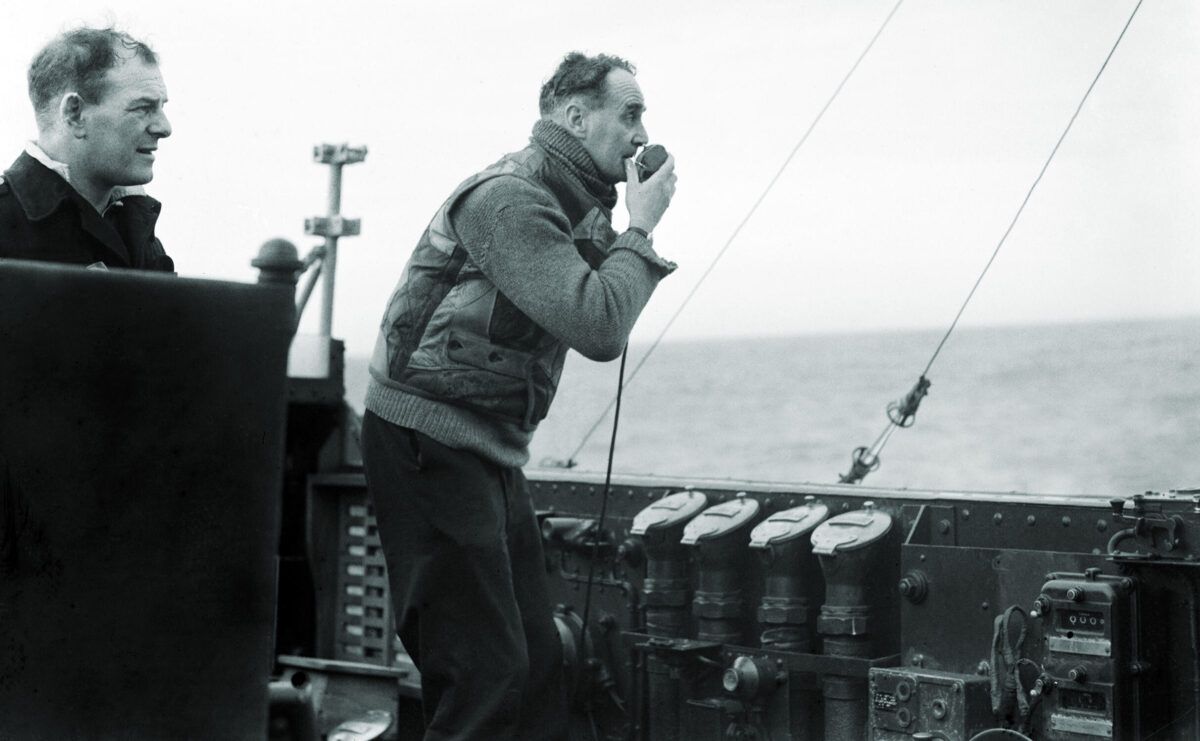
In the spring of 1942, Walker took command of the Second Support Group, first of the new striking forces. From the bridge of Starling, his own sloop, he drilled Wild Goose, Cygnet, Wren, Woodpecker and Kite until they became a team, swinging into action with few orders, no fuss and no mistakes.
In June, Walker found an opponent worthy of his guile, a fair, lithe German officer, Kapitänleutnant Gunter Poser, commanding officer of U-202. This U-boat was returning home after a special mission in which she had landed five Nazi agents in the United States on Long Island’s Amagansett Beach. It was U-202’s ninth operational trip of the war, and 27-year-old Poser was a quick-witted, capable captain.
On June 13, Poser’s officer of the watch sighted mastheads through the periscope and called him to the control room. Poser took over the eyepieces and went suddenly rigid. “My God!” he exclaimed. “They are destroyers. Diving stations!” Horns sounded, and within seconds U-202 was down to 500 feet. Poser had met Walker’s Second Support Group hunting in fresh pastures.
On Starling, the asdic (sonar) officer was already reporting, “In contact, sir.” The captain turned to the asdic officer and announced, “Going in to attack now.” Starling surged forward, her bows cutting swiftly through the placid sea. The “ping” of the sonar beam echoing from the hull of U-202 came faster as the range shortened. “Stand by depth charges…Fire!” came the order.
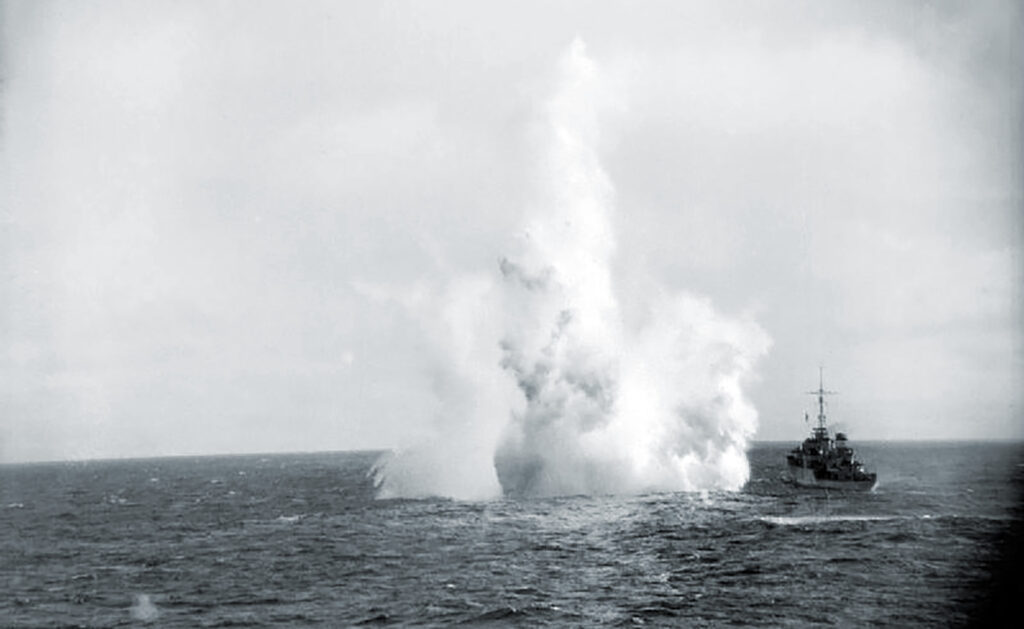
Tons of high explosives rolled from the stern rails and shot from throwers on either side of the quarterdeck to curve gracefully downward through the air. Ten charges rumbled through the water toward the hidden enemy.
For a few seconds there was silence. Then miles of ocean and the waiting sloops quivered as the blasting charges exploded in a series of deafening, crackling roars. Huge columns of water boiled to the surface and sprayed into vast fountains astern of Starling. The great cascades subsided; there was no U-boat. Walker settled down to the game relentlessly. His adversary was proving tough to hold and hard to find.
During exercises, Walker had evolved a form of attack known as Operation Plaster. It called for three sloops steaming in line abreast to roll depth charges off their sterns. Now he ordered Wild Goose and Kite to join Starling, and the three sloops steamed forward dropping a continuous stream of charges–the naval equivalent of an artillery barrage before an infantry attack.
The sea heaved and shook under the impact of the explosions. Twisting and turning and always leaving a trail of charges, the ships plastered the area. In three minutes, 86 depth charges had rocked and shaken the attackers almost as much as it had U-202.
Poser decided to dive deep under the fearsome barrage. “Slow ahead both engines,” he ordered. “Take her down slowly.” Tensely, the control room crew watched the depth gauge. How far down would she go? Could they ever get below the rolling roar of the depth charges? The engineer officer called out the readings, “Five hundred feet…550…600…650…700.” That was the limit. Much more and the submarine would crack under the tremendous pressure. “Seven hundred and fifty.”
Poser’s eyes were fixed on the controls, and his mind was concentrating on the creaks and groans reverberating from the straining hull.
“Seven hundred and eighty…800….” came the engineer officer’s warning. Poser remained silent. “Eight hundred and twenty…850….”
Poser snapped out his commands: “Level off and keep her trimmed at 800 feet. Steer due north with revolutions for 3 knots.”
Far above, Walker was talking to his officers: “No doubt about it. She’s gone deeper than I thought possible, and our depth-charge primers won’t explode beyond 600 feet. Very maddening indeed.”
He grinned and continued: “Well, long wait ahead. Let’s have some sandwiches sent up. We will sit it out. I estimate this chap will surface at midnight. Either his air or batteries will give out by then.” It was shortly after noon on June 13.
By 8 p.m. Poser had taken several evasive turns without result. He could not shake off his tormentors. At two minutes after midnight his air gave out. He ordered reluctantly, “Take her to the surface.”
Without any audible warning, U-202 rose fast through the water to surface with bows high in the air. Her crew leaped through the conning tower hatch to man her guns, and Poser shouted for full speed in the hope of outrunning the hunters.
On Starling’s bridge, the tiny silver conning tower was visible in the moonlight. “Star shell…commence,” ordered Walker.
One turret bathed the heavens with light. Then came a flashing crash of the first broadside from all six sloops laying a barrage of shells around the target. A dull red glow leaped from behind the conning tower of the U-boat.
A dimmed lamp blinked from Starling, and firing ceased while Walker increased speed to ram. Then he saw the jagged stump of the conning tower ablaze and shouted in triumph. U-202 was obviously too damaged to escape. He ran alongside, raking her decks with machine-gun fire and firing a shallow pattern of depth charges that straddled the submarine, enveloping her in smoke and spray.
Poser clutched the hot periscope column, drew his revolver and shouted a last order: “Abandon ship! Abandon ship!” The cry was taken up and passed through the U-boat. Poser turned to say goodbye to his officers. Rather than be captured, he was taking his own life.
At 12:30 a.m. the battle was over—16 hours after it had begun. When the Second Support Group returned to Liverpool with U-202 and two more killings to its credit, Walker learned that his elder son, Timothy, had joined the crew of a British submarine operating in the Mediterranean.
The following month, Admiral Karl Dönitz, commander of the U-boat fleet, threw 150 U-boats into a midsummer blitz against the increasingly busy Atlantic convoy routes. Johnnie Walker again led his striking force into the Bay of Biscay to meet the enemy at his departure points.
On July 29 the enemy came in sight on the horizon, three conning towers in line ahead. Walker’s inherent love for the dramatic came to the fore. He beckoned to the signalman and ordered, “Hoist the General Chase.” For a moment the signalman was confused. Then, with a gleeful grin, he ran up a signal used only twice before in the Royal Navy, once by Sir Francis Drake when he chased the Spanish Armada from the English Channel, and again by Admiral Horatio Nelson at the Battle of Trafalgar.
Off the leash at last, the five British sloops sallied forward. On Starling’s bridge, Walker waved his cap in the air as though urging her to greater efforts as the guns of the entire group thundered a broadside at the unsuspecting U-boats.
In 30 seconds, all three had been hit from a range of four miles, making diving impossible. Ten minutes later it was all over.
In August, Johnnie Walker took his ships back to their Liverpool base. He was conning Starling alongside the tricky berthing dock when a signalman reported, “There is someone ashore waving as though he wants to come aboard urgently, sir.”
It was an officer from Sir Max Horton’s staff. As Starling neared the dock, he jumped aboard and ran to the bridge where he saluted Walker and said, “I have been ordered to report to you, sir, that your son Timothy has been killed in action while serving in a Mediterranean submarine.”
From that moment, Walker became a quietly savage seeker of revenge against Germans. In a two-week hunting strike, Walker’s group sank six U-boats, claimed two more probables and damaged another. It was a tremendous achievement made all the greater because those were the days when German scientists had equipped their submarines with “gnats”—torpedoes that homed on propellers and followed an attacker no matter how he twisted and turned to evade them; and the snorkel, a breathing device that enabled U-boats to stay under water for prolonged periods.
The first of the six kills was U-264, commanded by Kapitänleutnant Hartwig Looks, a veteran submariner. Shortly after dawn one morning, Looks sighted the Second Support Group through his periscope. As the sloops passed, he fired a gnat torpedo in the general direction of the nearest—Starling.
On the sloop’s bridge, Walker spun around at an excited shout from a lookout to see the track of the torpedo approaching his stern, homing on the propellers. There was no time to increase speed or to take violent avoiding action. His mind raced. Unless he could think of a way out in the next few seconds, Starling was doomed. With eyes fixed on the line of bubbles, he rapped out orders: “Hard aport….Stand by depth charges….Shallow setting….Fire.”
Suddenly the air was rent by two almost simultaneous shattering roars. The first came from the depth charges and the second, by far the more frightening, from the torpedo, which had gone off 5 yards from the sloop’s quarterdeck. The depth charges had countermined the torpedo a second before it struck.
Walker led the sloops in a plaster attack. The pounding barrage was kept up for five minutes before the evidence of success appeared–a huge air bubble that collapsed to spread chunks of wood and ghastly human remains over the sea.
Once in the approaches to Liverpool, tension sapped away. The men were worn-out but happy. In this mood the sloops arrived off Liverpool to be met by a destroyer flying the flag of Sir Max Horton. A brief exchange of signals revealed that also aboard was the First Lord of the Admiralty, the then Right Honorable A.V. Alexander, later to become Viscount Alexander of Hillsborough.
The destroyer’s crew waved and cheered the proud line of sloops into the harbor as they maintained station as rigidly as guardsmen, with ensigns flying stiffly in the breeze.
Walter was promoted to captain, and a galaxy of medals (six in all) fell into his lap. He looked forward to rest, his future assured.
It was not to be, however. Scientists wanted an experienced seaman to take them on a hunt for enemy aircraft armed with guided-missile bombs, nicknamed “Chase-Me-Charles.” So after only three days in Liverpool, Walker led his ships back to their old stamping ground, the Bay of Biscay, to patrol well inshore under the enemy guns to entice rocket-firing aircraft into the air.
In one day, the sloops were subjected to 12 Chase-Me-Charles attacks, a hair-raising experience because the scientists, experimenting with a device for breaking the radio contact between the aircraft and the missile, were upset at the thought of shooting anything down.
On the third day, two missiles were fired at Wild Goose within seconds of each other and, after wobbling on a proper course straight for the sloop, suddenly fell into the sea. One scientist thought this significant and asked Walker what electrical machinery was running then that would not have been running during earlier attacks. Investigation revealed that one of Starling’s officers had been shaving at the time, using an electric shaver.
Excited, the scientist begged Walker to sail even closer to the French coast to coax a further series of attacks. Walker did so, and the Luftwaffe sent up a squadron armed with orthodox bombs and guided rockets.
As the planes came in low and launched their satellites, four electric shavers—all the group could muster—were switched on. Every rocket swerved off course and crashed into the sea.
In March, Walker and his group were assigned to escort a unique convoy to Russia—unique because the most valuable ship of them all was the four-funneled U.S. cruiser Milwaukee. She was a gift from President Franklin D. Roosevelt to Josef Stalin, and although sailing under the Stars and Stripes with an all-American crew, she was placed in the care of the Royal Navy for the voyage.
Walker sank two more U-boats on this trip, and Milwaukee was duly delivered. She was handed over to the Russians, who rechristened her Murmansk, and the British group sailed for home with the American crew.
On the way back, a spate of urgent signals indicated that U-473 had torpedoed and sunk the American destroyer Donnell about 200 miles away. Having enjoyed his recent experience of working with Allies, Walker promised his passengers to seek out and avenge their compatriots.
It was a classic hunt. Although the enemy could be anywhere within a radius of 200 miles, Walker drew on his vast knowledge of U-boat tactics to calculate several possibilities. He chose the enemy’s most likely course and moved to intercept.
Two days later, U-473 stalked a fresh area of operations and found the Second Support Group already there. U-473 proved to be a slippery opponent. The British hunted the U-boat for 23 hours in a nervy, protracted wait punctuated by clouds of gnats that sent them scudding in all directions. Always they managed to regain contact.
Once again it was the lack of air that forced U-473 to surface, and again the combined fire of the group sent a U-boat to the bottom. Honor was satisfied. Donnell was avenged.
When the hunters returned to Liverpool, Eilleen Walker was aghast at her husband’s haggard appearance. The toll being taken of his strength and resistance frightened her. Walker was killing himself, gradually and inevitably.
General Dwight D. Eisenhower, Allied commander in chief, had decreed that the Normandy invasion forces—and if possible the entire English Channel—must be free from the threat of massed U-boat attack for the D-Day landings to succeed. From D-Day to D-plus-14, the assault forces would have to be landed safely, the beachhead consolidated, and the buildup of supplies assured.
On June 6, D-Day, 76 U-boats sailed from their Biscay bases into the Channel to disrupt the landings in Normandy. As sighting reports streamed into Starling, Walker said: “Eisenhower wants two weeks. He’ll not only get it, but this is our chance to smash the U-boat arm for all time.”
In those first three days, he directed his 40 ships into no fewer than 36 attacks, during which eight U-boats were destroyed and many more damaged. Aircraft claimed another six, and the first enemy wave withdrew. The U-boats returned later for another desperate effort to penetrate into the Channel, and for a week there was no rest for men or ships.
Each time it was Starling’s turn to retire for new ammunition her crew snatched a few hours’ sleep. But not Walker. He attended conferences, adjusted tactics, laid new plans and with seemingly inexhaustible energy took his ship back to sea to resume the struggle. Only a handful of U-boats needed to reach the landing area to create the havoc that would give the enemy vital respite.
The two weeks demanded by Eisenhower passed without a single U-boat getting through. In the third week, three slipped past the defenders and caused a moment of panic among the great invasion fleet, but they were quickly destroyed. After three weeks, the U-boats withdrew again, unbelievably mauled. They were never to return in strength.
Walker had achieved his final ambition—destruction of the U-boats as an integrated fighting force. The Battle of the Atlantic was won; the Battle for the Channel had never been lost.
Even Walker’s own officers were becoming alarmed at the gray, drawn face of their captain. His eyes had sunk back into a gaunt face that was itself little more than skin stretched across bones. His lean frame sagged, and his normal decisiveness was being replaced by growing hesitancy and an uncertain search for the right words when sending signals.
Yet no one could foresee the end. Johnnie Walker’s name was acclaimed in the press alongside those of the glamour boys—Patton, Bradley, Montgomery and Mountbatten. An Admiralty representative called on Eilleen at her Liverpool home to relay the news that her husband was to be knighted by King George VI. Now, she thought, he will have to take a rest.
The afternoon following his arrival home, the couple went to the movies to see Madame Curie. Afterward, he complained of giddiness and a curious humming noise in his head. At home he was violently sick, and the giddy spells returned.
Walker was rushed to the hospital and immediately examined. “All your husband needs is quiet and rest,” Eilleen was told. But the next day it became apparent that something was seriously wrong with Johnnie Walker. The news that his life might be in danger spread from Eilleen to Sir Max Horton and then throughout the whole command.
At midnight on July 9, 1944, Eilleen was summoned to her husband’s bedside. Too late. Johnnie Walker was dead. Officially he died of a cerebral thrombosis. In fact, he died of overstrain, overwork and war weariness; his mind and body had been driven beyond the normal limits in a life dedicated to the total destruction of the enemy, revenge for his son and to the service of his country.