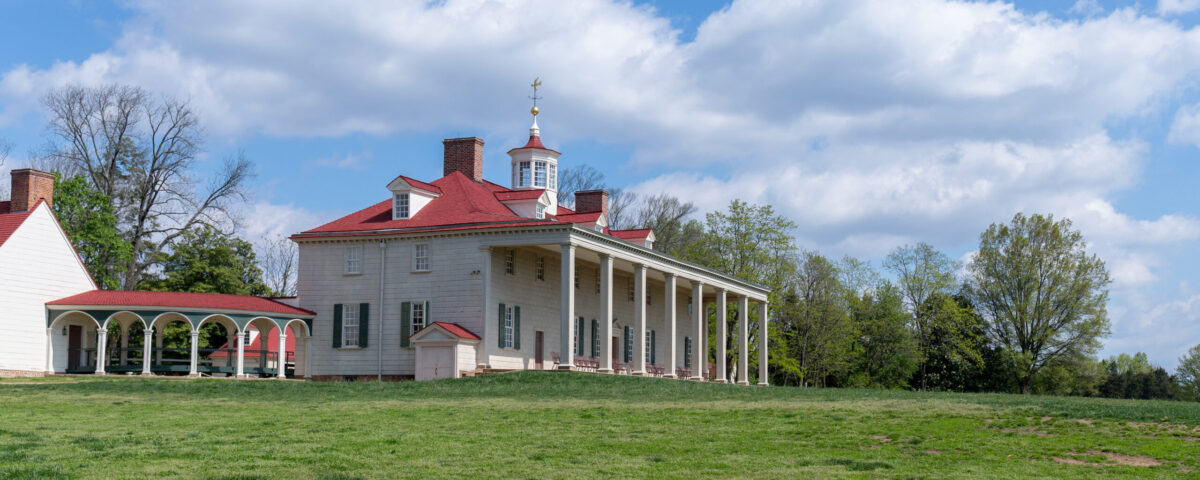
Late on an autumn night in 1853, a passenger boat slowly made its way down the Potomac River. Adhering to a tradition that began during the War of 1812, the captain tolled a bell in solemn respect for George Washington as the craft passed Mount Vernon, his beloved Virginia estate. The sound awakened Mrs. Louisa Cunningham, a passenger on the boat who had been sleeping in one of its cabins. She ventured out on deck and beheld a dramatic but heartbreaking sight: Mount Vernon, illuminated by the moon, was in a state of ruin, its roof collapsing and its old, weakened portico held upright only by means of unsightly wooden supports. Overgrown shrubs, tall grass, and withered trees surrounded the once proud home of the first president.
Disturbed by the sight, Mrs. Cunningham described the experience in a letter to her daughter, Ann Pamela, who at the time was receiving treatment in Philadelphia for a permanent spinal injury. “I was painfully distressed at the ruin and desolation of the home of Washington,” Mrs. Cunningham wrote, “and the thought passed through my mind: Why was it that the women of his country did not try to keep it in repair, if the men could not do it? It does seem such a blot on our country!” As her daughter read this, she was filled with a sense of purpose that could be quelled by nothing less than rescuing and preserving Mount Vernon as a permanent memorial to President Washington.
Confined to her bed, Ann needed considerable help to initiate such a large undertaking. She composed a forceful letter urging the “Ladies of the South” to become active in raising enough money “to secure and retain the home and grave” of Washington “as a sacred spot for all coming time!” She signed the letter “A Southern Matron,” lest anyone know the identity of the woman who dared such a task, and sent it to the Charleston Mercury, which printed it in December 1853. Other newspapers copied the letter, effectively publicizing her initial effort to obtain and preserve the estate. But before Ann Cunningham and the ladies she enlisted could pursue their goal, they would have to overcome numerous obstacles, not the least of which was opposition of John A. Washington, Jr., great grand nephew of George Washington and the last private owner of Mount Vernon.
Following President Washington’s death in 1799, Mount Vernon passed through a long line of heirs who, for either financial or occupational reasons, had been unable to maintain the estate. By the time Mount Vernon came to belong to John A. Washington, Jr., years of unintentional neglect seriously jeopardized its future. Aware that he could not maintain the estate, the newest owner made several unsuccessful attempts to sell it to either the state or federal government. Speculators and other undesirable venturers offered large sums of money for the home, but Washington refused to sell the property to anyone with questionable motives. He looked with skepticism on every offer, including that of the frail Miss Cunningham and her determined followers.
When she learned that Mount Vernon was for sale, Ann feared that she would not have time to organize an effective fund-raising campaign. To forestall a quick sale, she wrote to Mrs. Washington in late 1853, hoping to appeal to her more gentle personality. With great diplomacy Ann explained, “when you reflect on the rare nature of this enterprise and the results which must follow its success, I trust Mr. Washington and yourself will not only return a favorable answer to our appeal for time, but will determine in your hearts that no other shall be allowed to possess Mount Vernon, not even Congress, should they apply at last.”
In early 1854, Ann held a public meeting in her hometown of Laurens, South Carolina, to organize a fund-raising campaign. Inside a small, rustic church, her mother presided over the assembly, generously beginning a subscription list with her own hundred-dollar donation. By the end of the meeting $293 had been raised. This gathering marked the beginning of what would become the Mount Vernon Ladies’ Association of the Union.
Soon citizens nationwide became aware of the struggle to save Mount Vernon. Newspapers whose editors were sympathetic to the ladies earnestly spread word about the cause. The editor of the Mobile Herald and Tribune wrote an article supporting the women’s endeavors saying, “the purchase of Mount Vernon by women impresses me as a most admirable way to secure the property and set it solemnly apart to the guardianship of the hero’s grave. The form of the tribute, hallowed by womanly affections and executed by womanly devotion, is the most fitting it can assume.”
The newspaper accounts alerted famous orator Edward Everett to the women’s cause. When the 61 year old admirer of George Washington met Ann in 1856, he was smitten with a desire to aid the Mount Vernon campaign and decided to do so by using his talent as an orator. Thereafter, he deliver his popular speech on the first president’s character to benefit the Ladies’ Association. Everett’s assistance marked a turning point in the history of the Mount Vernon Ladies’ Association, and his speechmaking tours provided vital financial support and prestige.
Less than two weeks after Cunningham met with Everett, the ladies faced a legislative battle that was essential to their cause. They discovered that they had no legal foundation on which to assume ownership of Mount Vernon and needed a formal charter stating their goals, financial plan, and proposed method of ownership. Once formulated, the charter had to be presented to the Virginia legislature for approval. In ante-bellum society, where women were not encouraged to become involved with financial matters or the managing an estate, the ladies needed a mixture of charm and firm resolution to be successful in the ensuing fight for a charter. They found a champion who possessed these traits in actress and playwright Anna Cora Mowatt Ritchie.
Mrs. Ritchie, who had enjoyed a successful acting career before marrying the editor of the Richmond Enquirer, played a lasting role in the struggle to preserve Washington’s home. She and her husband, who also lent his support, invited a number of the state legislators to their home one evening. After plying their guests with fine Southern cuisine and a “musical soiree,” they tactful raised the subject of the charter. Lulled by the evening’s festivities, the legislators were receptive to the idea of a charter, some immediately pledging their sincere support. Overjoyed by the response, Mrs. Ritchie wrote to Ann exclaiming that “Governor Floyd pledged himself to use his best endeavors to pass our bill and at once–so did all the other members and senators present. After all the ladies had left, the gentlemen still remained and talked to me, and some were actually warmed into enthusiasm . . . .”
Unfortunately, that enthusiasm quickly subsided, and the bill needed for the charter was not brought before the legislature as expected. Badgered by persistent inquiries from the ladies, the legislature finally considered the bill a month later. To ensure that the bill would reach the floor of the House, Ritchie and several women of the Richmond Mount Vernon Committee prudently converged on the state capitol on March 17 to hear the momentous decision. Anxious as to the fate of their endeavor, they conspicuously sat in full view of the membership. In the House of Representatives, only two opposing votes were cast; the Senate passed the charter unanimously. The Mount Vernon Ladies’ Association had overwhelmingly achieved legal status. Filled with enthusiasm after the victory, Anna Ritchie proudly wrote to Miss Cunningham, “Mount Vernon is secure–is ours! We may be sure of that. All praise and honor be to you.”
A mere one hundred miles away at Mount Vernon, however, John Washington, Jr., coldly delivered a different opinion. On learning that the Ladies’ Association had been chartered, Washington quickly withdrew Mount Vernon from sale. His reasoning has never been determined, though a number of speculations have been made. He may have disliked the idea of turning the property over to a group of women or disagreed with the provisions of the charter. Always fearful that Mount Vernon would fall into unworthy hands, he may have believed the charter too loosely constructed.
If the latter were the case, he need not have worried. The charter rested on a fail-safe plan. It stated that the Mount Vernon Ladies’ Association had indeed already begun raising funds through public subscription to purchase the estate, and that they would turn a large part of the money over to the care of the Commonwealth of Virginia, whose governor would then approach Washington to procure a contract. Once signed, that document would bind Washington to transfer the deed to Mount Vernon, along with two hundred acres of land, over to the care of the Ladies’ Association, which would remain under the state’s supervision. The governor would pay Washington $200,000 from the funds collected by the ladies for formal possession of the house and property. Should the association be unable to maintain the estate, the Commonwealth would take charge of the operation.
As the public learned that Mount Vernon was not for sale, donations rapidly diminished. Other less spirited individuals would have abandoned the fight to preserve the house; Ann Cunningham, however, refused to give way. The following June, she boldly made arrangements to see Washington personally.
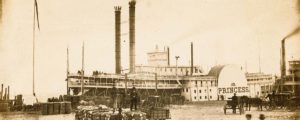
During the summer of 1856, Ann journeyed down the Potomac on a steamboat to Mount Vernon. Lacking the strength to walk from the dock up the hill to the mansion, she arranged to be carried up in a chair. Mr. Washington received her courteously but remained unreceptive to her plans. According to her account of the meeting, written a decade later, Ann told Washington that “it was leap-year, woman was bound to have her way, he might resist with all his might, but I knew I was to be the victor, and must counsel him to follow the example of his illustrious ancestor, who never acted upon a grave affair without having slept on it.”
Having suffered a number of personal attacks on his character for refusing to sell Mount Vernon, Washington’s resolve had hardened to the point where neither additional sleep nor thinking would lead him to change his mind. Ann, unaware of this as she approached Washington just before climbing into her carriage to leave Mount Vernon, expressed her heartfelt regret at how the public was treating him. Remembering the scene, she wrote, “I looked up to him as I said this. What a change in his face! Unawares, I had at last touched the sore spot, the obstacle no money could have removed. I now found that he believed the whole thing had been arranged between the Association and Virginia to put an indignity upon him!!”
Now that both parties understood the situation, tension eased considerably. Washington still tried to bypass the Ladies’ Association and sell the property directly to either the federal or state government, but he continued to have no success.
By 1858, Mount Vernon was on the brink of ruin. Washington must have realized the hopelessness of his situation, for on March 14 Ann received a letter from him in which he considered turning the mansion and a large portion of land over to the care of the Ladies’ Association. In a cold, formal tone he wrote, “Under the circumstances, and believing that after the two highest powers in the country [the federal and state governments], the women of the land will probably be the safest, as they will certainly be the purest, guardians of a national shrine, I am willing so far to comply with your request as to await for a reasonably limited period of time the propositions you may wish to make to me on behalf of the Association over which you preside.”
At the very time Ann was reading Washington’s letter, a new charter of incorporation was being drafted. Like the first, it stipulated that Mount Vernon was to be “forever held . . . sacred to the Father of His Country” and, should the Association disband, the Commonwealth of Virginia would assume ownership of the property. Accompanying the new charter was a constitution outlining the formal offices of the Ladies’ Association; one regent would preside over a council made up of a number of vice-regents chosen from each state in the Union. The Virginia legislature easily passed the revised charter and the new constitution, and the governor approved them on March 19. Gaining legal authority to purchase Mount Vernon, the first regent–Ann Cunningham–invited Washington to Richmond to sign the papers. He, accepted the terms of the contract, which he signed on April 6, 1858.
The $200,000 price was an enormous sum for that time. Washington received a down payment of $18,000, the remainder of the money to be paid in four annual installments. The Washingtons retained the right to live in the house until final payment was made.
Mount Vernon’s mansion and grounds looked as if they had long been abandoned. In July 1858, Harper’s Weekly published an article describing the deplorable condition of the estate. Though slanted to promote the endeavors of the Ladies’ Association, the article was filled with images of “decay on every side. . . . Normandy contains far better preserved memorials of William the Conqueror than Virginia does of Washington.” The ladies would require considerable time and money to restore the house and grounds to the condition in which General Washington had known them. Fortunately, they had Edward Everett on their side.
In addition to his speeches on Washington, Everett agreed to write a year-long series of weekly essays for the New York Ledger and donate his $10,000 fee to the Ladies’ Association. In all Everett raised more than $69,000 for the restoration of Mount Vernon.
To manage the large sums of money given to the association, Everett nominated a close friend and international banker, George Washington Riggs, for the office of treasurer. On May 7, 1858, Riggs wrote to Ann that he would happily serve in the post with the understanding that “no compensation or salary” would be “attached to the office.” Honored by Riggs’s enthusiasm, the regent gladly made him an integral part of the organization.
In February 1859, the association paid Washington $41,666 as a second installment. The ladies had hoped to pay off the full price of the estate by that time but wisely decided to direct some money toward much needed repairs since the house seemed as if it would collapse before they could take possession of it. In July Riggs surveyed the situation and reported that “the timbers supporting the roof are almost entirely gone. . . . A severe storm might blow it down in its present condition.” Masts from boast supported portions of the portico; the house needed painting; windows were in need of repair; parts of the front staircase balustrade had to be replaced; and outside, the gardens that had delighted General Washington required much attention, as did the tomb. An elderly man who visited Mount Vernon in 1802 was consulted about the location of the ground’s original walkways. He apparently remembered a great deal about the estate’s early-nineteenth-century condition, for he remained a rich source of information as late as 1872.
Slowly, the restoration proceeded. Although anxious to obtain full ownership of the property, the Ladies’ Association members were realistic enough to see that saving the home was of more immediate importance than owning it. With generous donations arriving from all over the country, however, Riggs was able to announce that the final payment to Washington had been made on December 9, 1859. Miraculously, the ladies, led by the irrepressible Ann Pamela Cunningham, had raised enough money to pay for Mount Vernon years ahead of schedule. The Association took formal possession of the plantation on George Washington’s birthday in February 1860.
Nearly a year later, Cunningham arrived at Mount Vernon with her belongings to establish the Association’s headquarters. Crippled by her spinal injury, she settled into a first floor room. During the bleak winter months of 1860, she commented that “everything looks well–a great change in all out-buildings. The portico is up & being painted.” Mount Vernon was rapidly becoming what she had envisioned seven years before: a permanent memorial to George Washington.