The spirit-stirring drum, the ear-piercing fife,
The royal banner, and all quality,
Pride, pomp, and circumstance of glorious war!
-William Shakespeare, Othello
Music has been an integral part of warfare and the soldier’s life since the dawn of history. Even the instruments on which it is played have themselves acquired great symbolic power — a regiment’s drums are second only to its colors as an emblem of honor and tradition. In the 18th century, the act of enlisting was described as ‘following the drum. Even today, those ancient symbols continue to be evoked by titles such as Dave R. Palmer’s Summons of the Trumpet, a study of strategy in the Vietnam War.
The function of music in war has always been twofold: as a means of communication and as a psychological weapon. Among the oldest references to the latter role appears in Chapter 6 of the Old Testament’s book of Joshua, with an exceptionally detailed description of the deployment of ram’s horns against Jericho, the oldest fortified human settlement known to archaeology. Although ram’s horns do indeed make a powerful blast of sound (to use the phrase favored by King James I’s translators), they can hardly be assumed to have been sufficient in and of themselves to level Jericho’s 7-meter-high walls of thick, undressed stone. Still, the biblical account of his campaign makes it clear that Joshua was a most subtle general who compensated for the numerical and technological inferiority of his men (at least some of Jericho’s Canaanite garrison had iron weapons, whereas the Israelites’ were entirely of bronze) by means of intelligence gathering, hit-and-run tactics and psychological warfare. Barring a highly coincidental earthquake, the story’s description of Jericho’s walls collapsing was most likely allegorical. Even if the exact nature of Joshua’s strategy remains conjectural, however, it seems clear that his elaborate scenarios, staged in view of the defenders and climaxing with his priests blowing their horns in unison, fired up his warriors and weakened the Canaanites’ will to resist.
Both the Greek and Roman armies used brass and percussion instruments — including the ancestors of the modern cornet and tuba — to convey information on the march, in the field and in camp. Greek armies on campaign employed musicians to accompany poetic recitations of odes and paeans designed to remind soldier and citizen alike of the valor of past heroes. After the collapse of Rome in the West, its tradition of martial music was preserved and refined by the Eastern empire in Byzantium.
There was no shortage of such practices among Rome’s Celtic enemies, who for centuries charged — and later marched — into battle accompanied by their own array of horns, drums and bagpipes. So integral were bagpipes to the Scottish martial repertoire that Britain outlawed the instruments after the defeat of Prince Charles Edward Stuart’s Scottish army in 1746 — only to lift the ban for the benefit of its own Scottish regiments soon thereafter.
During the first half of the Middle Ages, music was found in the courts and churches of Europe but not on the battlefield. The Crusades changed that, as they did so much else. Impressed by the Saracens’ use of military bands as both a means of instantly transmitting orders to distant formations and as a weapon of fear and affray, as Bartholomaeus Anglicus expressed it in the 13th century, the Christian knights soon emulated them. Among the Saracen instruments adapted were the anafil, a straight, valveless trumpet; the tabor, a small drum, sometimes snared; and the naker, a small, round kettledrum, usually deployed in pairs. The earliest mention of their use in combat appeared in Itinerarum Regis Anglorum Richardi I, a history of the Third Crusade published in 1648. In one battle fought in Syria in 1191, it describes trumpet calls being used to signal the start and recall of a Christian cavalry charge.
When veteran Crusaders returned to Europe, they brought instruments and ideas with them. As they were absorbed into various feudal or mercenary armies, the use of martial music spread rapidly. Such music also acquired new modifications, as different soldiers adapted it to their local tastes and practical needs. To the trumpets and drums were added shawms (early double-reed wind instruments) and bagpipes. Bands accompanied armies on campaign, played aboard ships or added their pomp to tournaments, festivals and other court functions.
In his 1521 treatise Libro della arte della guerra (The Art of War), Niccoló Machiavelli wrote that the commanding officer should issue orders by means of the trumpet because its piercing tone and great volume enabled it to be heard above the pandemonium of combat. Cavalry trumpets, Machiavelli suggested, ought to have a distinctly different timbre, so that their calls would not be mistaken for those pertaining to the infantry. Drums and flutes, he averred, were most useful as an adjunct to discipline on the march and during infantry maneuvers on the battlefield itself. One of his contemporaries commented at that time, Such a custom is still observed in our time, so that one of two fighting forces does not assault the enemy unless urged by the sound of trumpets and kettledrums.
By the end of the 17th century, warfare had become a stylized and highly formal business, as fierce charges gave way to the application of pressure by movement and massed firepower. Soldiers of the 1700s were required to function almost as automatons, to obey, smoothly and in formation, whatever commands were given by their superiors. With clouds of gunsmoke added to the din of combat, oral commands or personal example were not always reliable means of giving direction to an army. An order that was not heard — or worse, not understood — could be as dangerous as the enemy. Musically transmitted signals, however, could be heard above the crash of gunfire. The voice of the trumpet and the cadence of the drums were clear and unambiguous, making them vital to command and control.
Over time, the various national armies of Europe standardized their musically conveyed orders into a set of calls. Manuals from as early as the mid-16th century list such calls as Marche, Allarum, Approache, Assaulte, Retreate and Skirmish. Being able to identify those signals and translate them into specific actions was as basic a training skill as loading a musket.
Every nation eventually adopted its own signature march — the precursor of the modern national anthem — and its troops were required to memorize it as well. Amid the smoke of battle, a column of troops on the move half a mile away might be friendly or hostile, but even if their battle standard was obscured, they might be identified by their march music. Resourceful commanders had a way of sneakily turning those conventions to their advantage. In one incident during the Thirty Years’ War, a German force deceived its opponents by maneuvering to The Scots Marche. During the Battle of Oudenarde in 1708, a key fight in the War of the Spanish Succession, Allied (Anglo-Dutch-Austrian) drummers played The French Retreate so convincingly that part of the French army did, in fact, withdraw from the field.
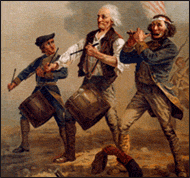 |
| Yankee Doodle 1776, by A.M. Willard, typifies music’s wartime role throughout the ages — both as a means of battlefield communication and as a way to generate patriotism and bravery. (Library of Congress) |
When the first American soldiers manual — compiled by Maj. Gen. Wilhelm von Steuben — was issued to the Continental Army in 1778, it contained a list of beats and signals modeled on those used in European armies. More quickly than in Europe, however, the bugle replaced the fife and drum ensemble in the American ranks. In 1867 bugle calls for the U.S. armed forces, mostly patterned after French models, were codified and standardized into a form that largely survives today.
Although the electronic age has largely relegated bugle calls to ceremonial functions, they can still be resurrected if power or circuits fail. Communist Vietnamese forces used bugle calls in two 20th-century Indochina wars. The Chinese, who lacked modern radio communications, also used bugles during the 1950-53 Korean War. American soldiers and Marines were quite unnerved by the haunting sound of the Chinese bugle calls, stylistically alien to their ears, echoing among the dark hills around them. Their function was, in fact, the same as it had been in the 16th century, but the psychological effect revived that of the ram’s horn millennia earlier.
While burgeoning technology eclipsed the need for music to accompany movement on the battlefield by the mid-20th century, it remained an effective means by which states could manipulate the morale, energies and attitudes of armies and indeed entire populations. Perhaps it is difficult for 21st-century media cynics to look back on the quaint ditties that were popular in World War I and comprehend just how powerful a song such as Over There could be as a motivator of patriotism. Nevertheless, the classic songs of that period crystallized and gave form to an enormous amount of inchoate popular emotion.
It was during World War II, however, when both radio and cinema had become mature, ubiquitous technologies, that it became possible for governments to impress the art of music wholly into their service. Marches were still effective in all their customary roles, and the popular song again became the vehicle for knee-jerk sentiments. Most historians of popular culture agree that World War II’s pop songs were curiously inferior to those of World War I — few outlived their brief moment, and most have become dated to the point of embarrassment — but World War II was also the first time that classical music was mobilized as a weapon of war.
The Allies co-opted a prize from the Axis by adopting as their trademark the opening notes of Ludwig van Beethoven’s Symphony No. 5 — three Gs and an E-flat, corresponding to three dots and one dash in Morse code — to signify V for Victory. That musical signature served as a recurring leitmotif in Allied films, concerts and countless other forms of propaganda. How it must have galled Josef Goebbels not to have thought of it first!
Every combatant nation had musicians willing to contribute what they could to the war effort. In the United States, everyone from Frank Sinatra to Leopold Stokowski gave War Bonds concerts and made recordings exclusively for the armed forces. Jazz leader Glenn Miller lost his life en route to play for troops overseas, and cornetist Jimmy McPartland landed on D-Day with the U.S. infantry.
Nothing generated greater support for the Soviet Union than the dramatic story surrounding the creation and export-under-fire of Dmitri Shostakovich’s Symphony No. 7, subtitled Leningrad. A frail man with a weak heart, the composer was told that his greatest service to the Motherland would be to continue practicing his art, rather than serving in the Red Army. In July 1941, however, with the Wehrmacht advancing on Leningrad, he began composing his seventh symphony between shifts as an air raid fireman and while under heavy aerial bombardment. In October the Kremlin ordered him flown out of the city to the wartime capital of Kuybyshev on the Volga River. There, he completed his symphony and dedicated it to Leningrad, which by then was undergoing the most frightful and protracted siege of modern times.
Worldwide interest in the new work ran high. The orchestral score was microfilmed and flown to the West in a dramatic odyssey that included top-secret stops at Tehran and Cairo. Arturo Toscanini and Leopold Stokowski nearly came to blows as they vied for the right to conduct its North American premiere. Toscanini ultimately outmaneuvered his rival, although he later dismissed the work as trash. American audiences received it ecstatically, however. Its opening movement, featuring a hypnotic 13-minute crescendo depicting the relentless Nazi advance, is a gripping musical impression of mechanized warfare, and its concluding movement is a thrilling paean to victory. In terms of generating political, emotional and financial support for the Soviet cause, that one piece of music was worth three or four Murmansk convoys.
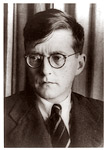 |
| A native of Leningrad, Dimitri Shostakovich composed most of his Seventh, or Leningrad, Symphony from the besieged city. (Library of Congress) |
Even though the German propaganda ministry was scooped on Beethoven’s Fifth, there was plenty of music left to work with. The Third Reich had inherited a treasure trove of musical culture, produced by an unbroken line of musical geniuses ranging from Johann Sebastian Bach, Wolfgang Amadeus Mozart, Beethoven, Franz Schubert, Robert Schumann, Johannes Brahms and Richard Wagner to Anton Bruckner.
Wagner’s operas in particular were for Goebbels and his vast bureaucracy metaphors and symbols that could be used to lend prestige to the Nazi regime, and resonance to the blathering of its ideologues. Adolf Hitler was equated with the Wagnerian hero Siegfried. It was even rumored in the 1930s that Winifried Wagner, the composer’s daughter-in-law, was destined to become Hitler’s wife.
There were, of course, some untidy details in the picture of German music under the Nazis. Felix Mendelssohn’s music vanished overnight — in spite of his Catholic conversion, he remained a Jew in Nazi eyes — as did the music of Paul Hindemith (officially and inaccurately labeled a decadent modernist), who became a U.S. citizen. Germany’s other greatest living composer, Richard Strauss — by 1940 a crotchety, cynical old man — accommodated himself easily to the new regime. Pianist Walter Gieseking promoted German Kultur by means of tours in neutral countries. Other ambitious young men, such as conductor Herbert von Karajan, took advantage of the Reich’s cultural peculiarities to advance their careers in a manner they have since defended as apolitical, but which many historians have regarded as simply coldblooded.
The musical world has always had its own politics and frequently Byzantine backstage intrigues, but the greatest artists — whatever their medium — prefer to inhabit an inner, spiritual world that does not mix comfortably with ideological and political priorities. Thrown suddenly into a totalitarian society, such artists can be corrupted by their own naiveté — as was the Dutch conductor Willem Mengelberg, whose political instincts were those of an adolescent child, but who was exiled from his country in 1945 for collaboration. Or, left defenseless by their idealism, they can be crushed by the apparatus of the state.
In the case of German conductor Wilhelm Fürtwangler, probably the most profound interpreter of the Austro-German repertoire the world has ever known, that struggle reached tragic dimensions. Fürtwangler’s career was almost ruined, and his death in 1954 undoubtedly hastened, by worldwide accusations that he was a Nazi or at least a servant of the Reich. Overwhelming evidence has surfaced since the war, however, to cause him to be viewed more sympathetically. The product of a sheltered, highly cultured upbringing, for years he was simply unable to take the Nazis seriously. When he finally realized the extent of their evil, he fought them from within, taking upon himself the burden of trying to be the conscience of German civilization. As early as 1933, Fürtwangler lodged a public protest to Goebbels about the mistreatment of Jewish artists. Unwilling, due to Fürtwangler’s international fame, to move against him openly, Goebbels responded that those of us who are creating modern German politics consider ourselves artists…art can be not only good or bad, but racially conditioned….
As Goebbels’ Propaganda Ministry assumed control over the press, theaters, cinemas and concert halls, the works of more than 100 impure composers vanished. The ranks of most orchestras were purged of their Jewish musicians, and such great musical artists as Bruno Walter, Otto Klemperer, Artur Schnabel and Lotte Lehmann went into exile. Fürtwangler agonized over whether to follow his colleagues — had he done so, he could have had his pick of orchestras in the United States or unoccupied Europe. But he was unable to believe that his beloved homeland was unshakably in the grip of what he viewed as street-brawlers and psychopaths. Surely, he rationalized, if he could keep before the German people the ideal example of Beethoven’s music, then sanity would return to the nation. He therefore chose to stay and mount a one-man spiritual resistance. I felt that a really great work of music was a stronger and more essential contradiction to the spirit of Auschwitz than words could ever be, he wrote after the war. It proved to be a noble but naive attitude, and it was totally misunderstood by many outsiders. Just before war broke out, Fürtwangler visited composer Arnold Schönberg, whose music had been banned. Torn between fleeing or remaining in Germany, the tormented conductor cried, What must I do? Calmly, sadly, Schönberg replied, You must stay and conduct great music.
Fürtwangler did more than that. He publicly fought the Nazis on such issues as banning Hindemith’s music and the 1939 order to dissolve the Vienna Philharmonic, which was rescinded due to his passionate intervention. He used his influence and international contacts to save the lives of many Jewish musicians, and obstinately refused to honor Nazi protocol demanding that every conductor begin his concerts with the raised-arm salute — an insult that raised audience applause and made Hitler seethe with rage. In regard to conducting in occupied countries, Fürtwangler wrote Goebbels, I do not wish to follow tanks into countries in which I have formerly been an invited guest.
Although Fürtwangler’s prestige protected him to some degree, the Gestapo was prepared to arrest his entire family if he showed any sign of fleeing the country. The defiant conductor must have known that, even as he knew that his telephones were tapped and his mail tampered with. In the final weeks of the war, Reichsführer Heinrich Himmler, who hated him far more than Goebbels did, determined to take the conductor down with the regime. Fürtwangler escaped to Switzerland just hours ahead of the Gestapo order for his arrest.
By 1945, the use of music to fuel German morale reached a saturation level. For some reason, Les Préludes by Hungarian composer Franz Liszt — whose romantic works had, after all, influenced his son-in-law, Richard Wagner — was always used to accompany film footage of dive bombers. Les Préludes was also used as a signature theme for the Sondermeldung, or special announcements, that periodically interrupted normal radio programming to announce victories, after the reading of which a snappy contemporary march would be played. We’re Marching Against England was played ad nauseam in 1940-41, then quietly replaced by anti-Bolshevik themes when the Wehrmacht moved east instead of across the Channel. There was a carefully nurtured atmosphere of ceremony surrounding those broadcasts; Goebbels considered it vitally important that this image be preserved, even after the tide of war had obviously turned against the Reich. When a weekly magazine had the audacity to print a photograph of the recording used to herald the Sondermeldung announcements, Goebbels threatened the editors with a long vacation in a concentration camp.
In spite of Goebbels’ calculated efforts, the Brownshirt marches that set feet a-tapping in 1934 had started to grate on people’s nerves by 1944. Germans made bitter jokes about them. The light music programs that were piped throughout the Reich as a kind of Muzak had to drop Dancing Together Into Heaven from their play lists when Allied bombing raids lent them a measure of ghoulish irony. Mozart’s Requiem was banned as too depressing. Operas such as Beethoven’s Fidelio and Giacchino Rossini’s William Tell, with their themes of liberty triumphing over tyranny, were eventually suppressed. Jazz and swing music, naturally, were verboten.
Wounded heroes back from the Russian Front were not only rewarded with Iron Crosses but with passes to the Wagner Festival at Bayreuth — possibly not the ideal way to spend one’s furlough, especially if the featured opera chanced to be the 17-hour-long Der Ring des Nibelungen. Orchestras gave concerts in the Krupp munitions plants, although how much spiritual sustenance the undernourished, exhausted tank assemblers might have derived from those events is open to question. Round-the-clock radio broadcasts constantly featured the works of great Aryan composers. In order to broadcast the lengthy symphonies of Anton Bruckner without interruption, German technicians made the first significant use of magnetic tape as a recording medium. Allied intelligence personnel, monitoring those broadcasts in the wee hours of the morning and unaware of the new tape technology, assumed that Goebbels kept ordering the entire Berlin Philharmonic out of bed at 3 a.m. to play live concerts.
In his novel War and Peace, Leo Tolstoy observed that the effectiveness of an army is the product of the mass multiplied by something else; by an unknown ‘X’….the spirit of the army. Throughout history, music has had the effect of raising that unknown ‘X’ by a considerable power. What was true of the Saracens during the Crusades remained true during later conflicts. In 1861, at the outset of the American Civil War, a young South Carolina private wrote after an especially rousing concert: I have never heard or seen such a time before. The noise of the men was deafening. I felt at the time that I could whip a whole brigade of the enemy myself!
What works for a regiment can be made to work on a national level, to a greater or lesser degree, depending on the skill and persuasiveness of the manipulation. Even the horrors of modern warfare have proved easier to bear when their struggles are identified with and ennobled by great music. In 1942, on a nameless killing ground on the Russian Front, a diary was found in the pocket of a dead German soldier who had just returned from leave in Berlin. One of the last entries concerned a concert he had attended. Last night I heard a performance of Bruckner’s Ninth, the young man had written, and now I know what we are fighting for!
This article was written by William R. Trotter and originally published in the June 2005 issue of Military History magazine.
For more great articles be sure to subscribe to Military History magazine today!