
Wyatt gave Spike the bad news, that the bullet intended for the mayor had instead killed Dora Hand. Kenedy took out his rage on the rifle-toting Masterson, telling him, ‘You ought to have made a better shot than you did!’ Bat replied, ‘I did the best I could.’
How does a cowboy from the Texas Panhandle kill the most popular woman in a Kansas cow town and not hang for the offense? The cowboy was Spike Kenedy. The woman was Dora Hand. And the town was Dodge City. It happened in the fall of 1878. The strange fate that brought these two people together in a tragic shooting incident is by itself a fascinating frontier tale. Adding dash to the drama is the fact that Mayor James H. “Dog” Kelley was unwittingly involved, and four of Dodge City’s legendary lawmen—Wyatt Earp, Bat Masterson, Charlie Bassett and Bill Tilghman—had a hand in chasing and apprehending the killer.
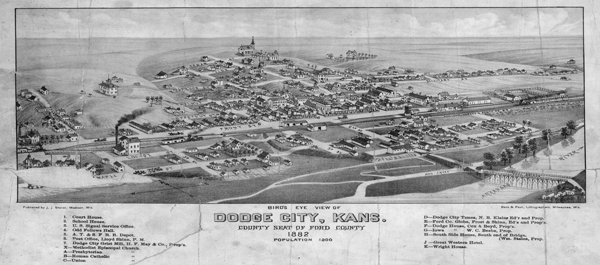
In 1878 Dodge was a cattle-trading and -shipping center with a reputation for mayhem, especially when Texas drovers hit town to shake off the trail dust. Sober citizens had begun to temper Dodge’s rowdy reputation. But the famous lawmen of Dodge and Ford County could only do so much to control the hard-drinking cowboys and gamblers. On April 9, Texas cowboys killed Bat’s brother Ed Masterson, the town marshal. Still, by fall Dodge seemed to be settling down. Then, on October 4, things heated up again when a kind and refined lady of the stage was shot in her sleep.
In October 1878, James “Spike” Kenedy was a dark and handsome 23-year-old who favored his Mexican mother, Petra. He was also the willful and wayward son of Mifflin Kenedy, a stern former ship’s captain and Pennsylvania Quaker who had come west to seek his fortune. For a while, Mifflin had partnered with Richard King in the King Ranch, one of Texas’ largest spreads. When the partnership dissolved in 1868, Kenedy purchased Laureles Ranch, a 172,000-acre tract 23 miles from Corpus Christi. Both King and Kenedy contributed much to the economy of Dodge City. In 1878 alone their cowboys drove 15,000 Longhorns to Dodge, “Queen of the Cow Towns.”
In contemporary accounts, Spike Kenedy is described as a half-breed, and short shrift is given his mother. Petra Vela de Vidal Kenedy, in fact, was the daughter of Gregorio Vela, a onetime provincial governor of Mexico under Spanish rule. Petra had married Mexican army Colonel Luis Vidal and was already a 26-year-old widow when she married Mifflin Kenedy on April 16, 1852. She was beautiful, intelligent and a devout Catholic. She bore Vidal five children and Mifflin six, including Spike, Mifflin’s second oldest son. Henry F. Hoyt, a doctor who knew young Spike, wrote of him, “With his athletic physique, dark hair and eyes, he was the handsomest bachelor in the panhandle.”
The young Kenedy shared neither his mother’s devotion to the Catholic Church nor his father’s strict Quaker leanings. According to Bat Masterson biographer Robert DeArment, “[Spike] liked whiskey, whooping and whoring, and as heir to the Kenedy fortune, he considered himself immune to arrest by cow-town marshals.” At Ellsworth, Kan., on July 20, 1872, Spike had an altercation at a poker table with the well-known gunfighter Print Olive, and both men suffered gunshot wounds. By reaching into his pockets, Mifflin Kenedy managed to get his son off the hook in Ellsworth, but Spike didn’t learn any valuable lessons.
During much of the 1870s, DeArment says, Spike hung around Tascosa, Texas. Hoping to make a man of his unruly son, Mifflin Kenedy established him in the panhandle with 2,000 cattle and a crew of herders. At first it seemed to work. But Spike would revert to his wild ways whenever he set foot in Dodge City, where, according to one acquaintance, he “was unable to withstand the temptations of the underworld.” He was quite a contrast to Dora Hand, the refined lady who managed to take the “Wickedest City in the West” by storm.
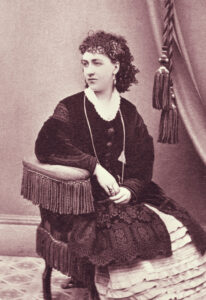
Described as “beauteous and gifted,” Hand was a 34-year-old actress and singer who had drifted to Dodge from the East. Her background is a mystery. Legend has it she came from a good Boston family, had studied music in Europe and had once been a grand opera singer under contract with a major impresario in New York. Like Doc Holliday, she was supposedly battling tuberculosis and had come west for the healthier climate. The estranged wife of musician Ted Hand, she used the stage name Fannie Keenan.
Hand came to Dodge City on the advice of friend Fannie Garretson, a seasoned performer who had made the rounds of the cow towns and mining camps. Garretson was also a friend of Dog Kelley, the flamboyant Dodge mayor and part owner of the Alhambra Saloon and Gambling House. Through that connection, Garretson and Hand landed stage gigs for a lucrative $40 a week at the Lady Gay Dance Hall and Saloon, co-owned by Ben Springer and Jim Masterson (younger brother of the late Marshal Ed and Ford County Sheriff Bat). Some accounts claim Hand arrived in Dodge City as early as May 1877, while others suggest she didn’t get there until the summer of 1878.
In any case, the men of Dodge quickly took notice. In Wyatt Earp: Frontier Marshal, author Stuart Lake describes Hand as “the most graciously beautiful woman” to come to Dodge “in the heyday of its iniquity.” In The Trampling Herd, Paul Wellman writes, “By all accounts, she was a beautiful creature, with a face and voice which gave men strange nostalgic dreams of better days and finer surroundings.” An archived magazine article from Dodge City’s Boot Hill Museum describes her thus: “[She] was of medium height and build, with a face of classic beauty. There was a grace and charm in her walk. She dressed plainly, usually in black, and this color seemed to accentuate the ivory whiteness of her soft skin.”
Hand was an instant hit at the newly opened Lady Gay. In Notorious Ladies of the Frontier, author Harry Sinclair Drago describes the saloon as a “free-wheeling resort, with its bar at the rear of the auditorium doing a land-office business between acts.” Rowdy or not, the Lady Gay boasted such popular entertainers as comedian Eddie Foy. And now Hand seemed a rising star, professionally and personally. Not only did she win over the rough, rambunctious cowboy audience with her good looks and trained soprano voice, but she also made a conquest of the mayor.
Dog Kelley was often seen squiring Dora around town. Soon she was the featured soloist at the Lady Gay, earning an astronomical $75 a week. Kelley also worked out an agreement with the owners of the Alhambra, allowing the lovely lady to sing there five nights a week for two hours. “This arrangement must have added considerably to her income, for she now turned in earnest to succoring the poor and unfortunate, and it is as an angel of mercy that Dodge remembers her,” Drago writes. “She was often observed setting out in the morning, modestly dressed, with a market basket bulging with groceries on her arm. Somewhere in its depths there was likely to be found a toy or a bit of candy she had promised to an ailing child—white, black or Mexican.”
In Dodge City: Queen of Cowtowns, Kansas historian and author Stanley Vestal also speaks of her generosity: “During the day she proved a kindly, resourceful and energetic person, always ready to help anyone in trouble. If some raw boy from Texas who had never even seen a train before lost his pile at faro or drank too much redeye and was rolled south of the Deadline, she could be counted on to grubstake him or redeem his saddle so that he could ride home. She asked no security or even the names of the men she helped. When someone fell sick, she was willing to play the part of a practical nurse. Of course, in such a small community, everybody knew all about everybody else, and few people in Dodge were more respected than Fannie Keenan.”
She helped raise public consciousness about the “unfortunate poor,” Drago writes. Her good deeds also prompted some of the more charitable citizens to do something to help. But, as Drago reveals: “Some of the members of the Ladies Aid Society of the First Methodist Church resented being shown their duty by ‘such a woman.’ The Reverend Mr. Wright confounded her critics by inviting Hand to appear as soloist at the Sunday evening services. When she took her place beside the organist, the church was crowded to the doors, which was something of a phenomenon. An hour later she was back on the stage at the Lady Gay.” Lake sings further praises for her cow-town generosity: “By night she was the Queen of the Fairy Belles, as old Dodge termed its dance-hall women, entertaining drunken cowhands after all the fashions that her calling demanded. By day she was the Lady Bountiful of the prairie settlement, a demurely clad, intensely practical, generous, forceful woman, to whom no appeal for the succor of another’s trouble would go unheeded.”
No one showed a greater interest in Dora Hand than Dog Kelley. According to Drago, he was both an admirer and unofficial sponsor. In Cowboy Capital of the World: The Saga of Dodge City, Samuel Carter III puts it more bluntly, “Not only was Kelley often seen at the two saloons where Dora sang, but Dora herself was often seen going and coming from Kelley’s…cabin on the fringes of the city.”
Kelley was almost certainly not the only man in her life. Drago refers to Hand and her friend Garretson as “seasoned honky-tonk troupers, and their morals may not have been any better than they should have been,” but, he insists, they were not whores. Lake, though, hints that the entertainer may have been one of Dodge City’s high-class soiled doves: “Every man and woman in Dodge, good, bad or indifferent, knew all sides of Dora Hand’s life among them, and, as one of them put it 50 years after: ‘The only thing anyone could hold against her was her after-dark profession, and by Godfrey, I’m allowing that she elevated that considerably.’”
No matter the rumors, Hand’s star continued to rise in Dodge City. In the summer of 1878, she appeared as Fannie Keenan at the Comique—sharing the bill with Fannie Garret-son, Eddie Foy and a troupe of entertainers—and at Ham Bell’s Varieties. At one point she left Dodge to tour with the Hernandez Comedy Company and take in St. Louis. But she returned to Dodge as popular as ever.
While Dora was basking in fame and admiration, Spike Kenedy was falling further afoul of the law. “Of the hundreds of cowpunchers who swaggered through the streets of Dodge that summer of ’78,” DeArment writes, “a few became well known to the peace officers through their penchant for troublemaking and their frequent appearances in police court. One of these was young Jim Kenedy.” On July 29, 1878, Dodge City Deputy Marshal Wyatt Earp arrested Kenedy for carrying and brandishing a pistol. On August 17, Marshal Charlie Bassett arrested him for disorderly conduct. A judge let Spike off with a fine and a warning to stay out of trouble. He didn’t.
Spike Kenedy, like many other men in town, was smitten with the lovely Dora Hand. He was jealous of Dog Kelley’s relationship with the singer and apparently wanted to steal her away from the mayor. “Young Spike,” writes Samuel Carter III, “spent much of his time at the Alhambra, drinking up his father’s money, until he became so drunk one night, and so attentive to Dora Hand, that Jim Kelley threw him out.”
Hand may not have had anything to do with the argument. But Kelley and Kenedy had some kind of falling out and, in particular, had words on August 17 after Spike’s arrest and subsequent release. “Kenedy nursed a bitter hatred for the Dodge City law officers, but he lacked the backbone to take up a personal fight with any of them,” DeArment writes. “Instead, he expressed his grievances to Mayor Kelley one night in Kelley’s own establishment, the Alhambra. Kelley informed him that the marshals were acting under his orders and that young Kenedy had better behave while in Dodge or prepare himself for worse treatment. Kenedy then flew into a rage and leaped at the mayor. Kelley gave the younger man a thorough beating and dumped him in the street. Kenedy was furious. Mouthing dark threats against the life of the mayor, he mounted up and rode out of town. No one in Dodge expected to see him again.”
But the trouble between Kelley and Kenedy didn’t end there. Spike longed for revenge. He couldn’t carry a gun in Dodge City, so, according to some accounts, he began to lay a trap. He watched Kelley closely and noted his nightly routine. Then Spike took a train to Kansas City, bought the fastest horse he could find and returned to Dodge. “In planning revenge,” Lake wrote in his Earp biography, “Jim Kennedy [sic] elected to kill Kelley in his sleep, by shooting through the flimsy wall of the bedroom at the front of the mayor’s two-room shack, which Kelley customarily occupied.”
Kelley’s shack stood behind the Great Western Hotel and was the same “cabin” townspeople had often seen Dora entering and leaving. As the mayor spent many late nights at the Alhambra, he was in the habit of sleeping in the shack. The wood-frame building was partitioned into two bedrooms, and Kelley, as Kenedy knew, slept in the front room.
What Kenedy didn’t know that early October when he returned to Dodge to kill the mayor was that Kelley was suffering from some kind of intestinal illness and needed an operation. But as Kelley was on bad terms with the town doctor, T.L. McCarty, he had gone to Fort Dodge to seek the advice of an Army surgeon. Prior to leaving town, he had invited Dora Hand and Fannie Garretson to stay at the shack. Fannie occupied the front room, Dora the back.
According to articles in the October 5 Dodge City Times and October 8 Ford County Globe, at about 4 or 4:30 on the morning of October 4, a lone horseman rode up to Kelley’s shack behind the Great Western. This “midnight assassin” squeezed off two .44-caliber pistol rounds at the shack and then galloped off. “The first shot,” reported the October 8 Globe, “after passing through the front door, struck the floor, passed through the carpet and facing of the partition and lodged in the next room. The second shot also passed through the door, but was apparently more elevated, striking the first bed, passing over Miss Garretson, who occupied the bed, through two quilts, through the plastered partition and, after passing through the bed clothing of the second bed, struck Fannie Keenan in the right side, under the arm, killing her instantly.”
No one actually saw Kenedy fire the shots. But when Assistant Marshal Wyatt Earp and policeman Jim Masterson responded to the gunshots, they were told Spike had committed the cowardly murder. The outraged citizens of Dodge demanded Kenedy be brought to justice. At 2 p.m. on October 4, a posse set out after the suspected murderer. Ford County Sheriff Bat Masterson, Marshal Charlie Bassett, Wyatt Earp and soon-to-be-lawman Bill Tilghman rode out with Ford County Deputy Sheriff William Duffy. There is some debate over who headed the posse, Masterson or Earp, but it’s of little consequence. The October 12, 1878, Ford County Times rightly dubbed it “as intrepid a posse as ever pulled a trigger.”
The now-famous posse members guessed Kenedy would head for the safety of his rich father’s ranch near Tascosa, Texas. By riding though a fierce rainstorm, they managed to jump the trail ahead of him near Meade City, 35 miles southwest of Dodge. On the afternoon of October 5, Kenedy caught sight of the waiting lawmen and tried to gallop away. But Masterson and Earp quickly put a stop to that—Bat putting a .50-caliber rifle round in Kenedy’s left shoulder and Wyatt shooting Kenedy’s horse out from under him. According to Lake, when the posse pulled the wanted man from beneath his dying mount, Spike immediately asked after the condition of Dog Kelley. “Did I kill him?” Wyatt gave Spike the bad news, that the bullet intended for the mayor had instead killed Dora Hand. Kenedy took out his rage on the rifle-toting Masterson, telling him, “You ought to have made a better shot than you did!” Bat replied, “I did the best I could.” Spike was so badly wounded that on December 16, Dodge City doctors would take 5 inches from his left arm, leaving it permanently crippled.
The posse brought the wounded Kenedy back to Dodge on October 6 and kept him in jail, as much to protect him from angry citizens as to hold him for a murder trial. Predictably, his cattle baron father, Mifflin Kenedy, rushed to Dodge City from Texas. Apparently the elder Kenedy brought with him a satchel full of money. The October 29 issue of the Ford County Globe reported with a wink: “Kennedy [sic], the man who was arrested for the murder of Fannie Keenan, was examined last week before Judge [R.G.] Cook and acquitted. His trial took place in the sheriff’s office, which was too small to admit spectators. We do not know what the evidence was or upon what grounds he was acquitted.”
In a March 20, 1951, letter to historian Stanley Vestal, Stuart Lake reflected that the elder Kenedy had paid as much as a $25,000 “fee” to prominent citizen Bob Wright—with some money likely going to Master-son and other Dodge City officials—to buy his son Spike an acquittal, citing “lack of evidence.”
In the meantime, Hand’s funeral drew one of the biggest turnouts Dodge City had ever seen. One old cowhand who witnessed it was quoted as saying, “Every store, saloon and gambling house in Dodge closed during the funeral, and 400 men with their sombreros on their saddle horses rode behind the spring wagon that carried Dora Hand up Boot Hill.”
“She was a prepossessing woman,” a reporter wrote in the October 5, 1878, issue of the Dodge City Times, “and her artful winning ways brought many admirers within her smiles and blandishments.”
Historians have labeled Dora Hand as anything from angelic nightingale to outright prostitute. Whatever her designation, her shooting death was a frontier tragedy, and Dodge City has never forgotten her.
Susan Leiser Silva, who died on June 11, 2008, helped husband Lee on his multivolume Wyatt Earp: A Biography of the Legend. For her extensive work on illustrations, her name appears on the title page of his Volume II, Part I, subtitled Tombstone Before the Earps. For further reading: Silva’s Volume I, The Cowtown Years, and Thunder Over the Prairie: The True Story of a Murder and a Manhunt by the Greatest Posse of All Time, by Howard Kazanjian and Chris Enss.