
As Orville Wright made a final visual inspection of the aircraft, Lieutenant Thomas Selfridge stood nearby, failing to suppress a grin. The young officer’s excitement irritated Wright. He didn’t trust the man and resented having him along–but the army had insisted. And since Orville and his brother Wilbur wanted to sell airplanes to the army, he had no choice.
The date was September 17, 1908. A few months earlier Selfridge had become the first soldier to pilot a heavier-than-air machine. He had flown a craft named the White Wing for nearly 100 yards at a height of 10 feet. A group called the Aerial Experiment Association (AEA), headed by Dr. Alexander Graham Bell, had built the machine. The Wright brothers distrusted the AEA and thought the rival group had violated Wright patents. Selfridge was the association’s secretary, so Orville naturally bristled at the army’s request that he take the officer along as an observer on a test flight.
Tests had been postponed for three days because of high winds. Finally the air settled enough for the flight to proceed, and a crowd of 2,000 gathered to watch the spectacle on the grounds of Fort Myer, Virginia, adjacent to Arlington National Cemetery and across the Potomac River from Washington, D.C. The plane stood poised on its starting track. “You might as well get in,” Wright said to Selfridge. “We’ll start in a couple of minutes.” The 26-year-old lieutenant smiled and jumped into his seat, looking like an eager schoolboy.
Wright then climbed aboard. Two assistants turned the twin propellers to start the engine as Orville adjusted his goggles. At a signal from Wright, soldiers dropped a rope to release a heavy weight from a tall tower behind the airplane. The weight pulled a catapult wire that shot the plane down a launching rail and into the air. The crowd cheered, then watched with bated breath as the craft struggled into a slow climb. With the 175-pound Selfridge aboard, the plane carried more weight than it ever had before. Wright eased the flyer upward and finally leveled off at 100 feet before steering the craft into its first graceful turn at the far end of the parade ground.
One observer later remarked, “Wright could be seen, hands on lever, looking straight ahead, and Lieutenant Selfridge to his right, arms folded and as cool as the daring aviator beside him.” Selfridge waved to the upturned faces as the plane soared above the crowd at 40 miles per hour. Everything seemed to be proceeding perfectly.
The two fliers had completed three circuits and were airborne but four minutes when Wright heard an unfamiliar tapping sound. Concerned, he shut off the engine and shouted to his passenger that he intended to land. As Wright began the final run a loud crack pierced the air. Below, the crowd gasped as a piece of a propeller fluttered to the ground. The plane immediately dipped sharply to the left. Wright pulled hard on the lever controlling the front rudder. The plane appeared to briefly recover, climbing about 10 feet. Now at an altitude of 75 feet, Wright struggled to keep control. Suddenly, the craft faltered. “Oh! Oh!” Selfridge cried.
Standing near the cemetery wall below, Arlington’s superintendent watched the plane careen into a steep nosedive. “It came down like a bird shot dead in full flight, doing almost a complete somersault and throwing up a dense cloud of dust,” he later reported.
The spectators stood momentarily stunned. Then they surged across the field to the plane. The post commander sensed that the situation could get out of hand and ordered a cavalry guard forward to stem the tide. “If they don’t stand back,” he yelled, “ride them down!” The first rescuers to arrive at the crumpled plane began to clear the debris of wood and canvas. Both fliers lay bloodied across the wire braces in front of their seats. Wright was moaning in pain, his right arm extended under Selfridge as if to hold him up. “Oh, my arm,” he cried. Selfridge was unconscious and had a deep gash across his forehead. “Call for an ambulance,” someone shouted. “Hurry!”
FIFTEEN YEARS EARLIER, in 1893, Alexander Graham Bell sat in his Washington study for an interview with a writer from McClure’s magazine. A man of immense curiosity and intelligence, Bell was not content to rest on his laurels as the inventor of the telephone. He was anxious to get on with a new endeavor–manned flight. “I have not the shadow of a doubt that the problem of aerial navigation will be solved within ten years,” he said. “That means an entire revolution in the world’s methods of transportation and of making war.”
Mastery of the air did seem within grasp. Samuel Langley, a friend of Bell’s and secretary of the Smithsonian Institution, had already launched crude flying models from the tower of the Smithsonian Castle. In May 1896 he invited Bell to witness a test of an aerodrome model at Quantico on the Potomac. The steam-driven, one-quarter-scale model flew for half a mile at a height of 100 feet, marking the first long flight of a self-propelled, heavier-than-air craft. “It seems to me that no one who was present on this interesting occasion could have failed to recognize that the practicability of mechanical flight had been demonstrated,” Bell wrote.
Bell and Langley weren’t alone in their interest. In Dayton, Ohio, brothers Wilbur and Orville Wright switched their attention from bicycles to airplanes. One of their first steps was to write to Langley at the Smithsonian, requesting information about flight. Langley’s assistant quickly sent them some background information.
The motors of the time lacked the combination of power and light weight necessary for flight, so Bell concentrated his efforts on kites, believing he could obtain valuable data with them. Experiments over the next decade convinced him that bigger wasn’t necessarily better–when you increased the size of a craft’s supporting surfaces, the weight increased at an even greater rate.
Langley, renowned as an astrophysicist, also continued his own research. On October 8, 1903, he attempted to launch a full-size, manned craft he called the Great Aerodrome from a converted houseboat on the Potomac. The experiment proved a disaster. One of the plane’s guy wires caught the houseboat on take-off, and the machine fell broken into the water. Another attempt on December 8 also ended in failure. The Aerodrome plunged into the icy river, and rescuers pulled its sputtering and swearing pilot out of the water. Press coverage was merciless. One newspaper reported, “The fact has established itself that Professor Langley is not a mechanic, and that his mathematics are better adapted to calculations of astronomical interest than to determining the strength of materials in mechanical construction.” Adding insult to injury the article continued, “We hope that Professor Langley will not put his substantial greatness as a scientist in further peril by continuing to waste his time, and the money involved, in further airship experiments.” Langley was humiliated by his failure and suffered a fatal stroke in 1906. “They broke his heart,” Bell said of the press.
The unassuming Wright brothers had no taste for such public scrutiny, and they conducted their research in secret. Nine days after Langley’s disappointment, the Wrights’ Flyer made the first sustained, controlled flight of a heavier-than-air manned aircraft at Kitty Hawk, North Carolina. Their best flight was only a modest 852 feet, but the Wrights had made a major breakthrough. For the next two years the duo concentrated on perfecting their piloting skills while trying to market their plane. As they waited for the rest of the world to catch up, the Wright brothers improved their designs and secured a patent on their invention in 1906. When the government came knocking, they’d be waiting.
In the meantime, Bell continued his own efforts. In 1907 he called together four men to form the Aerial Experiment Association, a sort of aviation think tank. Two of the four were Canadian engineers Frederick W. Baldwin and J.A. Douglas McCurdy. The most famous member was Glenn Curtiss. Cocky and something of a self-promoter, Curtiss manufactured motorcycles. He had used one of them, a seven-foot-long machine powered by a monstrous 8-cylinder engine, to set a world speed record of 136 miles per hour. That same summer he had soloed in an airship powered by one of his own engines. In 1906 he had even tried to interest the Wrights in one of his engines, but the brothers had politely rebuffed him.
The fourth associate was Thomas Selfridge, a West Point graduate and the army’s foremost aeronautical expert. Bell had asked his friend, President Theodore Roosevelt, to dispatch Selfridge to the Bell summer home in Nova Scotia as an official observer for the War Department. Likeable and earnest, Selfridge was the nephew of two rear admirals and no stranger to demanding assignments, having commanded troops in San Francisco during the 1906 earthquake and fire.
The association first set out to build a tetrahedral, man-carrying kite. Afterwards, Bell expected each associate in turn to construct a machine of his own design, with assistance from the other members. Bell wanted the group to further develop the tetrahedral, but he had a broader view as well. He aimed to make a practical flying machine of any design, one with such “inherent automatic stability” that he himself would be unafraid to fly in it.
In December 1907 the AEA took to the air in a strange craft called the Cygnet. More than 42 feet wide and 11 feet tall, it looked nothing like a Wright machine. It consisted of 3,393 individual cells, each resembling a small pyramid. Selfridge was the “pilot” of the unpowered craft. He lay flat in an open space in the center, with no control over the Cygnet’s flight other than what he could accomplish by shifting his weight. On the brisk morning of December 7, a steamer on Nova Scotia’s Bras d’Or Lake towed the Cygnet until it reached a height of 168 feet and remained aloft for more than seven minutes. As the kite descended to the lake, the red silk covering on the wings obscured Selfridge’s vision. Consequently he failed to release the towline in time and the craft collapsed as the steamer dragged it through the water. Still, Bell was ecstatic. The flight marked the inventor’s first success with a manned aircraft.
Developments in aviation prompted President Roosevelt to direct the War Department to solicit bids for a military aircraft. It did so in late 1907 with detailed specifications calling for a craft able to carry 350 pounds–including two passengers–and enough fuel for a 125-mile flight. The craft had to stay airborne for one hour and reach a speed of 40 miles per hour. Reflecting a nineteenth-century mindset, specifications required that the craft be easily disassembled for transport by wagon. This was the opportunity the Wrights had been waiting for. They submitted a proposal.
In the meantime, the Association turned its attention to biplanes. Bell granted Selfridge the privilege of spearheading the design of the group’s first airplane as a reward for risking his life in the Cygnet experiment. Selfridge wrote to the Wrights, asking for information on basic aerodynamics and wing construction, and the brothers politely wrote back with advice and recommended technical papers they had published and documents on file at the Patent Office. The association forged ahead and produced the Red Wing, named after the red silk–left over from the Cygnet–that covered the wings. On March 12, 1908, the Red Wing took to the air on a lake near Curtiss’s home in Hammondsport, New York. Selfridge was away on military duty, so Baldwin flew the plane, gliding across the ice on sledge runners and then soaring more than 300 feet before crashing back down to the ice. It was the first successful public flight of a flying machine in the United States.
The AEA christened its next design the White Wing and incorporated great improvements over its predecessor. Instead of sledges, the plane had wheels. Even more important, it employed ailerons, small, hinged surfaces at each wing tip that allowed the pilot to control the plane’s roll, or lateral movement, and make banked turns. The Wrights controlled their airplanes with wing warping, in which steel wires controlled by the pilot twisted the wings in opposite directions. As far as the Wrights were concerned, ailerons used the same principle as wing warping and infringed on their patent. When Scientific American incorrectly reported that the AEA was offering to sell copies of the White Wing, the Wrights were outraged. “Curtiss et al. are using our patents, I understand, and are now offering machines for sale at $5000 each, according to Scientific American,” Orville wrote to Wilbur. “They have got good cheek!”
The White Wing demonstrated the trial-and-error nature of early plane design. Initially, the group didn’t connect the plane’s steering mechanism to the wheels, making control impossible on the ground. Baldwin had hoped that the plane’s aerial rudders would prove sufficient for the purpose. Once this was corrected, the AEA made a series of flights in May. Selfridge, back from duty, flew some of them and entered the history books as the first United States officer to fly an airplane.
Now it was Curtiss’s turn. He was already adept at the public relations game and wanted to capitalize on the media attention surrounding a competition sponsored by Scientific American. The magazine offered a trophy to the first aviator who publicly piloted a craft for a distance of one kilometer. When the Wrights declined to participate, Curtiss gladly took up the challenge and picked July 4 to do it.
On that day the AEA rolled out the June Bug, a Curtiss design powered by his own 25-horsepower motor. Curtiss flew the craft for more than a mile, easily winning Scientific American’s contest. “We all lost our heads, and shouted and I cried and everyone cheered and clapped,” wrote Bell’s daughter, Daisy. Bell and the Association must have felt invincible, given their remarkable progress. In the span of four months they had successfully launched three different aircraft. Most importantly, they had done so without injury.
The Wright brothers were less impressed. They had been willing to let the AEA use their patents for basic research but nothing beyond that. “We did not intend to give permission to use the patented features of our machines for exhibitions or in a commercial way,” Orville warned in a letter to Curtiss.
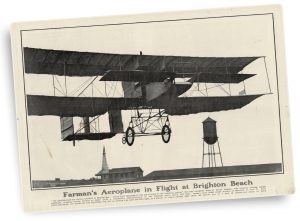
While the AEA was busy grabbing headlines, the Wrights were preparing to demonstrate their machines to the military. Wilbur traveled to France to dazzle European audiences, while Orville remained in the United States for a series of flights at Fort Myer in September. His improved Wright airplane had seats for two fliers positioned over the central frame, but initially Orville flew alone and stabilized the craft with ballast in the empty seat. Almost daily he set new endurance records, climaxing with a flight of 74 minutes and 20 seconds on September 12. The army wanted to see how the craft performed with a passenger, so Orville took Lieutenant Frank Lahm and Major George Squire up on separate flights. Each trip was flawless, although one of the propellers cracked on September 9. Orville had two larger replacement blades sent down from Dayton, and his mechanics installed them.
Although Selfridge was obviously the army’s most experienced aviator, Orville was distinctly unhappy about flying with him. “I don’t trust him an inch,” he wrote to Wilbur. “He is intensely interested in the subject, and plans to meet me often at dinners, etc. where he can pump me. He has a good education and a clear mind. I understand that he does a good deal of knocking behind my back.” Nonetheless, on September 17 Orville took Selfridge aloft for that fatal flight.
ONCE EXTRICATED FROM the wreckage, the two injured airmen were carried on stretchers to the post hospital. Wright had sustained a fractured thigh and several broken ribs on his right side. Although his injuries were serious, he recovered after a long convalescence. Selfridge wasn’t so lucky. A combination of a fractured skull and internal injuries proved fatal. He died that night. America’s first military pilot had become the airplane’s first fatality.
In France, Wilbur was shocked at the news and tortured by guilt. “The death of poor Selfridge was a greater shock to me than Orville’s injuries, severe as the latter were,” he wrote to his sister, Katharine. “I felt sure ‘Bubbo’ would pull through all right, but the other was irremediable.” Wilbur, the older brother, also felt that he was somehow responsible. “I cannot help thinking over and over again ‘If I had been there, it would not have happened.'”
Back home, army officials vowed to continue their efforts. “It is a very sad happening and one to be deeply regretted,” said Secretary of War Luke Wright, but he blamed the accident on a mechanical flaw rather than any miscalculation of basic principles. “I see no reason why this accident should give any serious setback to the experiments in aeronautics by the army.” Others echoed this sentiment. Augustus Post, secretary of the Aero Club of America called Selfridge a “martyr to the cause” but added, “It is not likely that the accident, as deplorable as it is, will have any serious effect in retarding the work of progress that has been so pronounced within the last few week.”
An accident investigation revealed that the right propeller blade had broken and flattened somewhat, and the difference in thrust between the two blades caused the mysterious tapping sound. Aerodynamic pressures forced the right blade out of position enough for it to clip the wires controlling the vertical rudder. According to the army’s official report, “The rear rudder fell to the side and the air striking this from beneath, as the machine started to glide down, gave an upward tendency to the rear of the machine, which increased until the equilibrium was entirely lost. Then the aeroplane pitched forward and fell straight down, the left wings striking before the right. It landed on the front end of the skids, and they, as well as the front rudder was crushed.”
Orville Wright was absolved of any blame. He had done the best he could under the circumstances. One week later, Selfridge was buried with full military honors in Arlington National Cemetery. One year later, the Signal Corps purchased a Wright machine for $30,000. It was the world’s first military airplane.
Though heart-sickened by their companion’s death, the members of Bell’s association were not deterred in their work–at least for a brief period. Four months later McCurdy successfully flew his Silver Dart in Canada. Shortly thereafter the association disbanded, ostensibly for having achieved its primary objective. But Mrs. Bell, who had financed the group’s efforts, may have identified the real reason when she wrote, “The beautiful bond of companionship, which we called the Aerial Experiment Association, was broken when Tom Selfridge sealed his devotion to our cause with his life.”
Its members went their own ways. Curtiss kept the competition with the Wrights alive by forming his own aviation company. Using the AEA’s patents, he built new planes even as the Wrights battled with him in court. In 1912 Wilbur died of typhoid fever, weakened, his family believed, by the pressures involved in trying to protect the family business from men like Curtiss. Orville finally won a patent infringement case against Curtiss in 1914, but his triumph was short-lived. With the outbreak of World War I, the federal government stripped away Wright’s patent protection to facilitate a free exchange of ideas among aircraft manufacturers.
By then Bell had returned his attention to the growing telephone industry, staying instrumental in the expansion of long distance service. If he felt any ill will toward the Wright brothers, he never showed it. In 1908 Bell wrote to the secretary of the Smithsonian, Charles Walcott, and suggested that the Institution do something to honor the brothers. Walcott agreed, and two years later the Smithsonian Institution awarded Wilbur and Orville its first Langley Medal for achievements in aviation.
Wyatt Kingseed is a freelance writer from Columbus, Ohio. His article “The Great Escape” appeared in the February 2000 issue of American History.