Talk of sabotage was in the air following the Normandie’s loss. Had someone slit the fire hoses? Were German spies working on the ship?
It was shortly after 2:30 in the afternoon on February 9, a cold, clear Monday in 1942. Over at Pier 88 on West 49th Street in New York City, Clement Derrick was removing the last of four stanchions in the Grand Salon of the SS Normandie, a lavish ocean liner that was being converted into a troopship, the USS Lafayette. As his welder’s torch penetrated the metal, sparks suddenly spat out onto nearby bales of burlap that had been wrapped around the ship’s highly flammable life preservers. The resulting shower of fire could not be quenched, and by 3 p.m. much of the luxury liner, the pride of a once-free France, was engulfed in flames. Dark black plumes of smoke reached across Manhattan, propelled by a brisk northwest wind. New Yorkers looked up as the oily smoke became a scrim across the midday sun.
Mayor Fiorello La Guardia was in the middle of a radio speech, assuring New Yorkers that the nickel subway fare would not be raised, when word of the burning Normandie reached him. The mayor cut short his speech and raced to the pier. By now hundreds of New Yorkers, following the smoke and the sounds of sirens, had arrived to watch as streams of water from a line of fireboats tried in vain to quell the blaze. Bellevue Hospital sounded its dreaded seven bells—the signal for a citywide catastrophe—and at nearby Pier 92, where the Queen Mary and Queen Elizabeth had their berths, a makeshift hospital was set up for the workers who were being carried off the stricken ship.
Crowds of people had gathered for blocks along the waterfront. As the fire raged, more fireboats arrived. For hours their fountains of water flooded the ship’s cabins. Soon there was more water than fire. Then, at 3:40 p.m., just as the mayor and Rear Adm. Adolphus Andrews, commander of the U.S. Navy’s 3rd Naval District, were attempting to board the wounded vessel, it suddenly lurched several feet to port. It was the beginning of the end.
The deathwatch took on a carnival atmosphere as skyscraper windows all over the city were thrown open so New Yorkers could watch the awful spectacle. The pier was alive with firemen and ambulance crews, with hawkers and food vendors, all watching as the great ship began to drown in the water that was meant to save it.
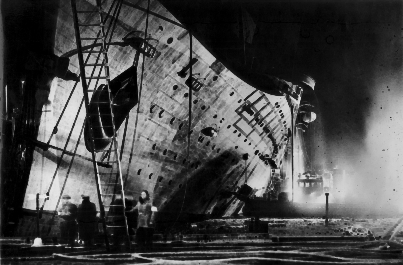
It took 12 hours for the Normandie to die. At precisely 2:35 the following morning, with the acrid smell of burning metal still hanging over Times Square, the elegant creature rolled over on its port side and gave up the fight. The following day, thousands of New Yorkers showed up at the pier to gape at the destroyed ship. Five-year-old Miki Rosen saw it from the inside of the family car: “My father wanted us to see it because it was an historical event. I was terribly frightened by this enormous thing that I knew was supposed to be upright and bobbing up and down. It didn’t even look like a ship. It was a mass of iron floating in the water.”
Talk of sabotage was in the air. Had someone slit the fire hoses? Were German spies working on the ship? Was it perhaps gasoline that spurted from the sprinkler system? What the hapless Clement Derrick knew to be an accident was a troubling mystery to New Yorkers—one that would spur them to extraordinary measures to feel safe again.
For New Yorkers, and for the entire country, the possibility that the once-glorious ship had been brought down by Germany or the Vichy government was very real. In a Brooklyn courtroom just a month earlier, 33 German agents had been sentenced to serve a total of more than 300 years in prison. They had been led there by counterespionage agent William Sebold, a 42-year-old German American. Operating under the name Harry Sawyer, Sebold was set up in an office on 42nd Street, where the FBI observed his meetings with New York–based spies through a two-way mirror. A year before, the FBI had set up a shortwave radio station on Long Island so they could listen in on conversations between German spies in New York City and the men in Germany from whom they took orders.
German spies had been operating in the United States with very little censure since the 1930s, taking jobs in factories and bars along the Manhattan, New Jersey, and Brooklyn waterfronts. As bartenders, they could easily pick up vital information from seamen. Some had worked on American ships during peacetime, placing them above suspicion. In The American Home Front: 1941–1942, Alistair Cooke tells the story of an American seaman whose tanker was torpedoed by a U-boat. His leg was badly mangled in the attack, and after bringing him aboard the German submarine to patch up his wounds, the U-boat commander asked if any of the crew were from Brooklyn. “Maybe I worked with some o’ you guys,” the German boasted in perfect Brooklynese. “I was twelve years in the Brooklyn Navy Yard.”
Ironically, in Alfred Hitchcock’s 1942 spy thriller Saboteur, which was in postproduction when the Normandie caught fire, a German agent by the name of Frank Fry fills the fire extinguishers in a California airplane plant with gasoline, igniting a catastrophic fire. Seizing an opportunity to sharpen the plot, Hitchcock obtained a newsreel of the burning Normandie and had Norman Lloyd, who played the German agent, ride in a taxi down the West Side Highway. As he passes the stricken ship, Lloyd looks out the window and smiles smugly, indicating to the audience that yet another act of sabotage has succeeded.
In the weeks that followed, Americans continued to file past the ship in what seemed like an endless wake. The sight of the luxurious liner to the stars (the Normandie had carried William Randolph Hearst, James Stewart, and Sonja Henie on its last crossing) lying on its side like a dead whale was a discomforting one. A New York Times editorial captured those feelings: “The investigation should be relentless. It is not alone a ship that has been damaged. Men may have to die on the other side of some ocean because help cannot get to them in time.”
And it was relentless. As newspaper columnists and radio broadcasters kept talk of sabotage very much alive, six different investigations were under way. Even President Roosevelt was not ruling out sabotage, asking his secretary of the navy immediately after the fire if any enemy aliens had been permitted to work on the ship. Just three days after the fire, the FBI restaged Clement Derrick’s lethal accident, bringing the welder and the crew that was with him to an area where they had erected a stanchion similar to the one he was working on at the time of the fire. They surrounded it with bales of burlap and watched as the repeated ballet produced the same terrible result.
Although the FBI’s investigation put the possibility of sabotage to rest, the sight of the destroyed ship’s carcass in the Hudson River made New Yorkers question the U.S. Navy’s ability to protect the coastline, or even the city’s waterfront. Ever since the United States had entered the war, German U-boats had been making deadly mischief off the Long Island and New Jersey beaches; in the month of January alone, they had sent 13 Allied ships filled with precious cargo (not to mention the lives lost) to the bottom of the sea. When the British tanker Coimbra was torpedoed, the resulting fire was so intense that Long Islanders could see its deathly glow from their homes. And still the lights of Asbury Park and Atlantic City were shining out toward the sea like welcoming beacons for the enemy.
In March, Manhattan district attorney Frank Hogan decided it was time to fight fire with fire. After a meeting with Lt. Cmdr. Charles R. Haffenden of the U.S. Office of Naval Intelligence, Hogan set in motion a plan that would rely on the services of one of the country’s most notorious criminals, who was then serving time in upstate New York’s Dannemora prison.
Charles “Lucky” Luciano had been sitting in his jail cell in 1939 when the Normandie was moved from France to New York Harbor to keep it safe, hatching a plan with his visitors, mobsters Frank Costello, Meyer Lansky, and Moe Polakoff, to get him released from jail. Part of that plan involved the Normandie; it wasn’t until the bombing of Pearl Harbor, however, that Luciano’s scheme began to take form. Calling his three pals together again, he showed them a newspaper article in which the navy expressed concern about the possibility of Germans sabotaging ships in the harbor. It was Luciano’s idea to create a “sabotage incident” and then fix it, so the U.S. Navy would come to him for help. Luciano would provide that help in exchange for a pardon from the man who sent him up the river, former prosecutor Thomas Dewey, who would be elected governor in 1942.
A month later, Frank Costello paid Luciano another visit, this time letting him know that fellow mobster Albert Anastasia had worked out a scheme with his brother “Tough” Tony, a major figure in the International Longshoremen’s Association, to do something big that might involve the Normandie.
Now, in March 1942, with the famous ship destroyed and with Luciano still in jail, believing that Albert Anastasia had carried out his sabotage scheme, the navy arranged a meeting in Haffenden’s private office off the mezzanine of the Hotel Astor between the lieutenant commander and Joe “Socks” Lanza. The labor racketeer reigned over the Fulton Fish Market and in a burst of patriotism agreed to use his mackerel fishing fleet to help ferret out the U-boats plaguing the New York coastal waters. With this handshake agreement a strange marriage was sanctioned between the U.S. Navy and key players in the New York Mafia.
But helpful as Lanza’s fishing fleet might be in spotting U-boats, it was not enough. The New York waterfront—especially the West Side docks, with their constant gridlock of merchant and troopships—was vital to the country’s war effort, and needed protection.
The man who controlled it all was Luciano. On May 12, 1942, the mobster was removed from Dannemora prison and brought south to Great Meadow Correctional Facility in Comstock, a kinder, gentler place by prison standards. In return for a one-way ticket to Sicily after Luciano’s sentence was served—a deal made good on after the war, when he was paroled in 1946—Luciano agreed to become the silent arm of U.S. Naval Intelligence.
As he put out the word to cooperate from his jail cell, that arm reached beyond the docks into the heart of the city. The heavily German neighborhood of Yorkville—with its vestiges of an American Nazi organization called the German American Bund—was still a gravitating spot for German agents who might pick up some vital bits of information in its popular bars. Bartenders became Luciano’s eavesdroppers. Harlem numbers runners and guys who serviced the city’s vending machines were turned into informants. That cigarette girl in the nightclub, the hatcheck girl in the restaurant, or the attendant in the powder room might be listening.
It did not last forever, but for a brief period of time when patriotism was the country’s unifying glue, the U.S. Navy and the Mafia were partners. Damon Runyon couldn’t have written a better script.
Excerpted from Over Here! New York City During World War II by Lorraine B. Diehl (Smithsonian Books, 2010). © Lorraine B. Diehl.
This excerpt originally appeared in the March/April 2010 issue of World War II magazine.