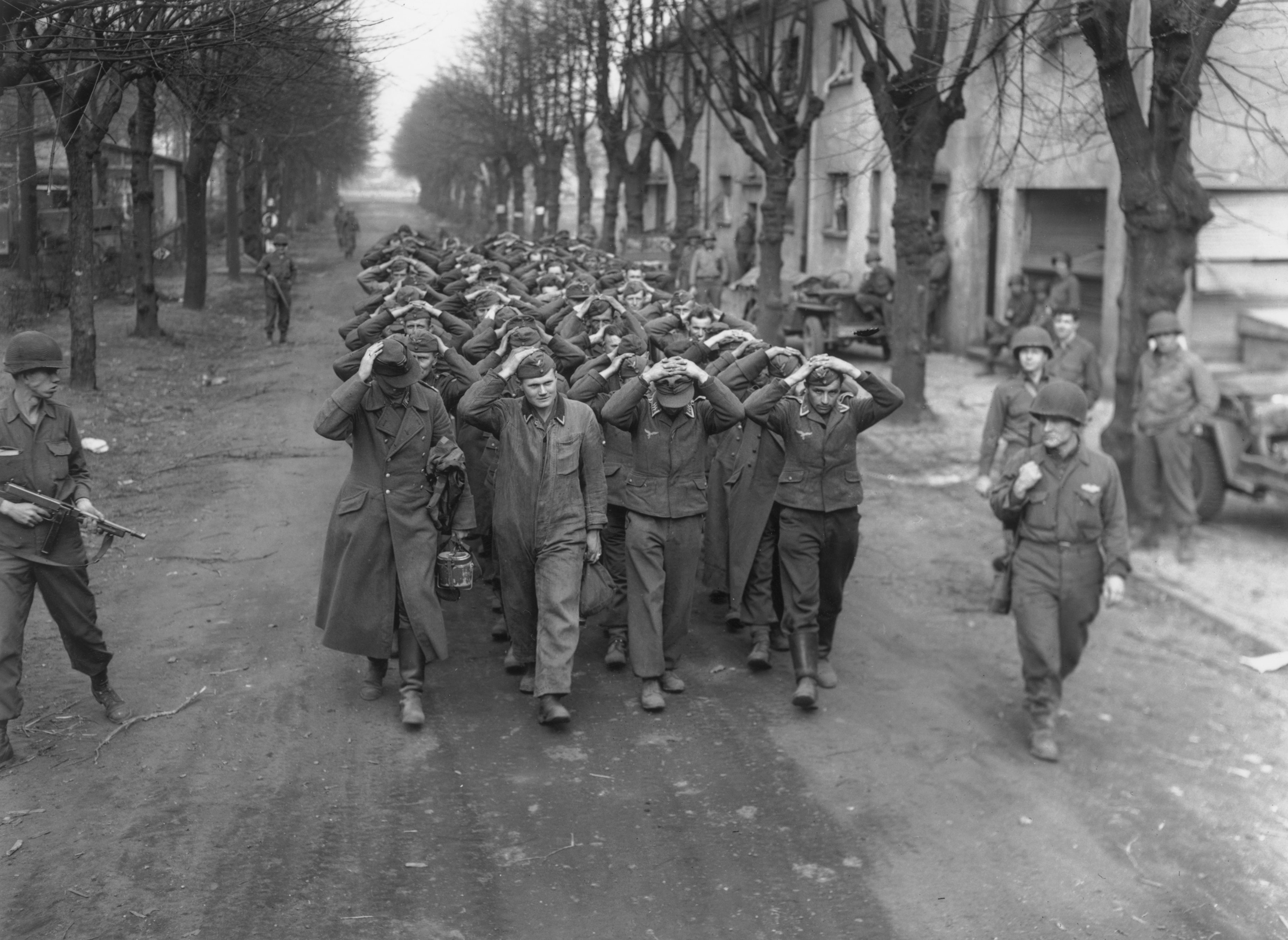
The last weeks of World War II in Europe have, with a handful of exceptions, long been perceived as the pursuit of shattered German armies by the victorious Western Allies, the smashing of the last Nazi strongholds by the Soviet hammer. The scenes that purport to show an easy, quick, and Homerian victory—Sherman tanks rumbling through destroyed German cities, Hitler’s suicide, the Soviet banner flying above the ruined Reichstag—have become well established in the popular imagination.
For the American GIs entering the heart of Germany, however, April 1945 was a month filled with some of the most brutal fighting of the war, when the horrors of the Nazi regime were finally revealed to the world. In fact, some GIs, witnessing the atrocities committed against their own and against those held in the concentration camps they liberated, would find themselves “raging inside with boiling hatred,” as one GI recalled, and met violence and cruelty with violence and cruelty.
The curtain went up on Nazi Germany’s last act with the capture of the Ludendorff Bridge at Remagen on March 7, 1945, which opened the way for the Allies’ final thrust. For the Americans, it was an opportunity to use their greatest strengths, mechanization and firepower, to overwhelm the Wehrmacht once and for all. It was the perfect type of campaign for the U.S. Army.
Gen. Dwight Eisenhower’s final offensive was led by the most powerful forces in American military history: Gen. Omar Bradley’s 12th Army Group, consisting of Lt. Gen. Courtney Hodges’s First Army and Lt. Gen. George Patton’s Third Army. Bradley’s northern flank was secured by the U.S. Ninth Army under Lt. Gen. William H. Simpson, assigned to Field Marshal Bernard Montgomery’s British 21st Army Group; his southern flank was secured by Lt. Gen. Jacob Devers’s 6th Army Group.
The first goal of the breakout was to encircle and destroy German Army Group B, led by Field Marshal Walter Model, which was attempting to hold the critical industrial regions of the Ruhr area. For the Germans, the Ruhr was a strategic necessity, because it was also a strategic weakness: to lose the Ruhr was to lose the war. As the Americans exploded out of their bridgeheads to the south, and the British out of theirs to the north, the Ruhr became a death trap for Model.
The U.S. Army’s 83rd Infantry Division would play a critical role in the race to cross the Elbe River and crush Model’s army. After supporting the crossing of the Roer River in March, the 83rd was assigned to XIX Corps for the deathblow. In addition to the 83rd, XIX Corps also had the tough 2nd Armored Division; the 29th “Blue and Gray” Division, which had spilled its first blood on Omaha Beach and was one of the premier American divisions of the war; and the battle-hardened 30th Infantry Division. Together they formed a single fist for the drive to the Elbe.
One veteran of the 83rd would proudly note, “We set new infantry speed records—records that surpassed those of even the best Allied armor.” Indeed, the 83rd would earn the nickname “Rag Tag Circus” because the troops, in an effort to move faster, confiscated a motley batch of vehicles. The commander of the 83rd’s 329th Infantry Regiment later recalled, “To us, it was no circus. Admittedly, however, we may have looked like a summer carnival group entering a country town as we dashed along the highways and byways of the Prussian provinces, for we had pressed into service every conceivable means of transportation we encountered.”