Stephen Harding is senior editor at Military History. His article for World War II became part of the foundation for his critically acclaimed new book The Last Battle.
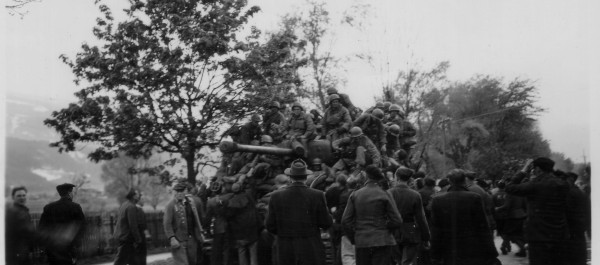
On the morning of May 4, 1945, 1st Lt. John C. “Jack” Lee Jr. sat cross-legged atop the turret of his M4 Sherman tank, comparing the Austrian countryside before him with the map that lay on his lap. For the last five months, Lee, a stocky twenty-seven-year-old from Norwich, New York, had led Company B of the 23rd Tank Battalion on a headlong advance across France, into Germany, and now—in what would turn out to be the last days of World War II in Europe—into the Austrian Tyrol.
His tank, nicknamed “Besotten Jenny,” was parked on a low hill on the south bank of the Inn River, overlooking the village of Kufstein, three miles southwest of the German border. All three of the 23rd’s tank companies had crossed the frontier the day before, leading the 12th Armored Division’s Combat Command R on its drive southward from the suburbs of Munich. Lee’s company had spearheaded the drive into Kufstein, and had fought its way through a formidable German roadblock before clearing the town of its few defenders. Now, with the lead elements of the 36th Infantry Division moving in to assume responsibility for the area, Lee and his men could catch a few minutes’ rest.
Lee was profoundly tired and hoped that Kufstein would be Company B’s last battle. Like every other soldier in the European theater, he knew that the war could end at any moment—Berlin had surrendered two days earlier and organized German opposition was crumbling—and the young officer didn’t want any of his men to be the last American killed in “Krautland.”
Yet even as he pondered what the war’s end would mean to him and his fellow tankers, events were unfolding literally just down the road that would shatter his dreams of immediate peace. Lee was about to be thrust into an unlikely battle that would involve a mountain castle, a group of combative French VIPs, an uneasy alliance with the enemy, a fight to the death against overwhelming odds, and one of the last combat actions of World War II in Europe.
The castle that was soon to figure so largely in Lee’s life lay fourteen miles to the southwest of where he sat perched atop his tank. Topped with storybook crenelations and accompanied by a rich history, Schloss Itter, as it’s called in German, was first mentioned in land records as early as 1240. Since then, Itter has passed through a number of hands. After Germany’s March 1938 annexation of Austria, the castle’s robust construction and relatively remote location attracted the attention of the notoriously secretive Nazis. Within months of absorbing Austria into the Greater Reich, the German government requisitioned Castle Itter for unspecified “official use”—which included housing for several months in 1942 an organization called the “German Association for Combating the Dangers of Tobacco.” On February 7, 1943, it fell into new hands yet again, for on that day, the structure and all its outbuildings were requisitioned by the Wehrmacht on behalf of the SS.
Surviving records indicate that from the moment of its 1943 requisitioning, Itter was planned as a detention facility for VIP prisoners—those whom the Germans considered potentially valuable enough to be kept alive and housed in relatively decent conditions. Officially referred to as an Evakuierungslager, or evacuation camp, the castle was put under the operational control of the regional concentration camp command at Dachau, ninety miles to the northwest. As one of that sprawling death camp’s 197 satellite facilities in southern Germany and northern Austria, Itter drew its funding, guard force, and support services directly from its soon-to-be-infamous parent facility.
The castle’s conversion into a high-security prison didn’t take long. It already had massive walls; a deep, dry moat; and a virtually impregnable gatehouse. The addition of tangles of concertina wire and dozens of intricate locks rendered the castle virtually escape-proof. Twenty of the existing guest rooms in the central housing structure were converted into secure, if unusually roomy, cells; others were turned into guardrooms and offices.
SS planners at the camp command at Dachau tapped Sebastian Wimmer, an equivalent of a captain in the SS, as commander of the new prison and assigned him some twenty-five members from the SS’s concentration camp guard service. These soldiers were for the most part older, less capable troops with no combat experience. Most had served as guards at the larger camps, and were happy to spend whatever was left of the war guarding VIP prisoners in an alpine redoubt far removed from the horrors of the Final Solution.
Within days of the completion of its conversion into a prison, Castle Itter welcomed the first of what would become a veritable “Who’s Who” of VIP captives: Albert Lebrun, who had been president of France until he was replaced by Philippe Pétain in July 1940; former Italian prime minister and dedicated anti-Fascist Francesco Saverio Nitti; and André François-Poncet, former French ambassador to both Germany and Italy.
These three didn’t stay long at Castle Itter; they were quickly supplanted by the entirely French cast of characters that would remain there through the end of the war. Among them were former prime ministers Édouard Daladier and Paul Reynaud; trade union leader Léon Jouhaux; generals Maxime Weygand and Maurice Gamelin; tennis star Jean Borotra; right-wing leader Col. François de La Rocque; and Michel Clemenceau, politician and son of World War I–era prime minister Georges Clemenceau.
Also present were Alfred Cailliau, a relatively minor politician who was being held at Itter only because his wife, imprisoned along with him, was the sister of Free French leader Charles de Gaulle; Reynaud’s thirty-one-year-old secretary (and future wife) Christiane Mabire; Jouhaux’s secretary, Madame Brucklin; the wives of Borotra and Weygand; and Marcel Granger, a relative of Free French general Henri Giraud.
While all were French, the prisoners at Itter could not possibly have been more politically diverse or more determinedly irascible. Reynaud and Daladier were bitter political enemies, and both former prime ministers detested General Weygand who—having replaced Gamelin as supreme commander of French forces in May 1940—surrendered to, and initially collaborated with, the occupying Germans. Gamelin, for obvious reasons, was not at all fond of Weygand, and sided with Reynaud against Daladier. La Rocque, who in the early 1930s had led the rabidly anticommunist Croix-de-Feu (“Cross of Fire”) organization, could not abide Jouhaux, whose Confédération Générale du Travail was France’s largest trade-union group. And, finally, there was Borotra, who was at Itter not for his fame as the tennis world’s “Bounding Basque,” but because, after resigning as Vichy’s commissioner for sport and physical education in April 1942, he was later caught attempting to flee the country to join Allied forces.
The VIP prisoners quickly segregated themselves by political persuasion, avoiding each other as much as possible. They even took to eating at separate tables in the small dining room: the Weygands, the Borotras, and La Rocque at one; Reynaud, Mabire, Gamelin, and Clemenceau at another; and the others—who were seen as “neutrals”—at a third. One can only imagine the heated exchanges that must have occurred among these once-powerful, still resentful personages, and the perverse joy their captors must have taken in their internecine squabbling.
François-Poncet described the Germans’ attitude toward the Itter prisoners as “a mixture of brute force, politeness, and occasional attempts at friendship.” Daily life for the captives was certainly better than it would have been at virtually any other German-run prison. The French “inmates” slept in converted guest rooms, had free access to the castle’s substantial library, and took their daily exercise in a courtyard built around a thirteenth-century fountain. Daladier even had a clandestine radio in his room on which he listened to BBC broadcasts, courtesy of a Yugoslav political prisoner, Zoonimir Cuckovic. Known among the prisoners as “André,” Cuckovic had been transferred by the Germans from Dachau to Itter to work as an electrician, and would later play a key role in his fellow captives’ survival.
The essentially benign routine at Castle Itter began to change as Germany’s fortunes declined throughout 1944 and into 1945. Food became increasingly scarce for both the prisoners and their guards, and a growing shortage of fuel for the castle’s generators meant that candles and lanterns ultimately replaced the electric lights.
While the prisoners could rationalize the deprivations as a sign of Germany’s impending defeat, they also knew their lives might not be worth much to Nazi leaders intent on covering up their own crimes. During the last days of April, Clemenceau—who spoke fluent German—summoned Wimmer to a meeting with Reynaud and Gamelin. He reminded the castle’s commandant that the lives of all the French prisoners were in the SS officer’s hands. Wimmer replied that the deaths of any of the prisoners there would not be compatible with Germany’s postwar interests and said he would aid in their escape if necessary.
Nonetheless, the arrival of a constant stream of senior SS officers at the castle kept the French on edge. Often accompanied by their wives and always loaded down with weapons, baggage, and booty, the SS men used Itter as a way station as they attempted to escape the advancing Allies. Most stayed only long enough to requisition what food and water they could, but on the night of April 30, 1945, Eduard Weiter, the last commander of Dachau, settled in with a retinue of his subordinates and their wives and children.
Weiter, whom Daladier later described as “obese and apoplectic, with the face of a brute,” had ordered the execution of some two thousand prisoners before leaving Dachau. The French captives at Itter were aware of the executions and were concerned that Weiter’s arrival foreshadowed their own deaths. As it turned out, however, the only death Weiter had on his mind was his own. Early on the morning of May 2 he shot himself in the heart. Incredibly, he lived—but went on to finish the job with a bullet to his brain. A group of Weiter’s SS minions tried to bury him in the village cemetery but the local priest rebuffed them, so they hurriedly interred the “butcher of Dachau” in an unmarked grave in a field outside the castle walls.
Weiter’s suicide galvanized Wimmer, who abruptly fled the castle with his wife early on May 4 after assuring Reynaud and Daladier that he would find a way to protect the French prisoners against the Waffen-SS troops active in the surrounding hills. He was only marginally true to his word; all he did to ensure the promised protection was to enlist the aid of a war-wounded Waffen-SS officer recuperating nearby. At Wimmer’s urging, the young officer, whose name is lost to history, agreed to put on his uniform and go up to the castle to look after the French VIPs.
The commandant’s sudden departure from Castle Itter convinced the guards that it was also time for them to leave, and by daybreak on May 4, the French notables had the former prison all to themselves. At the urging of Weygand and Gamelin, the former prisoners broke into the weapons room and armed themselves with pistols, rifles, and submachine guns. Putting their differences aside for the moment, Reynaud, Daladier, and the two generals agreed that the presence of SS units in the area meant the former prisoners could not just wait to be liberated by the Allies. They had to act.
The agent of that action was the always-helpful Zoonimir Cuckovic, a.k.a. André, who volunteered to go find the nearest Allied unit and bring it back to secure the castle.
Vaulting aboard a bike liberated from a shopkeeper in the surrounding village, Cuckovic set off for Wörgl, a large town on the Inn River six miles northwest of the castle. He was unaware that much of the town was occupied by elements of a Waffen-SS regiment, and was lucky to stumble instead upon a group of Wehrmacht troops led by a surrender-minded major named Gangel. Upon hearing of the French notables at Castle Itter—and no doubt realizing that aiding in their rescue would reflect well on him and his men—Gangel dispatched Cuckovic toward Inns-bruck, thirty-eight miles to the southwest. Innsbruck had just been taken by the U.S. 103rd Infantry Division, and chances were excellent that Cuckovic would encounter American troops moving east toward Wörgl. But to be on the safe side, and possibly to better his own chances with the Americans, Gangel jumped in his Kübelwagen and, leading a truck packed with some twenty Wehrmacht troops, sped off toward Kufstein, thirteen miles in the opposite direction.
This two-pronged effort to locate American units paid off in spades. Halfway between Wörgl and Innsbruck, Cuckovic encountered elements of the 103rd Infantry Division and was directed to Maj. John Kramers, a German-speaking officer in the 103rd’s mili-tary government section. Kramers summoned a French liaison officer, Lt. Eric Lutten, and together the two formulated a rescue plan. Within two hours they had pulled together a small task force of four M10 tank destroyers, three jeeps, and a truck bearing a platoon of infantrymen from the 411th Infantry Regiment. Accompanied by American war correspondent Meyer Levin and French photographer Eric Schwab, the convoy set out for Itter along the same refugee-choked roads Cuckovic had negotiated on his way to Innsbruck.
Their trip wasn’t as uneventful as Cuckovic’s had been, however. Several miles short of Wörgl, Kramers’s column was hailed by a group of Austrian anti-Nazi partisans who had been fighting SS units further along the road. As the Americans were pondering their next move, enemy artillery rounds started landing about one hundred yards away. Kramers and the senior M10 officer quickly decided to pull into the cover of the surrounding trees and wait for the barrage to lift before moving on toward Itter.
Major Gangel, meanwhile, had rolled into Kufstein with a huge white flag fluttering from his vehicle. His story of a group of French VIPs being held in a nearby castle earned him a trip to the 23rd Tank Battalion’s forward command post, where he recounted his tale to the battalion’s commander and intelligence officer. That was when 1st Lt. Jack Lee’s dreams of peace officially came to an end. Summoned to the 23rd’s command post, he volunteered to take a patrol up to the castle to secure the French captives.
Lee chose eight volunteers to man the patrol’s two Shermans: his own Besotten Jenny and Lt. Wallace S. Holbrook’s “Boche Buster.” Lee’s crew included Sgt. William T. Rushford, Cpl. Edward J. Szymcyk, Cpl. Edward J. Seiner, and Pfc. Herbert G. McHaley. Lt. Harry Basse, Company B’s motor officer and a close friend of Lee’s, took command of Boche Buster, whose crew included Tech. Sgt. William E. Elliot and Sgt. Glenn E. Shermann. Lee also tapped six members of the all–African American Company D, 17th Armored Infantry Battalion, to ride atop the tanks. At the last moment, Lee dragooned five M4s and crews from the 36th Infantry Division’s 142nd Infantry Regiment to provide extra firepower. Bringing up the rear of the column were the Wehrmacht’s Gangel in his Kübelwagen and the truckload of German soldiers.
The group set off toward Wörgl in the early afternoon, its members well aware that Waffen-SS units were still putting up fierce rear-guard resistance throughout northern Austria. Fortunately for Lee and his men, the SS regiment that had been in Wörgl just hours earlier had pulled out of the town. Austrian partisans welcomed the Americans, and at their urging Lee agreed to leave the five 36th Infantry Division tanks on the northern edge of Wörgl, to defend the main road leading into the city.
Now commanding two tanks, fourteen Americans, and Gangel’s Wehrmacht troops, Lee set off through the center of town and toward Itter. There was only one substantial bridge over the small river that bisected the valley, and Lee discovered that the SS had wired it with demolition charges. He had the Wehrmacht troops remove the explosives, then posted Basse’s tank and its accompanying infantrymen there to protect the crossing point. Basse chose to accompany Lee to the castle, leaving Sergeant Elliot in command of Boche Buster.
By this time Lee could see his objective just over four miles ahead, and he ordered his driver to move out carefully. His caution was justified: within minutes, the Sherman rounded a curve in the road and almost drove over a squad of SS troops trying to set up a roadblock. The infantrymen riding on the tank’s rear deck opened fire, as did the Sherman’s bow machine gunner and Gangel’s troops in the truck, and the SS troops fled into the surrounding woods. Lee ordered his driver to “open her up,” and the tank slued around another corner and up the road to the castle, the Wehrmacht truck close behind. Roaring over the short bridge at the top of the road, the vehicles lurched to a stop directly in front of Itter’s main gate as night began to fall.
The arrival of the eagerly anticipated rescue force left Castle Itter’s French “guests” decidedly unimpressed. The former prisoners had been expecting a column of armor supported by masses of heavily armed American soldiers. What they got was a lone tank, seven Americans, and—to their chagrin—a truckload of armed Germans.
While Gangel went out of his way to be polite and accommodating to the French, Lee was apparently his typically brash self. Paul Reynaud must have found the American lieutenant particularly irritating, for in his postwar memoirs the former prime minister remembered Lee as “crude in both looks and manners,” and sniffed, “If Lee is a reflection of America’s policies, Europe is in for a hard time.”
Crude or not, Lee knew his job. Within minutes of arriving at Castle Itter he had compiled a list of the French notables, positioned the Sherman in front of the main gate so it could command the road, and began rustling up food and bunks for his hungry, tired men. After a brief round of celebratory toasts with the French, Lee, Basse, Gangel, and the young SS officer from the village set off to scout defensive positions and talk over strategy.
Lee’s plan was simple: since he didn’t have enough vehicles to move his men, the French, and the Germans back to Kufstein, he’d stay put and wait to be relieved by advancing American forces. While the presence of Waffen-SS units in the immediate area was a worry, Lee believed that Castle Itter’s thick walls would allow his tiny force to hold off all but the most determined attackers.
His theory was put to the test far sooner than he’d expected. Just after eleven o’clock that evening, Waffen-SS troops in the hills opened fire on the castle with rifles and machine guns. Whether they had come specifically to eliminate the French VIPs or had just decided to wipe out the small Allied force in their midst remains unclear, but the result was the same.
Lee’s men and the Wehrmacht troops moved to their prearranged positions and began returning fire. The shooting from both sides remained desultory until dawn, but with first light things turned serious. Machine guns pounded the exterior walls and blew out the narrow windows of the central housing block. Then an 88mm antitank gun lobbed a shell into the upper floor of the main building, destroying Gamelin’s empty room. Moments later, a second 88 round slammed into Lee’s tank as Corporal Szymcyk was preparing to fire its main gun at SS men in the village. Szymcyk jumped from the tank and ran to cover behind the castle gate just before its gas tanks blew, turning the Sherman into an inferno.
The destruction of Besotten Jenny signaled the start of a general attack. SS troops swarmed from the tree line to the east, sprinting toward the castle’s main gate. Others began scrambling up the hill on the west, trying to reach the relative cover of the lower walls. American and German defenders poured fire from the castle’s upper walls and loopholes, taking a heavy toll with their rifles and machine guns. Even the French notables got into the act: Reynaud, Clemenceau, La Rocque, and Borotra all fired at the attackers.
Nonetheless, fire from the SS troops and the still-concealed 88 killed several of the Wehrmacht men and wounded several others. Among the dead was Major Gangel, killed by a sniper as he and Lee attempted to spot the 88’s position from a rooftop observation post.
By this time, Maj. John Kramers and his party from Innsbruck had reached the bridge outside Wörgl where Elliot and Boche Buster were standing guard. From that vantage point they could clearly see the battle raging around the castle. Kramers’s group consisted by then of just four men: himself, Eric Lutten, Meyer Levin, and Eric Schwab, riding in a jeep. Since Kramers had crossed beyond the 103rd Infantry Division’s operational boundary and into the 36th’s area of operations, he’d been ordered to halt the advance of his M10s and infantry. Infuriated, he’d left them in town.
But the small party soon grew. By the time it reached the bridge, lead reconnaissance elements of Lt. Col. Marvin J. Coyle’s 2nd Battalion, 142nd Infantry Regiment had joined Elliot and Boche Buster. While the new arrivals knew nothing of the Castle Itter operation, they quickly secured Coyle’s permission to join the rescue effort.
Before setting off with the reinforcements, Kramers attempted to raise Lee by radio. He was unable to do so and urgently cast about for another means when one of the Austrian partisans pulled him into Wörgl’s undamaged town hall. Picking up a telephone, he simply called the castle. Kramers was soon speaking with Lee, who reported that the SS fire was increasing and the defenders were running perilously low on ammunition. Kramers told him help was coming and jumped back in the jeep with Lutten, Levin, and Schwab. The four roared off in pursuit of the 142nd Infantry tanks and halftracks, which had set off toward the castle with Boche Buster in the lead.
While news of the approaching relief column cheered Castle Itter’s defenders, it did little to improve their immediate situation. The SS attackers hadn’t yet managed to breach the fortress’s walls, but they were pressing their attack with what Lee would later call “extreme vigor.”
By noon the American-German force was almost out of ammunition. Aware that he was running out of options, Lee accepted Jean Borotra’s offer to leave the castle and guide the relief force through the village’s twisting streets. The former tennis star slipped out during a lull in the firing, dashed across forty yards of open ground, eluded several groups of SS men in the woods, and set off at a jog down the road toward Wörgl.
Always the pragmatist, Lee began planning what he and his shrinking command would do if the relief force didn’t show up in time. The solution was literally medieval: the defenders and the French notables would withdraw into the castle’s massive keep. They would use their few remaining rounds of ammunition, their bayonets, and—if necessary—their fists to make the SS men fight for every stairwell, every hallway, every floor. Securing the agreement of Weygand and Gamelin, both of whom had deferred to the young American throughout the battle despite their own exalted ranks, Lee began pulling defenders off the walls and shepherding the French toward the keep.
Sensing victory, the SS troops pressed their assault on the castle’s entrance. Just before three in the afternoon, a squad of men was settling into position to fire an antitank rocket at the front gate when the sound of automatic weapons and tank guns behind them in the village signaled a radical change in the tactical situation. The cry “Amerikanische panzer!” [“American tanks!”] from a Wehrmacht soldier high in the keep alerted the castle’s defenders that the relief force was shooting its way up the road. Seconds later, the SS attackers began melting into the surrounding woods. The battle for Castle Itter was over.
Within minutes Boche Buster and the other vehicles rolled up to the front gate to be met by the castle’s jubilant defenders—white, black, American, French, and German. As journalist Meyer Levin set about interviewing everyone in sight, Lee and Basse walked over to Elliot and Sherman. Feigning irritation, Lee looked Elliot in the eye and said, simply, “What kept you?” The four Americans all dissolved in laughter, fueled by equal parts exhaustion and relief.
Later, as members of the rescue force began removing the dead and caring for the wounded, the French notables were driven off in hastily requisitioned automobiles. They were on their way to Innsbruck to be suitably feted by a succession of senior Allied officers, after which Reynaud, Daladier, and the rest would return to France to resume their careers—and, undoubtedly, their acrimonious political disagreements.
For Lee and his men, the battle’s aftermath was more anticlimactic. The seven Americans and the surviving Wehrmacht soldiers all piled unceremoniously into the back of a two-and-a-half-ton truck for the ride back to Kufstein. Once there, the Germans were marched off to a POW cage; the African American soldiers rejoined their unit; and Lee, Basse, and the other tankers settled in for well-deserved chow and sleep. Jack Lee and Harry Basse were later recognized for their leadership during the battle for Castle Itter—the former with the Distinguished Service Cross and the latter with the Silver Star. At the end of May, Lee finally received his long-awaited promotion to captain.
While the unusual circumstances of the action at Castle Itter made it the subject of a few newspaper and magazine articles, including a July 1945 piece in the Saturday Evening Post by Levin, Lee himself summed it up best. A few months before his death in January 1973, he was asked by a reporter in Norwich how he felt about the long-ago incident. Lee thought for a minute, then replied, “Well, it was just the damnedest thing.”
This story appeared in the August/September 2008 issue of World War II magazine.