The Arabian heat rose up in shimmering waves, blurring the Bedouins’ vision and parching their throats. They deployed along the crest of a hill, taking shots at Turkish soldiers who fired back at them from their post below. Suddenly there erupted a thundering sound as about 50 camel riders, led by the fierce Howeitat warrior Auda abu Tayi, galloped downhill into the rear of the terrified Turks. Then a tribal leader among the motley collection of Bedouins sniping from the hill looked over at the lone British officer among them and yelled, “Come on!” Both men rushed downward, followed by 400 camel-mounted Bedouins, robes and headdresses flowing about them as they smashed into the flank of the Turkish force.
Now in the enemy’s midst, the British officer fired his service revolver into the fleeing khaki shapes around him when all at once his camel dropped like a lead shot, hurling him to the ground. He lay stunned, waiting to be killed by the Turks or trampled by his own men. When the dazed Briton sat up, he saw that the battle was over. It had lasted only a few bloody moments. The Bedouins were finishing off the Turks with rifle and sword. In the end, 300 of the enemy lay dead, for the loss of only two Arabs. It was a brutally efficient battle fought with surprise, fury, courage and a fine tactical sense—qualities that would become emblematic for the campaigns of T.E. Lawrence, “Lawrence of Arabia,” one of the 20th century’s most brilliant and fascinating military minds.
Born in North Wales on August 16, 1888, Thomas Edward Lawrence was a unique, complex character shaped by several forces. One was his height. Standing only five feet and five inches, he felt different from his four brothers and the other boys at school. Another determining factor was his discovery that he was the illegitimate son of Sir Thomas Chapman and his Scottish-born mistress, Sarah Lawrence. Lawrence’s independent nature was thus formed by an acute sense of his otherness, his knowledge that whatever he achieved in life would be due to his own efforts. He was bright and strong-willed. And as a boy, he began physically and mentally testing himself, as if for some inevitable future ordeal. A fine student, Lawrence went to Oxford to study history and wrote his thesis on Crusader castles. During a three-week research tour in the Levant, he became enchanted by the Arabs. Back in Britain, he completed his studies with a First Class Honors degree, and then, burning to return to the Middle East, he joined a British Museum excavation at the Hittite site of Carchemish in northern Syria, as an archeological assistant. He worked on and off at that important dig from 1910 to 1914, learning Arabic and how to deal with the Arabs. Then the war broke out.
Lawrence was commissioned a lieutenant in the British Army and, with his specialized knowledge of the region, detailed in 1915 to the Military Intelligence Department in Cairo, under the direction of Colonel Gilbert Clayton. The relaxed atmosphere of the office demonstrated little concern for military etiquette. The staff there quickly recognized Lawrence as an invaluable member, with a quick and agile mind. He collected geographical data for mapmaking, interviewed prisoners and worked on a reference book, the Turkish Army Handbook. War planners with a West-centric viewpoint often derided the war in the Middle East as a “sideshow of a sideshow,” but Lawrence knew that it was of enormous importance for the millions of Arabs living under Ottoman rule.
Although promoted to captain in March 1916, Lawrence found office work dull and longed for action. His brothers Will and Frank had died on the Western Front, a tragedy which filled him with guilt as he sat in the comfort of colonial Cairo. He also dreamed of leading an uprising of Arabs against their Turkish oppressors. His desires were soon fulfilled when the army sent him and two other British officers on a secret mission to secure the escape of an Anglo-Indian force led by Maj. Gen. Charles Vere Ferrers Townshend, which had been surrounded by Turks at Kut al-Amara in Mesopotamia. Lawrence and his fellow officers met with their Turkish counterparts, but all they could obtain was the release of some of the wounded. It was a sad and frustrating business. Townshend and 12,000 of his surviving men surrendered on April 29, 1916. Lawrence’s finely written reports on Kut and Arab nationalism, however, impressed his superiors so much that they sent him on another important mission.
In the Hejaz (western coastal Arabia) something momentous had taken place. King Hussein of the Hashemite clan, the grand sharif (a descendant of Muhammad) of Mecca, had declared a revolt against Ottoman rule on June 5, 1916. Lawrence was dispatched to Jeddah to report on developments. A keen observer of men and character, Lawrence met Hussein’s four sons, sizing them up to see if one of them was fit to become the military leader of the revolt. In Seven Pillars of Wisdom, Lawrence’s epic account of the revolt, he recalls dismissing them all until he met the tall, elegant Prince Feisal bin Hussein bin Ali, immediately realizing “that this was the man I had come to Arabia to seek—the leader who would bring the Arab Revolt to full glory.” He returned to report on the situation, but was promptly sent back to Arabia in December to act as adviser and liaison officer to Feisal. He would remain in the field for the next two years.
The situation was grim. The Bedouins were fickle warriors, ferocious when honor or booty were at stake, but drifted away when they grew bored or took too many casualties. For their service, Feisal and Lawrence had to pay them gold and balance the varying blood feuds and traditional mistrust between the clans. Although their numbers were not insignificant—according to a report Lawrence wrote in 1919, at one point the Arabs had “raised some 14,000 Harb tribesmen, 11,000 Beni Salem villagers and 9,000 Juheina”—discipline was slack, and artillery was sorely needed to give punch to their attacks.
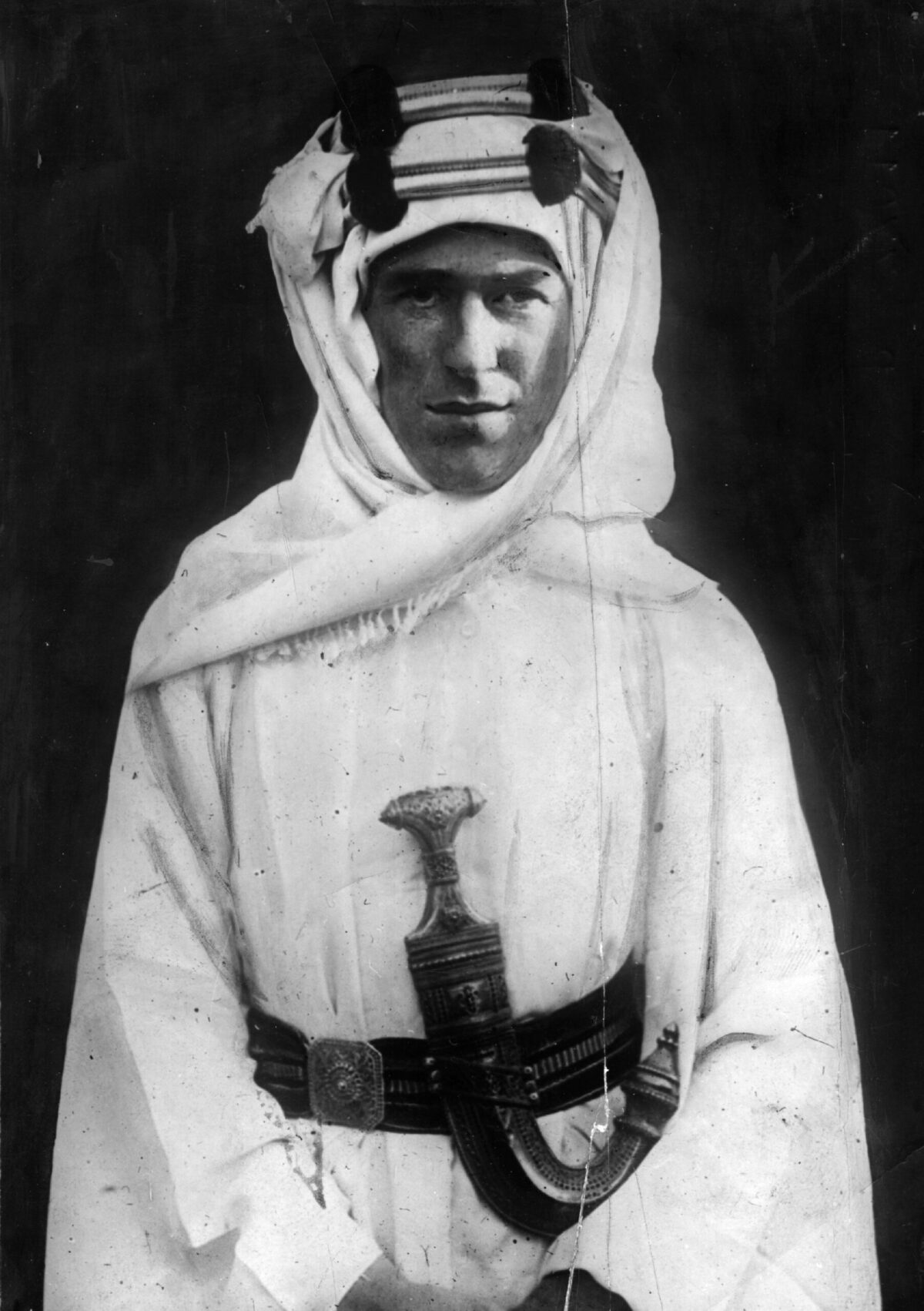
But Lawrence was impressed by Feisal’s cool and resolve. Staying in the leader’s tent, Lawrence carefully observed how he handled his men with patience and tact. During that time, Feisal presented Lawrence with beautiful robes of silk and gold. Lawrence readily put them on, for in such garb—a visual symbol of status and importance—he would be more acceptable to the Arabs. The flowing gowns were also ideal for the heat and camel riding.
On January 3, 1917, Lawrence went off on his first desert raid with 35 armed tribesmen. Under cover of darkness, they rode their camels out of camp, dismounted and scrambled up a steep hill overlooking a Turkish encampment, which they peppered with rifle fire until driven off. Returning, they came across two Turks relieving themselves, and took them back to camp for questioning. That minor triumph was later counterbalanced by a small tragedy when, to prevent a crippling blood feud from breaking out, Lawrence had to personally execute a member of his own band, a deed that would haunt him for the rest of his life.
An important steppingstone in the revolt was the capture of the coastal town of Wejh, which fell with the vital assistance of the Royal Navy in 1917. After that, ill with dysentery and malaria, Lawrence—an amateur soldier unhampered by formal military training—had time to reflect on the course of the revolt and grand strategy. Both Feisal and Lawrence felt that the revolt must move northward toward Syria and Damascus, with the goal of achieving Arab independence. The idea of the uprising had always been to drive the Turks out of Medina and the other major cities of Arabia. While he was ill, however, Lawrence decided that it would be better to keep the Turks bottled up in the city. The Bedouin forces had no taste for siege warfare and could not fight like a regular army, so Lawrence wanted to use the Arabs’ strengths—speed, superb knowledge of the terrain, immense individual courage—to strike at the Turks’ supply lifeline, the Hejaz Railway, stretching nearly 700 miles from Medina to Damascus.
At the end of March, Lawrence set off on his first raid against the railway, a Turkish station at Abu el-Naam. After carefully reconnoitering it, Lawrence crept down to the lines at nightfall and laid a Garland mine under the tracks, cutting the telegraph wires as he left. The next morning, the Bedouins overran the station with the aid of a mountain gun and a howitzer, setting several wagons of a nearby train on fire. As it steamed out of the station, Lawrence blew the mine under the front bogies, knocking it off the rails. Although the Turks got the train rolling again, the operation was a success.
Such victories were mere pinpricks against the Ottoman forces, however. Lawrence’s gaze now fell on the important Red Sea port of Aqaba. Taking it would secure the Arabs’ supply routes from Egypt, enable the revolt to tap into new sources of manpower and allow raiders to comfortably strike at the Hejaz Railway. Lawrence had visited Aqaba before the war and knew that the port was heavily defended from the sea at Wadi Itm, a narrow passage. Capture Wadi Itm, and the port would be in Arab hands. Lawrence consulted with Feisal and other Arab leaders, who liked his idea of slicing through the desert to surprise the Turks from behind. As a preliminary to the attack, it was necessary to establish contact with the powerful Howeitat tribe, which would swing the other tribes into support for the revolt. In March, Lawrence met the fierce and fearless Howeitat leader Auda abu Tayi, who had reputedly killed 75 rival Arabs and didn’t bother counting Turks. Lawrence explained his plan for Aqaba, which Auda thought feasible. Both men then worked out the details.
The two men liked each other, which says much for Lawrence’s ability to sway men more powerful than himself. Although he possessed abundant charisma and a forceful character, his strength lay in his ability to enable others to achieve their goals. He understood that to motivate the proud Bedouins one did not need to bark out orders, but rather to gain their respect through deeds and high personal courage. “Lawrence rarely spoke,” recalled Colonel Pierce C. Joyce, who fought alongside him. “He merely studied the men around him and when the argument ended…he then dictated his plan of action which was usually adopted and everyone went away satisfied.”
“It was not, as is often supposed, by his individual leadership of hordes of Bedouin that he achieved success,” Joyce added, “but by the wise selection of tribal leaders.” That and dispensing gold. “I combined their loose shower of sparks,” Lawrence wrote, “into a firm flame….”
As the Arab revolt became more successful, it attracted attention at the diplomatic level. The French and British had imperial designs in the region and opposed a strong, independent nation of Arabs. In meetings between the British politician Sir Mark Sykes and French diplomat Georges Picot in 1916, the Ottoman lands were carved up, with France taking Syria and Lebanon, while Britain would administer Mesopotamia, Transjordan and most of Palestine. Lawrence learned of that deal from a cynical letter Colonel Clayton had written outlining the Sykes-Picot Agreement, stating that “the occupation of Aqaba by Arab troops might well result in the Arabs claiming that place hereafter. It is thus essential that Aqaba should remain in British hands after the war.” As the British officers fighting alongside the Arabs learned of that agreement, they were appalled. Feisal, an astute politician, sensed that Britain and France had agreed upon some sort of a deal, and he began to lose faith in them. And Lawrence, an idealist nourishing a romantic image of Arab freedom, was plunged into a deep depression. He admired the Arabs and considered Feisal a friend. He was surrounded by men who passionately believed in the cause without knowing the truth. “In revenge,” Lawrence told himself, “I vowed to make the Arab Revolt the engine of its own success…to lead it so madly in the final victory that expediency should counsel to the Powers a fair settlement of the Arabs’ moral claims.”
But there was still much to be done. With Auda and his men, Lawrence set out on the long march through the simmering heat of the desert to Aqaba. Along the way, they blew up railway lines near the town of Deraa and then entered the barren, sun-beaten desert called El Houl. They visited one Bedouin camp after another, feasting on rice and lamb by night, recruiting and swelling their ranks by morning. But in the back of his mind Lawrence felt guilty, felt that he was betraying these men. “I had to join the conspiracy,” he wrote in Seven Pillars, “and…assured the men of their reward…but, of course, instead of being proud of what we did together, I was continually and bitterly ashamed.” His personal crisis worsened. In his notebook, Lawrence wrote on June 5: “Can’t stand another day here. Will ride north and chuck it.” Another message said ominously, “Clayton. I’ve decided to go off alone to Damascus, hoping to get killed on the way: for all sakes try and clear this show up before it goes further. We are calling them to fight for us on a lie, and I can’t stand it.”
Lawrence then broke away from the main force and embarked on an extraordinary 300-mile trip into Lebanon and Syria, talking with clan leaders to enroll their support for the revolt. With the help of local tribes, he blew up bridges and rode to the outskirts of Damascus to meet with resistance leaders. “At the time,” he recalled, “I was in a reckless mood, not caring very much what I did….A bodily wound would have been a grateful vent for my internal perplexities….” For that exploit, the army recommended Lawrence for Britain’s highest award for bravery, the Victoria Cross. He was ineligible, however, because no other British officer had witnessed his deed.
Back again with Auda, Lawrence and the Arabs made a large semicircular trek through the desert and fell on Aqaba from behind on July 6. The surprised Turkish garrison quickly surrendered. With that astonishing, almost bloodless victory, the Arab revolt became a force to be reckoned with. “After the capture of Aqaba,” he wrote in 1927, “things changed so much that I was no longer a witness of the Revolt, but a protagonist in the Revolt.”
Lawrence was being modest, for he played a major role. The Turks had offered a reward for his capture, and a report on the situation in Arabia, sent to Cairo in February 1917, said that “Lawrence with Feisal is of inestimable value….” After Aqaba, Lawrence was awarded the Companionship of the Bath and promoted to major. He then had an important meeting with the new commander in chief of the Egyptian Expeditionary Force, General Sir Edmund Allenby, who agreed to Lawrence’s strategy for the revolt. “I gave him a free hand,” Allenby said after the war. “His cooperation was marked by the utmost loyalty, and I never had anything but praise for his work, which, indeed, was invaluable throughout the campaign.” Lawrence now held a powerful position, as an adviser to Feisal and a person who had Allenby’s confidence.
The attacks on the railway continued throughout 1917. During one, Lawrence blew up a locomotive with an electric mine. “We had a Lewis [machine gun],” he wrote in a letter to a friend, “and flung bullets through the sides. So they hopped out and took cover behind the embankment, and shot at us between the wheels at 50 yards.” The Arabs brought up a Stokes mortar, and the Turks fled across open ground. “Unfortunately for them,” Lawrence continued, “the Lewis covered the open stretch. The whole job took ten minutes, and they lost 70 killed, 30 wounded and 80 prisoners,” for the loss of only one Arab. While the Arabs looted the train, another Turkish force arrived, nearly cutting off the Bedouins. “I lost some baggage, and nearly myself,” Lawrence added nonchalantly. In another letter about that same “show,” Lawrence confided, “I’m not going to last out this game much longer: nerves going and temper wearing thin….This killing and killing of Turks is horrible.”
Lawrence’s exhaustion was heightened when he and a raiding party of about 60 Arabs failed to blow up an important railway bridge over the Yarmuk River. Allenby had requested the raid, and Lawrence was wracked with guilt over its failure. Later, while reconnoitering the important railway junction at Deraa, Lawrence, trying to pass himself off as a light-skinned Circassian, was arrested by the Turks, brought to their commander and severely beaten before being “dragged about by two men, each disputing over a leg as though to split me apart: while a third man rode me astride.” Lawrence escaped, but the torment of that night was seared upon his consciousness and his soul, emotionally maiming him.
Although those personal tragedies were immense, global events were sweeping away the old order and remaking the world. In November, the Bolsheviks seized power in Russia, publishing secret documents discovered in Tsar Nicholas II’s files. One of them was the Sykes-Picot Agreement. The embarrassed British government hurriedly reassured the Arabs that the terms of the agreement had not yet been ratified, which Feisal and other Arab leaders only partially believed. Later, the Balfour Declaration was published, stating that the British government favorably viewed the establishment of a Jewish homeland in largely Arab-populated Palestine. Both of those events would have an enormous impact on the region and the world after the war, up to the present day. Then, after a brilliant series of battles fought by Allenby, British forces entered Jerusalem on December 11. Allenby invited Lawrence to enter with him on foot. An official uniform was borrowed for Lawrence, who was delighted by it. “For me,” he later wrote, “it was the supreme moment of the war.” But now the race was on to Damascus, the intellectual and political heart of the Arab world.
After a well-earned week’s rest in Cairo, Lawrence returned to Aqaba, which was now utterly transformed. Ships were offloading weapons, bags of gold coins, Rolls-Royce armored cars, a squadron of aircraft and a battalion of Imperial Camel Corps. The fluid band of Arab fighters was now being called the Arab Northern Army, and the Arab Regular Army boasted about 6,000 men.
In January 1918, Lawrence and an Arab force commanded by Feisal’s brother Zeid helped direct the closest thing to a set-piece battle in the entire campaign. At Tafileh, a village south of the Dead Sea, they were frontally attacked by three battalions of Turks. Marching into withering fire from the Arabs, the Turks where then outfoxed on the field by the fluid, flexible counterattacks by the Arabs. In the ensuing rout, 400 Turks were killed and more than 200 taken prisoner in what military historian Basil Liddell Hart labeled “a miniature masterpiece.” Lawrence was awarded the Distinguished Service Order for that action, and in March he was promoted to lieutenant colonel.
Although mentally and physically exhausted and eager for Allenby to reassign him to a quieter job, Lawrence had to push on with the fight. Throughout the spring and summer of 1918, while the Germans pursued a massive series of offensives to win the war on the Western Front, Allenby laid plans to use the forces available to him to launch the final assault on Damascus, assigning Feisal’s Bedouins the task of cutting railway and telegraph lines. The offensive was finally launched on September 19. In a magnificent tactical move, Allenby had the Arabs execute a feint at Amman, which drew Turkish forces into that direction while the main British armies struck a hammer blow at the weakened Turks in the Levant. With four armored cars, 40 machine guns, four artillery pieces, two aircraft and 8,000 tribesmen, Lawrence and Feisal swept through Deraa and massacred a rear column of the Turkish Fourth Army. Joining up with units of the British cavalry, they swiftly marched northward toward Damascus. Lawrence pushed the Arab forces on, making sure that they would enter the city first and thus establish their authority for the peace talks afterward. Driving in a Rolls-Royce tender, Lawrence entered the city on October 1 as the populace poured out wildly into the streets, yelling “Feisal! Urens!”—as the Arabs pronounced “Lawrence.” “From this cup,” Lawrence later wrote, “I drank as deeply as any man should do, when we took Damascus: and was sated with it.” His war was over, and two days later he was heading back to England.
But his work was yet not done. As the victorious Allied governments planned to meet with their vanquished enemies at Versailles in 1919, Lawrence presented his views on the region to the British cabinet. He gained added prestige and notoriety when, in a private audience with King George V, he refused to accept the insignia of the awards he had received, citing Britain’s unfulfilled promises to the Arabs. Lawrence went to Paris with the British delegation to the peace conference in January as adviser and interpreter for Feisal. At the conference, before the press and at social gatherings, Lawrence argued the Arab cause. At that same time, he began working on his Seven Pillars. The Middle East, however, had little priority for the imperial powers.
With Britain and France intent on partitioning the Middle East, Lawrence returned to England to write, refusing all offers for a career in government. In 1919, the journalist Lowell Thomas, who had met Lawrence briefly during the war, began a series of slide shows about the battles in the Middle East. These proved extremely successful, and “Lawrence of Arabia” became famous. Although Thomas’ lectures were sometimes pure fantasy—labeling Lawrence “the uncrowned king of Arabia” and the like—Lawrence used his newfound celebrity to revive his efforts to seek a just settlement for the Arabs. He also started a letter-writing campaign in The Times and elsewhere. By 1920, however, the French had thrown Feisal out of Syria and the Arabs were rebelling against the British mandate in Iraq. Lawrence joined Winston Churchill at the Colonial Office to find a solution, which eventually resulted in Feisal’s becoming king of Iraq and his brother Abdullah king of Transjordan. It was, Lawrence felt, an honorable settlement.
But Lawrence was a shattered man. His body was wracked by illness and weight loss and scarred by dozens of wounds. The war, the deep psychological trauma suffered at Deraa, politics, writing Seven Pillars and his celebrity status had all taken a toll on him, and he became depressed and tormented by existential angst. A terrible indication of his burdens is that from 1923 onward, Lawrence arranged to have himself beaten. Whether that was out of penitence, punishment or to suppress undesired urges is unknown. As a respite, he joined the ranks of the Royal Air Force (RAF) under the name of John Hume Ross in 1922. When that was discovered by the press, he was discharged, but he joined the Royal Tank Corps the next year under the alias of T.E. Shaw. In 1926, he completed Seven Pillars of Wisdom, which was available only by subscription. By then he was back in the RAF and stationed in India when Revolt in the Desert, a popular abridgment of his book, was published to instant acclaim. Lawrence also wrote a novel, The Mint, about life in the RAF, and completed a highly praised modern translation of Homer’s Odyssey. He kept up a voluminous correspondence with some of the most influential artists and politicians of the day. Haunted by the press, who were now claiming that he was a spy in India, he returned to Britain, where he lived in seclusion at Clouds Hill, his cottage in Dorset. Stationed at Plymouth, he was influential in the design of a high-speed rescue boat for the RAF. He also indulged in one of the great passions of his life, motorcycle riding. He retired from the RAF in March 1935, but just two months later, on May 13, he was injured in a motorcycle accident near Clouds Hill, and died six days later.
Lawrence had longed for fame and was appalled by it. He wished to be accepted by others, yet was a strong individualist. He was an intensely lonely man who had legions of friends. A bookish person, perhaps his first love in life was writing and literature. But his talents were legion, and he excelled at everything he put his hand to. From such volatile mixtures, geniuses are born; the contented rarely achieve greatness. Lawrence was a rarity, for he had dared to dream and to turn his dreams into reality.
This article was written by O’Brien Browne and originally published in the October 2003 issue of Military History.