On Christmas day, 1864, John Clark Ely shivered against the cold wind that blew through the small prison near Meridian, Mississippi. A sergeant with the 115th Ohio Volunteer Infantry Regiment, Ely had been captured by forces under Confederate General Nathan Bedford Forrest twenty days earlier near LaVergne, Tennessee. The weeks following his capture had been difficult for the former school teacher and his fellow prisoners. By Christmas, several had already died of exposure. Ely must have wondered what the future held for him when he wrote in his diary: ‘[C]hristmas Day and such a day for us prisoners. Hungry, dirty, sleepy and lousy. Will another Christmas find us again among friends and loved ones?’
Ely was transferred to the infamous Andersonville, Georgia, prison camp where he was housed until March 24, 1865. On that date, their Confederate captors finally released Ely and the other half-starved, sickly survivors of his company for exchange. One prisoner later wrote of their exodus: ‘Coming like cattle across an open field were scores of men who were nothing but skin and bones; some hobbling along as best they could, and others being helped by stronger comrades. Every gaunt face with its staring eyes told the story of the suffering and privation they had gone through, and protruding bones showed through their scanty tattered garments. One might have thought that the grave and sea had given up their dead.’
Sergeant Ely joined approximately 5,500 other prisoners released from Andersonville and Cahaba prisons at Camp Fisk, a parole camp located on the Big Black River four miles east of Vicksburg, Mississippi. Arriving at the camp on March 31, Ely expressed relief at his impending release when he wrote in his diary that he and his fellow prisoners had come to the place ‘we have looked for … Oh this is the brightest day of my life long to be remembered.’
When news that the war was over reached the prisoners at Camp Fisk, they knew that at long last they were out of harm’s way and would shortly be released. On April 14, Sergeant Ely recorded in his diary: ‘Today Major Anderson again raises the same old flag over Sumter and today the North rejoice over their victories and today came an order from General [Napoleon] Dana for us to be paroled and sent North. Bully, may we soon see our sweethearts.’
While the men were still at the parole camp, word reached them that President Abraham Lincoln was dead. Since all telegraphic communications between the North and South had been cut off by the order of Secretary of War Edwin Stanton, the sad news was brought to Vicksburg by way of the steamboat Sultana.
Built in Cincinnati, Ohio, in early 1863 for Captain Preston Lodwick, the 260-foot-long Sultana was reported to be ‘one of the largest and best steamers ever constructed.’ With a legal carrying capacity of 376, the Sultana, which had a crew of eighty to eighty-five, was permitted to take on only about 290 passengers. Lodwick owned the Sultana until March 1864, when he sold her to three investors, one of whom was J. Cass Mason, the steamer’s captain and master. However, to off-set his financial problems, Mason had, by mid-April of 1865, sold most of his interest in the Sultana to his first clerk, William J. Gambrel and others.
After the Sultana docked at Vicksburg, Mason went into town on a quest for passengers for his boat’s return trip. General Dana, the Union Commander for the Department of the Mississippi, had ordered that the soon-to-be paroled prisoners at Camp Fisk be sent northward from Vicksburg on privately owned steamboats, with the vessels’ owners receiving five dollars per enlisted man carried and ten dollars for each officer.
Mason, in an effort to get as many of these soldiers as possible for his upriver trip, met with two army officers — Brigadier General Morgan L. Smith and Lieutenant Colonel Reuben B. Hatch — while the Sultana was stopped at Vicksburg. Because Smith, commander of the post and the District of Vicksburg, was, like Mason, from St. Louis and had been a riverboat captain for several years prior to the war, the two may have been acquainted. In any event, Smith promised Mason a full load of soldiers for his upriver journey.
Mason got a similar promise from Hatch, the chief quartermaster for the Department of the Mississippi and a man whose military record was tarnished by evidence of corruption. Early in the war, while serving as an assistant quartermaster at Cairo, Illinois, Hatch had been arrested for taking bribes in the purchase of military supplies. The evidence of his guilt was overwhelming, but thanks to his brother, O. M. Hatch — the secretary of state for Illinois and a friend and financial supporter of President Lincoln — Reuben Hatch never appeared before the court-martial tribunal that had been ordered to try him. O. M. Hatch, along with Illinois Governor Richard Yates and Jesse K. Dubois, the state auditor, wrote to Lincoln proclaiming Reuben Hatch’s innocence and seeking the president’s aid.
President Lincoln endorsed their letter and forwarded it to the judge advocate in Cairo who was handling the prosecution, requesting that if ‘the Judge Advocate has the means of doing so I will thank him to give me his opinion of the case.’ Lincoln also appointed a civilian commission to investigate the charges leveled against Reuben Hatch. Two of the three men on the commission were from Hatch’s home state of Illinois, so it was not surprising that the accused was cleared of all charges.
Following his exoneration at Cairo, Hatch continued his military career, rising to the rank of lieutenant colonel. In early 1865, a military commission at New Orleans tested Hatch on his knowledge of the duties of an assistant quartermaster general — a position he had held for the previous four years — and found him ‘totally unfit’ to discharge the duties of that post. Nonetheless, just ten days after the board released its findings, Hatch was inexplicably made the chief quartermaster for the Department of the Mississippi, stationed at Vicksburg.
After receiving assurances from General Smith and Colonel Hatch that he would have a full load of soldiers aboard the Sultana when it headed north from Vicksburg, Mason reboarded his steamer and embarked for New Orleans. The Sultana arrived at the Crescent City on April 19 and remained there for two days before heading back to Vicksburg with approximately 250 passengers and crewmen on board.
Despite the conclusion of government inspectors, following an April 12 inspection in St. Louis, that the Sultana ‘may be employed as a steamer upon the waters herein specified, without peril to life from imperfection of form, materials, workmanship, or arrangement of the several parts or from age or use,’ crew members aboard the vessel soon became concerned about the condition of the steamer’s massive boilers. One crewman, who disembarked only two hours before the Sultana left New Orleans, later reported that the boilers had been patched or repaired at Natchez, Mississippi, and at Vicksburg on the two previous trips.
The crew’s concerns proved justified when steam was discovered escaping from a crack in one of her four boilers as the Sultana reached a point about ten miles south of Vicksburg, forcing her to continue up the Mississippi at a greatly reduced speed. Fearing that the crack posed a significant threat to the safety of the steamboat, her chief engineer declared that he would not proceed beyond Vicksburg until necessary repairs were made.
Meanwhile, Confederate authorities had finally agreed to parole the prisoners waiting at Camp Fisk. General Dana ordered that muster rolls listing the names of the men be prepared as quickly as possible, so that the soldiers could be immediately transported by train to Vicksburg to board steamers tied up at the docks.
The officer in nominal command of the prisoner exchange was Captain George Augustus Williams. A graduate of the United States Military Academy at West Point, Williams was a veteran of more than 13 years of service in the regular army but had never risen above the rank of captain. While serving as the provost-marshal at Memphis, Tennessee, in 1864, he had been dismissed from service because of ‘excessive cruelty to prisoners and gross neglect of duty.’ He was saved from disgrace by the intervention of Union General Ulysses S. Grant, whose written testimonial helped persuade the army to reverse his dismissal.
When military business took Captain Williams away from Vicksburg in mid-April, Captain Frederic Speed, assistant adjutant general for the Department of the Mississippi, volunteered to be his interim replacement. Since Williams was still absent when the Union troops were paroled, Speed began to assemble the rolls and arrange transportation for the war-weary soldiers. The first contingent of 1,300 anxious troops was shipped upriver on the Henry Ames, followed soon after by 700 soldiers aboard the Olive Branch.
The Sultana finally docked at Vicksburg early on the evening of April 23. Arriving so soon after the departure of the Olive Branch, the Sultana almost did not get any prisoners to carry north. Captain Speed, aware that the rolls of only three hundred of the remaining soldiers had been prepared, reported to General Dana that no prisoners would be shipped on the Sultana; he could not, he said, complete the remaining paperwork before the steamer’s scheduled departure on the following day.
Furious when he learned that his steamer was to get none of the prisoners promised him, Mason went immediately into Vicksburg and met with Colonel Hatch, General Smith, and Captain Speed. At first, Speed refused to place any of the soldiers on the Sultana until the necessary rolls were completed. During the meeting, however, Captain Williams, who had returned to Vicksburg that afternoon, convinced Speed that there was no need to prepare the rolls before the soldiers boarded the steamer. According to Williams, the men could merely be checked off as they went aboard, and the rolls completed after the departure of the boat.
Later that same evening, Speed reported to General Dana that all the prisoners remaining at the parole camp and in the hospital at Vicksburg would be shipped as planned on the Sultana. Dana was also informed that the total number of prisoners to be shipped would be between 1,300 and 1,400, the number of men Speed estimated still awaited transport.
Captain Speed’s decision to place all of the remaining prisoners on one vessel was expedient rather than prudent. Since the Sultana had a legal carrying capacity of 376 passengers, even his estimate would have been far too many for the steamer to hold. In reality, however, Speed had grossly underestimated. Instead of 1,300 to 1,400 prisoners awaiting transport, there were in excess of two thousand.1
Mason knew that time was critical; if the Sultana did not leave on April 24, some other steamboat would carry the remaining troops from Vicksburg. Thus, the leaking boiler that had slowed her return from New Orleans had to be repaired quickly. R. G. Taylor, a local boilermaker who had been summoned to examine the problem, told Mason that extensive repairs were needed. Mason implored Taylor to settle for patching the leaking boiler so that the steamer could leave Vicksburg on schedule. Although he initially refused, Taylor finally agreed to place a small patch over the area leaking steam. After completing the job, he warned that the repairs were only temporary and was assured by Mason that the work would be completed when the Sultana reached St. Louis.
The next morning, Williams and Speed traveled to Camp Fisk. The two officers agreed that Speed would remain at the parole camp to supervise the loading of the men onto the trains, while Williams would ride on the first train back to Vicksburg, where he would keep count as they boarded the Sultana. The tired but excited former prisoners, grouped according to their native states, quickly climbed onto the first train.
The confidence that Williams and Speed had in the ability of the Sultana to carry all the remaining prisoners was not shared by Captain William F. Kerns, the quartermaster in charge of river transportation. Kerns had tried in vain to convince Speed to place some of the men on the Lady Gay, a steamboat then docked at Vicksburg that was larger than the Sultana. Speed, refusing to divide the prisoners, continued to maintain that they all could travel on the one vessel. The Lady Gay, therefore, headed north from Vicksburg without a single paroled prisoner on board.
A few minutes after the departure of the Lady Gay, Captain Williams and the first trainload of former prisoners — an estimated 570 — pulled into Vicksburg. These men joined 398 soldiers already on board the Sultana, who probably came from the military hospital. Thus, the Sultana then exceeded her carrying capacity by more than six hundred. Among this first contingent was Sergeant Ely. He noted in his diary that the ‘Sultana [was] a large but not very fine boat.’
As the day wore on, two more trainloads of men boarded the Sultana. Captain Williams, whose responsibility was to count the soldiers as they went aboard the steamer, was not at the dock when the second group of men walked across the Sultana‘s gangplank. Consequently, four hundred soldiers were not added to his tally.
After this second load of soldiers boarded the Sultana, Captain Kerns warned Colonel Hatch that too many prisoners were being placed on the one steamer and tried to have some men sent north on the recently arrived Pauline Carroll. Hatch sent a telegram to Speed at the parole camp asking if there were more prisoners than could go aboard the Sultana. Speed, still convinced that there were no more than a total of 1,400 to be shipped that day, replied: ‘[No,] they can all go on one boat.’ With that assurance, Hatch refused to divide the men between the two vessels.
Equally certain that his assessment was correct, Captain Kerns approached General Smith, pleading with him to ‘interpose his influence and have part of the prisoners go on the Pauline Carroll.’ Smith, like Hatch, did nothing.
The third and final train arrived at the riverfront late on the afternoon of April 24, carrying approximately eight hundred paroled prisoners. As the long column of soldiers from the train snaked toward the Sultana, Captain Kerns once again implored Speed, who had ridden into Vicksburg on the train, and Williams to reconsider and place some of the men on the Pauline Carroll, which was still docked beside the Sultana. Both officers refused Kerns’s request. Williams, who had been aboard the Sultana, declared that there was plenty of room on her decks for the men to be comfortable. A little while later, Kerns watched in dismay as the Pauline Carroll steamed away from Vicksburg with a total of 17 passengers.
Dr. George S. Kemble, the medical director of the Department of the Mississippi, who visited the Sultana after the second trainload of men had boarded, shared Kerns’s view. Concluding that the steamboat was too crowded for the comfort and safety of the sick men, Kemble sought and received permission from General Dana to remove 23 men who were confined to cots from the Sultana. He also redirected a column of 278 soldiers who came from the hospital.
Major William Fidler of the 6th Kentucky Cavalry, the highest ranking Union prisoner of war, also disagreed with Williams’s assessment. As the last detachment of men boarded the steamer, Fidler complained to Mason that there were too many passengers aboard the Sultana. By now, the vessel’s captain, having received many more troops than even he desired, was growing concerned about the stability of his boat. Although he ‘thought he could carry them through,’ Mason nevertheless protested any further loading. He too was ignored.
While the exact number of people loaded onto the Sultana on April 24 remains unknown, there can be no question that the steamer was grossly overcrowded. The human load was so great that it was necessary for the crew to install extra supports for the upper decks, for fear that the sagging floors might collapse. Captain Speed was shocked when informed by George Williams that he had counted 1,996 men boarding the ship, several hundred more than his estimate.
What Speed did not realize was that Williams’s figure only included the prisoners from the first and third trains, since the soldiers from the second train boarded the Sultana without being counted. In reality, the steamboat carried as many as 2,100 soldiers, approximately 100 civilian passengers, and 85 crewmen for a possible total of more than 2,300 people, more than six times the vessel’s legal limit.2 William J. Gambrel, the first clerk and part owner of the Sultana, told one soldier that ‘if we arrived safe at Cairo it would be the greatest trip ever made on the western waters, as there were more people on board than were ever carried on one boat on the Mississippi River.’
At 9:00 p.m. on April 24, the Sultana slowly backed away from the wharf at Vicksburg and headed north on the flood-swollen Mississippi River. The enormous weight of the passengers and cargo on the decks of the steamer worried her crew. Gambrel warned Major Fidler that any sudden movement by the prisoners could cause the decks to collapse. He also expressed concern that too many men crowding to one side of the deck could result in the boat capsizing.
That horrifying scenario almost played out when the Sultana docked briefly at Helena, Arkansas. Word quickly spread among the passengers that a photographer was setting up his camera on the west bank of the river. The excited soldiers, hoping to be caught on film, quickly moved to the port side of the boat, causing the Sultana to list dangerously. The resulting photograph, however, is the last picture taken of the steamer, as well as of many of those on board.
The Sultana continued upriver on the morning of April 26. John Clark Ely’s diary entry for that day — his last — read: ‘[V]ery fine day, still upward we go.’
After a four-hour stop at Memphis that evening, the steamer headed across the wide river to Hopefield, Arkansas, where she took on a thousand bushels of coal. At about this time, Captain Mason, who had grown increasingly concerned over the safety of the Sultana and her passengers, told one prisoner that ‘he would give all the interest he had in the boat if it was safely landed in Cairo.’
By 2:00 a.m. on April 27, the top-heavy Sultana had reached a point seven miles north of Memphis, where the river was nearly four miles wide. Most of the passengers slept on the crowded decks, as stokers shoveled coal to feed the four massive boilers that were located on the main deck between the waterwheels. Rising above the boilers were the upper decks, constructed of light, flimsy wood that was coated with highly combustible paints.
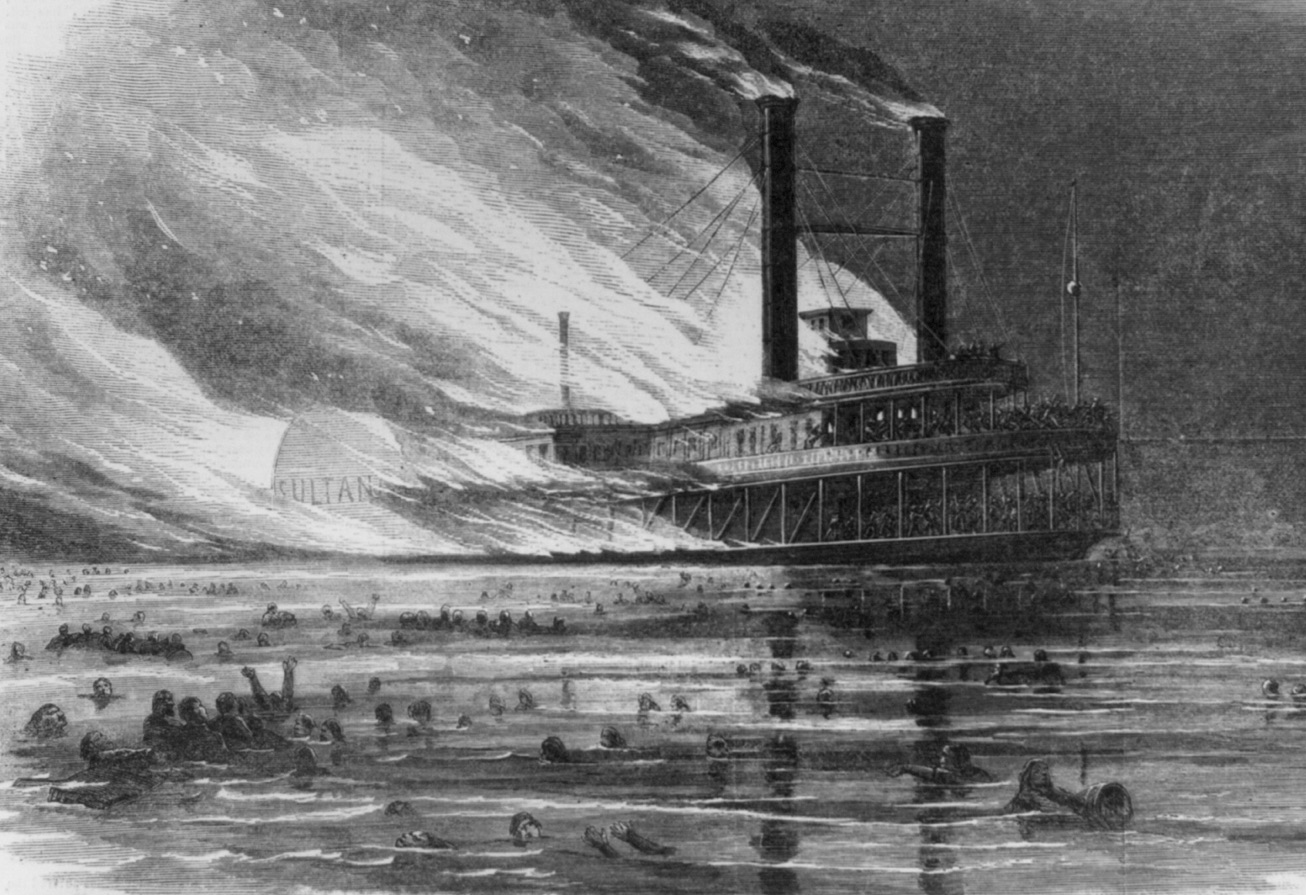
Suddenly, three of the huge boilers exploded with a volcanic fury that a witness on the shore described as the thundering noise of ‘a hundred earthquakes.’ The blast tore instantly through the decks directly above the boilers, flinging live coals and splintered timber into the night sky like fireworks. Scalding water and clouds of steam covered the prisoners who lay sleeping near the boilers. Hundreds were killed in the first moments of the tragedy. The upper decks of the Sultana, already sagging under the weight of her passengers, collapsed when the blast ripped through the steamer’s superstructure. Many unfortunate souls, trapped in the resulting wreckage, could only wait for certain death as fire quickly spread throughout the hull. Within twenty minutes of the explosion, the entire superstructure of the Sultana was in flames.
The burning wreckage began to drift slowly downriver, as those on board fought to survive. With only 76 life preservers and two small lifeboats available, most of those who survived the blast jumped for their lives into the river. In the hours before dawn, hundreds of soldiers and civilians struggled in the river as they awaited rescue. But help did not come until 3:00 a.m., an hour after the explosion. The Bostonia II, plowing downriver, came upon the Sultana engulfed in flames, and immediately began to haul the survivors from the water around the wreckage.
In Memphis, sailors stood on the decks of United States Navy gunboats watching the red glow from the dying steamer that lit the northern horizon, yet no rescue effort was launched until approximately 3:20 a.m., by which time cries could be heard from out across the river. As cutters from the gunboats began sweeping the river in front of Memphis for survivors, their crews were directed in the darkness by the victims’ screams for help. A sailor aboard the USS Tyler wrote in the ship’s log that ‘of all the sounds and noises I ever heard that was the most sorrowful; some cursing, calling for help; and shrieking. I will never forget those awful sounds.’
When the sun rose in the eastern sky, more than 1,700 were dead or dying. Among the fatalities were Captain Mason, William Gambrel, Major Fidler, and Sergeant Ely.
At daybreak, the survivors commenced the grim and often futile task of searching for comrades. Samuel Pickens of the Third Tennessee Cavalry tried to locate his brother William. The following day Pickens wrote to his mother to give her the grim news of the disaster. ‘[I] must confess,’ he told her, ‘that to the best of my knowledge William is among the lost. I have not heard of him since the explosion took place and I have no hope of ever hearing from him anymore.’
More than 500 of those who made it to shore were placed in hospitals; the Soldier’s Home at Memphis took another 241. Many of these injured did not live to enjoy the freedom they had so recently won. Sergeant William Fies of the 64th Ohio Infantry, in describing the grim sights in one of the hospital wards, wrote that he ‘was placed in a ward with quite a number who were severely scalded, or otherwise badly injured, and such misery and intense suffering as I witnessed while there is beyond my power to describe. The agonizing cries and groans of the burned and scalded were heartrending and almost unendurable, but in most cases the suffering was of short duration as most of them were relieved by death in a few hours.’
Because no accurate assessment of the number of passengers had been made, it was impossible to calculate the exact number of dead. Both the military’s estimate of 1,238 and the Customs Department’s figure of 1,547 were based strictly on Captain Williams’s tally of prisoners placed on the Sultana at Vicksburg and were, therefore, too low. In reality, the death toll stood at more than 1,700.
Within hours of the disaster, General C. C. Washburn, the commanding officer at Memphis, appointed a military commission to investigate the tragedy. After weeks of testimony, the commission discounted the crowded conditions aboard the Sultana, concluding that ‘the evidence fully shows that the government has transferred as many or more troops on boats of no greater capacity than the Sultana frequently and with safety.’
General Dana and Brigadier General William Hoffman, the U.S. Army Commissary General of Prisoners, each conducted investigations. Hoffman’s findings were the most critical of the military’s involvement in the Sultana tragedy. He concluded that the’shipment of so large a number of troops (1,866) on one boat was, under the circumstances, unnecessary, unjustifiable, and a great outrage on the troops.’ His report also pointed a finger of guilt at General Smith, noting that although he ‘had nothing officially to do with the shipment of the troops; yet as it was officially reported to him by Captain Kerns that too many men were being put on the Sultana, it was proper that he should have satisfied himself from good authority whether there was sufficient grounds for the report, and if he found it so he should have interfered to have the evil remedied. Had [Smith] done so, the lives of many men would have been saved.’
The cause of the destruction of the Sultana has always been in dispute. Many Northern newspapers immediately blamed the tragedy on sabotage, a possibility discounted by all of the various military investigations. The Washburn Commission concluded that insufficient water in the boilers precipitated the explosion, despite testimony to the contrary by the Sultana‘s second engineer, who was on watch at the time of the explosion and who died soon after from the injuries he had received.
It was the investigation and report of J. J. Witzig, the supervising inspector of steamboats, that shed the most light on the cause of the tragedy. Witzig contended that the shoddy repair to the middle larboard boiler at Vicksburg had caused the explosion. The small patch, he reasoned, was too thin to stand the excessive pressure in the boiler on the upriver trip.
At the conclusion of all the military investigations, Hatch and Speed were ordered to appear before court-martial tribunals. The charges against Hatch stemmed from the fact that he had selected the Sultana to transport the prisoners. Speed, because of his temporary replacement of Williams, was deemed to be the officer in direct command of the prisoner transfer.
On November 1, 1865, a court was appointed to try Captain Speed at Vicksburg. Although the government called several witnesses to testify, the prosecution failed to compel the appearance of one key witness, Lieutenant Colonel Hatch. A request by the prosecutor to the Secretary of War to have Hatch arrested and brought to Vicksburg to testify went unanswered. In June 1866, the military court found Speed guilty on all charges and sentenced him to be dismissed from the army. The verdict, however, was later reversed by the judge advocate general, and Captain Speed was honorably mustered out of service.
Hatch never stood before a court-martial tribunal. On June 3, 1865, he was relieved of his duties as chief quartermaster of the Department of the Mississippi. A few weeks later, he boarded the northbound steamer Atlantic, carrying $14,490 in government money. During the voyage, the safe of the Atlantic was robbed. The thief was caught before the boat reached St. Louis, and all the money was recovered, except for more than $8,500 in government funds Hatch claimed he had placed in the safe. He was found to have violated military regulations by removing the funds from the Department and was held personally liable for the loss of the money. Thus, Hatch’s career ended as it began — in controversy.
With Speed’s exoneration, the military closed the books on the Sultana tragedy. In the end, no one was held responsible for the worst maritime disaster in American waters. Speed stayed in Vicksburg, becoming a criminal court judge and a powerful voice in Mississippi politics. George Williams retired from the military in 1870 as a major; he later served several terms on the school board in Newburgh, New York. General Smith, after resigning from the army, served as second assistant postmaster general during the Grant administration. On December 29, 1874, Smith was thought to have committed suicide after an article appeared in The New York Times accusing him of taking a $50,000 bribe.
The horror of the Sultana tragedy was multiplied by its futility. Headlines in the Memphis Daily Appeal screamed: ‘IT WAS MURDER!’ And the newspaper was correct. There was no military reason requiring or justifying the placement of so many soldiers aboard the Sultana. The real cause of the disaster was not the failure of the patch on the boiler, but the conspiracy of greed at Vicksburg that put the quest for profits above the safety of the weary soldiers who thought the horrors of war were behind them forever.
As the years passed, several survivors attempted to persuade the government to erect a monument in memory of their fallen comrades, but to no avail. Shortly before his death, Sultana passenger James H. Kimberlin expressed resentment toward his country when he wrote: ‘The men who had endured the torments of a hell on Earth, starved, famished from thirst, eaten with vermin, having endured all the indignities, insults and abuses possible for an armed bully to bestow upon them, to be so soon forgotten does not speak well for our government or the American people.’
This article was written by Jerry O. Potter and originally published in the August 1998 issue of American History Magazine. For more great articles, subscribe to American History magazine today!