St. Petersburg, Florida, is not generally considered a city that can boast of an aviation ‘first.’ But on January 1, 1914, the St. Petersburg-Tampa Airboat Line was born there–the world’s first scheduled airline using winged aircraft. A plaque on the entrance to St. Petersburg International Airport proclaims: ‘The Birthplace of Scheduled Air Transportation.’
Traveling in that first passenger airplane made of wood, fabric and wire was a far cry from flying in today’s comfortable, air-conditioned airliner. From all accounts, however, those first airline flights were not so bad, provided you did not mind sitting out in the breeze with water spraying in your face. Passengers sat on a wooden seat in the hull of a two-place seaplane that did not have a windshield and rarely flew more than five feet above the water. That is the way it was on that momentous day in sunny Florida only a decade after Orville and Wilbur Wright made their historic first flights at Kitty Hawk, N.C.
The aircraft in St. Petersburg was a Benoist (pronounced Ben-wah or Ben-weest) Model 14, built by St. Louis manufacturer Thomas W. Benoist. Best known for the sparking batteries and automobile self-starters he manufactured, Benoist also built 17 different models of landplanes and seaplanes between 1910 and 1917. His aircraft advertisement claimed: ‘My plane is figured down to the last equation, and improved up to the second. Every nut, bolt, wire, wood member, and piece of cloth is examined, tried and tested before it goes into our machines. Some others may be built as good, but none are built better, because we use the best of everything.’ An early aviation visionary, he said he often ‘dreamed of the skies filled with air lanes carrying the world’s passenger and freight traffic.’
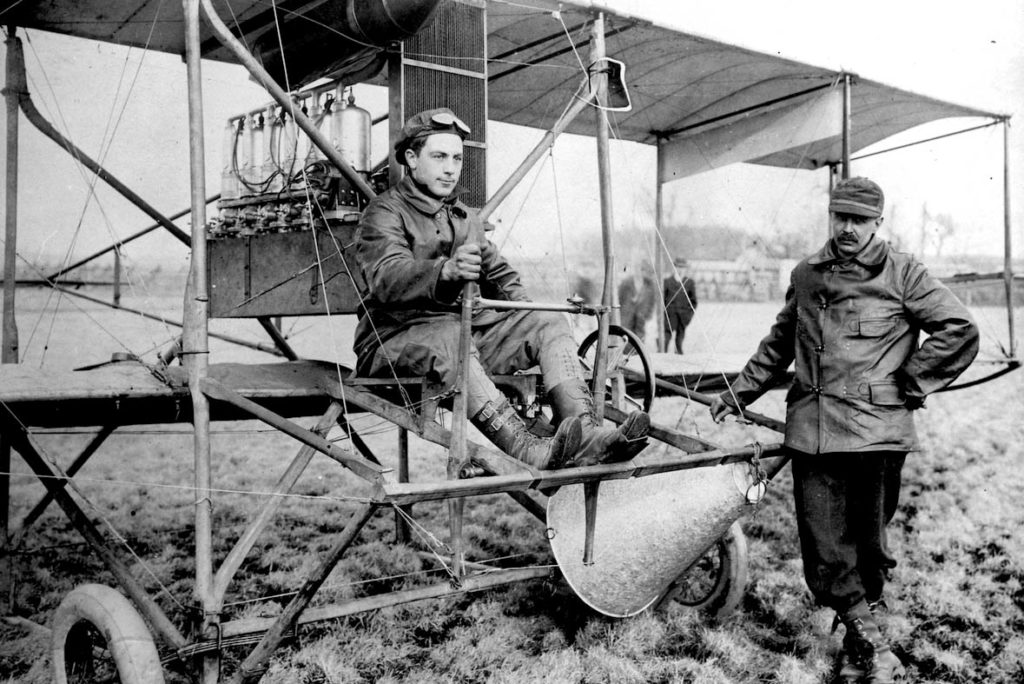
The pilot on that historic January 1914 flight was Antony H. Jannus, a Benoist test pilot and instructor who had carried Captain Albert Berry aloft to make the first parachute jump from an airplane on March 1, 1912. Jannus flew a number of exhibitions demonstrating Benoist planes throughout the Midwest and was a contestant at a Chicago air meet in September 1912. Later that month, he established an American passenger-carrying record by taking three men with him on a 10-minute flight. On November 6, 1912, flying an early model Benoist on a single float, Jannus and J.D. Smith, his mechanic, left Omaha for New Orleans in an attempt to set a distance record for winged aircraft. Although it took six weeks to make the 1,973 mile trip because of stops for exhibitions, a near-disastrous fire, repairs and a bout with appendicitis, Jannus received wide acclaim in the newspapers as ‘the pioneer flying-boat pilot of the world.’ Shortly thereafter, he was credited with setting a ‘continuous flight with passenger’ record by flying the 251 miles from Paducah, Ky., to St. Louis in four hours, 15 minutes.
Jannus, who was born in Washington, D.C., in 1889, had been employed by the Emerson Marine Engine Co. in Alexandria, Va. He had been sent to the airfield at College Park, Md., in November 1910 to install a marine engine in a modified Curtiss-type airplane with Farman landing gear, made by Frederick Fox and Rexford Smith, and was instantly obsessed with learning to fly. He began flying after receiving only cursory instructions and was soon making cross-country flights at altitudes up to 300 feet. Jannus flew several times from the Polo Grounds in Washington and made some air-to-ground radio tests for the Signal Corps. In July 1911, he traveled to St. Louis, where he was hired by Benoist as a flying instructor. Roger, his older brother, a graduate of Lehigh University, also was caught up in the excitement of flying. He later joined Tony at the Benoist factory and took lessons from him.
The driving force behind the St. Petersburg Tampa Airboat Line was Percival Elliot Fansler, a Florida sales representative for Kahlenberg Brothers, a Wisconsin manufacturer of diesel engines for fishing boats. He became fascinated with Benoist’s progress in aircraft design and manufacture. He recalled later: ‘My appetite for speed was whetted by my experiences in racing boats. Having heard that Tony Jannus had made his famous trip down the Mississippi in a flying boat, I started correspondence with Tom [Benoist]. After receiving two or three letters that dealt with the details and capabilities of the boat, the idea popped into my head that instead of monkeying around with the thing to give ‘jazz’ trips, I would start a real commercial [air]line from somewhere to somewhere else. My experience in Florida led me to conclude that a line could be operated between St. Petersburg and Tampa. The distance was about 23 miles–some 15 of which were along the shore of Tampa Bay, and the remainder over open water. I wrote to Tom about the scheme and he became immediately enthusiastic.’
Fansler agreed to go to Tampa, select a suitable seaplane route and make all the business arrangements. Benoist promised he would furnish three airboats, mechanics and pilots if Fansler was successful in getting some financial backing.
Fansler went to Tampa in late November 1913 but found no one there interested in issuing a contract for an airline franchise. On December 4, he went across Tampa Bay to St. Petersburg, then a city of only about 9,000 people during the winter months. ‘They thought I had a mighty clever idea,’ he wrote later, ‘but they didn’t believe there was any such thing as a flying boat. I talked a group of a dozen men into putting up a guarantee of $100 each, and the Board of Trade came in with a like amount.’
Fansler immediately wired Benoist to come to St. Petersburg. On December 17, 1913, Benoist signed the world’s first airline contract for heavier-than-air planes–10 years to the day after the Wright brothers had first flown successfully at Kitty Hawk. (Delag, a German airline using dirigibles, operated a scheduled route between Freidrichshafen, Frankfurt, Hamburg, Leipzig, Potsdam and Dresden from 1910 to 1914 and carried 37,000 passengers without mishap. German historians concede that the schedule was rarely kept.)
The agreement called for a cash subsidy of $2,400 from the city of St. Petersburg, but only if the Benoist company supplied planes and pilots and maintained two scheduled flights daily between St. Petersburg and Tampa, six days a week for three months. Regular service was to begin on January 1, 1914. For each day that the scheduled flights were made on time, the city guaranteed to pay $40 a day through January and $25 a day in February and March.
The day after the contract signing, the St. Petersburg Times reported that ‘a fleet of hydro-aeroplanes’ would make regular trips between St. Petersburg and Tampa, and predicted that the service would ‘prove to be of great benefit to the city.’ When queried about the safety of the operation, Fansler said, ‘there is no more liability of accident in one of the boats than in an automobile, and the airboat will seldom be more than five feet above the water.’
Fansler, as general manager of the airline, fixed the price of a one-way ticket at $5 for the 22-minute trip. Passengers were allowed a maximum weight of 200 pounds gross, including hand baggage. ‘Excess weight [was] charged at $5 per hundred pounds, minimum charge 25 cents,’ according to the handbills distributed throughout the two cities. Besides operating two scheduled flights per day, six days a week, Fansler recalled that ‘our agreement with our backers permitted us to indulge in special flights at any price we cared to name, and we made a number of these trips at $10 to $20 each.’
Charter flights could be arranged from St. Petersburg to several other Florida sites–Pass-a-Grille, Clearwater, Tarpon Springs, Bradenton, Sarasota, Palmetto, Safety Harbor and Egmont Key. Advertisements for these flights stated they would cost $15 and ‘trips covering any distance over water routes [would be made] from the waters’ surface to several thousand feet high at passenger request.’
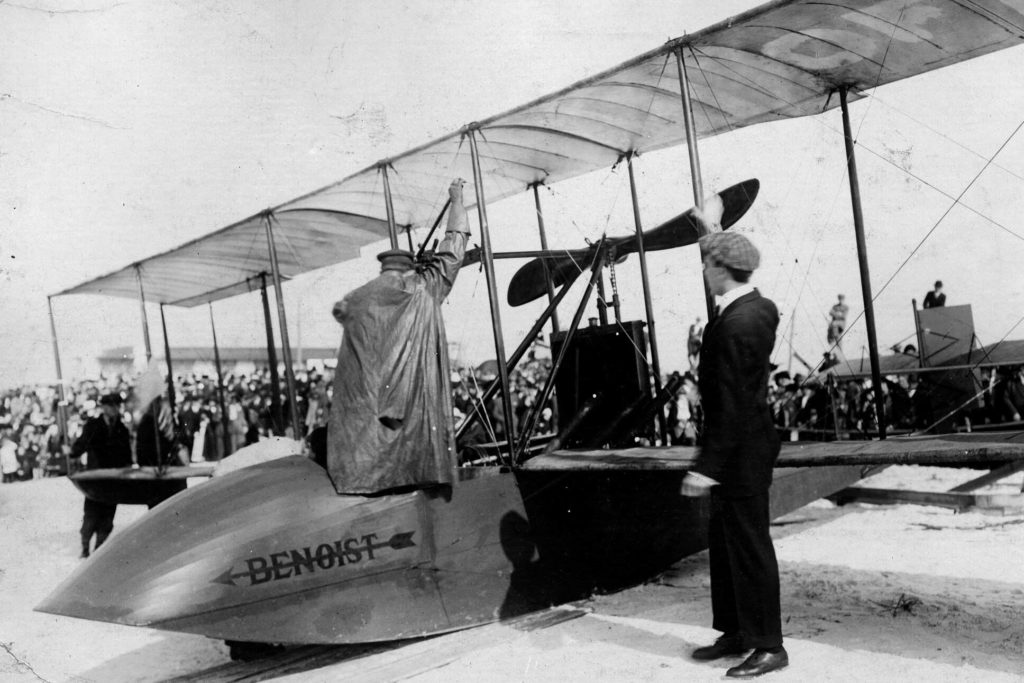
Today, a 22-minute flight from St. Petersburg to the famous Cigar City would seem a long time, but the alternatives in 1914 were a 21Ž2-hour trip by steamship to circumnavigate the bay area, or 12 hours by train. There is no reliable estimate of the time it would have taken by automobile in those days of hand-cranked engines, solid rubber tires and unpaved roads.
In addition to starting the airline, Fansler announced that a training school for pilots would be established. Three Benoist airboats were shipped from the St. Louis factory for both purposes. One was a Model 13; the other two were Model 14s. The Model 13 was to be operated by the school for instruction, and the 14s were to be used for passenger transport. A large, open-ended hangar was planned.
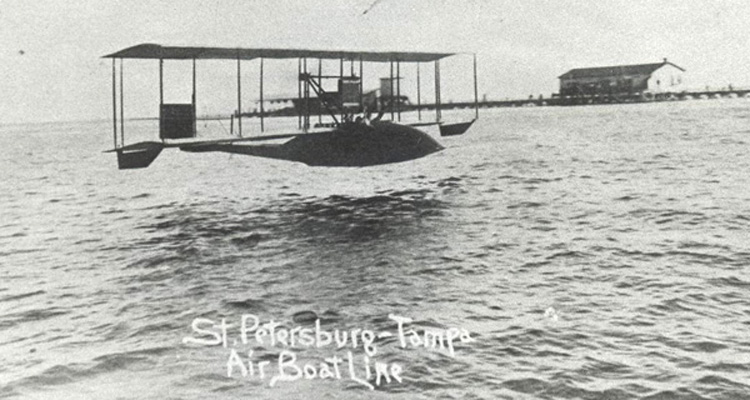
The first of the two Model 14 Benoist airboats, No. 43, arrived by train from Paducah, Ky., and was promptly assembled. It weighed 1,250 pounds, was 26 feet long and had a wingspan of 44 feet. Although the plane was built to hold only a pilot and one passenger on a single seat, sometimes two small passengers could be accommodated. Tony Jannus gave it two test flights on December 30 and 31, 1913, accompanied on one of them by Benoist’s chief mechanic, J.D. Smith, and on the other by a local man named J.G. Foley.
Smith, whom Jannus called ‘Smitty, the Infallible,’ was especially adept at maintaining the Roberts 6-cylinder, in-line, liquid-cooled, 75-hp engines that Benoist used in his planes. Smith had raced motorcycles as a young man, and when he read about Benoist in 1912, he left his home in Jamestown, Pa., for the St. Louis plant. Benoist found him voluntarily sweeping snow off a plane in subfreezing weather and hired him on the spot.
The hull of the Benoist flying boat was made of three layers of spruce with fabric between each layer. The Roberts engine and a pusher propeller gave the aircraft a top speed of 64 mph. The wings were of linen stretched over spruce spars. It was claimed, though not accurately, that the Benoist was the only plane in the world at the time that had the engine placed down in the hull. The plane was touted for publicity purposes as ‘a motor boat with wings and an air propeller.’ It was priced at $4,250.
Although this early Benoist had greater stability than later models, the low placement of the engine proved to be a maintenance headache. The propeller had to be located high enough to avoid the water spray, and the connection between the engine in the hull and the pusher propeller required a chain drive that often slipped off its track. Later Benoist models had one or two 100-hp Roberts direct-drive engines mounted under the top wing.
By New Year’s Day of 1914, the continual attention the local paper was giving to the promised inauguration of scheduled flights had built up intense interest in the new venture. After a parade from downtown St. Petersburg to the waterfront, an Italian band from the Johnny Jones Show played at the municipal pier as Jannus readied the airboat for flight. A crowd of 3,000 looked on while a ticket for the first flight round-trip to Tampa on the airline was auctioned off. Former Mayor Abraham C. Pheil won the honor of being the first airline passenger with a bid of $400. The airline donated the money to the city for the purchase of harbor lights.
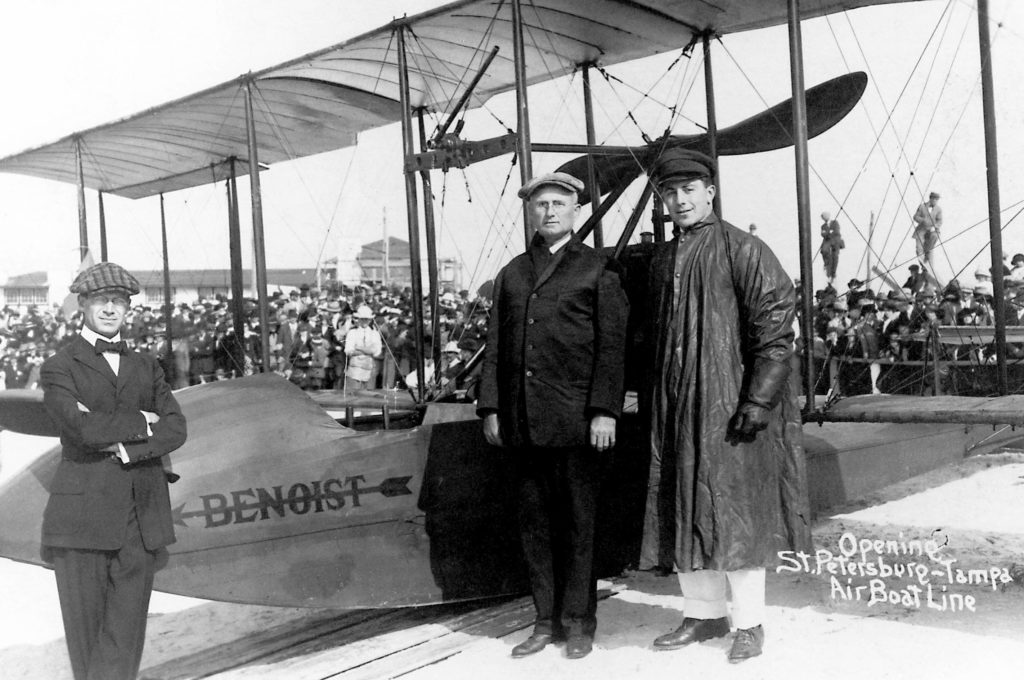
Fansler made a short speech as the airboat was being placed in the water, ‘What was impossible yesterday is an accomplishment today, while tomorrow heralds the unbeliev able,’ he concluded. At 10 a.m. the ex-mayor donned a raincoat, stepped gingerly into the hull and sat on the small wooden seat beside the pilot. Jannus started the two-cycle engine and tested the controls. He waved to the crowd, taxied out and took off into history. Halfway to Tampa, however, the engine began misfiring, and he landed in the bay briefly to adjust it. He took off again and, 23 minutes after the original takeoff, landed at the entrance to the Hillsborough River before an excited crowd of 2,000.
Police held the crowd back as Jannus and Pheil obliged a cameraman who asked them to pose for pictures. A reporter from the Tampa Tribune asked Pheil why his hands were all greasy. He replied that it was from ‘assisting Mr. Jannus to adjust some machinery.’ Pheil went to a telephone and called St. Petersburg to announce their arrival.
Jannus and Pheil left Tampa for the return trip at 11 a.m. and arrived back in St. Petersburg before another cheering crowd. Just before the afternoon flight, a second auction was held, with Noel A. Mitchell the successful bidder for a round-trip flight at $175. The next day, Mrs. L.A. Whitney, wife of the secretary of the Chamber of Commerce, made the flight to Tampa and back to become the first woman passenger to fly on a fixed-wing scheduled airline. (Actually, Mae Peabody of Dubuque, Iowa, was the first woman to make a local flight out of St. Petersburg.) Whitney described the flight as ‘the most delightful sensation imaginable–it is like being rocked to sleep in your mother’s arms.’
The St. Petersburg Times announced that it had signed a contract with the airboat line to fly papers daily to Tampa, which would make it ‘the first newspaper in the world to use flying machines for delivery purposes.’ The announcement added, ‘This will be the most unusual carrier system in all the world and Tampa readers, when they receive their copy… will read a newspaper delivered as no other.’
The Tampa Tribune noted that the first flight had been made ‘without mishap’ and gave the event a banner headline in its January 2 edition–‘The First Commercial Air Ship Line Inaugurated.’ The article stated: ‘When the airboat arrived yesterday morning, a crowd of 2,000 was waiting near the temporary landing [site], another 1,000 saw what they could from the Lafayette Street bridge, and 500 more were across the river. When the dock was reached, an enthusiastic cheer went up, and there was a clapping and the waving of hats and handkerchiefs. A moment later, there was a rush down the three narrow planks connecting the platform with the shore; men, women and children [were] fighting to get down to the boat and its two occupants.’
There was amused reaction from other state newspapers. The Jacksonville Metropolis editorialized that ‘St. Petersburg is now a city of pelicans, porpoises & planes.’ Its rival, the Jacksonville News, advised: ‘St. Petersburg papers might secure an obituary sketch of all aeroplane passengers at the same time they take the passenger manifests. It might save time.’ The Estero Eagle asked, ‘Is Tampa such a tough and wicked old city that its residents are preparing to fly from it?’
The Tampa Tribune responded to that question a few days later: ‘All airboat passengers have been from St. Petersburg and are apparently eager to get to Tampa.’ The St. Petersburg Independent replied: ‘It is noticeable that the time from Tampa is always faster than the time to Tampa. Once having reached Tampa, no matter how anxious to get there, the passengers are always in a hurry to get away.’
Jannus’ flight records show that an additional five short flights of about 10 minutes each were made that epic day. He noted that the engine was burning 13 gallons of fuel and about a gallon of lubricating oil per hour of flight.
The airline service had to sort out a few administrative problems. The Tampa Port Inspector required that the airline get a license for all its pilots and planes, so Jannus immediately applied for one, which was issued on February 17, 1914, by the U.S. Department of Commerce. Some historians claim it was the first airline pilot’s license in the United States. According to Edward C. Hoffman, president of the Florida Aviation Historical Society, the license they have on hand has the word’steamboat’ crossed out and ‘Aeroplane’ typed in. (Another license was granted on August 10, 1914, at Cleveland, Ohio, which states that it is issued for ‘Operator Motor’ and appears to be for operation of motorboats.)
Local merchants took advantage of the airline’s sudden renown to advertise that their wares were being transported by air. A Tampa florist filled orders to St. Petersburg for as much as $50 worth of cut flowers a day. The Hefner Grocery Co. in St. Petersburg ran an ad touting Swift premium smoked hams and bacon that had been delivered by ‘Airboat Express.’ The ad said, ‘Although they came high, the price is low.’ Some mail was carried but not on government contract.
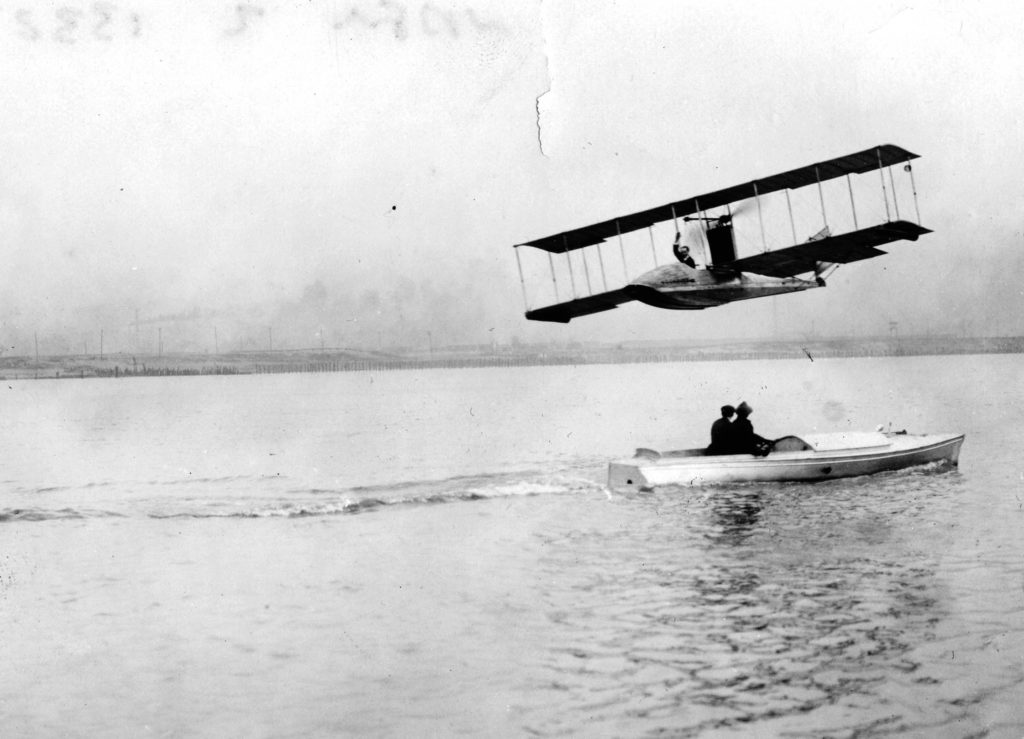
The other two airboats, one a Model 13 and the other a 14, arrived on January 31. Roger Jannus was to be the backup pilot. Heinrich Evers, a German, and Byrd Latham enrolled as students, and both soloed at St. Petersburg. Evers wrecked the Model 13 on its second flight.
The airline operated successfully for the three-month period. A total of 172 regular trips were made, and 1,205 passengers were carried (some two at a time) for an estimated 7,000 air miles. Of the 50 days scheduled for flying, only seven days were lost because of weather or maintenance problems. On one flight, however, Jannus had to land in choppy water when the engine ran rough because of dirt in the carburetor. One pontoon and a portion of one lower wing were damaged. Fansler reported that Jannus fixed the carburetor, ‘got the boat into the air again with skill and flew on in with a portion of the wing hanging like the broken wing of a bird.’
On another forced landing due to engine problems, Jannus hit a submerged object and the boat hull sprang a leak. As Gay Blair White notes in The World’s First Airline, ‘This was the only case in which a passenger got his feet wet, and he would not, if he had stayed on the machine until a motor boat came out and took him off. However, as the boat had four air-tight compartments and none of these were punctured, the damage caused by the accident was trivial.’
According to Fansler, the demand for reservations remained high: ‘We had a waiting list a yard long, and not once did we have to fly without a passenger.’ In addition to the scheduled trips, about 100 charter and sightseeing flights were reported in the two Model 14 airboats. Repair costs were stated as less than $100. An estimated $12,000 in fares was taken in, but local historians believe that the freight cost of getting the planes to Florida, employee wages and gas and oil allowed only a small profit. On March 28, as the contract expiration date neared, Benoist said, ‘We have not made much money, but I believe we have proved that the airplane can be successfully used as a regular means of transportation and commercial carrier.’
The airline operated for another five weeks after the March 31 contract termination date, but passenger interest declined rapidly as the’snow birds’ (winter residents) retreated northward. On April 27, Tony and Roger Jannus, apparently bored between scheduled runs, raced each other several times over an eight-mile course. The last official airline flight was made on May 5, 1914.
The original aircraft, No. 43, was sold to Byrd M. Latham, who took it to Conneaut Lake, Pa., to provide sightseeing flights. The plane crashed in July 1914 with a 250-pound passenger aboard. Both men were thrown into the water, and the airboat was nearly destroyed. Latham salvaged the radiator and engine and built another airboat ,which he named Florida. It was returned to St. Petersburg and placed in storage. Later, with Tony Jannus piloting, it crashed when a wing fell off. Only the engine was salvaged, and it was placed in a second Florida and test-flown by J.D. Smith.
Smith and Roger Jannus took No. 45 to San Diego in December 1914, where it crashed on February 15, 1915, with Smith piloting. The passenger escaped injury, but Smith lost seven teeth. Number 44 suffered a broken wing and remained at St. Petersburg until 1915, when it was repaired by Smith. The plane later crashed and was destroyed with Tony Jannus at the controls.
The two Florida cities are proud of their aviation ‘first’ and have reminded the aviation community about it each year since 1964. To celebrate the 50th anniversary of the historic flight, the St. Petersburg and Tampa chambers of commerce established the Tony Jannus Award. The award is given annually on Tony Jannus Day to an individual ‘who has contributed to the growth and improvement of the scheduled airline industry.’
The first recipient was U.S. Senator A.S. ‘Mike’ Monroney (D-Okla.), who sponsored progressive federal aviation legislation. Other recipients include Jimmy Doolittle, Juan Trippe, Eddie Rickenbacker, C.R. Smith and Donald W. Douglas. Recent winners were Herbert D. Kelleher of Southwest Airlines; Alan Boyd, former secretary of transportation; and Martin Schroder, founder of MartinAir.
A flying replica of the 1914 Model 14, No. 43, was constructed by George Hayes, Russell St. Arnold and 28 other members of the Florida Aviation Historical Society. The replica was piloted on its first and all subsequent flights by Edward C. Hoffman. The initial flight was made on October 9, 1983. About 30 to 40 more short flights were made to ‘work out engine and chain problems, as well as weight and balance questions,’ according to Hoffman. A flight from Lake Tarpon to St. Petersburg was made just before Christmas 1983.
The construction of the replica had not been easy. None of the original drawings could be found, so new plans were made from photographs, newspaper clippings and stories that appeared in articles in old issues of Aero & Hydro magazine. A Chevrolet straight 6-cylinder engine was substituted for the original Roberts power plant when none of the latter could be located.
At 10 a.m. on New Year’s Day 1984, Hoffman took to the air to commemorate the Jannus flight of 70 years before. The replica was flown about seven times more at Tarpon Springs to make an Imax film that was then shown at the National Air & Space Museum in Washington, D.C. The replica’s total flying time was six hours, 40 minutes, and it never flew again. The Chevrolet engine was later replaced with a light wooden replica of the original Roberts for display purposes.
This replica of the historic Benoist No. 43, an original Benoist propeller, a pennant that had been tied to the plane and a 1914 newspaper carrying the area’s most exciting aviation story of the time are all on display in the Benoist Pavilion at the St. Petersburg Historical and Flight One Museum. The birthplace of scheduled air transportation is memorialized by a plaque that was dedicated on October 12, 1957, by Pinellas County authorities. It reads: ‘Here, in this county, Thomas W. Benoist, pioneer airplane builder, first proved to the world that the amazing new invention, the flying machine, could be put to work for the benefit of mankind.’
Although short-lived, the three-month scheduled service did indeed prove that aircraft with good maintenance and competent pilots could provide safe public transportation.
This article was written by C.V. Glines and originally published in the May 1997 issue of Aviation History.
For more great articles subscribe to Aviation History magazine today!