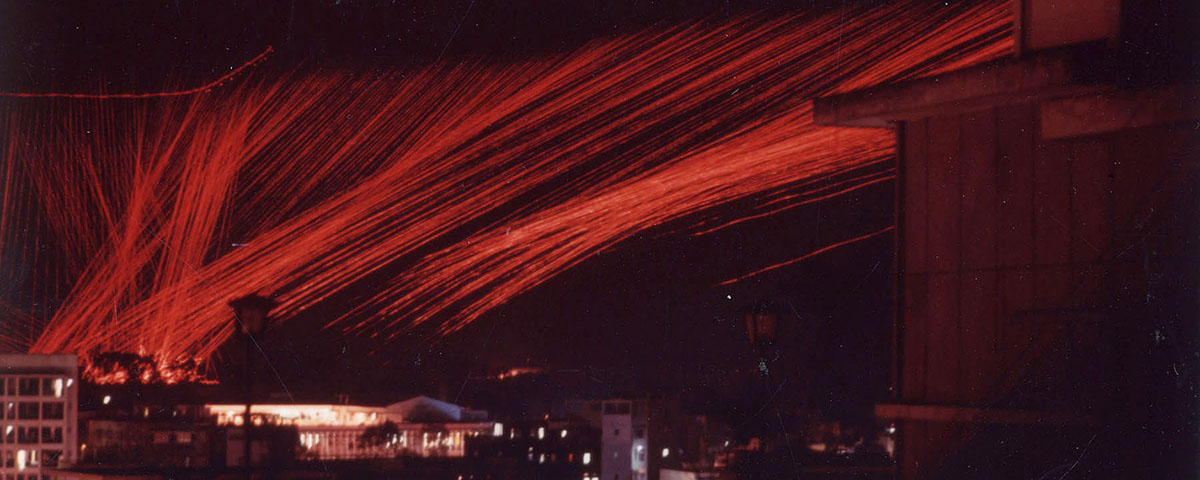
On the night of December 23, 1964, Communist Viet Cong guerrillas pressed night attacks against several Republic of Vietnam (RVN) outposts in the Mekong River delta. Defenders at one such government stronghold radioed for fire support, and soon the sound of two radial engines were heard in the dark sky. As flares dropped from the aircraft, the VC interrupted its assault to wait for the plane and its flares to leave the area. The guerrillas had used this tactic many times before to frustrate the brief advantage given the entrenched government forces by the powerful flares dropped by U.S. and RVN Air Force C-47 (the venerable Douglas DC-3) flareships.
As the VC went to ground, a roar, as if from some unseen dragon, filled the night as streams of fire and death licked the earth from above. Every few seconds the roar stopped, only to return from another direction, but still directed at the guerrillas below. Faced by a devastating new weapon, the VC withdrew. Later that night, the scenario was repeated farther south at Trung Hung to relieve another besieged garrison.
These were the first night combat missions flown by a modified twin-engine cargo plane whose predecessor, the C41, first took flight on December 18, 1935, and became the backbone of the air cargo and transportation fleet in World War II. By the end of 1964, the modified C-47s undergoing combat tests in Vietnam had flown 16 night combat missions, firing nearly 180,000 rounds to defend RVN outposts in and around the delta.
Combat tests continued throughout the spring of 1965 and, in May, the Air Force adopted the C-47 gunship variant as its first fixed-wing gunship. This decision ended decades of debate on side- and lateral-firing aircraft and heralded the development of an entire family of even more sophisticated interdiction and ground-support aircraft.
Although we tend to associate side-firing gunships with Vietnam, the concept was born more than a decade before World War II. In late 1926, Army 1st Lt. Fred Nelson, a pilot stationed at Brooks Field in San Antonio, Texas, proposed engaging ground targets with automatic weapons mounted perpendicular to the axis of an aircraft while the pilot flew a pylon turn around an imaginary center-point. Nelson argued that from such a banked turn, a pilot could keep his target in sight while directing near-continuous fire onto it. In 1927, to prove his point he mounted a .30-caliber machine gun on the left wing of a DH-4 biplane and, while sighting through a crude aiming device on a strut, successfully engaged a target. Despite his accomplishment, the concept was rejected as being too radical.
America’s involvement in WWII and the battle to win supremacy in the North Atlantic brought new life to the notion of side-firing aircraft. First Lieutenant Gilmour C. MacDonald submitted a proposal on April 27, 1942, to use lateral-firing .50 calibers against submarines. In this manner, MacDonald contended, a sub could be kept under constant surveillance and continuous fire while the attacking plane maintained a pylon turn. The Air Corps had already begun to modify fighter-bombers and light and medium bombers to interdict enemy logistic lines by increasing their payload of heavy machine guns, and MacDonald’s suggestion was disregarded.
In the summer of 1945, MacDonald tried once again to find a sponsor for his side-firing gunship, this time for use against ground targets instead of submarines. On May 2, he wrote the Research and Development Service Sub-Office at Dover Army Air Base suggesting the installation of a T-59 Superbazooka on liaison-type aircraft to pin soldiers in trenches and to attack tanks. However, the war was closing and no one was interested. Still undaunted, in 1947 MacDonald again tried to gain an audience by adding a side-firing machine gun to his previous bazooka-firing observation aircraft, but once again the idea was rejected.
The Korean conflict brought new demands on interdiction aircraft. In addition to night bombing of logistic centers, the large number of trucks and trains used by the North Koreans presented new problems for gunners as well as pilots. Modified WWII B-26 Invaders, redesignated A-26, armed with eight nose-mounted .50-caliber machine guns and six on the wings, were used with some success against a variety of targets but were limited by conventional head-on engagement tactics.
Never one to let a promising idea languish, in September 1961, then Lt. Col. MacDonald recommended lateral-firing rockets and guns to the Limited War Committee at the Tactical Air Command. The committee was investigating means of defending strategic hamlets in Vietnam but showed no interest in MacDonald’s ideas. Later that year, MacDonald met another person interested in lateral-firing gunships at a symposium at Eglin Air Force Base in Florida. This man, Mr. Ralph Flexman, shared MacDonald’s foresight and proved to be an integral linkage in the development of the modern gunship.
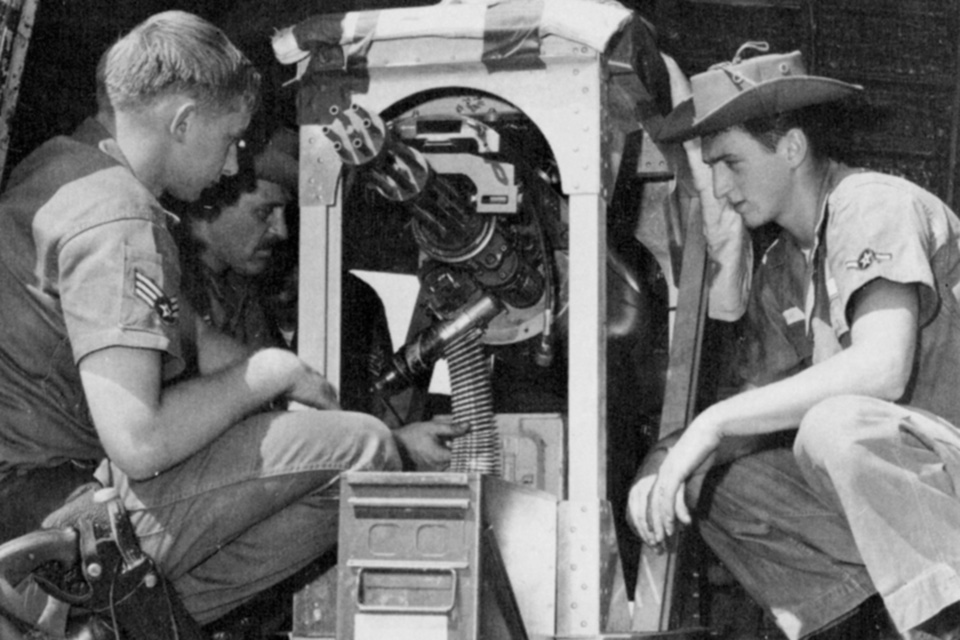
After discussing their theories, Flexman, then assistant chief engineer at Bell Aerosystems Company of Buffalo, N.Y., proposed a side-firing gunship to the Behavioral Sciences Laboratory at Wright-Patterson Air Force Base in Ohio. He suggested that lateral fire directed from a slow-moving, low-flying aircraft could triple the effectiveness of current systems by providing greater coverage and a higher angle of fire to pin down and destroy an adversary. His proposal, however, was immediately met with a litany of questions about ballistics, dispersion, aiming, and the time required to transition from straight and level flight into a pylon turn.
In April 1963, the MacDonald-Flexman consortium was joined by Air Force Captain John C. Simons, a research psychologist at Wright-Patterson. Simons was familiar with a unique method of mail delivery in the Amazon that involved a light plane flying a pylon turn around a small clearing and lowering mail bags on a long rope to the ground. Simons sent a copy of Flexman’s proposal to the Aerospace Medical Research Laboratory Office for Limited Warfare at Wright-Patterson for evaluation. Not surprisingly, the laboratory found the idea unsound and fraught with the same unanswered questions that had faced Flexman the year before. However, before Simons was instructed to stop meddling outside his field, in May an unofficial copy of his proposal found its way to the Air Force’s Aeronautical Systems Division (ASD), Limited Warfare Office.
Finally, the idea had landed on fertile ground, albeit by a most circumventive route. The ASD approved Project Tailchaser, calling for unarmed preliminary flight tests using T-28 and C-131 aircraft. Simons, initially allowed to participate in the test in conjunction with his normal duties, was replaced by Lieutenant Edwin Sasaki, a fellow researcher. The project really took off when Air Force test pilot Captain Ron Terry joined the project after completing a fact-finding tour in Vietnam in the summer of 1964.
Terry authored a proposal for hamlet and fort defense that won approval from the ASD Limited Warfare Office and, in August of 1964, guns were mounted in a C-131B appropriately named Terry and the Pirates (after a popular comic strip) for live tests at Eglin AFB. Instead of grease pencil markings on the pilot’s window, the team mounted a borrowed MK 20 Mod 4 gunsight from an A-1 Skyraider for what became Project Gunship I. Much of the other equipment aboard was also ‘borrowed’ or fabricated by the team, thus the plane’s appropriate name.
The team mounted a new General Electric SUU-llA/A 7.62mm minigun, designed for helicopter or Skyraider use and capable of firing either 3,000 or 6,000 rounds per minute, in the C-131’s cargo door. Live fire tests throughout the summer produced good results and captured the interest of the Ist Combat Application Group who wanted to know if guns could be mounted in C47 or C-123 cargo planes already maintained by Air Force Special Operations units in Vietnam.
Captain Terry jumped at the opportunity and mounted three miniguns in a C-47 for trials that began in September 1964. The plane conducted firing tests at altitudes from 500-3,000 feet and at a slant range of 1,750-9,000 feet. Terry found that he could fly the required pattern by holding a target between his left prop hub and the top of the engine cowl. The closer he flew to the target, the more bank was used. Then, with a little ‘Kentucky windage,’ he successfully engaged the target. He also discovered that the guns’ recoil pushed the aft of the plane starboard, resulting in a flight path that was more a series of arcs and straight lines than a true circle.
Convinced of the project’s potential, Terry and Sasaki briefed General Curtis E. LeMay, Air Force Chief of Staff, in early November 1964. LeMay approved the idea and sent Terry and company to Vietnam to modify two C47s for tests. The need for more fire support was critical. In late 1964, Communists were taking the offensive in Vietnam with nearly 1,800 attacks per month. In addition, VC forces attacked Bien Hoa Air Base on the night of October 31 and inflicted heavy losses to U.S. and RVN personnel and aircraft.
Terry arrived at Bien Hoa Air Base near Saigon on December l. After the miniguns arrived the following week, he seIected two test crews of six flight members and an interpreter, and two C-47s with relatively low flight time from the 1st Air Commando Squadron. The planes were modified to accept three minigun pods along the port side (two in the last two windows and one in the cargo door); an MK 20 Mod 4 gunsight mounted in the left cockpit window; and a selective trigger placed on the pilot’s control to fire one or all the guns. The pilot usually fired only two guns at a time in case of a jam and to conserve the 24,000 rounds of 7.62mm ammunition stored in the forward cargo compartment. Other onboard equipment included 45 flares that were thrown manually out the open cargo door, and radios to maintain contact with controllers, other aircraft and ground troops.
The conversions were completed on December 11 and 15 and the aircraft designated the FC-47 (fighter/cargo). The ‘fighter’ designation produced a roar of indignation from the fighter pilots who refused to accept the sluggish cargo plane as any sort of fighter. To soothe feathers, the new conversion became the AC-47 (attack/cargo).
The planes did not have long to wait before being tested in daytime combat. On December 15, the first AC-47 worked with a Forward Air Controller (FAC) and struck sampans, small structures, trails and suspected jungle staging areas. During the afternoon of December 21, FACs called the aircraft to hit a building occupied by VC. The next morning, infantry reported 21 enemy dead in and around the structure they described as a sieve.
Even before Captain Terry returned to the U.S. early in 1965 to join Project Gunship II (the development of the more powerful and sophisticated AC-130 gunship), AC-47s were proving themselves indispensable for outpost and hamlet defense and for interdiction of enemy logistics and troop concentrations. Air Force and Army officials were encouraged by the tests and production of a standard minigun-armed AC-47. There were field modifications that used surplus .30-caliber machine guns as interim armament while production of the scarce miniguns increased.
The new aircraft did not wait for the deployment of full AC-47 squadrons in country before gaining a nickname and a reputation among the VC. During the spring of 1965, Captain Jack Harvey, a member of Terry’s original flight crews, flew a night mission to defend a village in the Mekong River Delta. A Stars and Stripes reporter happened to witness the action and described the image of tracers streaming to the ground as dragon’s breath amid the roar of the guns echoing from the plane’s open door. On reading the depiction, the commanding officer of the 1st Air Command Squadron reportedly declared, ‘Well, I’ll be damned! Puff, The Magic Dragon!’ from the then popular Peter, Paul and Mary song. The name stuck. ‘Puff’ became the call sign for Harvey’s AC-47, then the only gunship in Vietnam, since the second one returned to the States for training. The VC also knew of ‘Puff.’ Captured documents often referred to the plane and said not to attack the ‘dragon’ since weapons were useless against it and would only infuriate the monster.
The first AC-47 squadron, the 4th Air Commando Squadron, deployed to Tan Son Nhut from Forbes Air Force Base on November 14, 1965, with two production AC-47s and three interim .30-caliber conversions. Seventh Air Force Order No. 411-65 gave the 4th ACS the mission to ‘ . . respond with flares and firepower in support of hamlets under night attack, supplement strike aircraft in the defense of friendly forces, and provide long endurance escort for convoys.’ The 4th ACS performed all of these tasks with exceptional panache.
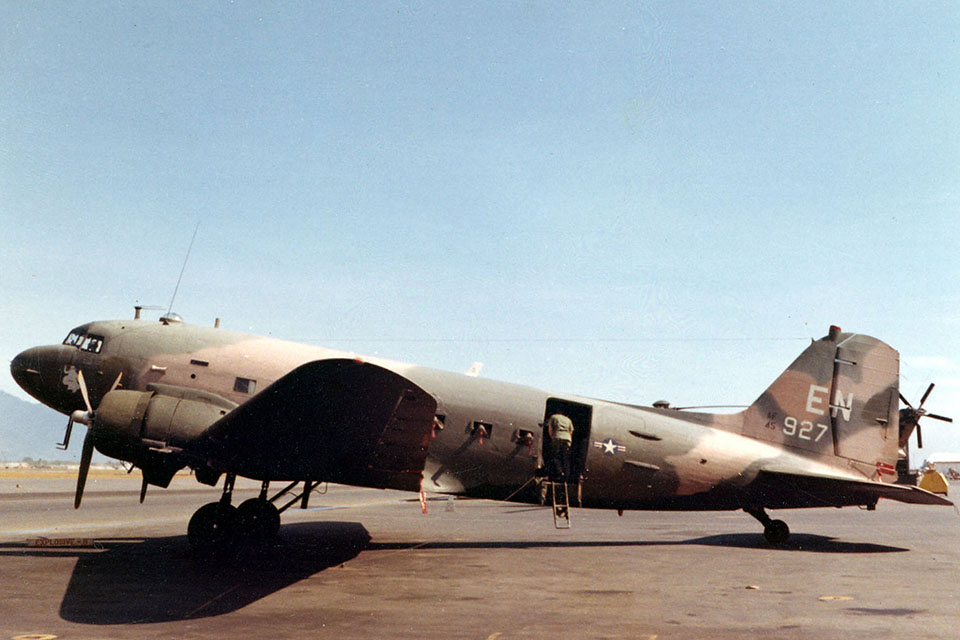
As its number of aircraft and crews increased, the 4th ACS forward-deployed planes to Nha Trang, Da Nang, Pleiku, Bien Hoa and Binh Thuy. The flight at Nha Trang became part of the 14th Special Operations Wing, fondly known as The Antique Wing because all of its aircraft were propeller driven. For the remainder of 1965, the gunships flew 277 combat missions, fired 137,136 rounds and 2,548 flares, and killed an estimated 105 VC in Vietnam and Laos. During this start-up period, the new unit lost only two planes, one to ground fire on December 17 while en route to Phan Rang from Tan Son Nhut and the other on Christmas Eve in Laos.
Shortly after the 4th ACS began deploying its aircraft, it christened the gunships with the lasting name ‘Spooky.’ How this occurred remains a topic of debate, but two versions of the story have survived. The first involved the mundane procedure for providing a call sign for new aircraft. During a conversation between 7th Air Force headquarters and the 4th ACD, two fighter pilots overheard the discussion and reportedly remarked, ‘What! Give that damned spooky Gooney Bird a tactical call sign?’ To this, 7th Air Force replied, ‘Okay, ‘Spooky’ it is!’ A second version says Spooky was derived from the plane’s night missions and unusual camouflage pattern that featured a flat black underside and conventional two-tone green and tan paint elsewhere. Whether Spooky thus came from indignant fighter jocks or simply from its unusual appearance and mission is left for the reader to decide, although the first is certainly more enthralling.
By the beginning of 1966, Spooky was cutting its teeth on a wide front. On January 8, pilots proved they could control their fire when they suppressed a VC .50-caliber machine gun and halted an attack on a hamlet in Phy Yen Provincc that had reached to within 100 meters of the defenders. On the same day, a Spooky sank an enemy junk along the southern coast. In June, the anti-ship role was repeated when an AC-47 assisted the US. Coast Guard cutter Point League by subduing guns on both a steel supply ship and ashore. The vessel was found to contain 7,000 weapons.
Gunship operations also expanded into Thailand and Laos, first with the unsuccessful defense of Air America Site 36 in northern Laos in January. On February 25, four Spookys arrived at Udorn Air Base for a 179-day tour before they relocated to the larger airfield at Ubon in April. While in Thailand and Laos, the gunships averaged two sorties per night flying armed reconnaissance and interdiction over the Ho Chi Minh trail alone and with other strike aircraft.
As the year progressed, Laos-based Spookys ran into heavier antiaircraft fire along the trail coming from 37mm and 57mm batteries, some of which were radar guided. As a result, the squadron was withdrawn back to Vietnam in August 1966 after losing six aircraft. A-26s and B-57s replaced the AC-47s until AC-130 Spectres arrived late the following year.
In Vietnam, the gunships continued to prove their effectiveness. In April, Spooky 23 helped defend Special Forces Detachment 41’s base camp near the Cambodian border. Despite heavy antiaircraft fire due to the close proximity to the border, the AC-47 stemmed the attack and was credited with 168 kills and with preventing the base being overrun. On July 15, during a VC attack on an RVN outpost in Phong Ding Province, a guerrilla loudspeaker announced ‘We are not afraid of your firepower.’ Four Spookys accepted the challenge, dropping flares and firing 48,800 rounds before two F-lOOs arrived on the scene with napalm. The attack ceased.
As the year progressed, so grew the AC-47’s accomplishments. On October 11, a record was established when a single Spooky fired 43,500 rounds and 96 aerial flares defending an outpost in Kien Phong Province. When the plane exhausted its ammunition, it returned to base, reloaded, and returned to the outpost in 30 minutes.
On the last night of 1966, Spookys flew their 500th through 503rd fort-defense missions. During the year, they had flown 5,584 sorties and fired 13.6 million rounds and 81,700 flares–two million rounds and 10,450 flares in December alone.
Experiments with new equipment continued throughout 1966. In March, smoke extractors were installed to remove fumes produced by the miniguns from the fuselage. By year’s end, more reliable General Electric MXU-470 miniguns began to arrive to replace most of the SUU-llA guns and all of the interim .30-caliber guns mounted in U.S. gunships. The new guns featured electric loading from a vertical drum that held an additional 500 rounds and required less space than did the SUU-llA.
Pilots also experimented with Starlight scopes as a followup to the unsuccessful mounting of forward-looking infrared (FLIR) equipment on Spooky during Project Red Sea the previous year. Although the Starlight scope experiment failed, some pilots, such as Major George W. Jensen and Captain Theodore M. Faurer, had some success with them. This limited success ensured that night observation devices (NOD) would be incorporated in ensuing gunship designs.
Spooky’s role grew in 1967 and, on June 27, they flew their l,000th fort-defense mission. When the VC expanded rocket and mortar attacks against air bases, gunships enlarged their orbits to counter the threat and proved to be the best defense due to their quick reaction time and firepower. During October, a second Spooky squadron was activated when 10 additional AC-47s arrived from the U.S. Each squadron had 16 aircraft. A third squadron was added later and brought the number of Spooky gunships in Southeast Asia to 53.
During 1967, the gunships flew 1,596 sorties to defend outposts, killed 3,650 VC, lost five aircraft to ground fire and crashes, and one to a mysterious disappearance offshore from Cam Ranh Bay.
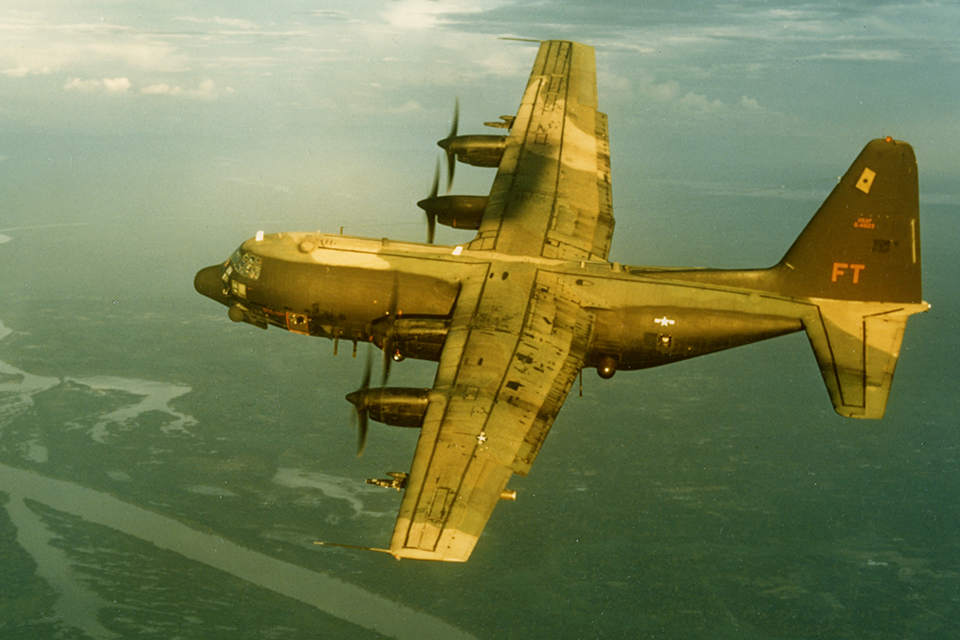
Captain Terry returned to Vietnam in September 1967, this time to test the gunship variant of the C-130 transport. The original AC-130 Spectre, ‘Super Spooky,’ was stationed at Ubon Air Force Base the following year and conducted interdiction raids along the Ho Chi Minh trail. The AC-130s achieved impressive results due in part to higher operating altitudes and upgraded armaments that included four 7.62mm MXU-470 miniguns, four 20mm GE M-61 Gatling guns, NOD and infrared sensors, and a fire-control computer to solve windage problems. Subsequent AC-130 variants also carried two 40mm Bofors automatic cannons; AN/AAD-4 FLIR and side-looking radars; low-light-level television; LAU-74/A automatic flare ejector systems; electronic countermeasure pods to confuse Soviet-made radar; and laser target designators, the ‘Black Crow’ vehicle-detection system; and not least of all, the Pave Aegis and Pave Spectre AC-130E carried a 105mm howitzer capable of hitting a target at 12,000 meters with its 44-pound projectile.
Following the melee that was the Tet Offensive, AC-47s returned to more routine defensive and interdiction missions. During the night of February 28, 1968, Nha Trang-based Spooky EN-770 was hit in the right wing by a VC mortar just as Sergeant John Levitow was preparing to throw a flare overboard. Shrapnel from the impact severely wounded Levitow and caused the flare to drop inside the fuselage, arming itself in the process. Realizing the dire consequence should the flare ignite when its safe-separation time expired, Levitow crawled to the armed flare and managed to throw it out the open cargo door just before it ignited explosively under the aircraft’s tail. For his valor, Sergeant Levitow was awarded the Medal of Honor.
In September, Spooky operated with NOD-equipped Marine Corps helicopter gunships in Operation Night Hawk. Although no tangible results came from the experiment, it did emphasize the need for NOD on AC-130 Spectre and AC-119 Shadow and Stinger gunships. At about the same time, bulletproof, jettisonable flare dispensers and emergency air scrubbers were mounted in the Spooky fleet to help prevent a catastrophic accident should an onboard flare ignite.
As more sophisticated AC-130 and AC-119 gunships arrived in country, plans to phase out US. Spooky units and to transfer assets to the Vietnamese and Royal Laotian Air Forces were set in motion. However, the US. planes continued to fly throughout the year working alone and in conjunction with other spotter, attack, and special-purpose aircraft. Some of these included the NOD-equipped Sleepytime 0-2, the Navy’s Black Pony OV-10 for canal and waterway patrols, B-57 and A-IE attack aircraft, C-47 and Moonshine C123 flareships and, of course, Spooky’s sister ship, the psywar C-47 Gabby or ‘Bullshit’ Bomber.
The latter combination played on the human weakness of responding to verbal provocation. On these operations, loud speaker-equipped C-47s flew orbits at about 3,500 feet while broadcasting messages to VC below. Meanwhile, Spooky flew a concentric orbit 500 feet lower and one-quarter turn behind Gabby. When VC opened fire to silence the psywar ship, Spooky responded. The system reportedly worked very well.
AC-47s also worked with the less well-known EC-47N electronic warfare Gooney Birds such as ‘Beep Beep’ of the 360th Tactical Electronic Warfare Squadron. These sophisticated aircraft located VC radio stations and headquarters and then called Spooky to put them off the air.
In March 1969, four AC-47s were deployed to Laos where their immediate success against ground troops led to a plan to convert several Laotian C-47s into gunships. During the summer, the plan was changed to give the Laotians several Vietnamese C-47s for modification, since the RVN Air Force was scheduled to receive U.S. AC-47s. By the end of September, five became Laotian gunships armed with SUU-llA guns. These were supplemented in January of 1970 by eight U.S. AC-47s from Vietnam that mounted the improved MXU-470 guns.
In Vietnam, the transfer of U.S. gunships to the RVN Air Force began in June, and 16 RVN Air Force C-47s that the US. began to convert in 1967 finally arrived in July and October. The long delay was caused by a shortage of SUU-llAs. Assigned to the RVNAF 817th Combat Squadron known as the ‘Fire Dragons,’ these were the South’s only gunships until the RVNAF received AC-119G Shadows in September 1971.
The first AC-119 gunships arrived at Phan Rang in early November 1969, the product of the Gunship III project. The AC-119 came in two versions, the ‘G’ model Shadow was propeller driven, while the ‘K’ Stinger had propellers and two jet engines. The ‘Flying Boxcars’ were modified by the Fairchild-Hiller Corporation for truck hunting and carried armament similar to the AC47, with the addition of upgraded electronics and terrain avoidance radar, FLIR and NOD, automatic flare ejectors and searchlights. The AC-119 gunship project was undertaken due to a shortage of C-130s at the time and the availability and larger cargo capacity of the C-119 over the C-47.
The last U.S. AC-47 combat mission was flown on December 1, 1969, by the 4th Special Operations Squadron (formerly the 4th ACS). By that time, the 53 U.S. Spookys surpassed the records of all other combat aircraft by flying in excess of 150,000 combat missions and defending 3,926 hamlets and outposts while expending some 97 million rounds of 7.62mm ammunition and 270,000 flares.
The old but stalwart Spooky had been replaced in the U.S. arsenal with first AC-130A Spectre, then AC-119G Shadow and AC-119K Stinger and, finally, with AC-130E Pave Spectre, Pave Prontos, Pave Aegis and Surprise Package gunships. Although the newer planes flew higher and faster, carried more powerful armaments, and could see through the night, it was Spooky that first came to the rescue of untold thousands of U.S. and Allied soldiers with its unforgettable dragon’s roar.
For more great articles, subscribe to Vietnam Magazine today!