
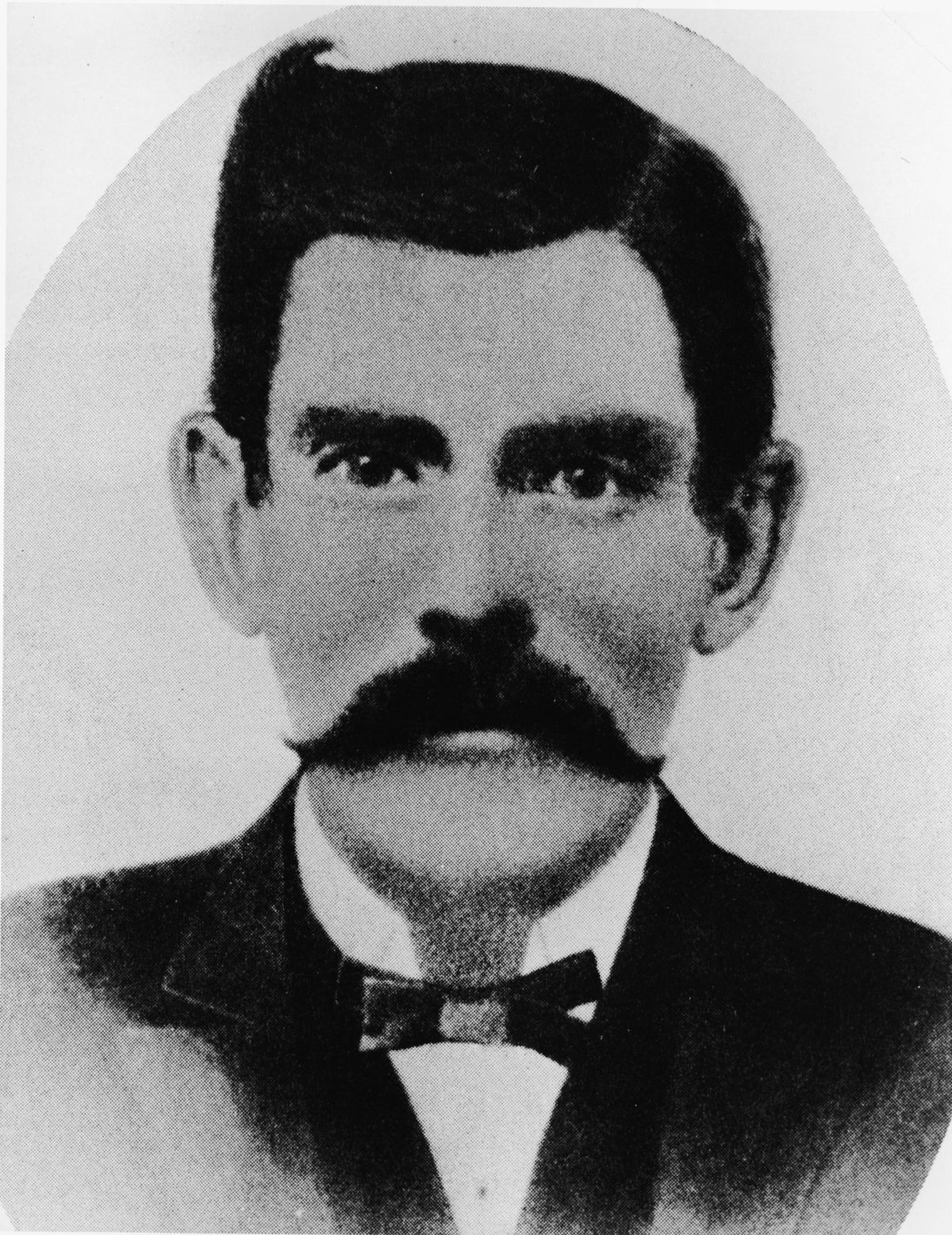
It was a spectacle that made the veteran gamblers seated around the faro and poker tables of Mannie Hyman’s saloon shake their heads in disbelief. Doc Holliday, whose reputation as a man not to be trifled with was unrivaled, had backed down before a loud, liquored gang of hard cases. He shambled off, pursued by the vilest terms of abuse from the lips of their leader, a grizzled Texan. Lesser lights and barflies echoed the profanity. They mocked Holliday, calling on him to pull his six-shooter, but he had no weapon on his person. And even if he’d had, would he have dared use it? He would not have hesitated in other places, at other times. Not in Dodge or Tombstone or Fort Griffin, but things were different here. Tears would well up in his spectral blue eyes as he recalled the sting of those words—tears sprung not from fear but from rage and humiliation.
By that night of July 21, 1884, Doc Holliday’s life in Leadville, Colo., had swung out of plumb. Pneumonia had laid him low on three or four occasions since he’d tossed his satchel onto the railroad platform of the carbonate camp two years earlier, and tuberculosis that had been in remission while he breathed the dry and salubrious air of New Mexico and Arizona territories had flared again, ravaging a body already scarred by chronic battles with the disease. When he got back on his feet, he was no longer the man he had been. Illness, an addiction to alcohol and an increasing dependence on opium had cost him steady employment as a faro dealer at the Monarch saloon, one of the more popular watering holes and a favored gathering place for gamblers in a town full of speculators, highfliers and fortune’s fools.
During his years in Arizona, from 1880 to 1882, John Henry Holliday had kept pace with men in the prime of health, but then he’d been forced to take refuge in the Rockies, fleeing Tombstone, Cochise County and the territory with the Earp brothers, ahead of a murder charge. The political influence of friends and associates kept him safe from extradition, but only so long as he remained within the borders of Colorado. Perhaps an excess of good health—relative good health, at least—caused him to ignore the risks inherent in Leadville’s bitter climate, perils of pulmonary complications about which even a local tourist guide issued warnings. There was not a more alluring half acre in the mountain state for a man who could live only by his nimble fingers and nimbler wits.
Once exiled from the Monarch, Holliday had to scrape by as an independent operator in other gambling rooms along Harrison Avenue, known simply as “the Avenue.” The Board of Trade, across the street, and Hyman’s Place, two doors down the block, at 316 Harrison, became his headquarters. It must have been especially galling for Holliday to watch two old adversaries prosper. In Tombstone he had belonged to a clique of gamblers called “the Easterners,” men who’d cut their teeth in the cattle towns of Kansas and Texas and the mining town of Deadwood, up in Dakota Territory. Opposing them in Arizona Territory was another group, “the Slopers,” who’d worked the mining camps on the Pacific slope of the Continental Divide during the 1870s. The Easterners, in the persons of Wyatt Earp, Luke Short and Holliday, had controlled the most lucrative games in Tombstone, turning aside all efforts by the Slopers to run them off. The factional struggle had reached a climax in February 1881, when Short killed the Slopers’ hired gun, Charlie Storms. Victory lay with Holliday’s side, but his enemies were not about to accept defeat with grace.
The leader of the Slopers was John Tyler, a 45-year-old native of Texas. He had emigrated from Tombstone after failing in his ambition to become the kingpin among the gamblers there and had settled in Leadville no later than May 1882, two and a half months before Holliday’s arrival. Tyler’s sidekick, Tom Duncan, may have come up from Tombstone with the head Sloper, but if not, followed soon after. Duncan’s first act was to become the pimp for one of Leadville’s leading madams, Mollie Price, but by July 1884, he had succeeded in polishing his reputation and had taken a job as a bartender at the Monarch, where he was busy ingratiating himself with the co-owners, Cy Allen and Alexander Scott. Tyler was employed there in Holliday’s old position, as a faro dealer, despite the fact that he had been fired from another gaming house in town for stealing from the cash drawer.
The logical question is: Why would Scott and Allen have hired him? The logical answer: He could be deadly when crossed. John Tyler had killed a man in San Francisco, and he had a history of using intimidation to gain his ends. In Tombstone he had tried to break up the games of rival gamblers at the fashionable Oriental saloon, and he and Holliday clashed there on October 10, 1880. Only the intervention of mutual friends had prevented a pistol duel between the two. Tyler had certainly not forgotten that day, and by the summer of 1884, he and his gang in Leadville were confident of their strength and Holliday’s weakness. That was reinforced by Holliday’s humiliating retreat on the night of July 21 from Hyman’s.
Holliday had borrowed $5 from an ex-Leadville policeman named Billy Allen, a bartender and special officer at the Monarch, a position that gave him the right to carry a gun and make arrests on the premises. Allen worked with Tyler and Duncan and was a member of their gang. Holliday was laggard in repaying what he owed Allen. In fact, he was nearly busted, his jewelry already in hock. Allen cornered him in the Monarch on Friday, August 15, 1884, and told him to pony up by noon on August 19 or else. The “or else” was a promise at the very least to thrash him—a promise Allen, a robust man fully 50 pounds heavier than 33-year-old Holliday, could easily have kept—or at the worst to kill him.
Doc Holliday was acutely aware of the danger he was in as August 19 dawned, his creditor still unsatisfied. Keeping gambler’s hours, Holliday had gone to bed at 5 in the morning and did not awaken until 3 in the afternoon—well past the deadline set for repaying the $5. Knowing that Allen was thick with the thieves at the Monarch, Holliday believed the debt would serve as a convenient pretext for his enemies to put him out of the way once and for all. He would later call Allen a “tool of the gang.”
Holliday left his room in the Star Block, a building located at 405 Harrison Ave., shortly after 3 p.m. He came upon a gambler named Pat Sweeney, who told him Allen had been to Hyman’s earlier that afternoon and was armed. Upon hearing this news, Holliday hiked back up the stairs to his second-floor room and may have concealed his revolver about his person, or he may have entrusted it to Sweeney or to a close friend and fellow boarder, Frank Lomeister, to carry to Hyman’s—testimony on this point is inconclusive. He then sent Lomeister to find Marshal Harvey Faucett or Captain Ed Bradbury of the Leadville Police Department and seek their aid.
En route to Hyman’s, Holliday bumped into Faucett himself in front of Sands & Pelton’s clothing store at 312 Harrison. He explained his predicament to the marshal, asking if Allen really was a special policeman. Sensing Holliday’s apprehension that this appointment would permit Allen to walk the streets armed, Faucett answered that even though Allen was a special, he had no right to carry a gun outside of the Monarch. Holliday then made a strange statement: “I’ll get a shotgun and shoot him on sight.” Strange, because it showed intent—to the city marshal, no less—to commit a crime in Colorado, and it was Holliday’s lawful conduct in this sanctuary that guaranteed he would not be extradited to Arizona Territory. There, he would have to stand trial for the Tucson train yard murder of Frank Stilwell on March 20, 1882—if Holliday’s sworn enemies did not assassinate him first. Events strongly suggest this remark showed Holliday’s desperate state of mind, but if he was carrying a concealed weapon and therefore liable to a fine he could not afford to pay, it may also have been disingenuous and intended to forestall the marshal’s searching him. Whatever the full intent, it alerted Faucett to a prickly situation. He set off posthaste to find Billy Allen. He entered the Monarch shortly thereafter, but Allen had just left.
Holliday shuffled through the double glass doors into Hyman’s and made sure his revolver was placed behind the bar, close by the lighter on the cigar case next to it. Versions differ as to the caliber of the large single-action Colt revolver, some claiming it was .41, others .44.
Billy Allen had left his house uptown and strolled down the Avenue. He stopped at the Tabor Grand Opera House to pick up theater tickets and get his shoes shined, and then went into the Monarch. After spending a few moments in the saloon, he was putting on his coat to continue down to Hyman’s when one of the proprietors, Cy Allen (no relation to Billy), warned him against hunting up Holliday just then. Billy Allen answered there would be no trouble and, with a careless air, walked out into the fading sunlight, striding down the boardwalk toward Hyman’s, the hands on the moon-faced clock that overlooked the Avenue to his right nearing 5 o’clock.
Holliday was lounging by the cigar case when he laid eyes on Billy Allen through the plate glass window at the front of Hyman’s. He reached behind the counter for his Colt and stared at the door. Allen pushed it open, hesitating when a voice outside hailed him. Then he stepped across the threshold, about 6 feet distant, and Holliday leveled the six-shooter that had been dangling in his hand and pulled the trigger.
The first shot sailed over Allen’s head, shattered a pane of glass in the double doors and lodged in the door frame. Startled, Allen spun on his heel, intending to flee, but tripped over the threshold and pitched forward, landing on his hands and knees. The ex-policeman scrambled to get to his feet. Holliday leaned over the cigar case and, almost on top of the man who’d been the hunter only seconds earlier, fired again. This shot hit its mark. The bullet tore into Allen’s right arm from the rear about halfway between the shoulder and the elbow and passed clear through, severing an artery in its flight. Jolted upright, Allen stumbled outside. He staggered against the wall of Dave May’s clothing store next door. By now he was in shock and bleeding freely, and he fainted into the arms of an onlooker.
Holliday had only winged his bird and had been ready to fire again. But before he could squeeze the trigger for a third time, the bartender had rushed up to him from behind and clamped down on his gun hand. Captain Ed Bradbury, who’d given Allen a belated warning, then charged into the saloon and snatched the smoking Colt. Holliday immediately asked for protection, and Bradbury led him to the county jail. At the same instant, Cy Allen and other friends of Billy Allen loaded the wounded man into an express wagon and conveyed him to his house. Doctor F.F. D’Avignon was summoned. He could find no pulse in Billy Allen’s right arm, and concluded the artery was severed. As quickly as possible, he sewed it together.
In light of his justifiable fear of being extradited to Arizona Territory should he kill someone in Leadville, Holliday must have been certain he was defending himself against an assassin. And this was exactly the coloring he gave to the event. While waiting to be assigned a cell in the county jail, he told a reporter: “It was not about the $5. That was taken as a pretext. It is about the old trouble, and Allen was picked out as the man to kill me.” The reporter pressed him about the trouble in Arizona, and he replied: “I lived there and was for part of the time a peace officer, and all I ever did was forced on me and I was tried and honorably acquitted of. There are people in town who desire to murder me for notoriety….”
Holliday demonstrated the quick wit of a veteran gambler, making shrewd use of the press, emphasizing his past service as a lawman and subtly arguing the Tyler gang was after him for no legitimate reason. This scenario would play much better with prospective jurors than airing as a motive a vendetta among sporting men, in which the respectable populace would tend to view each side with equal disfavor.
And according to a news report only days later, Holliday was winning his case in the court of public opinion, if not of law. After District Court Judge William W. Old bound him over to appear at the next term of criminal court, the Leadville Daily Democrat‘s account of the hearing (August 26, 1884) closed with the following paragraph:
The public sentiment, however, which has nothing to do with the law, is largely in favor of Holliday—[he] has been without a doubt an abused individual. The manlier class of the community not only appreciate this, but have little criticism to make as to his actions in connection with his trouble with Allen. For whatever the latter’s intentions may have been, Holliday had reasons, whether or not they are good in law, for believing that past persecutions were to be concluded by a violent assault.
Whatever Billy Allen’s intentions were when he strode through the front door of Hyman’s, they had become irrelevant. For the record, the preponderance of testimony at Holliday’s hearing went to show that Allen was not armed, but by then the overriding Western credo of “no duty to retreat” had won the day with public sentiment. “No duty to retreat” was a belief, enacted in the laws of several states, that a man who was without blame for provoking a confrontation was not obliged to flee from his assailant but was free to stand his ground regardless of the consequences. As one state Supreme Court justice put it in 1877, “Indeed, the tendency of the American mind seems to be very strongly against the enforcement of any rule which requires a person to flee when assailed.” This implied, as American West historian Richard Maxwell Brown points out, that to flee under such circumstances would be cowardly and un-American.
Holliday faced a tortuous legal process, his popularity notwithstanding. He’d had similar experiences in other places—Texas, Arizona and New Mexico territories, and most recently in Denver and Pueblo. The day after the Allen shooting, Captain Bradbury swore out a warrant for his arrest, charging him with assault with intent to kill. He was taken to court, and bail was set at $5,000. John G. Morgan, proprietor of the Board of Trade saloon, and Colonel Sam Houston, one of the managers, signed on as Holliday’s sureties, and he was released. His freedom was short-lived, however.
When Holliday presented himself before Judge Old five days later, he was stunned to learn his bail had increased by $3,000. Bondsmen additional to Morgan and Houston were required, and at first no one stepped into the breach. Recognizing the possibility of serious consequences, the Daily Democrat of August 27, opined, “Should Holliday be obliged to remain behind bars up to the day of his trial it would probably go very hard with him, as his constitution is badly broken and he has been really sick for a long time past.”
One probable reason why the bond was raised to $8,000 was the questionable condition of the shooting victim, who turned out to be difficult to treat. “Billy Allen, shot by Doc Holliday, is on the mend, although it will be a much longer time than was first anticipated before he will be able to be out,” the Daily Democrat reported. “His arm is frightfully swollen from wrist to shoulder and exceedingly painful. The case has been a good deal complicated from the first by Allen’s inability to take narcotics with the required effect. Pain kept him awake and the heaviest doses of morphine simply caused him to become delirious.” Allen possessed a remarkable constitution, however, and as if to belie the gloomy prognostication, he was out on the street the very next day. The judge lowered Holliday’s bond to $5,000 again, but for some reason Morgan and Houston failed to post it until September 6.
The imbroglio over his bond caused him to be held for more than a week in the county jail, which, though preferable to the sinkhole where city prisoners languished, was not calculated to improve his health and was symptomatic of the dire straits in which he found himself. One is compelled to ask: If he could rustle up bondsmen to the tune of $5,000 among the gambling fraternity, where his reputation was sterling, why could he not have negotiated a loan of $5 to pay off Allen and avoided all this trouble? There is no definitive evidence, but one might suspect it was a matter of pride. He approached Sam Houston only days before the shooting but met with a rebuff. Once may have been enough. He would not want to advertise that he was down and out. He had already pawned his jewelry, and Allen had taken a gun from him and put it in hock as well. (Why this did not cancel the debt or if it applied to another debt, testimony at the August 25 hearing never made clear.) And once Allen had made threats in front of witnesses, Holliday could not admit they had cowed him. He must have felt he had no choice but to stand up to his persecutor. A gambler who showed the white feather was not long for his profession, and Holliday had proved his staying power for over a decade.
The trial, postponed until Friday, March 27, 1885, proved to be anticlimactic. Holliday’s attorneys, Scott Ashton and Joe Taylor, consumed the morning and afternoon of the first day wrangling with District Attorney William Kellogg over procedural points, each side maneuvering to gain a technical advantage. The legal tussle continued through jury selection, a point of overriding importance for Holliday since he counted on gaining widespread community sympathy. The court called three venires (groups of potential jurors) before empaneling 12 good men and true to the satisfaction of defense and prosecution.
Billy Allen led off the prosecution’s case at 6 o’clock Friday evening. The defense made it plain in their opening remarks they would rely on the “no duty to retreat” precept, arguing that Allen had threatened to kill their client over the $5 debt and had hunted the streets for him carrying a deadly weapon. In view of these circumstances, Ashton and Taylor argued, Holliday was fully justified in arming himself and using whatever force was necessary for his self-defense. Allen testified that he was unarmed at the time Holliday shot him, that he had never threatened Holliday’s life, and that he did not even know Holliday was in Hyman’s Place when he entered it on the afternoon of August 19, 1884.
The defense was able to produce witnesses to refute Allen’s second and third assertions. He had threatened to “do up” (kill) Holliday at least once, promising to “beat his brains out.” No doubt Allen could have made good on that promise; Holliday was debilitated and weighed 122 pounds, Allen robust and 170 pounds. Billy’s own boss at the Monarch, Cy Allen, admitted he had warned Billy against venturing into Hyman’s because Holliday was there, and Captain Bradbury had also advised against it, but Billy Allen had said he would go anyway because he wanted to “speak” to Doc.
The defense put unemployed gambler Pat Sweeney on the stand, and he recounted an incident earlier on the day of August 19, when Holliday was still in his room and Billy Allen marched into Hyman’s after the noon deadline for repaying the loan had passed and “looked around the gambling room as if hunting someone—the butt end of a revolver in his hand.” Sweeney then hustled up the Avenue to tell Holliday that Billy Allen was armed and turning the town upside down looking for him. Thus the defense established that Holliday had cause to believe his next meeting with Allen could result in a fatal outcome, and it would be foolish not to be prepared to counter force with force. Their argument carried the day with the Leadville jury on March 28. The Leadville Carbonate Chronicle of April 4, 1885, reported, “The courtroom was then cleared for the purpose of allowing the jury to deliberate, and after a very short time a verdict of acquittal was rendered.”
For all intents and purposes, the decision brought an end to the vendetta between the Holliday and Tyler factions. There was one more flurry of activity during the last week of October 1885, when word on the street told of more gunplay, but the Leadville police, now under Marshal Patrick A. Kelly, brooked no foolishness from the adversaries, keeping a strict watch out for concealed weapons, and no violence came to pass. Certainly bitter feelings persisted, but by the winter of 1885, Holliday had decided against chancing another bout of pneumonia in the city in the clouds and had migrated to the more congenial climate of Denver.
John Tyler was still living in Leadville early in 1886, residing across the street from his crony, Tom Duncan, on West 4th, near the gaming parlors of the Avenue. Both had moved their place of business to the clubrooms in the Tabor Grand Opera House, 310 Harrison. Cy Allen and Alexander Scott, former owners of the Monarch, had leased the premises in 1885, and in 1887 Duncan would buy out Cy Allen’s share and become Scott’s partner. Tyler disappeared from Leadville after 1886, perhaps shipping out to the Far East and retiring to Honolulu.
Billy Allen’s career after Leadville was long and adventurous. Researcher Gary Roberts has traced him to Garfield County, Colo., in 1887, where he served as an Army scout during the Ute troubles. Afterward, he worked as a fireman in Pueblo and later as fire chief in Cripple Creek. By 1900 he was participating in the Klondike gold rush and was appointed a deputy U.S. marshal. The manager of the insurance underwriters of Colorado once described the popular Allen as “a strong, brave, determined man.” He died in the Old Soldiers’ Home in Orting, Wash., on March 21, 1941, at age 82.
Holliday’s fortunes did not improve in Denver, but the city provided the backdrop for a final meeting with Wyatt Earp, in either the winter of 1885-86 or the following spring. The comrades came together in the lobby of the Windsor Hotel. They knew the circle was closing, and both acknowledged it. Sadie Marcus watched their last conversation from a discreet distance and would later describe the skeletal Holliday as having a continuous cough and taking his leave “on unsteady legs.”
The last stop for Doc Holliday, in May 1887, was Glenwood Springs, Colo., a necropolis the old, familiar gamblers’ circuit had bypassed, as if by superstition. Holliday arrived aboard a stagecoach from Leadville, 75 miles to the south.
He came to drink in the medicinal waters, but even more, to take advantage of the altitude. “[It] is shown by the experience of consumptives to be the happy means that relieves their suffering from lung diseases,” noted the Leadville Herald Democrat of January 1, 1888. Holliday registered at the fashionable Hotel Glenwood, a Victorian confection of gingerbread, arches, dormers and wrought-iron battlements. How he could afford to stay there is uncertain, but he probably worked various jobs (including dealing faro) despite his bad health and also got money from friends. Unfortunately, the curative powers that enthusiasts attributed to the altitude and the springs proved unequal to the ravages of disease. Holliday, 36, died in his bed at the hotel, the morning of November 8, 1887.
Those who knew him best during his final years in Colorado lived in Leadville. It was there that he chose to make his stand against those who had harried him for half a decade. And in making it he had won for himself a last measure of dignity. He stood his ground when he could have decamped for any number of reasons?failing health, poverty, the threat of extradition for murder and formidable enemies eager to take advantage of his weakness. His obituary appeared in the Leadville Carbonate Chronicle on November 14, 1887:
There is scarcely one in the country who had acquired a greater notoriety than Doc Holliday, who enjoyed the reputation of being one of the most fearless men on the frontier, and whose devotion to his friends in the climax of the fiercest ordeal was inextinguishable. It was this, more than any other faculty, that secured for him the reverence of a large circle who were prepared on the shortest notice to rally to his relief.
This article was written by Roger Jay and originally appeared in the December 2003 issue of Wild West magazine.
For more great articles be sure to subscribe to Wild West magazine today!