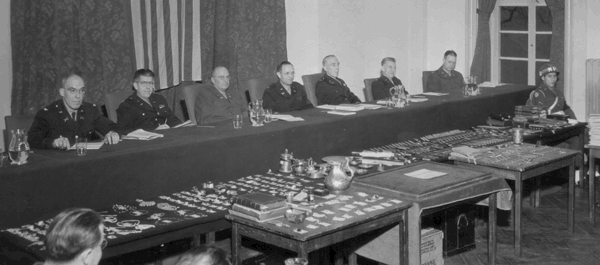
‘Get into trouble?’ Colonel Durant tersely replied when asked about the jewels. ‘I’m already up to my neck in it now.’
Throughout history soldiers have helped themselves to the riches of their foes. Indeed, the promise of booty was long the primary reason men went to war, their desire to acquire by theft what they’d never attain by rank or merit driving them to risk their lives in conflicts whose moral or political goals held little interest.
While the greatest looters of World War II were undoubtedly Germany, Japan, and Russia—each stole untold billions of dollars in art, industrial equipment, and individual wealth—soldiers of all the combatant nations helped themselves to the possessions of others. And while the U.S. military attempted to curtail looting, American soldiers were certainly not above “liberating” items that caught their fancy, especially in the European theater. Most of these thefts were smalltime and spur of the moment. But as the war in Europe wound down, a trio of drunken, brazen, and almost comically inept thieves—all of them, regrettably, U.S. Army officers—managed to pull off one of the most lucrative wartime thefts in history.
Late on the last day of October 1944 princes Wolfgang and Richard of Germany’s illustrious House of Hesse gingerly lowered a large wooden box into a hole in the basement floor of Kronberg Castle outside Frankfurt. Roughly two feet square and lined with zinc, the box held the bulk of the Hesse fortune—packets of rings, tiaras, necklaces, loose diamonds, and other jewels—which the princes hoped would form the basis of the extended family’s postwar prosperity.
It wasn’t an idle expectation: the treasure was worth some $2.5 million (roughly $31 million today). It included items belonging to several members of the Hesse clan, including the reigning matriarch, 74-year-old Princess Margarete of Prussia, and Margarete’s four sons and their wives. The princes and their mother were the scions of a German principality dating back to the 17th century.
Burying the valuables was intended to protect them from the increasingly frequent air raids pounding the Frankfurt area. Once the Allied armies arrived, the box could be retrieved from its hiding place and its contents used to ensure—through bribery of Allied officials, if necessary—that the surviving members of the House of Hesse did not suffer the indignities of occupation sure to be visited on their less well-heeled countrymen.
It was a reasonable plan, but unfortunately for the Hesses it didn’t take into account the U.S. Army’s admirable penchant for establishing rest-and-recreation facilities for its war-weary troops. Within weeks of Frankfurt’s fall to U.S. forces in early April, Maj. Joseph M. Hartley, a staff officer who had been given the task of setting up 14 officers’ clubs in the Frankfurt area, requisitioned Kronberg Castle. The Hesse family members still living in the building were unceremoniously moved to several cottages on the property, and on April 22 the facility was officially renamed the Kronberg Castle Country Club.
[continued on next page]