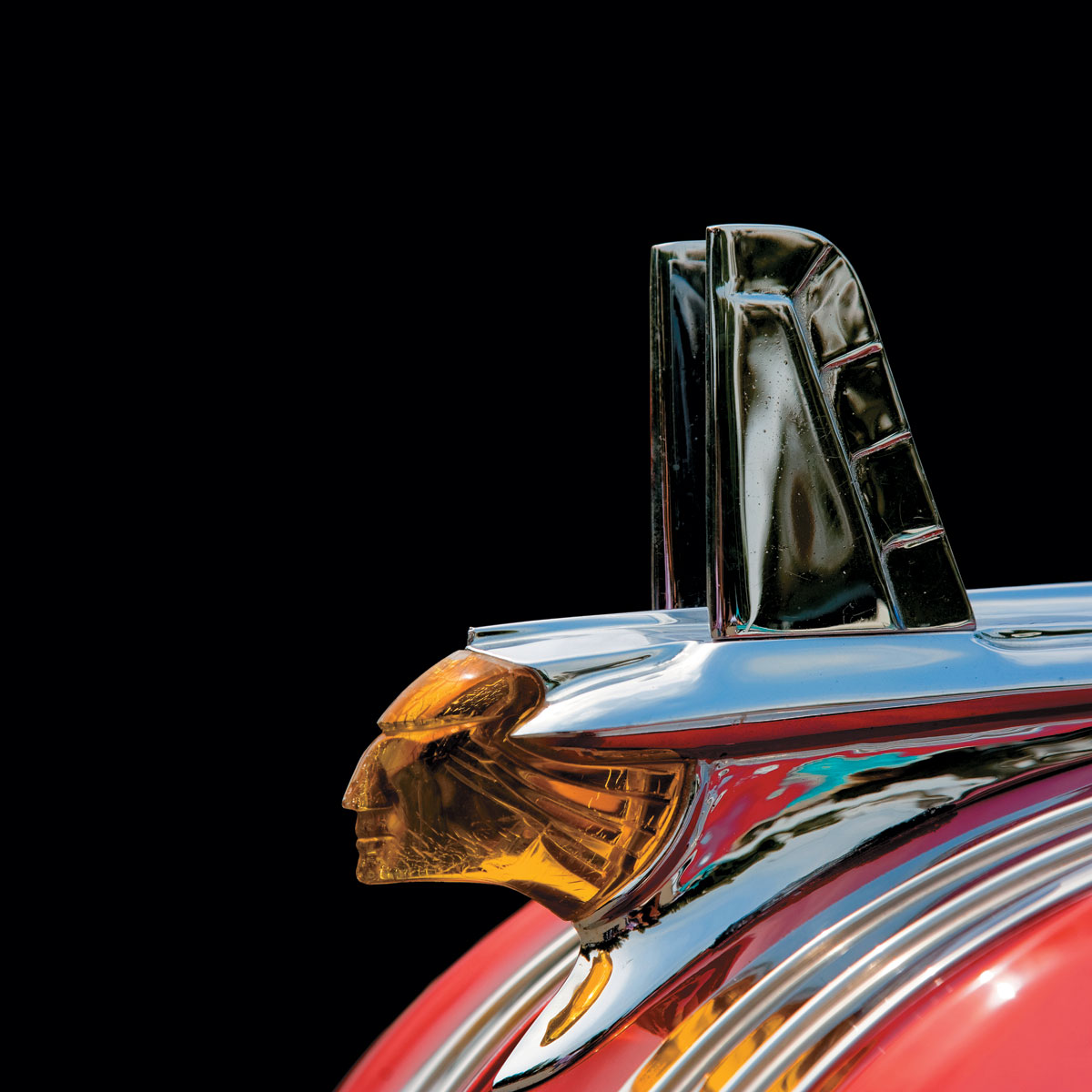
Pontiac began to shine in the 1950s, when its formula for success – more horsepower for the money – was applied with gusto.
When General Motors announced in May that it would shutter its Pontiac division following the 2010 model year, more than a few Americans cried. Great men grow old and die; great automotive brands needn’t die but often do. Here is a wistful reminder that brands are, in the end, as mortal as the men who create them. We remember them both for moments of greatness.
Launched in the 1920s, Pontiac was an immediate success for GM, but the marque’s greatest resonance, in terms of sales and cultural impact, came after the century’s midpoint, with the emergence of high-compression V8 engines and Detroit’s legendary horsepower wars.
No one today will remember Pontiac as a buggy manufacturer from the turn of the last century, named after an 18th-century chief of the Ottawa Indians. Nor will many recall when GM repurposed the name as part of a “Companion Make” program aimed at filling gaps in GM Chairman Alfred P. Sloan’s famous aspirational ladder for the company’s brands. In distinct contrast to the auto industry pioneer Henry Ford, who created the one-size-fits-all Model T, Sloan deigned to supply a car for every “purse and purpose.” The idea was to lead customers by small increments in price from lowly four-cylinder Chevrolets all the way up the socio-economic totem pole occupied by six- and eight-cylinder Buicks and Oldsmobiles to culminate in the rarefied exhaust clouds of leviathan, 16-cylinder Cadillacs.
Pontiac slotted in just above entry-level Chevrolet in GM’s master marketing plan. Offering a six-cylinder engine in a car priced like a four, it was “the Chief of the Sixes” and the only one of the companion brands to survive, with casualties including Marquette, LaSalle and Viking. But Pontiac didn’t truly begin to shine until the 1950s, when its historic formula for success, more horsepower for the money, was re-applied, with gusto.
This is the Pontiac many prefer to remember, the cars built between 1955 and the early 1970s, when a succession of high-powered managers—Semon “Bunkie” Knudsen, Pete Estes and John DeLorean—focused on heightened performance. From 1959 on, Pontiac also became synonymous with “wide-track,” as the wheels on new models were pushed apart to fill out the long, low and incredibly wide bodywork the company’s designers created that year in response to the industry’s de facto annual model change requirement.
The models that turned out to be Pontiac’s greatest hits during this period, cars including the Bonneville, GTO, Grand Prix and Firebird, were relatively unadventurous engineering exercises with crisp styling that marked a distinct left turn from the chrome-laden barges of the ’50s. The cars handled barely and burned premium gasoline like it cost 24 cents a gallon, which it did in 1963, the year the GTO was launched as a 1964 model. But they were fast. Or could be. Many Pontiac buyers were content to bask in the reflected glory of speedier brethren. That was, of course, the plan.
All of GM’s divisions were swept up in the horsepower race of the 1960s. However, Pontiac often had the most to show. Even Pontiac’s executives, memorably the longhaired DeLorean, appeared to deviate from the button-down conservatism associated with the parent company, helping to captivate not just the car buyers, but youth. To cap a decade spent flirting with this zeitgeist, a special edition of the GTO called “The Judge” debuted in 1969, named to tie-in with a recurring comedy sketch from the popular and faintly counter-cultural television show, Laugh-In. In it, the actor Sammy Davis Jr. would chant, “Here comes the Judge, Here comes the Judge,” and then the audience would crack up laughing.
You had to be there.
In the 1970s, automotive performance waned in the face of emissions controls and fuel economy standards that followed the energy crises of 1973 and 1979. Pontiac weathered these times ably, selling a record 920,000 cars in 1973 and even more in 1979. Comparing these figures to the 267,348 Pontiacs sold last year, one sees the problem. To be fair, though, Pontiac remained GM’s third best-selling division.
GM faltered by failing to offer a coherent, compelling vision of the future, as it had from the 1920s through the early 1970s. Instead, it fought government regulators for the right to preserve the past, sapping its energy and resources, while losing sight of what had worked in the past. Performance was downgraded as Pontiac’s raison d’être and for styling, GM defensively adopted an ersatz European approach in the 1970s and 1980s before moving to a Japanese-inspired one in the ’90s and beyond. By the time “We Build Excitement” became Pontiac’s marketing slogan, in 1983, technocrats had taken over. Excitement was nothing more than a memory, as a parade of Pontiacs big on tacky, plastic body-cladding and low on performance came to market.
Pontiac’s most infamous stab at winning back the public’s affection came in 2001, but was an unmitigated disaster. The launch of the Aztek, a crossover SUV subsequently voted the ugliest car ever built, still has many scratching their heads.
Decent cars followed—a revived GTO and the new G8, based on models built by GM’s Australian Holden subsidiary impressed critics—but none were enough to change general public perceptions. As Jim Wangers, the marketing sharp credited with bringing the first GTO to production, recently lamented, “The great Wide-Track era which took 10 years to build, took 35 years to destroy.”
Jamie Kitman, New York bureau chief of Automobile Magazine, won the 2009 National Magazine Award for Columns and Commentary. A lawyer, he also manages the rock groups They Might Be Giants and OK Go.