
Dawn of that August morning in 216 BC found Hannibal, commander of Carthage’s army in Italy, peering down at the plain separating his vantage point from the waters of the Adriatic Sea some three miles away. The Roman enemy was already advancing–an army of more than 85,000 men, aligned in the standard offensive formation of the widely feared legions. Hannibal’s force, some 56,000 in number, faced long, very long, odds.
The third century BC already had witnessed the growth of Rome and Carthage as the foremost powers of the central Mediterranean. Rome had developed slowly, over the previous five centuries, and was now the dominant military power on the Italian Peninsula. There had been frequent reverses, but Rome was able to build and solidify its holdings through political means, such as extending full or partial Roman citizenship to conquered cities or deserving individuals. A large degree of autonomy was granted to the peoples Rome defeated, in exchange for military help when Rome needed it. In this way, Rome was able to expand its territory and build its pool of available manpower without diluting its strength by creating armies of occupation.
Future rival Carthage was a city located near present-day Tunis, Tunisia, and was founded by colonists from Phoenician Tyre. Instead of gradually conquering and assimilating neighboring cities, Carthage grew through maritime commerce. Its empire was based on overseas trading stations in Spain, Sicily, Sardinia, Corsica, the Balearic Islands and along the North African coast. The hinterlands near these trading stations provided markets for Carthaginian commerce, manpower for Carthage’s armies and sources of wealth such as silver and gold mines. The income from the mines paid for mercenary armies, and people living in the area immediately surrounding Carthage were not given the freedoms such as those granted by Rome. No strong bond of loyalty was forged between Carthage and the immediate satellite area because of Carthage’s exploitation and the Carthaginian tendency to respond to resistance with great cruelty. The population of the city of Carthage itself was relatively small; the people were devoted to commercial enterprise. When military might was needed, Carthage found it expedient to use its mercenary troops, drawn from its economic spheres of influence.
As the two states grew, they came into conflict in Sicily. The city of Messina, located at the northeastern tip of Sicily, appealed to Rome for protection from nearby Syracuse. Carthage regarded Roman intervention as an intrusion into its domain and the First Punic (Latin for Phoenician) War resulted (264-241 BC). It was a costly conflict, to a large extent due to Roman lives lost while that city attempted to become a sea power. In 255 BC, the Romans lost 180 ships and 95,000 men in a single storm off the Sicilian coast, and in 253 BC another storm cost Rome an additional 150 vessels and their crews. A third Roman fleet later was ground to pieces off the rocky coast of southern Sicily in yet another storm.
Characteristic Roman persistence in the face of adversity finally brought victory–and the expulsion of the Carthaginians from Sicily. By the end of the years-long war, Carthage’s naval supremacy in the western and central Mediterranean had been broken. To be sure, Carthage’s ability to build and man a fleet had not been seriously impaired, but Carthage did not aggressively challenge the Romans at sea in subsequent conflicts. The reasons for this seeming lethargy on the part of the expert seafaring people will never be known, as no Carthaginian history of the Punic Wars has survived. Our information today comes from Roman sources.
Hamilcar Barca, Hannibal’s father, had been one of Carthage’s principal generals in the first war and had held out in Carthage’s last stronghold in western Sicily for a considerable period. Though finally defeated, he did not suffer the fate sometimes meted out to the unsuccessful Carthaginian generals–crucifixion.
At the conclusion of the First Punic War, Carthage’s mercenaries rose in revolt, aided by disaffected elements from the lands surrounding the city. Rome took advantage of her rival’s distraction and, in spite of the recent peace agreement, took control of Sardinia and Corsica and forced Carthage to pay a large indemnity. Carthage finally won the mercenary war, but the loss of Sicily, Sardinia and Corsica left her economic empire crippled and reduced the area from which she could hire troops.
Hamilcar took it upon himself to rebuild Carthaginian fortunes by occupying Spain. The city of Gades (Cadiz), located on the Atlantic Ocean outside the Pillars of Hercules, was older than Cartage and, like her North African ally, had started as a Phoenician colony. Carthage itself had traded in Spain and used Spanish mercenaries for many years. Hamilcar decided to build on these foundations and formally place large sections of Spain under Carthaginian rule. This would provide a base for military operations against Rome (which Hamilcar felt were inevitable anyway), give access to the large silver and gold deposits of the country and draw closer the region’s excellent Iberian and, Celt-Iberian mercenaries, both useful in combating the Romans.
Hamilcar Barba and Hasdrubal the Splendid, his son-in-law and successor, subdued a large portion of southern and eastern Spain and established the city of Cartagena (New Carthage) on the southeastern coast as the capital of Carthaginian Spain. The city-state’s leadership in the new land remained in the hands of one family, the Barcids. To minimize the unreliability to mercenary troops and recognize the loyalty of Spanish tribesmen to a worthy leader, the Barcid clan built an empire based on close relationships with local tribal leaders, rather than with the distant city of Carthage. Hasdrubal the Splendid utilized diplomacy and marriage to an influential chief’s daughter to cement relations with the indigenous tribes. Hamilcar’s three sons, Hannibal, Hasdrubal and Mago, would continue the work of Hamilcar and the first Hasdrubal–and nearly bring Rome to its knees during the Second Punic War.
Few details of Hannibal’s youth have survived. At age 5, he was with his father in Sicily at the end of the first war. At 9, he accompanied Hamilcar to Spain and spent his adolescent years there while the empire was created.
In 226 BC, Hasdrubal the Splendid had reached an agreement with Rome that recognized the Ebro River in northeastern Spain as the northern limit of Carthaginian interest in the area. Five years later, Hasdrubal was assassinated, and Hamilcar’s son Hannibal became the leader. At about that time, Rome began involving itself in the affairs of Saguntum, a city on the Mediterranean coast of Spain well south of the Ebro and therefore presumably in Carthaginian territory. Hannibal viewed the Roman moves as a prelude to the type of intervention that had touched off the first war. Hannibal laid siege to the town, which fell after eight months.
Hannibal’s strategic insight now became evident. From study of the First Punic War, Hannibal realized that Carthage could not prevail in a war far from Rome’s heartland. The huge populations at Rome’s disposal made a simple war of attrition a losing proposition for Carthage. Hannibal decided to fight in Italy itself, making Rome’s people bear the burden of the war while at the same time weakening the loyalty of Rome’s allies in Italy. Concurrently, military alliance could be negotiated with Rome’s enemies, notably Macedonia and Syracuse. And since Carthage’s fleet was no longer a match for Rome’s, the invasion of Italy would be by land.
To that end, Hannibal did his best to negotiate with tribes in his line of march well in advance of the onset of hostilities; he also concluded alliances with various north Italian Celtic tribes that were traditional enemies of Rome.
Hannibal’s was the first civilized army to cross the Alps. Exposure, desertion, accidents and fierce resistance by mountain tribes reduced his army from 40,000 to 26,000 during the trip, and most of the elephants accompanying the remarkable host also perished. Fortunately, once Italy was reached, the Celtic alliances provided replacements that brought the army back to its original strength.
Shortly thereafter, Hannibal fought two battles that demonstrated his mettle as a field commander and his determination to destroy rather than merely defeat his enemy. At the Trebia River, only 10,000 Romans escaped an ambush out of 40,000 engaged, and at Lake Trasimene, virtually an entire Roman force of 25,000 was killed or captured. From then on, the Romans were reluctant to fight a large-scale engagement. Hannibal, for his part, was careful to treat prisoner from Rome’s allied cities courteously, often freeing them without ransom to encourage disaffection with Rome’s cause. Captured Roman citizens, on the other hand, were held for ransom used to pay Hannibal’s men, or failing that, were often sold into slavery. The Carthaginian army lived off the land causing as much damage to the economy as possible.
After Lake Trasimene, Hannibal moved his army to southern Italy in order to recruit additional help in that quarter. And there, Hannibal’s depredations forced the Romans to become more aggressive. Two now consuls, Caius Terentius Varro and Aemilius Paulus, were given command of the combined legions of Rome with orders to make an end to the feared Carthaginian. Normally, the two consuls would have independent commands but, by custom, when their forces were combined, command of the whole alternated daily. Hannibal’s efficient intelligence system soon informed him that Varro was the more impetuous of his opponents, and so Hannibal decided to force an action on a day Varro was in overall command.
Hannibal seized a grain depot to lure the Romans to the site he had chosen for battle. The depot was located at the small village of Cannae, south of Rome and on the Adriatic side of the ‘boot’ of Italy.
The Roman force available for battle was large by the standards of the day. Eight full legions of infantry, some 40,000 men, were augmented by 40,000 allied infantrymen. About 2,400 Roman cavalry and 4,000 allied horse completed the army, for a total strength of 86,400.
In battle, the Roman infantry usually advanced on a broad front, with cavalry screens on the flank. The heavy infantry was preceded by skirmishers, who opened the engagement with flights of javelins and then retired to the rear of the formation. They were able to pass through the Roman formation because deliberate gaps were left in each line. The basic fighting unit of the heavy infantry was the maniple of about 160 men divided into two centuries. Rather than forming a continuous line, the two centuries were deployed one behind the other, leaving the gaps used by the retired skirmishers. At the point of attack or when in a defensive posture, the rear centuries could be moved up to fill the gaps.
The Hastati made up the first line of Roman heavy infantry. They were equipped with a heavy shield, a helmet, light and heavy pila (javelins) and a short, straight sword. The Princeps were the second line of heavy infantry. They were armed like the Hastati, but were somewhat older and more experienced. The Princeps’ centuries formed behind those of the Hastati, but were offset to block the gaps in the Hastati line. The third line, made up of the old veteran troops called Tritarii, had its centuries form behind the gaps in the second line, giving an overall checkerboard effect to the formation. The Tritarii had a thrusting spear in place of the pila of the first two lines.
In the hands of a skilled commander, the flexibility possible with this formation was advantageous, particularly against older military formation such as the phalanx. Unfortunately, the Roman method of appointing new consuls each year and rotating command daily if the consuls were deployed together made it unlikely the top military talent would be allowed to pursue a coherent plan. Roman courage, discipline and patriotism were rarely lacking, but the coming battle of Cannae would highlight the need for changes in the selection and responsibilities of army commander.
Aside from the top commanders, very few Carthaginians were present in Hannibal’s army. His basic components at Cannae consisted of North African, Spanish and Celtic personnel. Perhaps the steadiest foot soldiers available to Hannibal were the Liby-Phoenician heavy infantry, echo of the fact that Carthage was originally a Phoenician colony. The Phoenicians living in Africa (Libya) were subject to Carthaginian military service and acquitted themselves well. Originally armed like Greek hoplites, they now began equipping with Roman arms captured at the Trebia and Lake Trasimene.
In addition to the infantry, 2,000 Spanish cavalry were available to Hannibal. They were heavily armed and used as heavy cavalry, but the excellent quality of their horses allowed them to rival the speed of the Numidians.
About 25,000 Celtic infantry and 5,000 Celtic cavalry made up the remainder of Hannibal’s force. These wild tribesmen lived for war, but without the guidance of a commander like Hannibal, their lack of discipline made them unreliable. They were excellent swordsmen, but only the wealthiest wore armor. Often, the Celt fought naked, equipped solely with sword, shield and helmet. At the time of Cannae, Hannibal was arming these men with captured Roman weapons. He liked to use the Celts as shock troops that would cause disruption in enemy ranks prior to committing his African infantry. Of course, heavy Celtic casualties resulted, but they accepted their loses as the natural result of occupying the position of honor.
At Cannae (Barletta, Italy, today), the Romans were determined to crush Hannibal’s center. They formed extremely deep battle lines in order to bring maximum pressure to bear against the middle of the Carthaginian line. On the Roman right, the legion cavalry, some 2,400 strong, faced Hannibal’s Spaniards and Celts, totaling 7,000. The mismatch would prove a decisive element in the battle’s surprising outcome. On the Roman left, the 4,000 allied cavalry faced an equal number of Numidians.
Hannibal aligned his infantry in an unusual manner. The center of his position was convex, facing outward toward the advancing Romans. The wings bent backward from the center. Alternating units of Spanish and Celtic swordsmen held this convex line, and they were greatly outnumbered by the oncoming Romans. Hannibal positioned himself at the left end of the line, and his youngest brother Mago, held the right. Each end of the line was anchored by a dense square of African infantry, the location of which ensured that they would not be engaged until long after those at the center.
As the Romans advanced, a hot west wind blew dust in their faces and obscured their vision. At a range of about 35 yards, the Romans hurled their light javelins, causing casualties among the Spaniard and Celts. These pila often caused problems even if they only penetrated a man’s shield, because the shaft was difficult to remove and weighed the shield down, making the man vulnerable to an oncoming legionary.
At closer range, the heavy pilum was thrown, and then the infantry lines crashed together, the agile Celts and acrobatic Spaniards against the disciplined Roman masses. In time, the weight of the Roman assault began to take effect on Hannibal’s troops, and the center of the Carthaginian line receded. As Hannibal’s men were forced back, they found themselves slowly backing up a slope. The top of the slope formed a ‘V’ if viewed from above, the Spaniards and Celts now formed a concave line that conformed to that ‘V,’ with the African squares still anchored to their original position at the tips. Due to the nature of the terrain, the Romans fought uphill as they advanced and at the same time were restricted into a narrowing front as their mass of men entered the ‘V.’
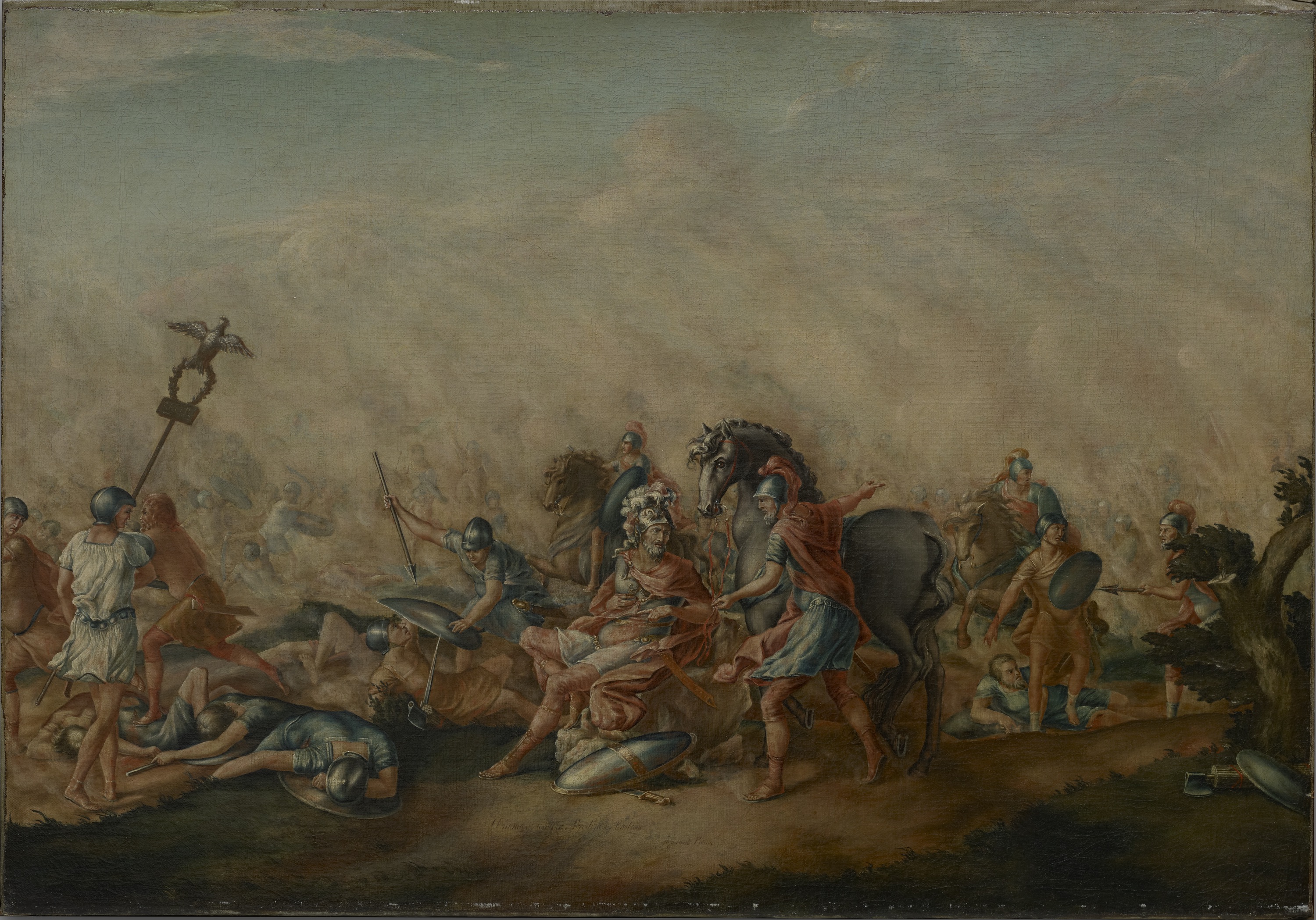
Although the Roman infantrymen did not know it, their fate was all but sealed by this time. Hannibal had planned for his cavalry to strike the decisive blows while his infantry fought a large-scale delaying action. As the battle opened, Hannibal launched the Spanish and Celtic cavalry on his left against the outnumbered Roman horse. The consul Aemilius accompanied these cavalrymen, who could not withstand the weight of the Carthaginian assault. Aemilius was wounded and the bulk of the Roman horse was driven from the field, uncovering that flank of the Roman army. While this occurred on the Carthaginian left, the Numidians on the right had been inconclusively engaged with the horsemen of Rome’s allies.
Hasdrubal, the Carthaginian cavalry commander on the left, reorganized his units and proceeded to ride behind the Roman infantry to the far side of the battlefield, where the stalemated cavalry fight continued between the Numidians and Rome’s allies. The allied horsemen now were taken by surprise and crushed between the two Carthaginian forces. The allied cavalry fled the field, taking the consul Varro with them. At this point, Aemilius was dead or dying, and Varro, the other commander, no longer was with the Roman army. The Roman and allied cavalrymen had been killed, captured or driven from the field. The Numidians were in pursuit of the allied horsemen, leaving the Celts and Spaniards as the only effective cavalry fore in the area.
By that time, the Roman infantry had fought its way up the slope and into the enclosed end of the ‘V,’ the point. As the men became more tightly packed into a confined space, fewer of them could use their weapons effectively. Romans in the rear ranks continued to push forward, but found they had little room to maneuver. The prevailing winds continued to blow dust in the faces of the advancing legionaries, making it difficult for them to appreciate their danger.
At this moment, the African square anchoring the Carthaginian flanks turned inward and advanced to further constrict the Roman infantry. Hasdrubal assaulted the Roman rear with his heavy cavalry, assisted by the Carthaginian light infantry. The encirclement was complete. Many Romans first discovered the danger when they felt the searing pain of being hamstrung by the knives and swords of the Balearic slingers. The courage of the Roman soldier was amply demonstrated–the legions fought on even though all hope was gone.
Gradually, though, the pocket of resistance was reduced in size as thousands of Romans were killed. And when, finally, it was over, the Roman army had been truly annihilated. Of the original force of 86,400, about 50,000 were dead, with about 4,500 others taken prisoner. About 17,000 Romans took refuge in two fortified camps nearby, but after further resistance cost 2,000 more fatalities, the remaining 15,000 surrendered. In all, some 71,500 Romans were dead or captured–83 percent of the entire army. Carthaginian losses were less than 6,000, most of them suffered by the Celts.
It is a measure of the greatness of the Roman people that they did not give up after a disaster of such magnitude, especially after the previous defeats at the Trebia and Lake Trasimene. When the Roman Senate next convened, 177 vacancies had to be filled, due to the casualties suffered at Cannae, but the Romans did not hesitate to continue the war.
Cannae represented the apex of Hannibal’s career, although he has been criticized for not attempting to end the war by sacking Rome itself at that point. Hannibal remained in Italy for 13 more years, but the determination of the Romans to fight on, regardless of losses, eventually gave them the opportunity to defeat the great Carthaginian.
The failure of Carthage to build a fleet strong enough to challenge that of the Romans made Hannibal’s task enormously difficult. He attempted to reduce Rome’s naval advantage by occupying the Italian coastal cities, home for the bulk of Rome’s sailors. Could Hannibal have held them, the odds against the Carthaginian fleet would have improved, but his limited manpower made it difficult for him to detach sufficient garrisons to prevent Roman recapture of the port cities. For 15 years in all, from 218 to 203 BC, Hannibal occupied large areas of Italy. He fought and defeated the Romans on numerous occasions but could not break their spirit. After Cannae, the Romans again became cautious about entering into full-scale battle against Hannibal, but their command of the sea and the decision to invade Spain, in spite of Hannibal’s continued presence on Italian soil, made reinforcement of Hannibal’s army a problem. Gradually, the troops who had crossed the Alps with Hannibal dwindled in number as well as in age, disease and wounds claimed them. Hannibal was able to maintain his army in the field by replacing casualties with men from the Italian Peninsula, first with Celts from the north and, later, when this source was cut off, with Bruttians and Lucanians from the south.
But Carthage’s lack of naval strength prevented Hannibal’s alliances with Syracuse and Macedonia from becoming fruitful. The Roman navy captured the text of the treaty between Hannibal and Philip V of Macedonia, and by the time the latter received a duplicate copy and acted upon it, a Roman fleet prevented his troops from crossing the Adriatic to Italy. Hannibal could not go to the aid of Syracuse when it was besieged by Roman troops because the Roman fleet prevented him from crossing the narrow Straits of Messina, and Syracuse fell.
In spite of all the difficulties, Hannibal proved to be a gifted leader able to get the very best from his men. His army was composed of mercenaries with no real ideological commitment to the Carthaginian cause, yet no record exists of any mutiny during its 5 years of campaigning in Italy. The army did not merely endure, it maintained a high level of morale and fighting spirit. After nearly a decade in Italy, the 500-man Numidian garrison of Salabria chose to fight to the death in the street defending their post when they might have cut their way to safety. Such conduct was especially remarkable for mercenaries having no great patriotic motivation. Too, they could reap no financial reward once they were dead. But…fight they did, anyway.
Spain was taken from Carthage and the Barcid family after Hannibal’s brother Hasdrubal duplicated the crossing of the Alps with a relief force, a desperate move that gave the Romans in Spain a free hand. Hasdrubal was unable to effect a union with Hannibal before being confronted by a strong Roman army in 207 BC. In the ensuing battle, Hasdrubal was defeated and killed. The first news Hannibal had of his brother’s arrival in Italy was when his head was catapulted into Hannibal’s camp. The loss of Spain cost Carthage an excellent source of mercenaries, along with the absolutely vital gold and silver mines needed to finance the use of mercenaries from other countries.
In October of 203 BC, Publius Cornelius Scipio, the conqueror of Spain, invaded North Africa and forced Hannibal’s recall to defend Carthage itself. Hannibal’s defeat at Zama at the hands of Scipio in the following spring, caused largely by a deficiency of cavalry strength, ended the Second Punic War.
Hannibal rose to the position of prominence in Carthage after the war and took steps that helped Carthage recover economically from the conflict. Rome viewed Carthage’s revival with suspicion, and Hannibal was forced to flee to the east, where he committed suicide in 183 BC rather than fall into Roman hands.
For more great articles be sure to subscribe to Military History magazine today!